
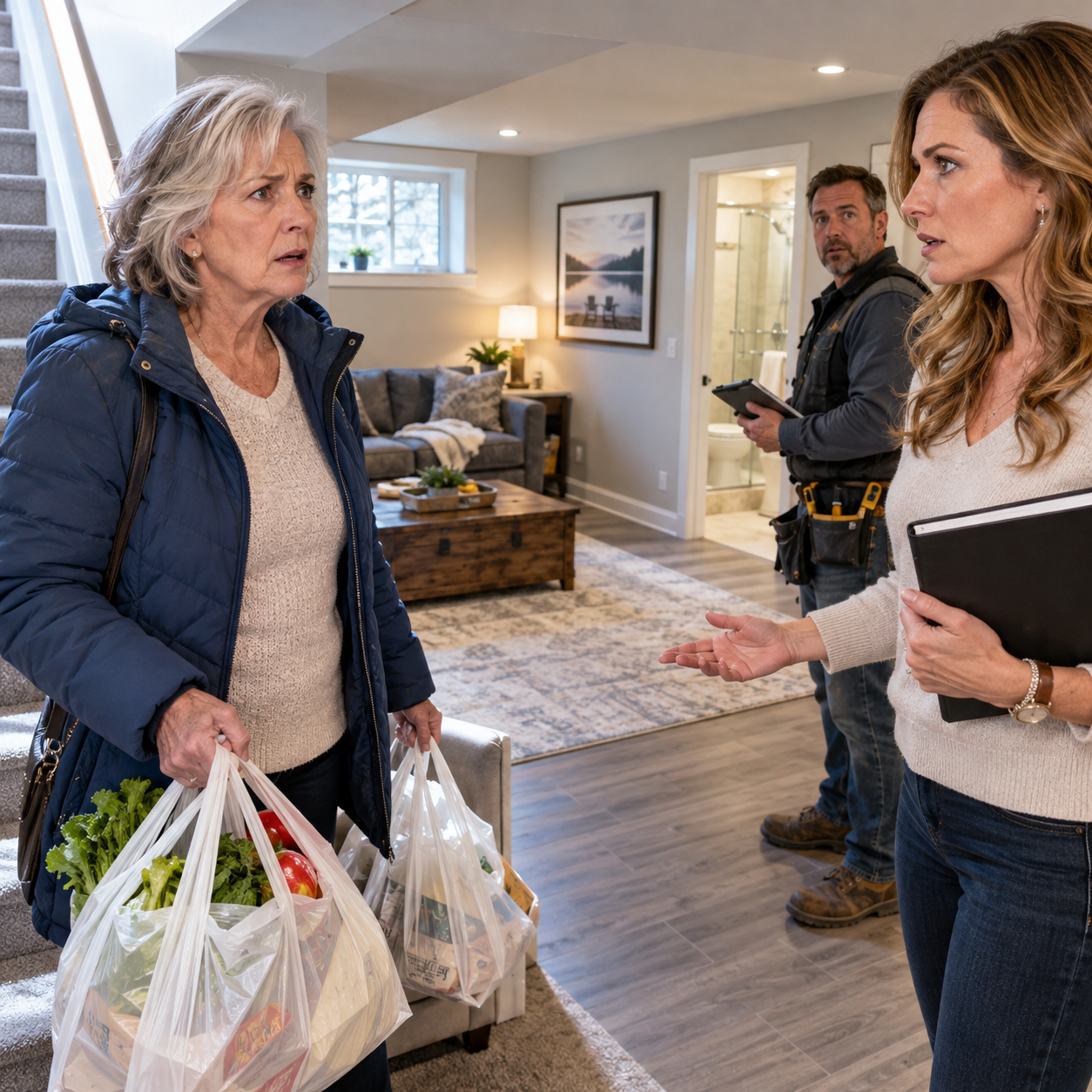
Part 2: A Contractor Arrived Before Anyone Told Me I Was Leaving
The contractor found a reason to inspect the furnace room. I asked Cheryl for thirty days.
“The crew won’t hold the opening,” she said. “We’ve already moved things around.”
That evening Nate sat beside her at the kitchen table. Their chairs were angled toward each other.
“I can leave in a month,” I said. “And we need to discuss the money I put into the basement.”
Nate sighed. “If you’d rented somewhere else for almost two years, you would’ve spent more than fourteen thousand.”
“So now the renovation was rent?”
“I’m saying you lived here without paying rent.”
“I bought groceries. I watched your children. I paid school expenses.”
Cheryl folded her arms. “We appreciate that. But we also gave you somewhere to live after Douglas died.”
A kindness ledger. Everybody had written their own column.
I went downstairs without arguing.
Over the next few days, boxes appeared near the stairs: my casserole dish, winter boots, framed photographs. Cheryl labeled them neatly, as if organization made the speed of my departure gentler.
Thursday morning, she caught me making tea.
“Just so we’re clear,” she said, “moving out shouldn’t affect Mondays.”
I waited.
“The kids’ pickup. They love seeing you.”
“If I’m no longer living here, why would you assume my schedule stays the same?”
She looked honestly confused. “Because that’s about the kids, not the basement.”
That was when I understood she didn’t think she was discarding me. In her mind, she was reorganizing resources. The office went downstairs. Grandma lived elsewhere. Grandma still picked up the children.
That afternoon Owen and I kicked a soccer ball across the backyard. He trapped it under his sneaker.
“Are you leaving because Mom doesn’t want you downstairs?”
I crouched beside him. “Adults sometimes need different houses. That doesn’t change who belongs to whom.”
“Will you still know where I live?”
“I think I can remember.”
Friday dinner was quiet. After Cheryl took the children upstairs, I asked Nate one last time for a month.
“I have to put Cheryl and the kids first,” he said.
“I’m your mother, Nate. I’m not asking to be first.”
He stared toward the hallway. “Sunday is Sunday, Mom.”
He went upstairs and left his phone on the table. I was carrying plates to the sink when the screen lit with Cheryl’s message.
Good. She’ll get over it. She won’t stop the pickups. She’d never risk seeing the kids less.
I didn’t touch the phone.
I finished the dishes, dried the counter, and went downstairs. For the first time, I stopped asking myself whether I was being too sensitive.
Part 3: Their Spreadsheet Showed Exactly What They Expected From Me
I opened my laptop and pulled up the household spreadsheet Nate had created for groceries, school costs, and shared expenses.
He had updated it Thursday night.
Under childcare, my Monday pickup was listed at zero dollars for the next three months. My card was still marked for one of Penny’s preschool charges. Under home improvements sat an $8,000 transfer scheduled for the following Tuesday.
A month earlier, Nate had talked about replacing the back deck. I had said I might be able to help.
In the spreadsheet, “might” had disappeared.
The transfer was marked confirmed.
I printed the page, opened my banking app, and canceled the payment. Then I removed my card from the preschool account effective the next billing cycle.
Finally, I called Val at the Innisfil community.
“Please tell me that one-bedroom is still available.”
“It is,” she said. “Are you ready this time?”
I looked around the basement I had paid for and spent nearly two years defending as proof of family closeness.
“Yes.”
By that afternoon I had signed a lease and was holding two keys on a blue plastic tag. Val handed me a social calendar with Friday potluck circled in yellow.
Back at the house, I packed books, sweaters, my mother’s quilt, and Douglas’s photograph. Then I wrote Nate a four-sentence email saying I had found a home, would leave Saturday as requested, would no longer cover preschool charges, and would not be available for standing weekly pickups.
I scheduled it for seven Saturday morning.
At seven thirty, my suitcases were by the side door.
Cheryl came downstairs first. “You’re actually leaving today.”
“You picked the day.”
She pressed her lips together. “So we’ll see you Monday?”
“No.”
Nate entered holding his phone, hair still flattened from sleep.
“Mom, what did you do? You canceled the transfer.”
“Yes.”
“And the preschool card?”
“Yes.”
“We booked the contractor based on that money.”
I placed the printed spreadsheet on the counter.
“You booked a contractor based on my money.”
His eyes moved across the rows and stopped at the edit history showing his name.
“My childcare: zero. My payments: assumed. My money: confirmed. None of it had my agreement.”
Cheryl shook her head. “We weren’t trying to use you.”
“I believe you didn’t call it that.”
I removed their house key from my ring and set it beside the spreadsheet.
“You decided where I would live, what I would still do, and which parts of me stayed available after I was gone.”
Nate looked up. “Mom—”
“I love you. That’s why I’m leaving before resentment ruins what is still worth saving.”
I picked up my suitcases.
Outside, the early autumn air was cool and clean. In my coat pocket, the keys to my own apartment pressed against my palm all the way to the car.
Part 4: I Left Their House and Reclaimed My Place in Family
The practical consequences came quickly.
Without my transfer, Nate and Cheryl postponed the basement conversion and lost part of the contractor deposit. Without my pickups, Nate turned down late jobs, Cheryl left work early, and they paid for an after-school program.
I heard most of this from Nate’s aunt.
I didn’t celebrate.
There were evenings when I almost called anyway. Habit could be persuasive. At four o’clock on Mondays, I would glance at the clock and picture Owen waiting with his backpack or Penny dragging her coat sleeve along the preschool hallway.
Then I reminded myself that loving them did not require rescuing their parents from every inconvenience. Nate and Cheryl were capable adults. The fact that I had made their lives easier did not mean they were incapable of managing without me.
My first Friday in Innisfil, I brought a casserole to the community potluck and nearly turned around at the door. Then a woman named Harriet waved me toward an empty chair and asked if I knew anything about tomatoes.
For twenty minutes we argued cheerfully about soil.
When I came home, I noticed how quiet the apartment was. Not lonely. Quiet.
Six weeks passed before Nate called.
“Can I come by?”
He arrived Sunday afternoon carrying coffee and cinnamon rolls. He stood awkwardly in my kitchen while I found mugs.
“This is nice,” he said.
“It is.”
He looked toward the window. “I didn’t realize how much you were doing.”
I waited.
“Pickups happened. Food showed up. Fees got covered. If something went wrong, you fixed it before it became my problem.”
“And Cheryl?”
“She thought you wanted to be needed.”
That hurt because it was partly true.
“I did,” I said. “For a while.”
He nodded. “We took advantage of that.”
I sat across from him. “You counted on my fear of losing the children.”
His eyes dropped to the coffee.
“Yeah,” he said.
No speech. No excuse. Just the ugliest truth in the smallest word.
I told him I accepted his apology, but we would not restore the old arrangement. I would see Owen and Penny because I was their grandmother, not because I was the unpaid machinery beneath his household. Emergencies could be emergencies. Convenience would no longer dress itself up as necessity.
He agreed.
“The fourteen thousand is finished,” I added. “I’m not asking for it back.”
His head lifted.
“I paid for an education. Expensive, but effective.”
A month later, he began sending me a small amount on the first of each month. I never asked what he called it, and he never called it repayment. I let him have the dignity of doing something without being managed through it.
Something else changed too. Nate began asking instead of informing.
Would you like to come to Owen’s school concert?
Are you free Saturday if the kids want to visit?
Could you help us Tuesday, and it’s completely fine if you can’t?
Small sentences, perhaps, but I noticed every one of them. For years I had rushed in before he learned the difference between receiving help and being entitled to it. Now he was learning, and so was I.
I see Owen and Penny often. Sometimes we go to the waterfront. Sometimes they spend Saturday at my apartment, where Penny colors at the table and Owen raids my crackers.
Cheryl and I are careful with each other, but not cold.
The first time she brought the children over herself, she stood in my doorway with Penny’s backpack.
“I owe you an apology,” she said. “I kept telling myself you were lucky to have us around after Douglas. That made it easier not to ask what all of this cost you.”
“Lonely people still get to have boundaries.”
“I know.”
“I don’t think you did then.”
“No,” she said. “I didn’t.”
That was enough.
My life is smaller now in the best way. My kitchen holds what I use. My calendar contains blank squares. My pension pays for my groceries, my books, my balcony garden, and the occasional ridiculous dessert Penny talks me into buying.
I used to think love meant making yourself indispensable. If everyone needed me, no one could leave me behind.
I was wrong.
Love is not measured by how much of yourself you let other people consume. Sometimes love looks like showing up. Sometimes it looks like saying no. And sometimes it looks like setting a house key on a counter, walking through a door, and trusting that the people who truly value you will learn how to knock.
The End .
All characters and events in this story are fictional, created for storytelling and entertainment purposes. Thank you sincerely for reading. Your feedback and support are invaluable and motivate me to continue sharing more stories with you.

