
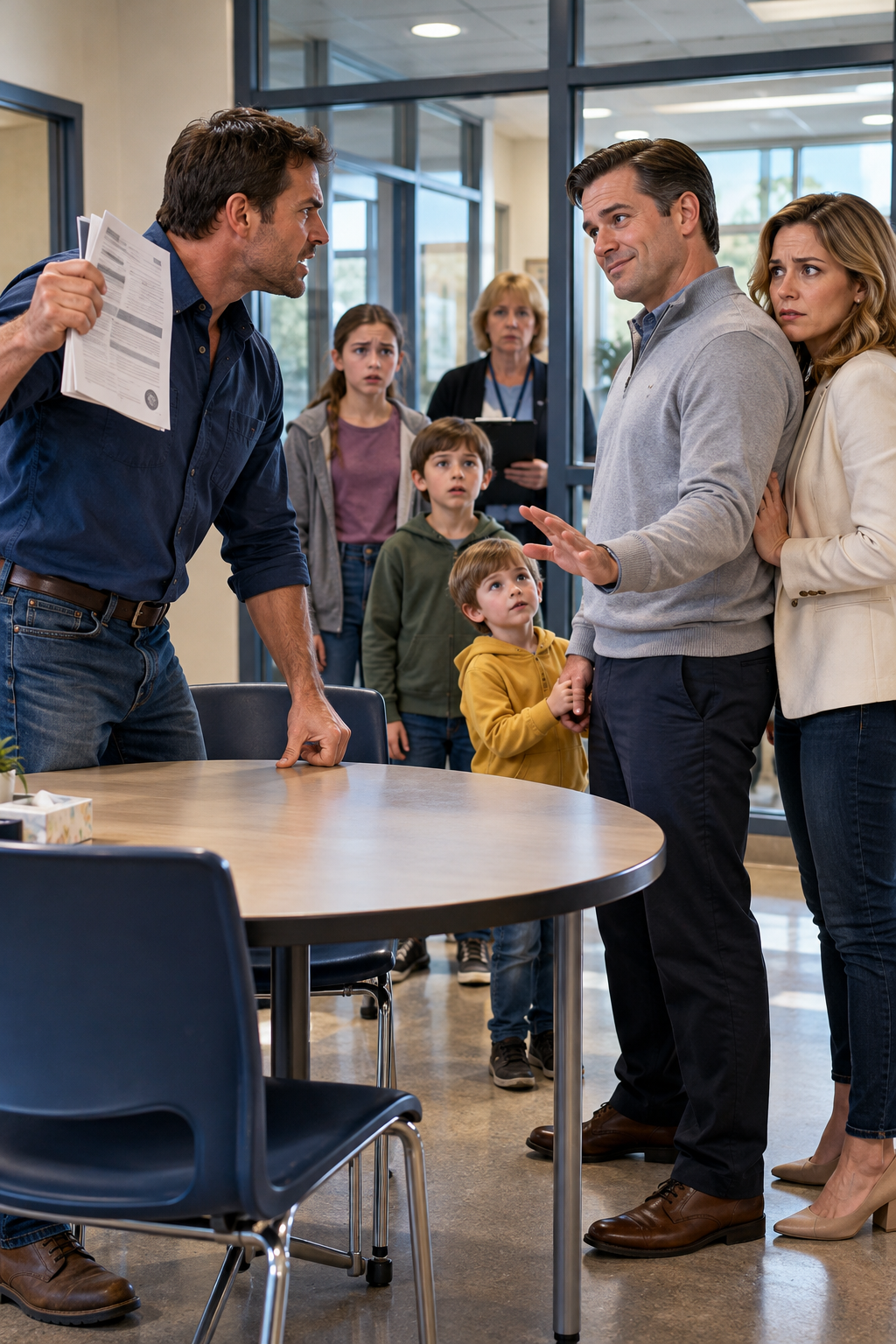
### Part 2: A Grandfather’s Hidden Evidence Forces Three Children Into Darkness
Thursday morning, I parked along Mill Road, beyond the entrance to Fred Ames’s farmhouse. The protective order forbade me from approaching the property, so I waited on the public roadside until Fred appeared beside his mailbox. He looked exhausted, his usually steady hands trembling around a folded newspaper. When I asked why he hadn’t defended me, he glanced nervously toward a security camera recently installed above his garage.
“That laboratory report isn’t a mistake,” he whispered. “Jason doesn’t just interpret those numbers, Vince. He creates them.”
Fred admitted that thirteen years earlier, while supervising the state laboratory’s toxicology division, he’d discovered Jason producing results without completing the underlying tests. Instead of reporting him, Fred had quietly arranged his resignation, believing the younger man deserved another chance. Jason subsequently established Buckner Analytical and gradually became indispensable to the county. Fred gripped my sleeve and said, “I thought I was saving a man’s future. I may have ruined dozens of lives.”
He promised to bring evidence to Judge Fenwick on Friday morning. Before leaving, he gave me another name: Noreen Howard.
Leroy helped me locate her within hours. Noreen was a senior analyst at Buckner Analytical and had once worked under Fred at the state laboratory. When I visited her house, she opened her front door only as far as the security chain allowed. The moment I mentioned Fred and the fabricated test, genuine terror crossed her face, and she slammed the door.
That afternoon, my railroad supervisor placed me on paid administrative leave. I drove home remembering how Becky had borrowed my truck two weeks earlier, supposedly because her car needed repairs. She’d had access to the glove compartment where those mysterious tablets were allegedly discovered. I could no longer avoid the possibility that my wife had helped manufacture the accusations.
At 9:41 that night, Fred finally texted me. He instructed me to meet him outside the courthouse at 8:30 the following morning and promised to bring something for Judge Fenwick. He insisted I come alone. I sat at my kitchen table afterward, turning Danny’s yellow locomotive between my fingers, unable to sleep.
What happened at the farmhouse that night, I learned later from Katie.
Shortly after eleven, she’d heard Jason’s vehicle outside and crept toward the staircase. Her grandfather stood in the kitchen facing Jason while Becky watched beside the sink. Jason demanded a document Fred had apparently prepared, and when Fred refused, he stepped forward and grabbed his shirt. Fred pulled away, caught his heel against a braided rug, and fell backward against the iron corner of the old kitchen stove.
Becky screamed and rushed toward her father. Jason insisted that Fred was breathing and ordered her not to call an ambulance immediately. He feared that investigators would discover why he’d been confronting the older man. When Becky begged him to get help, he asked for twenty minutes to arrange an explanation that would make the injury appear accidental.
From the staircase, Katie heard her mother agree.
Jason went outside to retrieve supplies. Instead of returning to bed, Katie woke Emmett and Danny, then led them downstairs. Fred was conscious but barely able to speak, and the boys carefully pressed a towel against his injury while Katie knelt beside him. He caught her wrist and whispered instructions about a sealed envelope inside his barn coat.
“Give it to Judge Homer Fenwick,” he told her. “Only him, Katie. Promise me.”
She promised.
After finding the envelope, Katie called 911 and reported her grandfather’s injury. Hearing footsteps approaching the house, she guided her brothers through the pantry, down the cellar steps, and out through the storm entrance. They hid inside the barn’s hayloft while emergency vehicles arrived.
From between the wooden boards, Katie watched paramedics take Fred away. Jason searched the farmhouse, then swept his flashlight across the yard and barn. The children remained motionless above him until he finally drove away.
They spent the remaining hours of darkness huddled together in the hay. Danny fell asleep against Katie’s shoulder while Emmett quietly asked whether their grandfather would survive. She admitted she didn’t know, but promised they’d done everything they could.
At dawn, Katie checked that the envelope was still sealed and buttoned Danny’s jacket over his dinosaur pajamas. She gave Emmett her gloves, took both brothers by the hand, and started walking toward Harlan Bend.
The courthouse was nearly three miles away.
She knew only one thing: whatever those papers contained, her grandfather had believed they were worth protecting with his life.
### Part 3: Three Bloodstained Children Deliver Evidence That Silences An Entire Courthouse
By 8:40 Friday morning, I was standing outside Judge Fenwick’s courtroom with Maria Fitch. Fred hadn’t arrived, and none of my calls had been answered. Becky waited nearby wearing a dark blue dress, her eyes swollen from crying. Jason stood against the hallway wall beside Terry Wagner, the laboratory collector whose signature appeared on my fabricated report.
I overheard Becky saying her father was still in surgery. Before I could question her, Jason moved between us and insisted we shouldn’t discuss family matters in the corridor. Then Becky turned toward him and demanded to know where the children were. Jason answered that they were safe with a family acquaintance, but something in his expression told me he had no idea where they actually were.
A commotion rose from the stairwell.
Bailiff Kurt Reed appeared first, carefully backing up the stairs as he tried to reason with someone behind him. Then I saw three small figures climbing toward us. For one terrible instant, I didn’t recognize them beneath their stained clothing and exhausted faces. Then Danny looked up, and I saw his dinosaur pajamas.
“Katie?” I whispered.
My daughter was supporting both her brothers, her tangled braid hanging across one shoulder. Their clothes bore the marks of what had happened inside Fred’s kitchen, and every adult in that corridor fell silent. Becky rushed forward, but Katie stopped her with a look so cold and wounded that my wife couldn’t take another step.
Katie looked down at the courthouse floor. “I’m sorry about the mess,” she told Kurt, noticing the dark prints behind her. Then she straightened her shoulders and asked to see Judge Homer Fenwick.
Kurt immediately called for medical assistance, but Katie insisted they weren’t injured. She explained that her grandfather had instructed her to deliver an envelope directly into the judge’s hands. Before anyone could respond, the judge emerged from his chambers carrying a coffee mug.
He recognized Katie and approached her. She pulled the envelope from inside her jacket and held it out. The moment he recognized Fred’s handwriting, his expression changed.
Judge Fenwick broke the seal and unfolded three typed pages accompanied by a handwritten letter. I watched his eyes travel downward, return to the beginning, then slowly reread the same passage. Later, Maria explained exactly what those documents contained.
Fred had confessed his decision to conceal Jason’s misconduct thirteen years earlier. He identified my impossible hair-test result and its fabricated collection record. More importantly, he described a secret practice that Noreen Howard had uncovered inside Buckner Analytical.
For almost three years, certain test results had been manufactured to secure particular outcomes. Employees marked those specimens with tiny green dots in the laboratory log. There were sixty-two suspicious cases, including twenty-nine that had influenced Judge Fenwick’s rulings.
One man, Daryl Hatch, had already spent nine months in prison because of a probation violation supported by fraudulent evidence.
Fred’s letter identified a storage freezer, specifying rack six, where retained specimens could supposedly be found. He also acknowledged Becky’s involvement and warned that any injury preventing him from delivering the evidence should be investigated.
The judge lowered himself onto a hallway bench, visibly shaken. Then he stood and ordered Kurt to summon deputies and ensure that Jason, Becky, and Terry remained available for questioning. Within minutes, all three were escorted into custody.
I gathered my children against me as medical personnel arrived. Judge Fenwick contacted the hospital and confirmed that Fred remained alive, though his condition was critical. He then issued an emergency order restoring my custody of Katie, Emmett, and Danny.
For a few hours, I believed the nightmare was ending.
By afternoon, Jason had been released on bail. County attorney Ivan Spurlock, a longtime golfing companion of Jason’s, publicly characterized Fred’s injury as an unfortunate fall. Becky was released, too, while Jason’s lawyers attacked the credibility of Fred’s letter.
Judge Fenwick recused himself from matters involving the laboratory, and a visiting judge authorized investigators to secure the retained specimens. But when deputies finally opened Buckner Analytical’s freezer that evening, rack six was empty.
Every container had disappeared.
Maria called me with the news after I’d finally persuaded the children to sleep. I stood beside their bedroom door, listening to Danny breathe, and realized Jason had somehow escaped the one piece of evidence that could expose everything.
Katie had risked everything to deliver the truth.
And before nightfall, the proof seemed to have vanished.
### Part 4: One Honest Railroad Signal Exposes The Man Behind Sixty-Two Lies
Saturday morning, someone knocked on my front door. Noreen Howard stood outside, gripping the handles of a wheelchair occupied by her husband, Gerald, whose oxygen tubing rested beneath his nose. She apologized for turning me away and explained that Jason had threatened her professional license after a calibration mistake three years earlier. He’d used that incident to keep her silent while fabricated reports passed through the laboratory.
“The freezer is empty,” I told her.
Noreen’s expression barely changed. “The freezer he expected them to search is empty.”
She explained that she’d secretly moved the genuine retained specimens months earlier, placing them inside a chest freezer in the basement of the Lutheran church on Elm Street. The containers were disguised among boxes marked for a charitable fund. She’d deliberately given Fred the false storage location because she knew Jason might discover his letter.
For the first time all week, I felt something resembling hope.
A visiting judge authorized recovery of the specimens, but early Monday morning, Noreen received a warning from the pastor’s wife. A man matching Jason’s description had visited the church asking about access to its kitchen. State patrol officers were scheduled to collect the evidence at dawn, and I knew Jason might reach it first.
I also knew the streets around that church better than almost anyone.
The bridge on Fourth Street was closed for repairs, leaving the railroad crossing on Elm Street as the only convenient approach from Jason’s side of town. Every night at approximately 3:07, a long coal train rolled through Harlan Bend. I’d maintained those crossing gates for nine years, and Leroy had helped install them.
I called Kurt Reed, who contacted the state patrol. Then I parked near the crossing and watched.
At 3:06, the warning bells began ringing. Jason’s pickup approached from the south, slowed sharply, and stopped as the striped barriers lowered. He sat helplessly behind the windshield while 110 coal cars passed beneath the streetlights.
I didn’t alter a single wire or interfere with the equipment. The crossing operated exactly as it had been designed to operate.
Before the final car passed, patrol vehicles positioned themselves behind Jason’s truck. When the gates rose, investigators stopped him and secured the church.
The evidence reached the state laboratory in Lincoln untouched.
Six days later, the independent testing results arrived. My retained sample showed no oxycodone whatsoever, and fifty-one of the other sixty-one suspicious specimens also tested negative. Several remaining cases contained missing or unusable evidence, raising further questions about the laboratory’s records.
The discovery triggered a sweeping investigation. Judge Fenwick returned to a crowded courtroom and publicly vacated twenty-nine orders affected by the fraudulent testing. When he reached Daryl Hatch’s case, he removed his glasses and personally apologized to the man who’d lost nine months of freedom.
Jason initially refused to cooperate. But during a recorded interview, an investigator questioned the laboratory’s unusually high positive rate. Jason couldn’t resist explaining that he believed a chemist’s judgment mattered more than the numbers produced by an instrument.
He insisted he’d manipulated outcomes to help families, not to enrich himself. He even described me as someone whose life had needed intervention.
His recorded statements, combined with the preserved specimens and other evidence, devastated his defense. The following spring, Jason pleaded guilty to seventeen counts of tampering and to first-degree assault for Fred’s injury. He received a nineteen-year prison sentence, and Buckner Analytical permanently closed.
Becky pleaded guilty to obstruction and submitting a false affidavit. Her cooperation spared her a prison sentence, but it couldn’t repair our marriage.
One evening in March, she came to our porch wearing the same blue dress she’d worn at the courthouse. She sat opposite me, twisting her wedding ring, and cried as she apologized for helping Jason frame me and delaying medical assistance for her father. I believed her remorse was genuine, but forgiveness and reconciliation were no longer the same thing.
“You’ll always be their mother,” I told her quietly. “I won’t stand between you and the children when contact is safe and appropriate. But I can’t be your husband anymore.”
She nodded, knowing there was nothing left to argue. Our divorce became final in June.
Fred survived his injury and regained consciousness nine days after the courthouse hearing. When Katie visited him in the hospital, wearing her yellow raincoat and carrying a library book, he immediately asked whether she’d delivered the envelope.
“Straight into his hands, Grandpa,” she answered.
Fred closed his eyes and began crying. He’d carried the shame of his mistake for thirteen years, and a twelve-year-old girl had found the courage to confront its consequences in a single night. Later, when I sat beside his bed, he apologized for allowing Jason to escape accountability years earlier, and I held his hand without pretending that everything was repaired.
Two weeks after the courthouse incident, Katie returned an overdue mystery novel to the Harlan Bend Public Library. The librarian recognized her and gently explained that no late fee would be charged under the circumstances. Katie nevertheless placed a dollar on the counter because, as she explained, she’d promised to return the book on time.
The librarian smiled through tears and pushed the dollar back toward her.
Outside, I waited in my pickup with Emmett and Danny asleep in the backseat. Their little yellow toy locomotive now hung from my rearview mirror, swaying whenever the breeze entered the open window. Katie climbed beside me, fastened her seat belt, and asked whether we could stop for ice cream before going home.
I looked at my daughter, remembering those terrible courthouse stairs and the way she’d apologized for footprints while carrying evidence that would restore dozens of lives.
For twenty years, I’d maintained signals designed to warn people when something dangerous approached. I’d believed that trustworthy systems were what kept ordinary families safe.
But the most important warning in our county hadn’t come from a laboratory, a courtroom, or a man with an impressive title.
It had come from a frightened twelve-year-old girl who kept her promise when the adults around her wouldn’t keep theirs.
And this time, someone finally listened.
THE END.
All characters and events in this story are fictional, created for storytelling and entertainment purposes. Thank you sincerely for reading. Your feedback and support are invaluable and motivate me to continue sharing more stories with you.


