
### Part 2: Behind the Locked Basement Door, My Marriage Collapsed Overnight
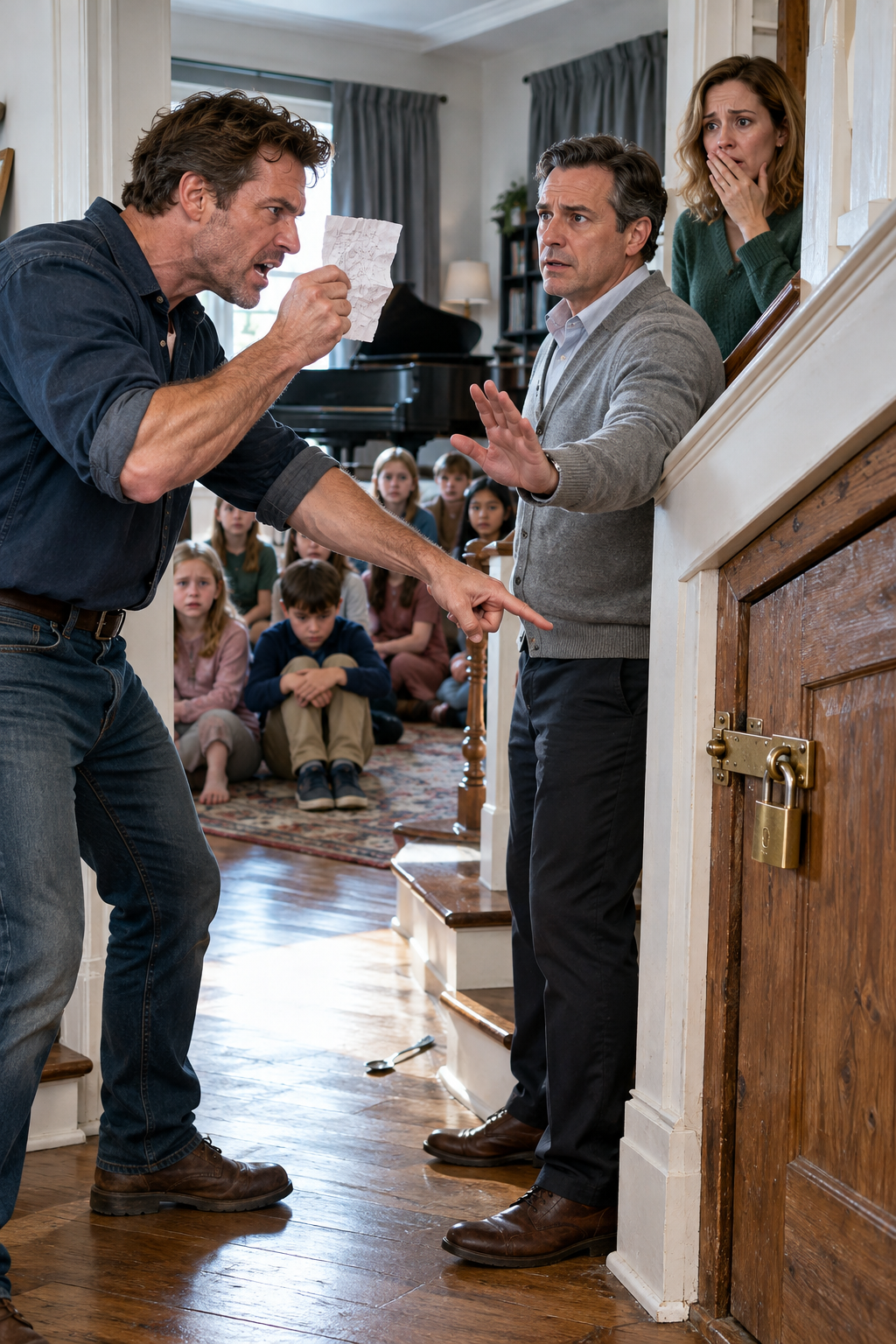
I ran to the garage, snatched the pry bar from my tool rack, and returned before Paul reached the basement. “Leland, you’re about to undo weeks of therapeutic progress,” he warned, standing behind me as I wedged the steel beneath the hasp. The first screw tore loose, then the second, and the lock clattered against the concrete as the door swung open. Inside the eight-by-six-foot room, gray foam covered every wall, a sleeping bag lay on the bare floor beside a covered plastic bucket, and an unlit battery lantern sat in the corner.
Josie was curled against the far wall, wearing her winter coat in a room cold enough to make me shiver. Her face was pale, her lips dry, and her eyes followed me without the slightest excitement, as though she had learned that even happiness might be punished. I knelt and extended my hand instead of grabbing her, waiting until she leaned forward and rested her forehead against my wrist. “I wrote the note,” she whispered. “Please don’t be mad.”
I pulled her gently into my arms and told her I had never been prouder of anything she’d done. She clung to my neck as I carried her toward the stairs, then whispered that Mommy had warned her I would disappear like Grandpa if she told anyone what happened downstairs. “They said you knew,” she added, and those four words struck harder than any accusation Paul could have made. “I didn’t know, sweetheart,” I said, fighting to keep my voice steady. “But I’m here now.”
Brittany stood at the top of the stairs, trembling, while Paul insisted Josie was confused and needed to finish her treatment. I walked past them without answering, carried my daughter through the motionless classroom, and caught Jacob silently forming the words “Thank you.” Outside, I wrapped Josie in my jacket, settled her in my heated truck, and called 911. I told the dispatcher that my seven-year-old had been confined inside a locked, soundproofed basement room, and I explicitly authorized officers to search every room of my property before anyone could remove the evidence.
Deputy Alvin Warren arrived twelve minutes later, followed by a child welfare worker. He photographed the room, examined the broken hasp, and discovered something that made the investigation far more complicated: every parent, including me, had signed paperwork describing the basement as a voluntary calming space. Paul claimed Josie had entered willingly, Brittany supported him, and several frightened children denied ever being locked inside. When Warren told me my wife had also accused me of being dangerously aggressive toward our daughter, I stared at him so long he finally lowered his eyes.
At the hospital, a pediatrician documented Josie’s dehydration, exposure to cold, and intense fear whenever a door closed. Child welfare investigator Trisha Albright listened patiently as Josie described punishments called resets, including longer periods for children who complained or told their parents. But Paul’s paperwork and the children’s frightened denials complicated the case, and Trisha warned me that an investigation would require more evidence. That evening, my lawyer and oldest friend, Stewart Pruitt, called with even worse news: Brittany had petitioned the court for sole temporary custody, claiming I had violently disrupted Josie’s education.
Within two days, Paul had relocated Hearthstone to the basement of Grace Fellowship Church, and most families followed him. Brittany moved into her sister’s guest room, while Josie remained with me under a temporary safety arrangement, sleeping with her bedroom door open and every hallway light burning. On Saturday night, I sat at the kitchen table staring at the drawings she’d hidden in my lunchbox, wondering how many warnings I had dismissed. Then my phone vibrated with a message from an unknown number: “I’m Paul Spears’ first wife. I know what happened at his last school, and I know exactly what he’s afraid of.”
### Part 3: His Former Wife Exposed the Promise He Could Not Break
Kathy Dudley met me Sunday morning inside the empty civic auditorium, where I regularly tuned an aging concert grand. She was a forty-three-year-old emergency nurse with tired eyes and a canvas coat she kept buttoned throughout our conversation. Sitting beneath the dim stage light, she told me Paul had once operated another small school called Cedar Lane Learning Circle, where a six-year-old boy named Floyd Gilbert had been confined inside a dark mudroom closet for most of a school day. “I was the nurse who admitted him,” she said, gripping the edge of the piano bench. “He spent two days in the hospital, and that was the day I realized what kind of man I’d married.”
Kathy explained that Paul genuinely believed children became healthier when they stopped expressing distress, which made his punishments especially difficult to challenge. When she confronted him about Floyd, he accused her of emotional instability, divorced her, and convinced several parents to defend his teaching methods. Floyd’s family eventually accepted a $60,000 insurance settlement with a nondisclosure agreement, and Paul left the county to rebuild his reputation under a new school name. “He didn’t abandon his methods,” Kathy said. “He learned how to make frightened parents believe those methods were kindness.”
Then she reached into her handbag and produced an old insurance document.
After Floyd’s hospitalization, Paul’s insurer had required a written policy guaranteeing parents unrestricted access to every classroom and instructional space. Paul had responded by adding Clause Seven to his enrollment agreement, turning a condition imposed on him into the centerpiece of his marketing. “He advertises that sentence everywhere,” Kathy explained, tapping the paper. “But nobody has ever actually walked into one of his classrooms without warning.” I remembered Paul smiling across our kitchen table while promising that children should never have secrets from their parents, and suddenly I understood the weakness hidden inside his greatest selling point.
Stewart joined us at noon, studied both documents, and found the detail that changed everything. Josie was still officially enrolled at Hearthstone because Paul had never issued a withdrawal notice or refunded our prepaid tuition, meaning I remained an enrolled parent with contractual observation rights. More importantly, the same provision protected every other parent whose child attended his relocated program at Grace Fellowship. “If he refuses entry, he contradicts his own signed agreement,” Stewart said. “And if we discover another locked room, he contradicts his sworn statement.”
That evening, Hugh Porter crossed the street and confessed something he’d been hiding for weeks. He had seen Paul’s gray station wagon parked behind our garage late on Thursdays, often while I was working at the auditorium, and once watched Paul slip away carrying his shoes. Hugh had convinced himself the visits were innocent until he could no longer ignore what he had witnessed. I thanked him, although the revelation made my chest ache, because it meant Brittany had not merely trusted Paul as an educator; she had been hiding a relationship with him while helping him take control of our home.
The next afternoon, Kathy and I visited Megan Tanner, Jacob’s mother, and watched her expression change when I described the soundproofed room. She admitted that Jacob had begun waking in terror, begging to be good, and that she had mistaken his fear for ordinary adjustment problems. When I told her how he had silently thanked me the morning I rescued Josie, she covered her mouth and began crying. She agreed to help us, and within two days, two other mothers had joined our effort.
Floyd’s father, Phil Gilbert, drove two hundred miles to meet us, bringing medical records and a determination that another child would not suffer what his son had endured. Trisha arranged an authorized child welfare visit, and Deputy Warren agreed to accompany us after reviewing the evidence and the safety plan. I visited Grace Fellowship beforehand and noticed a strangely muffled section of the basement hallway, near a former choir vestry. Nine days after rescuing Josie, I walked toward that church with five parents, a child welfare worker, and a deputy, carrying the enrollment agreement Paul had personally signed.
This time, we weren’t asking him to keep his promise. We were going to use it.
### Part 4: One Open Door Exposed Every Lie and Freed Us All
At 10:10 Thursday morning, we entered the church basement and found six children sitting in the same rigid semicircle I had seen inside my house. Paul stood beside a bright rug, his gray cardigan neatly buttoned, while Brittany held a coffee cup near the wall. The cup slipped from her fingers when she saw me, striking the floor with a crack that made three children flinch. Paul immediately raised his hands and announced that unscheduled visits were inappropriate, but Megan stepped forward holding her enrollment agreement.
“Any session, any room, at any time, without notice,” she read aloud, keeping her eyes fixed on him. Paul attempted to explain that parents were welcome during designated observation periods, but Trisha identified herself and confirmed she was conducting a visit under the existing child welfare safety plan. Deputy Warren stood beside her as Megan asked whether the promise Paul had written and signed was genuine. For the first time since I’d met him, Paul’s soothing voice disappeared, and his gaze darted toward a narrow wooden door near the basement stairwell.
I followed his glance, walked across the room, and pressed my palm against that door. Behind it, I heard shallow breathing, the rustle of clothing, and the unmistakable sound of someone struggling not to cry. A new brass slide bolt secured the door from the outside, with a rubber wedge pushed beneath it. I removed the wedge, drew back the bolt, and opened the door while the other parents watched in stunned silence.
Inside the cramped closet sat a little girl wearing a yellow raincoat, her knees drawn tightly against her chest. Gray blankets covered the walls, and when the light touched her face, she whispered the same sentence again and again: “I’m sorry I was loud.” Megan hurried forward, but I gently raised my hand, giving the girl enough space to understand that nobody intended to frighten her. Deputy Warren turned toward Paul and instructed him to step away from the doorway.
Then Paul made the mistake that destroyed his carefully constructed world.
“The reset program is under Mrs. Ramsey’s supervision,” he declared, pointing toward Brittany. “She’s the director of student care. I had no knowledge of any improper confinement.” Brittany stared at him, her face emptying of color as she realized he was sacrificing her to save himself. “You installed that bolt,” she said, barely above a whisper, and when Paul ordered her to stop speaking, her expression hardened. “You told me that silence was necessary, Paul. You wrote the schedules. You decided how long those children stayed inside.”
The room remained silent as Brittany confessed everything. She described the escalating punishments, the threats of longer resets, and the instructions she had repeated to children who begged to go home. She admitted that her relationship with Paul had begun before Hearthstone opened, and that he had encouraged her to exploit my trust because I would never suspect her of harming our daughter. Finally, she revealed that Paul had ordered her to tell Josie I already knew about the punishments, believing the child would stop asking me for help.
I stood beside the open closet and listened without interrupting, realizing that my daughter had spent weeks believing both her parents had abandoned her. Paul’s last attempt to defend himself collapsed when Brittany identified the hardware store where he had purchased the locks and produced messages documenting his instructions. Deputy Warren arrested him that afternoon, and the school closed while investigators interviewed the families. The children were finally free to speak, although some needed months before they could describe what had happened.
The legal process moved slowly, but the evidence endured. Prosecutors filed criminal confinement and child neglect charges, Floyd Gilbert’s earlier medical records established that the methods had been used before, and Paul’s insurer denied coverage after reviewing the evidence and his written transparency promise. He eventually accepted a plea agreement, still insisting that he had only wanted children to become peaceful. At sentencing, the judge told him that silence produced by fear was not peace, and no educational philosophy could excuse locking frightened children away.
Brittany accepted responsibility for her role, receiving probation and mandatory counseling in exchange for her testimony. We divorced, and although I could not forgive what she had allowed, I agreed that supervised contact with Josie might someday be possible if professionals considered it safe. When I asked Josie how she felt, she studied her hands before answering, “Maybe when it’s warm outside.” I told her there would be no pressure, no deadlines, and no decisions made without listening to her.
Spring arrived quietly, but our house no longer felt dead. The blankets were gone from the windows, Jacob Tanner was sleeping through the night again, and Hugh joined us for Sunday dinners, bringing homemade pie and pretending he hadn’t bought it from the bakery. One Saturday afternoon, I finished replacing the worn hammers in our old Mason and Hamlin piano, then pressed the middle A and listened to its slightly uneven tone. Josie appeared beside me and said, “Daddy, that note sounds scared.”
I adjusted the tuning pin until the wavering disappeared and struck the key again, letting the clear note fill the room. Josie listened, smiled without checking my face for permission, and began humming along, perfectly matching the pitch she had carried inside her heart through every terrible day. Then she asked me to open the piano lid completely because she wanted the music to travel farther.
I lifted it and stepped aside as she pressed the key herself.
For months, I had believed my greatest failure was not hearing what my daughter couldn’t say. But standing beside that piano, I understood something else: the note she hid in my lunchbox had been an act of courage no adult in that school had managed. Paul had written a promise that parents could open any door, never imagining a frightened little girl would find a way to make her father use it.
And as Josie’s music floated through our open windows, I knew our home was finally becoming what it had always promised to be.
A place where my daughter never had to be afraid of being heard.
THE END.
All characters and events in this story are fictional, created for storytelling and entertainment purposes. Thank you sincerely for reading. Your feedback and support are invaluable and motivate me to continue sharing more stories with you.


