Part 2: A Bank Statement Turns My Quiet Refusal Into Action
Three months earlier, Owen had suggested opening a separate account for wedding expenses that didn’t fit neatly into vendor contracts. There were stationery purchases, florist consultations, bridesmaid gifts, dress alterations, and dozens of small things Kristen said were difficult to track.
I deposited $16,000 and arranged for both of them to have access. I expected receipts, occasional questions, and perhaps a small balance left over.
On Monday morning, I drove to my bank.
Priya, a young employee who had helped me with my accounts before, greeted me warmly. When I asked for the wedding account balance, she typed for a moment, then looked at the screen with a slight crease between her eyebrows.
“Mrs. Marchmont, did you want the current balance?”
“Yes, please.”
“Nine hundred and forty-two dollars.”
I adjusted my glasses. “Would you print the transactions?”
She handed me several pages.
The first thing I noticed was a $1,100 payment to a downtown spa. Then came nearly $2,000 at a designer boutique on King Street. There was a hotel charge from Niagara-on-the-Lake, several expensive grocery orders, restaurant bills, and a six-month fitness membership.
I checked the dates. None matched wedding appointments I knew about.
At the bottom of the final page, I found a payment for custom stationery. It was one of the few expenses that actually belonged to the wedding.
“Is there a problem?” Priya asked gently.
I laid the pages flat.
“I believe I’ve been paying for someone’s personal life.”
She explained the available options, including removing card access and closing the account. Since the money had been placed there for their use, I understood that recovering the purchases wouldn’t be simple.
“Close it,” I said. “Transfer what’s left into my savings.”
Back home, I spread the statements beside the blue wedding binder I’d assembled in January. One folder held the heritage-estate venue contract. Others contained agreements for the Burlington caterer, florist, photographer, and string quartet.
Every signature was mine.
I took a sheet of paper and made two columns: what I had promised, and what I was still legally committed to paying. Years of managing transportation contracts had taught me that anger wasn’t a substitute for reading the terms.
Then I picked up the telephone.
The venue coordinator, Margaret, recognized my voice immediately.
“Mrs. Marchmont! Are we making changes to the menu?”
“No, Margaret. I’m calling to cancel the November booking.”
She paused. “Is everything all right?”
“The wedding arrangements are no longer something I can support.”
Margaret walked me through the cancellation clause. Because I was giving more than ninety days’ notice, I would lose the $6,000 deposit but owe nothing further.
“Please send that in writing,” I said.
The caterer retained an administrative fee. The florist had a waiting list and could fill the date. The photographer and quartet processed their cancellations according to the agreements.
By early afternoon, I had released myself from nearly all the $94,000 in planned obligations. The fees and forfeited deposits came to approximately $9,000.
It was a considerable amount to lose, but far less than the remaining cost of a wedding that had become an instrument of pressure.
I printed every confirmation and filed it behind the original contracts.
Next, I went to the hardware store.
Gerald had taught me how to replace deadbolts years earlier, after an attempted break-in on our street. I could almost hear his voice as I worked: Measure twice, Lydia. Don’t force the screws.
Both locks were changed before four o’clock.
Upstairs, I packed Kristen’s decorations carefully. I wrapped the fragile candleholders, folded the ribbons, and labeled the boxes so nothing would be damaged. Eight boxes and four bags eventually occupied the covered porch, protected from the afternoon sun.
I sent Owen a photograph of the items with a simple message asking him to collect them.
He called almost immediately.
I let it ring.
At 5:20, his truck turned into my driveway.
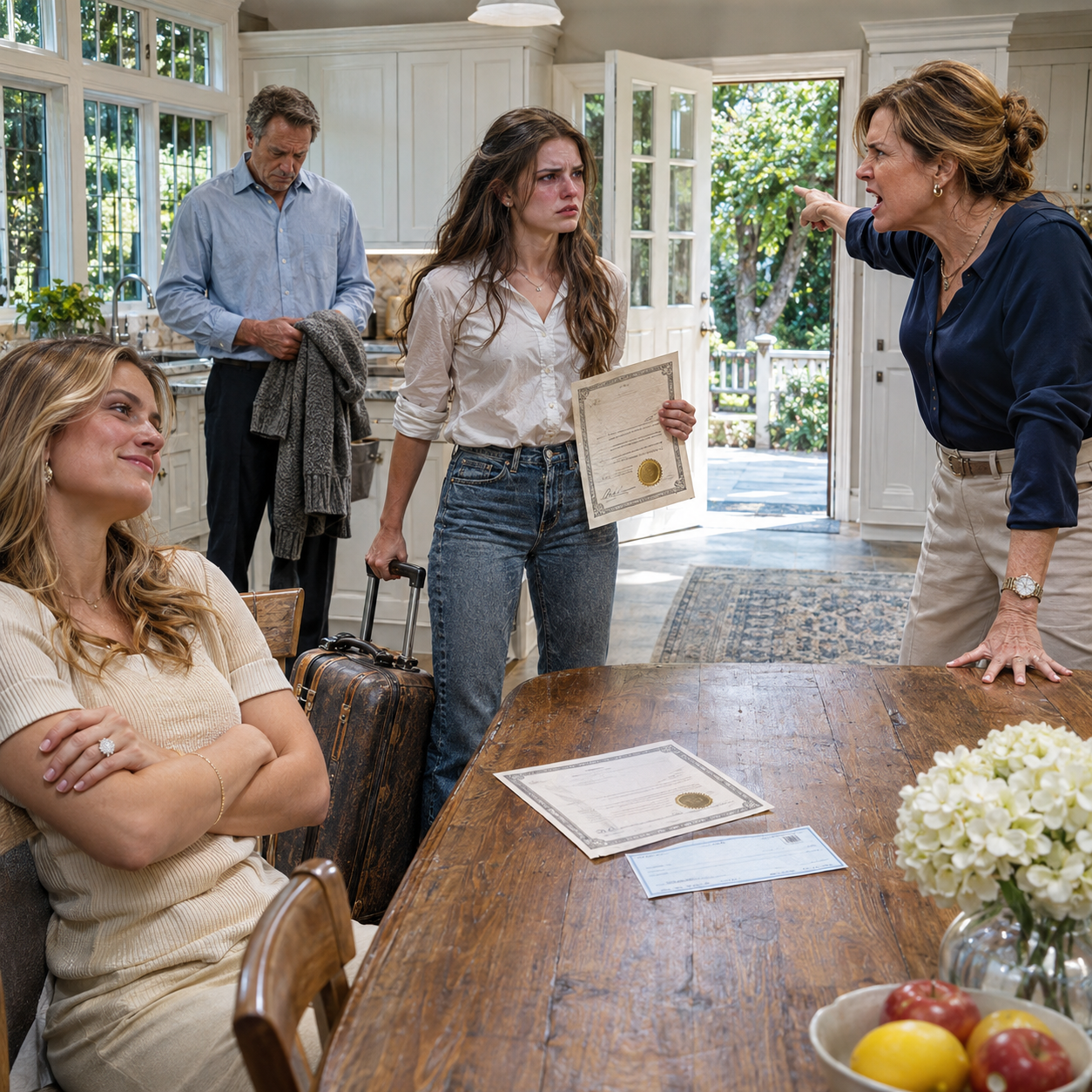
Kristen climbed out before he finished parking. She stopped at the porch, examined the boxes, then marched to the front door and inserted her key.
I heard metal scrape against the new lock.
She tried again.
“Lydia!” she shouted. “Open this door.”
I approached the entrance, fastened the chain, and opened it a few inches.
Owen stood behind her, staring at the boxes.
“Mom,” he said, “what’s going on?”
“I canceled the wedding contracts today.”
He looked at me as if I’d spoken in another language.
Kristen moved closer to the opening. “You canceled our wedding?”
“I canceled the arrangements I was paying for.”
“You can’t just decide that!”
“I checked. The contracts permit it.”
Her gaze flickered toward Owen. “Tell her.”
He swallowed. “Mom, we have deposits coming due. The venue—”
“The venue has already confirmed the cancellation.”
Kristen pressed her fingers against her temples. “We can’t replace that money in two weeks.”
“I understand.”
“No, you don’t. We’ve been planning this for months!”
“So have I,” I replied. “And I spent this morning reviewing the account statements.”
Her hands dropped.
“The spa, the hotel, the clothing purchases,” I continued. “Those weren’t wedding expenses.”
Owen turned toward her. “What hotel?”
Kristen opened her mouth, then looked back at me.
“Some of those things were connected to the wedding. I needed clothes for the events. We were under enormous stress.”
“A six-month gym membership?”
“That was supposed to come out of my personal account.”
“Then you can reimburse me.”
Owen’s expression changed as he looked between us.
“Kristen,” he said quietly, “how much did you spend?”
She didn’t answer.
I could have continued through every transaction, but doing it through a chained doorway would have turned the situation into a spectacle for the neighbors.
“The statements are available for you to review, Owen,” I said. “Your belongings are packed safely. Please take them before it gets dark.”
He rested one hand against the doorframe.
“Mom, please. Can’t we sit down?”
I looked at him through the narrow opening.
“Yesterday you told me I was dead to you unless I accepted everything. Today I’m accepting that you have the right to make your own decisions.”
He lowered his eyes.
“But I have the same right.”
I closed the door.
For almost half an hour, I heard them moving boxes and speaking in tense, interrupted sentences. Owen knocked twice, but I didn’t reopen the door.
When his truck finally pulled away, I returned to the kitchen and found the cup of tea I’d abandoned beside my novel.
It had gone cold.
I poured it out, washed the cup, and placed it upside down on the drying rack.
Then I sat at the table and looked at my son’s unanswered message.
I had protected my savings and my home.
I still didn’t know whether I’d lost my child.
Part 3: The People Who Stayed Quiet Begin Telling The Truth
On Wednesday, Gerald’s sister Beverly called.
“Owen says you’ve canceled everything,” she began carefully. “He’s beside himself, Lydia.”
I asked whether he’d mentioned the wedding account. When she said no, I photographed the transaction history and sent it to her, along with his ultimatum.
She called back twenty minutes later.
“Fifteen thousand dollars?” she asked.
“More than fifteen thousand spent, Beverly. And I’ve lost another nine thousand canceling contracts.”
There was a pause.
“I thought they were paying for most of this themselves.”
“They weren’t paying for any of it.”
Beverly sighed. “Gerald would have had a few things to say about that.”
She called Owen herself. I never asked what she told him, but she later admitted he’d been difficult to defend once he saw the statements.
Six weeks passed without a conversation between my son and me.
I continued working in my garden, visiting friends, and going about the ordinary business of living. Sometimes I picked up my phone to tell Owen something amusing, then remembered we weren’t speaking.
In August, a woman named Preet called unexpectedly.
She was the bridesmaid who had held Gerald’s photograph.
“Mrs. Marchmont, I hope you don’t mind me calling. There’s something about Kristen I think you should know.”
Preet explained that Kristen had accumulated substantial credit-card debt over several years. She’d been counting on wedding cash gifts to reduce those balances, and she believed Owen’s income would eventually take care of the rest.
“She was afraid he’d find out before they married,” Preet admitted. “I think that’s why she kept pushing for everything to happen exactly her way.”
I sat beneath the climbing roses and listened.
“Does Owen know now?”
“They tried getting a loan to rebook the wedding. The application brought up her debts. He’s been asking questions ever since.”
I thanked her. Before hanging up, she added, “I should’ve said something that day at your house. When she touched your husband’s picture, I knew it wasn’t right.”
Afterward, I sat outside until the evening turned cool.
Kristen’s behavior hadn’t been merely about decorating or showing off. Behind the expensive wedding was a financial problem she’d hoped marriage would help her escape.
But knowing that didn’t excuse what she’d done.
And Owen still had to answer for the part he’d played.
Part 4: My Son Returns Without The Woman He Defended
Three weeks later, Owen appeared at my door alone.
He looked tired. His beard was uneven, and the jacket he wore was one Gerald had given him years earlier. For a moment, standing beneath the porch light, he looked remarkably like the boy who used to come home after making a mistake at school.
“Can I come in, Mom?”
I stepped aside.
He sat at the kitchen table while I made tea. His hands remained wrapped around the mug long after it was cool enough to drink.
“Kristen moved out,” he finally said. “She’s staying with her sister in Calgary.”
I pulled out the chair opposite him.
“I saw her debts when we applied for the loan. I asked her why she hadn’t told me.” He rubbed his eyes. “She said she was afraid I’d leave. Then I found out what she’d been planning to do with the wedding gifts.”
He stared at the tabletop.
“I wanted to believe her. Even after I saw the statements, I kept making excuses.”
“And when I raised concerns?”
“You made things harder for me.”
The words surprised both of us.
Owen looked up. “That’s what I told myself. If you’d just gone along with things, I wouldn’t have to argue with her.”
I watched him turn his father’s old wedding ring around his finger. Gerald had given it to Owen after the engagement.
“You let me become the problem because that was easier than dealing with the real one,” I said.
He nodded.
“I’m sorry, Mom. Especially for that message. I read it again last night. I don’t know how I could say something so cruel to you.”
I wanted to reach across the table, but I waited.
“You were entitled to choose your wife,” I told him. “You were never entitled to demand that I surrender my home, my money, and my dignity to prove I loved you.”
A tear ran down his cheek. He wiped it away with the back of his hand, exactly as Gerald used to.
“I know.”
We talked until nearly midnight. I didn’t offer to rescue him financially, and he didn’t ask. Before leaving, he stopped beside Gerald’s photograph and straightened its frame.
“That’s a good picture of Dad,” he said.
“Yes,” I answered. “It is.”
He kissed my cheek before going home.
Trust didn’t return in one evening. It came back gradually, through Sunday dinners, returned phone calls, and conversations in which Owen learned to hear something he didn’t like without withdrawing his affection.
He began sorting out his finances and rebuilding his life. I kept my savings where they belonged, though I quietly hoped there might someday be an opportunity to help him for a better reason.
November arrived without a wedding.
On the morning the ceremony had been scheduled, I drove to Elora and walked beside the gorge. The trees were nearly bare, and the cold air made my eyes water. I bought myself lunch at a little restaurant and sat near the window watching families pass on the sidewalk.
For the first time in months, I wasn’t waiting for anyone to approve of my choices.
When I returned home, Owen had left a message asking whether I wanted company for dinner the following Sunday.
I called him back and said yes.
That evening, I put my coat away and paused beside the hallway shelf. Gerald’s photograph still stood where it had stood for years, his arm around my shoulders, both of us laughing beneath the mountains.
I touched the wooden frame.
I’d lost money protecting what mattered to me. For a while, I’d feared losing my son as well.
But Owen was finding his way back, not because I had paid for his happiness, but because he had finally learned that love should never require someone else to disappear.
I left the photograph exactly where it belonged and went into my kitchen to make coffee.
The End .
All characters and events in this story are fictional, created for storytelling and entertainment purposes. Thank you sincerely for reading. Your feedback and support are invaluable and motivate me to continue sharing more stories with you.