Chapter 2
Michael Brennan emerged into the lobby wearing a charcoal suit and the expression of a man who had just received news he couldn’t afford to ignore. His silver hair was neatly combed, but his usual composure had disappeared. He scanned the room, spotted me in the corner, and crossed the marble floor so quickly that several guests turned to watch.
“Jonathan,” he said, extending his hand. His fingers trembled slightly as I shook it. “I had no idea you were here. Please tell me what’s happened.”
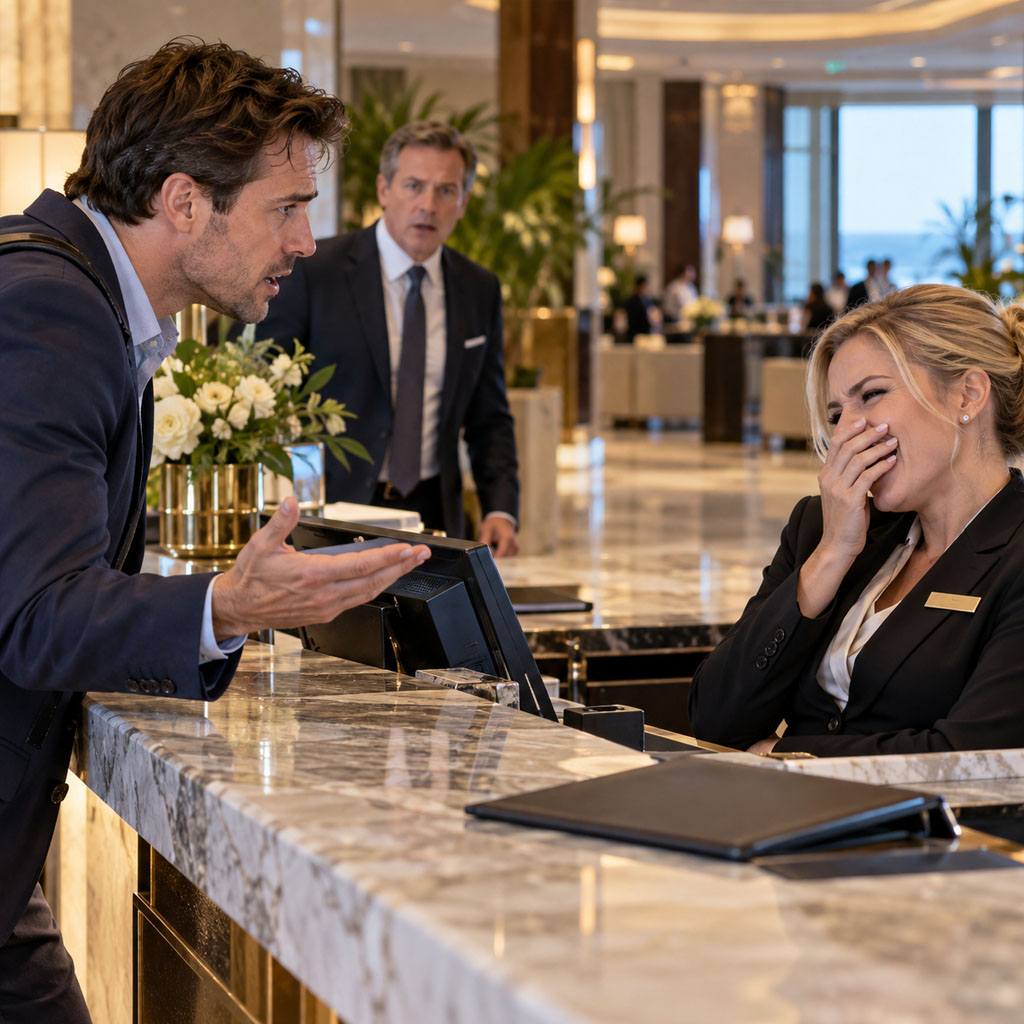
I gave him the facts without embellishment. I described the broken air conditioner, the repeated calls, the stained towel, and the used bandage beneath the nightstand. Then I told him about Vanessa’s response, including her laughter and her suggestion that I had planted the evidence myself.
Michael listened without interrupting. With every detail, his face grew more troubled. When I finished, he glanced toward the concierge desk, where Vanessa was still working.
“I need to see the room,” he said.
“You will,” I replied. “But before we go upstairs, I think you should ask your senior concierge how she handled my complaint.”
He stood still for a moment, drawing a slow breath. Then he walked toward the desk.
Vanessa looked up with a professional smile that vanished as soon as she saw his expression. “Michael. Is everything all right?”
He didn’t answer immediately. Instead, he looked across the lobby toward me, then returned his attention to her.
“Vanessa, do you know who that gentleman is?”
She glanced in my direction. “No. He’s a guest who had a complaint about his room.”
“A guest you laughed at?”
Her smile faltered. “I didn’t laugh at him. I was trying to explain our procedures.”
Michael’s voice remained quiet, but every word carried across the lobby. “You accused him of inventing a hygiene complaint, dismissed his request for a manager, and told him to fill out a comment card. Is that how you remember it?”
Vanessa’s eyes darted toward the other employees. The couple checking in had stopped their conversation, and the elderly woman in the armchair had set her magazine aside again.
“I think there’s been a misunderstanding,” Vanessa said. “He was making some pretty serious accusations, and I was simply trying to—”
“That man is Jonathan Reeves,” Michael interrupted. “He’s the travel critic whose review helped save this resort three years ago. His article brought us the kind of attention most hotels spend decades trying to earn. We built a significant part of our reputation on his recommendation.”
Vanessa went completely still.
Michael continued, his voice hardening. “And today, he came to you with a legitimate complaint about the condition of his room. You laughed at him and suggested he was lying.”
Her fingers tightened around the edge of the desk. “I didn’t know who he was.”
“That is precisely the problem,” Michael replied. “You didn’t know who he was, so you decided his concerns didn’t matter.”
Vanessa opened her mouth, then closed it. Her eyes filled with tears as the realization settled over her. She had spent six years working behind that desk, and in less than five minutes, her judgment had been exposed in front of her colleagues and the guests she was supposed to serve.
“Michael, please,” she whispered. “I’ve worked here for six years. I didn’t mean for this to happen.”
“Go to my office,” he said. “Wait there until I speak with you.”
She walked out from behind the desk with unsteady steps. As she passed me, our eyes met for a brief moment. I expected anger, perhaps resentment, or a look that blamed me for the trouble she’d brought upon herself. Instead, I saw something more complicated: the first flicker of awareness that the way she’d treated me said something about her own character.
Then she disappeared through the service door.
Michael turned back to me. “Let’s see your room.”
The elevator ride to the fourth floor was silent. When the doors opened, he followed me down the hallway and into Suite 412. The heat struck us immediately, thick and oppressive, and the faint musty odor seemed stronger than before.
Michael stopped just inside the doorway. His gaze moved from the peeling paint to the stained carpet, then to the refrigerator vibrating against the wall.
“Oh, no,” he murmured. “This is not acceptable.”
I showed him the photographs on my phone, along with the timestamps documenting when I had discovered each problem. I had kept the stained towel in a clean plastic bag so it could be examined without further handling, and the used bandage remained beneath the nightstand where I’d found it. Finally, I showed him my call history, which confirmed the times I’d contacted the front desk about the air conditioner.
He crouched to look beneath the furniture, then stood and stared at the bandage as though he hoped he had misunderstood what he was seeing.
“This should never have happened,” he said.
“No,” I agreed. “It shouldn’t.”
He examined the room more carefully, running a hand over the damaged paint near the ceiling and checking the thermostat himself. When he discovered that the unit wasn’t cooling at all, he pressed his lips together.
“This isn’t simply a bad guest experience,” he said. “It’s a failure of basic standards.”
I showed him the small camera concealed in my shirt-pocket pen, explaining that it had recorded my conversation at the concierge desk. I had been documenting the reassessment, not trying to trap anyone, and I intended to handle the footage responsibly through my publication’s review process.
Michael watched the recording on my phone. His shoulders stiffened as Vanessa’s laughter filled the quiet room. When the video ended, he remained silent for several seconds.
“What can I do to make this right?” he finally asked.
I’d been considering that question since the moment Vanessa dismissed me. Over the years, I’d seen hotels respond to bad experiences with everything from genuine reform to extravagant gifts intended to buy a critic’s silence. A complimentary suite could compensate for an inconvenience, but it couldn’t correct a culture that allowed problems to go unreported.
“I need three things,” I said. “First, complete transparency. I want to review your maintenance records, housekeeping procedures, staffing levels, and training materials. I need to know whether this is an isolated failure or a pattern.”
Michael nodded.
“Second, accountability. Not just for the person who laughed at me, but for everyone whose decisions allowed this room to reach this condition. Third, I want to finish my assessment. I’ll move to a properly maintained room, complete the stay I paid for, and publish an honest review based on what I find.”
“You’ll have full access to the records,” he said. “I’ll have our operations director prepare them by tomorrow morning.”
“What about Vanessa?”
His expression tightened. “Her conduct will be addressed immediately. But I also need to understand how we reached a point where an employee thought that was an acceptable way to treat a guest.”
That answer surprised me. He could have blamed Vanessa and declared the matter settled. Instead, he was beginning to ask the more difficult question.
He arranged for me to move to another suite and ordered an immediate inspection of the affected room. He also instructed the housekeeping supervisor to review the room-cleaning process and requested an urgent maintenance assessment of the fourth floor.
Before leaving, Michael stood by the window and looked out at the ocean. The resort’s manicured gardens stretched toward the beach, and guests were strolling along the paths as though nothing had happened.
“Three years ago, you wrote that this place understood what luxury meant,” he said. “I was proud of that review. I thought we’d built something that could last.”
“You did build something good,” I told him. “The question is whether the people responsible for it are willing to protect it.”
He turned toward me. “I intend to find out.”
Chapter 3
The following morning, a stack of records awaited me in a conference room overlooking the gardens. Michael had kept his promise, and the operations director had assembled maintenance logs, housekeeping schedules, training documents, and budget reports covering the previous two years. I began reading shortly after breakfast and continued well into the afternoon.
What I found was worse than I’d expected.
The Meridian Grand’s decline hadn’t begun with one careless housekeeper or one rude concierge. It had started about eighteen months earlier, when the private investment firm that owned the property began cutting expenses to improve its financial returns. Maintenance funding had been reduced by forty percent, housekeeping staff had been cut by a third, and the comprehensive training program that once defined the resort’s service had been discontinued.
The numbers told a clear story. Fewer housekeepers had been assigned more rooms, leaving less time for careful inspections. Maintenance requests had accumulated faster than technicians could resolve them, and managers had begun prioritizing visible problems in public areas over less obvious issues inside guest rooms. Employees who raised concerns were often told to work within the budget they had been given.
The consequences were visible in every department.
Michael had objected to several of the cuts, according to the correspondence included in the records. He had warned the ownership group that reducing maintenance and staffing would eventually undermine the guest experience. His concerns had been brushed aside, and internal notes suggested that some of the investors viewed him as too protective of service standards.
There was even discussion of replacing him before the end of the fiscal year.
I sat back in my chair and looked at the pages spread across the table. Vanessa’s behavior had been unacceptable, but it hadn’t developed in isolation. She had worked in an environment where employees were expected to do more with less, guest complaints had become routine, and management had allowed the distance between the resort’s promises and its actual performance to grow.
Understanding that didn’t excuse her actions. It did, however, reveal a larger problem.
By lunchtime, the three managing partners responsible for the resort’s acquisition had arrived from New York. Michael introduced them to me in the conference room. Douglas Fairbanks, the firm’s senior partner, was in his early sixties and carried himself with the practiced confidence of someone accustomed to controlling a room. Amanda Rothschild, who oversaw the hospitality portfolio, repeatedly checked her phone. Howard Blackwell, the youngest of the three, looked as though he’d spent the flight rehearsing explanations that no longer seemed convincing.
Douglas began with a polished apology.
“Mr. Reeves, we’ve reviewed the initial report, and we agree that the incident with our concierge was unfortunate. It’s not representative of the experience we intend to provide. We’d like to discuss a reasonable accommodation for the inconvenience you’ve experienced.”
He opened his briefcase and mentioned a substantial financial settlement, along with a lifetime membership in the company’s premium guest program.
I raised my hand.
“Please don’t misunderstand me, Mr. Fairbanks. I’m not here to negotiate a settlement, and I’m not interested in special privileges. I’m here to evaluate a hotel that I once recommended to thousands of readers.”
His expression remained courteous, but his eyes sharpened.
“My review will be published based on what I observed during my stay,” I continued. “I won’t change my findings in exchange for compensation. What you can influence is what happens next. I intend to document your response to the problems I’ve uncovered, and I will report whether the changes you make are genuine.”
Amanda finally put down her phone.
“What changes would you consider sufficient?” she asked.
It was a fair question, although I suspected she wanted a checklist that would allow the firm to spend as little as possible while protecting its investment.
I explained that restoring the resort’s reputation would require more than repainting the fourth floor and replacing a few appliances. The owners needed to restore adequate maintenance funding, rebuild housekeeping capacity, and reinstate the training program that had once helped employees understand what good service looked like. Michael also needed the authority to manage the property without being overruled whenever he requested resources necessary to maintain it.
“And the culture has to change,” I added. “A guest shouldn’t have to prove they’re important before anyone takes a complaint seriously. If your employees believe their job is to protect the company from guests rather than help the guests they’re serving, no amount of expensive furniture will make this a luxury resort.”
Douglas leaned back. “You’re asking us to reverse decisions that were made to improve profitability.”
“I’m asking you to consider what those decisions have cost you.”
Howard, who had been silent until then, cleared his throat.
“I led the acquisition,” he said. “I supported the budget cuts because I believed we could maintain the same standards with fewer resources. Michael warned me that we couldn’t. I thought he was being overly cautious, and I was wrong.”
Douglas turned toward him with visible irritation, but Howard continued.
“I signed off on those decisions. If we need to reverse them, I’ll take responsibility for making that happen. I’ll personally oversee the changes, and I’ll put my position on the line if I fail to deliver.”
It was the first statement in the meeting that sounded like genuine accountability. I looked at Howard for a moment, trying to determine whether he understood the scale of what he was offering. His expression held no obvious performance of remorse. He looked uncomfortable, but he wasn’t backing away from the truth.
Michael sat quietly beside me, his hands folded on the table. He had spent months warning the people in that room about the consequences of their decisions, and now the evidence was forcing them to listen.
Douglas finally closed his briefcase.
“We’ll review the budget and discuss the necessary adjustments,” he said.
“That’s a start,” I replied. “But I’ll be judging the results, not the meeting.”
Over the next two days, I continued my assessment from a different suite. The room was clean, the air conditioning worked properly, and the staff were attentive without hovering. Michael had brought in additional maintenance personnel and arranged for a thorough inspection of rooms across the property.
I also interviewed twelve employees, from housekeepers and bellhops to supervisors and department managers. Their accounts were remarkably consistent. They had entered the hospitality business because they liked helping people, but the cuts had left them exhausted and discouraged. Some were afraid to report maintenance problems because they believed management would blame them for failing to meet impossible schedules. Others described watching guests grow frustrated while knowing they lacked the authority or resources to solve the problems.
One housekeeper, a woman named Denise who had worked at the resort for eleven years, told me she used to take pride in preparing rooms for returning guests. She remembered the names of regular visitors and took satisfaction in the small details that made a room feel welcoming.
“Now we’re assigned so many rooms that sometimes I barely have time to finish one before I’m supposed to start the next,” she said. “I don’t want anyone finding something dirty. I just need enough time to do the job right.”
Her words stayed with me long after the interview ended.
Vanessa had made a choice when she laughed at my complaint. She had chosen contempt over concern, and she deserved to be held responsible for that decision. But the resort’s leadership had also made choices, repeatedly and over a long period, that had made it harder for employees to do their jobs well.
A single termination couldn’t fix that.
On my final morning, Michael met me in the lobby. He looked tired, but there was a new determination in his face.
“The owners have approved the changes,” he told me. “The maintenance budget is being restored, housekeeping staffing will increase by thirty percent, and we’re bringing back the full training program. I’ve also been given the authority to make operational decisions without seeking approval for every necessary expense.”
“That’s encouraging,” I said.
“It is. But I know we have a long way to go.”
He paused before mentioning Vanessa.
“She’s been terminated for her conduct and for the way she handled the complaint. She called yesterday asking whether there was any possibility of appealing the decision.”
“What did you tell her?”
“That her behavior had consequences. But I also told her something I wish I’d remembered before all of this happened.” He looked toward the concierge desk. “I told her that exhaustion, frustration, and a bad workplace can affect any of us. They may explain how someone loses their way, but they don’t excuse the harm they cause.”
I appreciated his honesty. Michael wasn’t pretending that Vanessa’s actions were harmless, and he wasn’t pretending that firing her would absolve the organization of its own failures.
As I left the resort, I knew my review would be difficult to write. The Meridian Grand had failed in ways that could not be dismissed as a few unfortunate accidents. But its leadership had begun taking steps toward meaningful reform, and that response deserved to be evaluated just as honestly as the failures themselves.
Chapter 4
Back in New York, I spent three days writing and revising my article. It was the most complicated review I’d ever prepared, partly because the problems were so serious and partly because I had seen people begin to confront them. I couldn’t ignore the hotel’s failures simply because its general manager had responded well, but I also couldn’t pretend that his response meant nothing.
The headline I chose was “The Rise, Fall, and Possible Redemption of the Meridian Grand.”
I described the overheated suite, the housekeeping failures, and my encounter with Vanessa. I explained how the resort’s owners had reduced staffing and maintenance funding while expecting the same level of service. I also described Michael’s decision to open the records, Howard’s admission that the budget cuts had been a mistake, and the changes they had promised to implement.
The review received three stars out of five, down from the five stars I’d awarded the resort three years earlier.
In the final section, I wrote that the Meridian Grand had failed its guests and could not expect its old reputation to protect it. But I also acknowledged that its new commitments offered a reason for cautious hope. I promised to return in a year to see whether those commitments had become lasting improvements.
My editor read the piece twice before approving it.
“Some people will say you’re being too generous,” Rebecca told me. “Others will say you’re being too harsh. That’s usually a sign you’ve written something honest.”
The article appeared in our March issue, and within days, other publications began discussing the resort’s decline and its attempt to recover. The story attracted attention because it illustrated a problem that extended far beyond one hotel: what happens when a business spends so much energy reducing costs that it forgets what customers are paying for.
The recording of Vanessa’s encounter became a point of discussion within the hospitality industry, though I was careful not to encourage a campaign of public humiliation. Her behavior had been wrong, but I had no desire to turn a legitimate review into a spectacle designed to make one woman a permanent target. My responsibility was to report what happened and explain why it mattered, not to invite strangers to destroy someone’s life.
Even so, the consequences for Vanessa were substantial. She lost her job, and the public attention made it difficult for her to find another position at a prominent resort. I heard nothing from her for several months, and I assumed our paths would never cross again.
Then, six months after the review was published, an email arrived in my inbox with her name in the sender line.
I almost deleted it without opening it. I expected an angry accusation or a demand that I remove the article. Instead, the message was quiet and painfully direct.
She wrote that losing her position had forced her to examine the person she’d become. For weeks, she had replayed the encounter in her mind, trying to understand why she had treated a stranger with such contempt. She had always considered herself a capable professional, someone who knew how to handle difficult guests, but the recording showed her a woman who seemed more interested in defending her pride than solving a problem.
She also told me she had found work at a small bed-and-breakfast in a quiet California town. The owners were a retired couple who cared less about her résumé than about whether she could treat their guests with kindness and respect.
“I’m not asking you to forgive me,” she wrote. “I know I was wrong. I just wanted you to know that your review forced me to face something I had been avoiding for a long time. Every day, I try to be more patient than I was yesterday. I don’t always get it right, but I’m trying to do better.”
I read the email three times.
There was no request for a favorable mention, no attempt to blame the resort entirely, and no claim that one bad day should erase what she’d done. She had acknowledged her responsibility without pretending the surrounding circumstances didn’t matter.
I thought about the woman I’d seen behind the marble desk, laughing at a guest because she had decided he wasn’t important. Then I thought about the person who had taken the time to write that email, admitting that she’d failed and trying to build a better life from the consequences.
Accountability was necessary. So was the possibility of change.
I replied briefly, thanking her for writing and wishing her well in her new position. I didn’t promise forgiveness, and I didn’t tell her that the incident no longer mattered. Some experiences leave marks, and pretending otherwise helps no one.
But I hoped she would continue learning.
One year after my original visit, I returned to the Meridian Grand.
This time, I booked under my own name. Michael met me in the lobby with a smile that looked less relieved than it had a year earlier. The resort had been through a demanding period, but the changes were no longer confined to emergency repairs and temporary staffing adjustments.
The fourth-floor rooms had been renovated properly, and the maintenance department had established a regular inspection schedule. Housekeeping had more staff, realistic room assignments, and time to check the details that had once been overlooked. The training program had returned, with an emphasis on listening to guests, resolving problems, and treating every person with dignity.
I spoke with Denise again. She told me the difference was visible in the way employees worked together. They had regular meetings where they could report concerns without fear of being blamed, and supervisors were expected to address recurring problems rather than simply remind staff to work faster.
“We can finally do the job the way we know it should be done,” she said. “That makes a bigger difference than people realize.”
During my stay, I found the service attentive and sincere. The room was immaculate, the air conditioning worked quietly, and the staff answered questions with the kind of easy confidence that comes from proper training and a supportive workplace. At dinner, the restaurant manager asked whether everything had met my expectations, then listened carefully when I suggested a small improvement to the menu.
It was the Meridian Grand I remembered, but it was also a property that seemed to understand more clearly why its earlier success had mattered.
On my final morning, Michael walked with me through the lobby.
“So,” he asked, “what’s the verdict?”
“I think you’ve earned four and a half stars,” I said. “I’m holding back the last half until I see that this level of service lasts. But you’ve done what you promised.”
He smiled, and for the first time since my original visit, I saw genuine relief on his face.
Howard Blackwell had also followed through on his commitment. He had become the strongest advocate within the ownership group for protecting the resources the resort needed. His experience at the Meridian Grand had changed his understanding of profitability, and he had begun arguing that a well-run hotel could outperform a stripped-down operation by earning repeat business and genuine loyalty.
Douglas Fairbanks had retired after the acquisition’s poor performance damaged confidence in his leadership, while Amanda Rothschild had moved to another firm. Howard now led the hospitality portfolio, and the decisions he once defended as necessary cost reductions had become lessons he shared with other executives.
The resort’s recovery was not a miracle. It was the result of restoring the people, resources, and standards that had made the place successful in the first place.
Before leaving, I passed the concierge desk. A young man stood behind it, greeting guests with a warmth that seemed natural rather than rehearsed. An older couple entered wearing matching tracksuits and carrying well-used travel bags. The concierge smiled at them as though he had been waiting all morning for their arrival.
“Welcome to the Meridian Grand,” he said. “We’re glad you’re here. What can I do to make your stay comfortable?”
The couple smiled back, and the woman began explaining that it was their first visit to the California coast. The young man listened closely and began suggesting places they might enjoy.
It was an ordinary exchange, so small that most people in the lobby would have forgotten it moments later. But I stopped long enough to watch, because it captured the difference between a hotel that merely sells luxury and one that understands hospitality.
I thought of Vanessa working in that small bed-and-breakfast, trying to become a better version of herself. I thought of Michael rebuilding the resort’s culture and Howard learning that responsible leadership sometimes means admitting that a profitable decision was also a foolish one.
And I thought about the responsibility that came with my own profession.
A review could help a struggling property find its footing, or warn travelers away from a place that had stopped honoring its promises. That power demanded restraint, careful documentation, and a willingness to acknowledge improvement when it was real. I had no interest in punishing people for the sake of a dramatic headline, but neither could I allow sympathy to replace honesty.
My follow-up review appeared the next month, awarding the Meridian Grand four and a half stars. Bookings rose over the following quarter, and the resort received renewed recognition from travel professionals who had once questioned whether it could recover. More important, guests were beginning to return because their experiences matched what the resort promised.
The hotel had regained much of its reputation, but I never forgot how easily it had lost its way.
People sometimes ask whether I feel responsible for what happened to Vanessa. They ask whether one encounter should have had such lasting consequences for someone who spent six years building a career. It’s a fair question, and I understand why people ask it.
My answer is that I didn’t make Vanessa laugh at a guest’s legitimate complaint. I didn’t make her dismiss the evidence or suggest that a person who appeared ordinary deserved less attention. Those were her choices, and she had to face them.
But I also don’t believe a person’s worst moment should automatically become the whole story of their life. Vanessa had been held accountable, and she was trying to change. I hoped she would be judged, in time, by the person she became rather than only by the woman who stood behind that marble desk.
The same principle applied to the Meridian Grand. Its failures had been serious, and its owners could not erase them with a fresh coat of paint or a polished apology. They had to demonstrate that they had learned something and were willing to keep learning.
That’s what redemption required: not forgetting what had happened, but doing the difficult work of becoming better.
I still review hotels. I still pay attention to the small details, the way a housekeeper prepares a room, the way a manager responds to a concern, and the way an employee treats someone who cannot offer anything in return. Those moments tell me more about a property than its chandeliers or ocean views ever could.
And whenever I see a guest approach a front desk looking tired, confused, or frustrated, I remember that afternoon at the Meridian Grand. I remember the laughter that carried across the lobby, the silence that followed, and the manager who came rushing through the service door because he finally understood what was at stake.
Vanessa thought she was dealing with an insignificant guest. Michael thought his resort was still living up to its reputation. The owners thought they could cut expenses without changing the experience they sold.
All of them were wrong in different ways.
The lesson wasn’t that every rude employee would eventually meet a powerful critic, or that people should be polite only because they might suffer consequences. The lesson was simpler and harder to practice: the way we treat people reveals who we are, especially when we believe there is nothing to gain from treating them well.
A person doesn’t need an important title to deserve respect. A complaint doesn’t become legitimate because the person making it is famous. And a business doesn’t earn a reputation by telling the world how excellent it is, but by honoring its promises when no one important appears to be watching.
I have never forgotten the sound of Vanessa’s laugh. But I have also never forgotten the young concierge greeting that elderly couple a year later, offering them the same warmth he would have offered a celebrity or a billionaire.
That was the moment I knew the Meridian Grand had finally begun to understand what I had praised in my original review.
Luxury was never the marble desk.
It was the person standing behind it.
THE END.
⚠️ All characters and events are fictional. Do not imitate or apply them in real life. 😌😌😌