### Part 2: My Sister’s Carefully Prepared Lies Collapse Under Unexpected Evidence
“Counsel, do you wish to address conditions of release?” Judge Vosberg asked, turning toward Magda’s attorney. He adjusted the reading glasses resting on his head and described my sister as a lifelong resident with no criminal history, strong community ties, and a record of caring for our elderly father. According to him, she was a responsible woman caught in an unfortunate misunderstanding between two sisters with a complicated relationship. He requested her release while the case proceeded.
Then he explained Magda’s version of what happened.
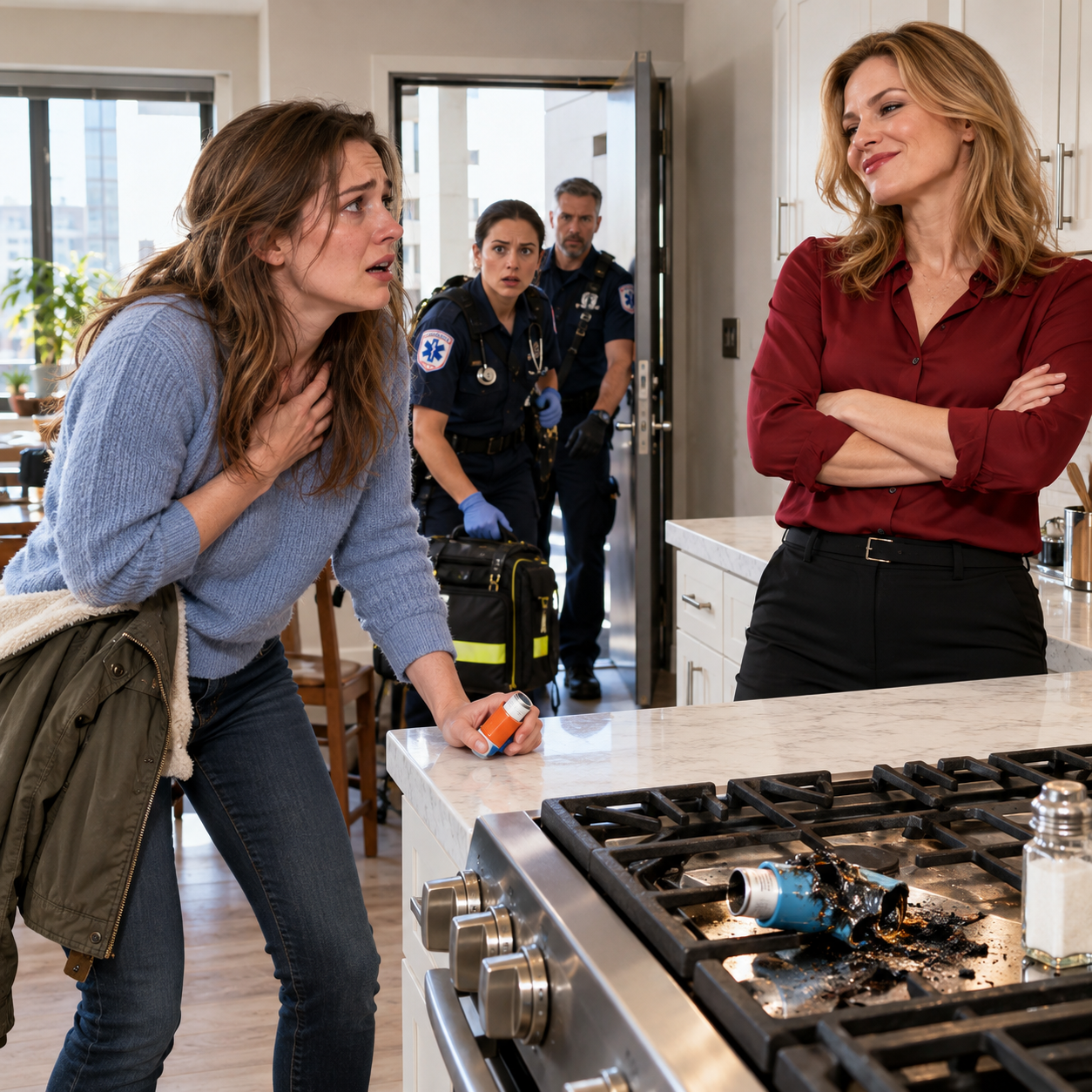
The inhaler, he claimed, had been expired and empty for months, and my sister had simply lost her temper over the clutter in my apartment. Burning it was foolish, he admitted, but she had never intended to harm me. As for my breathing difficulties, Magda believed I was experiencing one of my familiar panic episodes. I stared at the screen, astonished that someone could make those four minutes in my kitchen sound like a disagreement over housekeeping.
The prosecutor leaned toward his microphone. “Your Honor, the state has evidence relevant to those claims.” Judge Vosberg turned to Magda and explained that she was under no obligation to speak and that anything she said could be used against her. My sister wiped her cheeks, straightened her shoulders, and announced that she wanted to explain herself. Her attorney moved toward his microphone, but Magda had already begun.
“I would never hurt my sister,” she insisted, looking directly into the camera. “I’ve protected her since we were children. I carried her medicine everywhere because our mother trusted me.” She paused, gathering confidence, before claiming the burned inhaler was an old blue one she’d seen on my counter since summer. According to Magda, I’d deliberately exaggerated my breathing difficulties to punish her for an argument.
Then she denied threatening me.
“I never said those horrible things. She’s twisting what happened.”
Her lawyer closed his eyes.
For a moment, I almost felt six years old again, standing beside Magda while she explained to our mother why something wasn’t her fault. She’d always possessed a remarkable ability to sound certain, even when everyone else remembered things differently. I could picture our mother listening, nodding, and deciding that the older sister must know best. But the prosecutor wasn’t interested in which of us sounded more convincing.
He looked down at his notes.
“Your Honor, three points.”
First, investigators possessed the recording of my emergency call, placed at 3:17 that Saturday afternoon. Second, police had recovered the damaged inhaler from the stove, where part of its pharmacy label had survived the heat. The prescription was filled three days before the attack, and the pharmacy confirmed it had been dispensed as a new, full inhaler. I gripped the edge of my laptop, remembering the pharmacist handing me that unfamiliar blue device.
Then the prosecutor delivered the third point.
“For the previous four years, the victim’s prescribed inhalers were orange,” he explained. “Her pharmacy changed manufacturers this month. The blue inhaler recovered from the stove was the first blue one she had ever received.”
Magda remained completely still.
The prosecutor continued, emphasizing that the medication had been inside my apartment for only three days. My sister couldn’t possibly have recognized it as a blue inhaler she’d supposedly seen since summer. Her own description placed her hands on a specific device she had never encountered before that Saturday afternoon.
I hadn’t realized the color mattered. I’d simply collected my prescription and left it beside the salt shaker, exactly where I always kept my medicine. Yet this tiny detail, something neither of us had considered important, had dismantled the foundation of Magda’s explanation.
Her lawyer hurried to interrupt. “Your Honor, my client may have misspoken.”
Judge Vosberg raised her hand.
“Counsel, enough.”
For the first time, I saw something unfamiliar cross my sister’s face. She wasn’t crying anymore, and she wasn’t searching for someone to rescue her.
She was realizing that the truth had entered a room she could no longer control.
### Part 3: A Recorded Emergency Call Reveals The Truth Behind Her Cruelty
The prosecutor requested permission to play the entire emergency recording. Magda’s attorney objected immediately, arguing that introducing such material at an initial appearance was unusual and potentially prejudicial. Judge Vosberg listened without interruption, then reminded him that his client had voluntarily disputed the statements attributed to her. If those statements were relevant to determining release conditions, the court would consider the recording.
“Play it,” she ordered.
A small audio player appeared on the shared screen, its timestamp beginning at 3:17 p.m. I watched the prosecutor press the button, then heard my own frightened voice coming through the laptop speakers. My breathing was uneven, and I struggled to tell the dispatcher where I lived. Hearing myself in that condition was more painful than I’d anticipated. I pushed back my chair and walked to the kitchen window, wrapping my arms around my ribs.
I stood in the exact place where Magda had opened the window to clear away the smoke.
Then her voice emerged from the recording.
“Can’t breathe?”
She sounded amused, almost casually curious, as though she were commenting on something unimportant. A little later, while the dispatcher tried to determine whether anyone else was present, Magda’s voice came closer. “Tell them it’s just me. Tell them your big sister’s here. I’m watching.”
My fingers tightened around the windowsill.
On the recording, my sister wasn’t confused about whether I needed help. She knew I was struggling, knew I’d called for an ambulance, and knew she had destroyed my medication. Her own words contradicted the sympathetic explanation she’d offered the court. I turned toward the laptop and saw Magda hiding her face behind both hands.
Judge Vosberg instructed her to lower them and face the camera while the recording continued. Magda obeyed, her cheeks streaked with tears, and listened to the remaining minutes. I watched her expression change as the sound of my desperate breathing filled the virtual courtroom. For one unsettling moment, she looked almost surprised by what she heard.
Perhaps she’d repeated her revised version so many times that she’d begun believing it.
The recording ended after four minutes and two seconds. The prosecutor stopped sharing his screen, and silence settled over the hearing. Judge Vosberg looked down, wrote something on the papers before her, and returned her gaze to the camera. Her voice remained measured when she announced that Magda would not be released on bail.
Then came the condition my sister apparently hadn’t expected.
The existing no-contact order would remain in place and expand to include my home, workplace, and any facility where our father resided. Magda leaned forward abruptly, her expression twisting. “Your Honor, my dad,” she protested. “I’m the only one who takes care of him.”
The judge regarded her steadily.
“You’ve told this court about the care you’ve provided your sister,” she said. “The court has now heard what happened to her.”
Magda opened her mouth, but the judge adjourned the hearing.
The rectangles on my screen disappeared one by one. The prosecutor vanished, followed by the clerk and defense attorney, until only Magda remained against that pale green wall. She stared into the camera for one final second before her connection ended.
I sat alone with the dark screen.
I’d spent nine days imagining that hearing the truth might make me feel victorious. Instead, I kept thinking about Dad, sitting in his room with a crossword he could no longer finish. Magda had visited him every Monday, Wednesday, and Friday since he’d entered the facility. Whatever she had done to me, those visits had been real, and he would be waiting for her.
My phone rang later that afternoon. It was a nurse from his memory care facility, asking whether I could assume responsibility for Magda’s regular visits while the court order remained active. I looked toward the kitchen stove, where a faint dark stain still marked the metal grate.
“Yes,” I answered. “I’ll be there.”
For most of my life, Magda had been the daughter who stayed.
Now that responsibility belonged to me.
### Part 4: My Sister Faces Justice While Our Father Reveals One Last Truth
Five weeks later, my attorney called while I was standing in line at the post office. I was holding a package of old county marriage records I’d borrowed from the local genealogy society to scan. The woman ahead of me was arguing pleasantly with the clerk about postage, and somewhere behind the counter, a printer kept making a grinding noise. Everything around me remained ordinary while my lawyer delivered the news that would permanently change our family.
Magda had pleaded guilty to first-degree assault.
Under the agreement, prosecutors dropped the attempted murder charge, and the court accepted a sentence of seven years in prison. The no-contact order would remain effective throughout her sentence and for another five years afterward. My lawyer explained that Magda had said almost nothing during the plea hearing beyond acknowledging her guilt. Then she asked whether there was anything else I wanted to know.
“No,” I replied. “Thank you.”
I mailed my package, walked outside, and sat in my car until my hands stopped shaking.
I didn’t celebrate her sentence. I didn’t call our relatives or post the courtroom recording online, and I had no desire to hear anyone tell me she deserved something worse. Seven years wouldn’t erase the smell of burning plastic or the sight of my sister smiling while I struggled for air. But the court had recognized what happened, and I no longer had to argue with anyone about whether my suffering was real.
I had the gas stove replaced with an electric one, paying for it myself. The installer asked where I wanted the old appliance taken, and I told him anywhere I wouldn’t have to see it again. I also returned to commercial diving work, this time on a river barge assisting crews inspecting bridges. The days were damp, physically demanding, and often monotonous, but I found comfort in work that required my complete attention.
On the first Wednesday of each month, I still volunteered at the genealogy society, helping elderly members search through census records and family documents. And every Monday, Wednesday, and Friday, I visited Dad. The nurses eventually stopped asking whether I would be coming because they knew I would. I learned how to trim his fingernails, how he liked his sweaters folded, and how to recognize the difference between a tired afternoon and a difficult one.
One Wednesday, I found him sitting beside the common-room window, turning a crossword pencil between his fingers. I sat down and opened his puzzle book, reading him a clue I knew he couldn’t solve. He studied my face with unusual concentration, then glanced toward the doorway. “Where’s the other one?” he asked.
I held my breath.
“The one who comes on Mondays,” he explained.
For months, I’d believed Dad had forgotten Magda completely because he rarely remembered her name. But there he was, searching the doorway for the daughter who’d shown up every Monday for years. He might not remember what day it was or what he’d eaten for breakfast, yet some part of him still recognized the rhythm of her devotion. I looked down at the pencil in his hand, realizing that those five years hadn’t disappeared as completely as we’d believed.
“She can’t come right now, Dad,” I said softly.
He considered my answer, nodded, and placed his hand over mine.
I didn’t tell him about the courtroom, the recording, or the seven years Magda would spend away from us. He wouldn’t have understood, and I refused to make his remaining peaceful moments carry the weight of our broken relationship. Instead, I helped him fill in a word on his crossword, even though he forgot it almost immediately. When he grew tired, I stayed beside him, watching the afternoon sunlight move across the floor.
I still remember my sister running across our elementary-school playground with my inhaler clutched in her hand. I remember her counting my breaths and sitting beside me until I could stand. I also remember the woman who held that same medicine over a burning stove and smiled when I begged for help. Both memories are true, and accepting one doesn’t require denying the other.
I cannot give Magda the forgiveness she has never asked me for. I cannot return the years she sacrificed for Dad, and I cannot undo what happened in my kitchen. But I can honor the care she once gave him without excusing the cruelty she showed me.
That afternoon, Dad fell asleep with his hand resting over mine.
I didn’t move.
For once, I was the daughter who stayed.
And for the first time, I understood that staying wasn’t something I owed my sister.
It was something I could choose to give my father.
THE END.
All characters and events in this story are fictional, created for storytelling and entertainment purposes. Thank you sincerely for reading. Your feedback and support are invaluable and motivate me to continue sharing more stories with you.