I laid my aunt’s reunion invitation beside the message she had just sent me. Don’t come. No failures allowed. The ballroom reservation carried her signature. The hotel’s ownership documents carried mine. For ten years, my family had treated me like an embarrassment. Now they were preparing to celebrate beneath my name.
## Part 1: My Family Banned Me From Their Most Prestigious Reunion
The message arrived Wednesday afternoon while I was reviewing acquisition contracts in my executive office, forty floors above downtown Atlanta. My aunt Cynthia had written in the Deloqua family group chat, where thirty-nine relatives could witness my humiliation: “The family reunion is Saturday at the Crescent Regency. Natalie, please don’t attend. We have a reputation to protect, and no failures are allowed.” I stared at those words while sunlight spilled across my mahogany desk, then glanced at the framed photograph hanging opposite the windows. It showed me shaking hands with the Crescent family after completing the $280 million acquisition of their historic hotel brand.
The Crescent Regency, the most prestigious luxury hotel in Atlanta, belonged to me.
My phone vibrated again, this time with a message from my cousin Andrew. “And don’t show up wearing that ridiculous housekeeping uniform. This is an elegant event, not a charity fundraiser.” Before I could put the phone down, my mother added, “Natalie, please understand. Your aunt wants everything to reflect well on our family, and the Crescent Regency has very high standards.” I read her message twice, searching for even a trace of the woman who once told me that a person’s worth should never be measured by money.
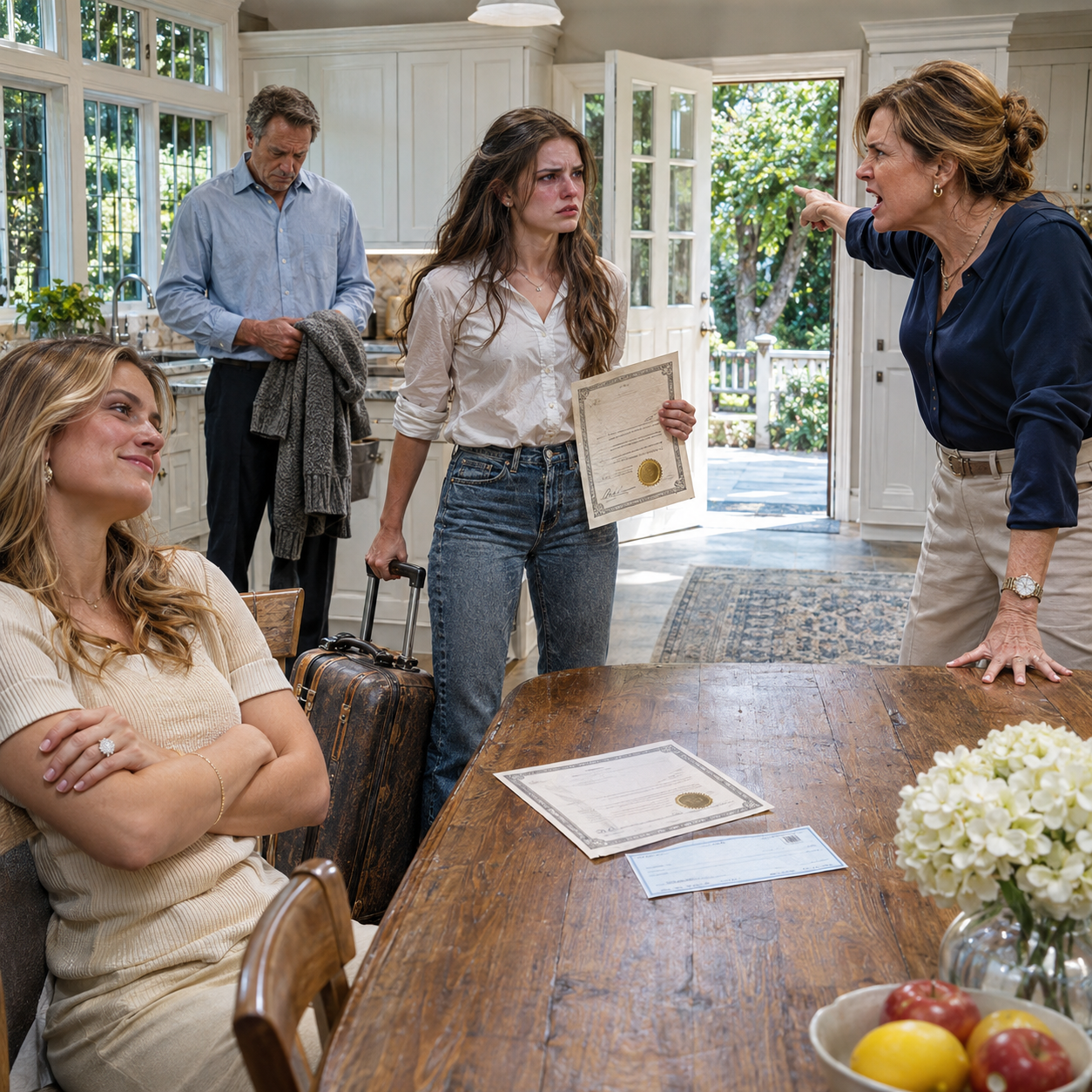
Ten years earlier, I had walked away from medical school at twenty-five because I knew I was pursuing someone else’s dream. My father, a respected attorney whose family included generations of physicians and surgeons, had watched me unpack my textbooks and demanded an explanation. When I told him I wanted to work in hospitality, he slammed his palm against the kitchen counter and said, “No daughter of mine is going to clean toilets for strangers. If you abandon medicine, you abandon this family.” My mother stood beside him, twisting her wedding ring, but she never asked why I was unhappy.
I took a housekeeping job at a modest hotel outside Atlanta and worked every shift the manager would give me. I changed sheets, scrubbed bathrooms, carried luggage, worked the front desk, and eventually learned how the business operated behind the scenes. Some nights, after fourteen hours on my feet, I slept in a storage room because the last bus had already left. While my relatives celebrated promotions and anniversaries over expensive dinners, I saved every dollar toward a future they refused to imagine.
Only my younger sister, Lena, believed I could build something worthwhile. She helped me prepare the paperwork for my first small-business loan and celebrated when I acquired a struggling boutique hotel in Savannah. Within three years, that neglected property had become a five-star destination, and the profits helped me acquire a second hotel, then another. Eventually, I founded Crescent Hospitality Group, which grew to fifteen properties across three continents, but my parents never asked what I had accomplished.
They still introduced me as the daughter who had dropped out of medical school to become a maid.
The final break came during Andrew’s engagement party at Cynthia’s house. I had privately warned my aunt about troubling public court records involving Andrew’s fiancée, including three lawsuits alleging embezzlement, but Cynthia accused me of trying to destroy her son’s happiness out of jealousy. She ordered me off her property while the entire family watched from the dining room. Months later, when the allegations became public and the engagement collapsed, nobody apologized; instead, they blamed me for having brought the matter up.
A soft knock interrupted my thoughts. My assistant, Janelle, entered carrying the quarterly revenue reports and confirmation that the Devo family’s Miami resort transfer had cleared its final review. “One more thing, Ms. Deloqua,” she said, placing a reservation folder on my desk. “The Deloqua reunion has been confirmed for Saturday evening in the Regency Ballroom, including the platinum champagne package. Your aunt is also requesting complimentary upgrades.”
I opened the folder and found Cynthia’s elegant signature beneath a reservation totaling more than most working families earned in several months. For weeks, she had posted photographs of the Crescent Regency online, boasting that her family would celebrate at Atlanta’s most exclusive address. She had no idea that the woman she considered a disgrace signed the hotel’s payroll and owned every chandelier above her banquet tables. “Should I prepare the final invoice?” Janelle asked.
“Not yet,” I replied, closing the folder.
Another notification appeared on my screen. Andrew had posted a photograph of the hotel entrance with the caption, “Some families are simply born for places like this.” I enlarged the picture until I could see the polished bronze dedication plaque mounted beside the enormous glass doors. Beneath the historic Crescent Regency name were five words my relatives had never bothered to discover: Natalie Deloqua, Owner and Founder.
I turned to Janelle. “Please tell James I need to see him. And make sure my family gets the grand entrance they’ve been dreaming about.”
“What should I tell him the occasion is?”
I looked at Cynthia’s message one final time before switching off my phone.
“Tell him,” I said, “the owner is coming to the family reunion.”
## Part 2: Behind the Ballroom Doors, I Prepared One Unforgettable Family Reckoning
James Chin, my head of security, entered my office twenty minutes later with his tablet tucked beneath one arm. He had worked beside me since my first little hotel, back when we fixed broken locks ourselves and sometimes carried luggage because there was nobody else available. When I explained Cynthia’s message, his expression hardened, but he waited until I finished speaking. “Are you asking me to keep them out,” he said, “or to let them discover whose building they’re standing in?”
“Both,” I answered. “But first, I want to understand exactly how they’ve been treating our employees.”
James opened the incident reports associated with my family’s previous hotel visits. Cynthia had repeatedly challenged legitimate charges and presented expired credit cards, while Andrew had demanded complimentary upgrades before insulting employees who refused. Uncle Victor had been barred from two hotel chains following complaints about his treatment of housekeeping staff. Reading those reports brought back the afternoons when my relatives had snapped their fingers at servers, left insulting tips, and spoken about service workers as though they were furniture.
My sister Lena called that evening, her voice trembling with anger. “Please tell me you’re not letting those people celebrate in your hotel after everything they said about you.” I told her about the reports and Cynthia’s elaborate plans, including hired photographers and an expensive champagne reception. Lena went quiet before asking, “Do they seriously have no idea how successful you’ve become?” I looked toward the acquisition portrait and answered, “They never cared enough to find out.”
James returned the following morning to discuss the reunion arrangements. Our event contracts permitted cancellation for documented misconduct, and I authorized refunds of the family’s prepaid charges so nobody could accuse the hotel of taking their money unfairly. I also asked him to preserve any security footage needed to document interactions with staff. “We’re not going to mistreat them,” I said, “but we aren’t going to reward them for mistreating anyone else.”
Then I gave him one final instruction about the ballroom.
“Remove the decorations, the banquet tables, and the flower arrangements. Leave one chair beneath the central spotlight.” James studied my face before asking whether I intended to confront all forty relatives at once. “They’ve spent ten years making me stand alone,” I replied. “For once, I want them to experience what that feels like.”
The next afternoon, Janelle told me several employees had volunteered to stay late for the event. One housekeeper, Maria, had heard Andrew making jokes about cleaning toilets and wanted to witness his reaction when he discovered who owned the hotel. I instructed Janelle to pay everyone their proper overtime and ensure that no employee was required to participate in the confrontation. I had built my business on respecting workers, and I refused to abandon that principle, even for the satisfaction of confronting my family.
Friday evening, I stood in my penthouse suite overlooking Atlanta as the last sunlight washed across the buildings. Lena called again, announcing that her camera was charged and she would be arriving early the following morning. She laughed about preparing to capture the expressions on everyone’s faces, but then her voice softened. “Natalie, they’re still our parents. Are you sure this is what you want?”
I opened my closet and pulled out a faded blue housekeeping uniform, carefully folded inside a protective garment bag. Its fabric had thinned with age, and a small embroidered name tag remained above the breast pocket. I remembered wearing it the night my father called and told me that Andrew had graduated from law school, then ended the conversation without asking how I was doing. “I don’t want to hurt them, Lena,” I said. “I want them to see the person they decided wasn’t worth knowing.”
After our call, I stood before the mirror and held the uniform against myself. There had been years when I couldn’t look at that clothing without remembering exhaustion, humiliation, and the constant fear of losing everything. Now I saw something different: the girl who kept showing up when nobody expected her to succeed. I pressed the uniform one last time and hung it beside my designer business suits.
Tomorrow, I would enter the most luxurious ballroom in Atlanta wearing the same clothes my family had used to define my failure.
And I would discover whether they could recognize success without its expensive disguise.
## Part 3: Forty Relatives Finally Discover Who Owns Their Luxurious Reunion Venue
Saturday morning arrived beneath a brilliant blue Atlanta sky, with sunlight pouring through the Crescent Regency’s towering glass entrance. I dressed in my old housekeeping uniform, pinned my original name tag over my heart, and placed a thick folder of documents beneath my arm. Inside were the family messages, records of their mistreatment of hotel employees, and certified ownership papers bearing the Crescent Hospitality Group seal. At nine-thirty, James called from the lobby.
“They’re arriving, Ms. Deloqua. Your aunt is already demanding early access to her suite.”
I opened the live security feed and watched Cynthia standing beside the marble fountain, dressed in an expensive cream-colored suit. Andrew hovered nearby, tapping furiously at his phone, while Uncle Victor argued with a front desk employee. My father entered wearing a tailored charcoal suit, followed by my mother, whose pearl necklace I recognized from a friend’s recent anniversary photographs. They looked exactly as they had ten years earlier: polished, confident, and certain that the world should accommodate them.
I sent a message to the family group chat. “I hope everyone enjoys the Crescent Regency. The service here really is exceptional.”
Cynthia responded almost immediately. “How would you know? They probably wouldn’t even let you through the front doors.” Andrew followed with, “Go back to scrubbing toilets, Natalie,” and my mother added, “Please stop trying to make today about yourself.” I stared at her words, feeling an old ache spread through my chest, before closing the conversation and calling James.
“Begin with the reservations,” I said.
At the front desk, the manager calmly informed Cynthia that her room reservation had been canceled and her prepayment refunded. The same information was provided to the other relatives whose reservations had been affected, along with the explanation that the hotel would not accommodate previously documented abusive conduct. Cynthia’s face turned crimson as she demanded to speak with the owner, and Andrew threatened to publish a devastating review. My father announced that he would involve his attorneys, only to receive a courteous reminder that the hotel had its own legal counsel.
Cousin Victoria began crying when she discovered that the suite she planned to use for changing into her evening gown was unavailable. Uncle Victor insisted the cancellation was a personal insult to the entire Deloqua family. James approached them with his usual composure and said, “The owner has arranged to address your concerns in the Regency Ballroom.” Cynthia straightened her jacket, apparently believing she had finally frightened someone into providing special treatment.
I watched them follow James through the ornate double doors.
The moment the doors opened, their voices fell silent. The ballroom’s enormous chandeliers were dimmed, its polished floor stretched empty beneath the vaulted ceiling, and a single chair stood in the center of a bright circle of light. There were no champagne towers, no gold-trimmed tables, and no floral arrangements waiting for their guests. Cynthia spun toward James and demanded, “What kind of disgraceful joke is this?”
“No joke, Mrs. Deloqua,” James replied. “The owner wishes to speak with you.”
I stepped into the ballroom carrying the folder.
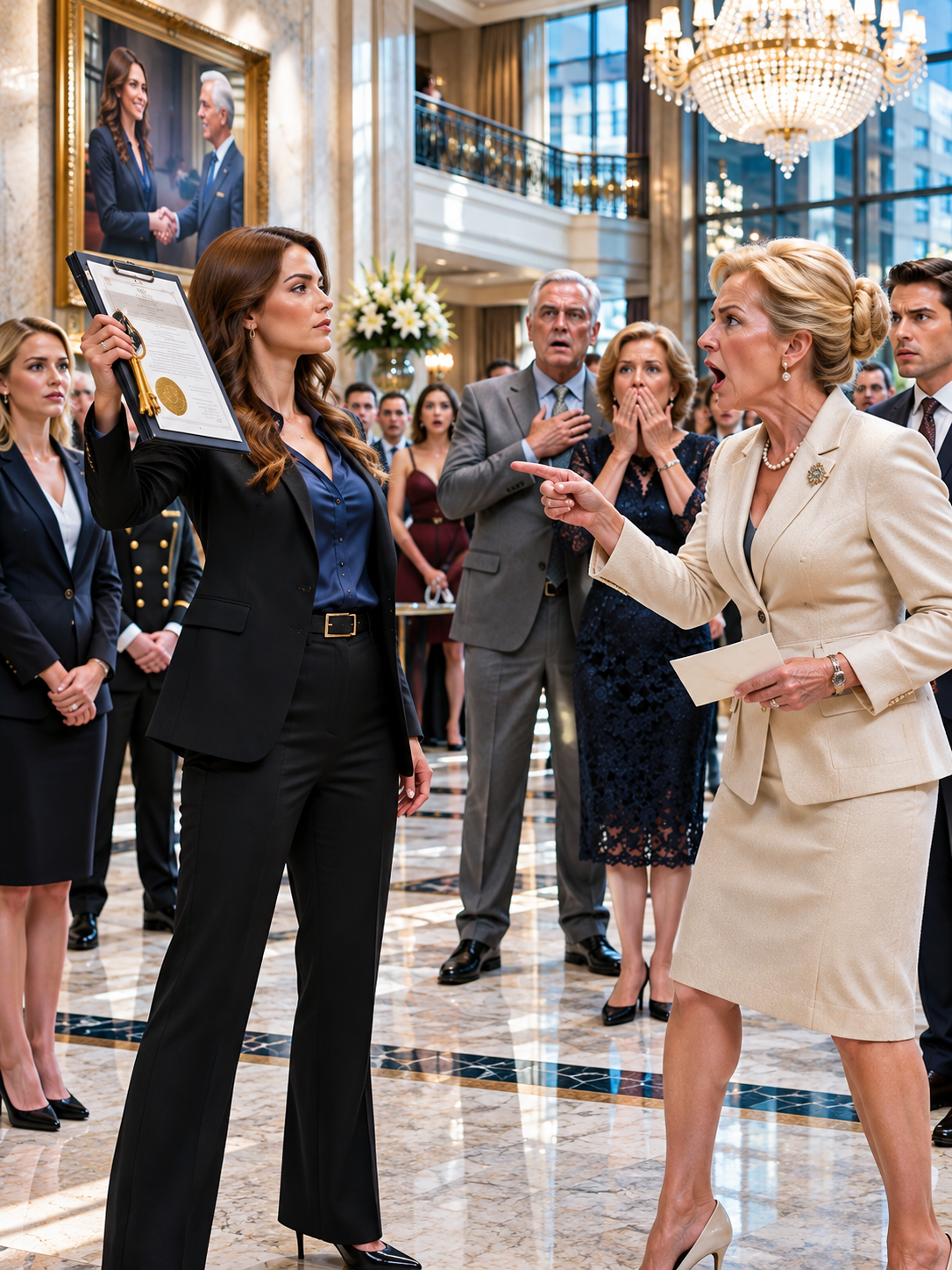
Forty faces turned toward me, and for several seconds nobody spoke. Andrew looked down at my uniform and burst into a nervous laugh, while my mother pressed a hand against her pearl necklace. My father’s expression darkened as he demanded, “Natalie, what are you doing here dressed like that?” I walked toward the spotlight, stopping beside the empty chair.
“Dressed like what, Dad? A housekeeper? Someone whose work embarrasses you?”
Cynthia stepped forward, pointing toward the doors. “This is a private family event, Natalie. We specifically told you not to come.” I placed the folder on the chair and looked directly into her eyes. “Actually, Aunt Cynthia, this is a privately owned hotel, and you’ve been requesting an audience with the owner all morning.”
I opened the folder and lifted the first document, allowing the gold corporate seal to catch the light. “Ten years ago, you told everyone I was throwing away my future by working in hotels. Five years ago, when I bought my first luxury property, nobody bothered to ask what I did for a living.” I turned the document toward them, showing the ownership registration and my signature. “Today, I own the Crescent Regency and lead Crescent Hospitality Group, with fifteen properties across three continents.”
Andrew’s laughter stopped.
My mother shook her head, whispering, “That can’t be possible.”
I handed the document to my father, whose legal training made him examine the signatures and corporate information almost automatically. His eyes moved across the page twice before his hand began to tremble. He recognized the acquisition details, the registration, and the company seal. When he finally looked up, his face had lost its color.
“Two hundred and eighty million dollars?” he whispered.
“That was the acquisition price for the Crescent brand,” I answered. “I bought it after building everything from the ground up.”
Cynthia reached for the chair as though her legs could no longer support her. “Then why didn’t you tell us?” she demanded, her voice cracking. I looked around the room at the same relatives who had laughed when I was excluded from holidays, weddings, and graduations. “Because you never asked,” I replied. “You decided my life was worthless before you knew what I’d made of it.”
I opened the second section of the folder and read aloud the messages Cynthia and Andrew had sent that week. Then I explained the complaints documented by hotel employees, the canceled reservations, and the refunds already issued. Andrew protested that his friends were expecting a grand celebration, but I refused to make the staff absorb another evening of insults. “You wanted this hotel because you believed it represented prestige,” I said. “I built it to represent something else: excellence without cruelty.”
My father stepped toward me, his eyes shining. “Natalie, please. We can discuss this privately.”
I remembered standing in his kitchen, holding my suitcase while he told me I was no longer welcome in the family. “I tried to discuss my future with you ten years ago,” I said quietly. “You told me I had no future worth discussing.”
James moved toward the entrance with his security team, and I told the family that the reunion would not take place at the Crescent Regency. Nobody was threatened or touched, but the protests that followed were loud enough to echo through the empty ballroom. Cynthia demanded reimbursement for the decorations she had ordered independently, while Andrew insisted that I had deliberately humiliated everyone. I let them speak until their anger exhausted itself, then asked James to escort them to the lobby.
Outside, the afternoon sun illuminated the massive stone archway above the hotel’s entrance. As the family gathered near the waiting cars, my father stopped in front of the bronze dedication plaque and read the inscription. He raised his fingers toward the engraved letters, tracing the name he had once said would never amount to anything. My mother stood beside him, staring at the same words.
Natalie Deloqua, Owner and Founder.
For the first time in ten years, my father had nothing to say about what I should have become.
## Part 4: My Father’s Last Offer Reveals the Truth About Success
When the ballroom doors finally closed, Lena emerged from a discreet corner near the entrance with her camera hanging against her chest. She had recorded the confrontation, with my permission, but the excitement on her face disappeared when she saw me standing alone beneath the spotlight. “That was unbelievable,” she whispered, touching my shoulder. “But are you okay?” I looked at the empty chair, remembering all the family celebrations where my absence had been treated as a convenience.
“I thought I’d feel happier,” I admitted. “Instead, I just feel finished.”
That evening, I changed into my usual navy silk blouse and tailored blazer before returning to the executive floor. My phone filled with calls, accusations, and sudden apologies, many from relatives who had never once congratulated me on a business accomplishment. Cynthia insisted I had ruined the family name, while Andrew claimed I had destroyed his reputation in front of his friends. My mother’s voicemail was different; she asked why I had never told her how far I’d come, then fell silent before admitting, “I suppose we never gave you much reason to.”
The following morning, local society pages began reporting that a prominent Atlanta hotel owner had canceled her own family’s reunion following allegations of disrespectful treatment toward service employees. The story spread when business reporters connected my name to Crescent Hospitality Group’s acquisition history. One headline described a former housekeeper who had become a luxury hospitality executive, while another focused on the unusual circumstances surrounding the canceled gathering. I declined interviews about my relatives, directing every reporter instead toward our employee development programs.
A week later, an envelope arrived at my office without a return address. I recognized my father’s handwriting immediately and opened it beside the same window where I’d first received Cynthia’s message. Inside was a formal letter printed on the stationery of Deloqua, Carr & Keene, the law firm my family had operated for generations. It offered me a prestigious position as a named partner, with an advisory role and a generous financial arrangement if I agreed to join the family business.
I read the offer twice, unable to decide whether to laugh or cry.
My father knew I wasn’t an attorney, and no amount of money could turn me into one without the required qualifications. His offer was carefully structured around business development rather than practicing law, but the meaning was unmistakable. Now that I had become wealthy and influential, the family that once disowned me wanted my name displayed alongside theirs. They had finally discovered something I could contribute, and they assumed I would be grateful for the invitation.
Then I noticed the firm’s office address printed beneath the letterhead.
Deloqua, Carr & Keene occupied three floors of the historic office tower adjoining the Crescent Regency. That building had been included in my hotel acquisition, although its commercial leases remained under a separate property-management company. For eight months, my father’s firm had been paying rent to a subsidiary of Crescent Hospitality Group without realizing that his supposedly unsuccessful daughter owned the property. He was offering me a place in a business that already operated beneath my roof.
I called Janelle and asked her to bring me a copy of the office-tower lease. When she placed it on my desk, I studied my father’s signature beside the corporate name that connected his rent payments to my company. The irony was almost unbearable, but I felt no desire to punish him through his lease. I had spent too many years working for people who possessed power without understanding responsibility.
Instead, I returned his letter with a photograph of my original housekeeping uniform and a handwritten note.
“Thank you for the offer, Dad. But I don’t need a place in your firm to prove that I belong somewhere. I prefer building businesses, owning properties, and creating opportunities for people who are willing to work. Your lease remains unchanged. I hope someday you’ll understand why that matters.”
I mailed the envelope myself.
Over the following months, the Crescent Regency continued growing, attracting guests who valued both its beautiful surroundings and the respect shown by its employees. I established a leadership development program for workers beginning in housekeeping, maintenance, food service, and front-desk positions. Maria, the housekeeper who had once been mocked by Andrew, became one of the program’s first management trainees. Watching her accept the promotion reminded me more clearly of my own success than any expensive acquisition photograph ever could.
Lena visited one evening after the hotel’s annual employee celebration. We walked through the quiet lobby, passing the polished fountain and the enormous windows overlooking downtown Atlanta. She stopped beside the bronze plaque and said, “You know, Mom asked me whether you’d ever come to dinner again.” I considered the question before answering, “Maybe someday, when they want me there because I’m Natalie, not because I own the building.”
Several weeks later, my father sent a handwritten card with no business proposal inside. It contained only three sentences: “I was wrong about your work. I was wrong about your future. I’m sorry I made you feel that my love depended on the path you chose.” I placed the card in my desk drawer without replying immediately, because some wounds deserve more than a hurried reconciliation. For the first time, however, his words sounded less like negotiation and more like regret.
Late one night, after the final guests had checked in, I took my old uniform from its garment bag and walked through the hotel corridors. I passed the housekeeping closets, the laundry room, and the service elevators where employees worked long after the chandeliers went dark. I remembered being twenty-five, exhausted and frightened, wondering whether my family might be right about the mistake I’d made. I wished I could reach backward through those years and tell that young woman to keep going.
When I reached the entrance, I stopped beneath the gold lettering and looked at my reflection in the glass. I had once believed that success would mean forcing the people who rejected me to admit they were wrong. But the greatest satisfaction had come from something quieter: knowing that my accomplishments were real, whether anyone in my family acknowledged them or not.
I touched the old name tag pinned above my heart and smiled.
The woman who cleaned hotel rooms and the woman who owned the hotel had always been the same person.
My family simply hadn’t known how to see her.
THE END.
All characters and events in this story are fictional, created for storytelling and entertainment purposes. Thank you sincerely for reading. Your feedback and support are invaluable and motivate me to continue sharing more stories with you.