Part 2: Hospital Records And Wedding Witnesses Challenge My Sister’s Excuses
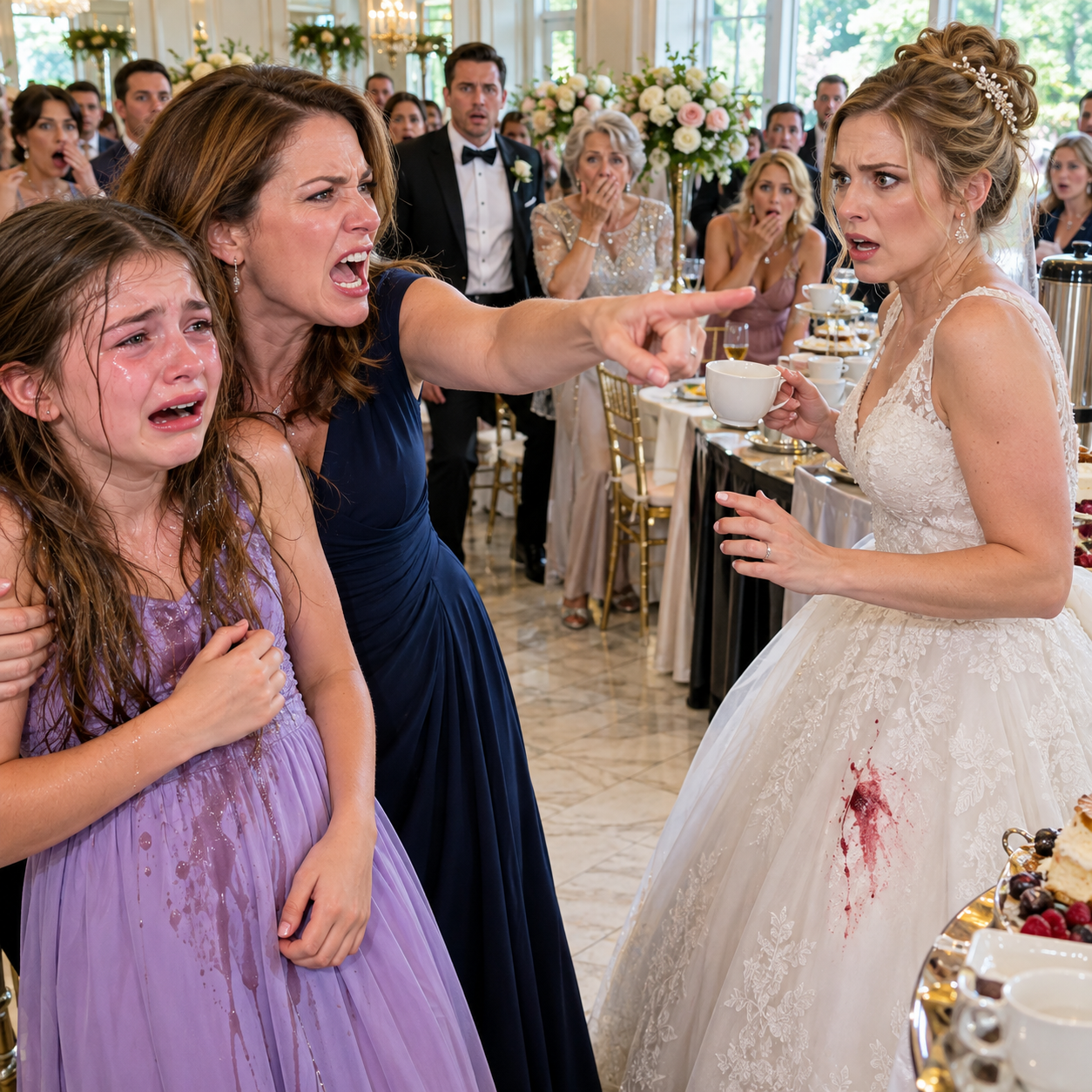
We returned home shortly after midnight. Lily fell asleep on the couch wearing one of my old cotton shirts, with a folded towel beneath her injured shoulder. I sat at the kitchen table with her discharge papers, a medication schedule, and my phone. Rebecca had sent six messages, each one more concerned about how people were describing the incident than about Lily’s condition.
Her final message read, “Please don’t tell everybody I attacked her. I threw a little cider, not the cup. There’s a difference.”
I photographed the message and placed my phone facedown. I wasn’t interested in arguing over words while my daughter slept in pain. Instead, I called the country club and asked for the event manager. A man named Daniel Foster answered, listened carefully, and promised to send the beverage ingredients and preserve any relevant incident reports.
The next morning, Daniel emailed the catering sheet. The drink was a mulled apple-and-pear cider containing cinnamon, cloves, citrus, and bourbon, served from a heated dispenser. His message confirmed that staff had been instructed to warn guests that the beverage and mugs were hot. He also explained that an incident report had been completed after our departure.
I forwarded the ingredient list to Dr. Brooks through the hospital’s patient portal. She responded that the heat remained the main cause of concern and that Lily should continue her prescribed care. Her reply included instructions about watching for infection, protecting healing skin, and attending a follow-up appointment. I printed everything and placed it in a folder, not because I was planning a fight, but because I couldn’t afford to forget any detail.
Mom called while I was preparing scrambled eggs for Lily. “Rebecca hasn’t stopped crying,” she began, and I could hear dishes clattering in her background. I asked whether my sister had been crying before or after she learned that Lily had second-degree burns. Mom hesitated, then said, “You know Rebecca. She does things without thinking when she’s embarrassed.”
I set the spatula down. “She threw a hot drink at a child, Mom.” My mother acknowledged that it was terrible, but immediately asked whether we could discuss the matter privately before people formed opinions. I told her Lily’s recovery mattered more than the reputation of anyone at the wedding. Mom sighed and said she was only trying to prevent another family tragedy.
Lily came downstairs halfway through the conversation, moving carefully because the dressing pulled against her shoulder. After breakfast, she asked whether Grandma was angry with us. I told her no, but she kept staring at the kitchen window. Finally, she admitted Rebecca had been making unpleasant comments throughout the reception, including remarks about her dress and how she smiled in photographs.
“Why didn’t you tell me?” I asked. Lily picked at the corner of a paper napkin and said she didn’t want me arguing with my sister at her wedding. I remembered telling Lily countless times to ignore Rebecca’s comments because that was simply how her aunt behaved. I apologized for treating her discomfort like something she was supposed to manage alone.
Two days later, Daniel called again. He’d spoken with a server who remembered Rebecca sampling the cider before dinner and commenting that it was hotter than expected. Another employee recalled seeing her take a freshly poured mug immediately before the incident. Daniel carefully distinguished their recollections from what he’d personally witnessed, and I appreciated that he didn’t try to make the evidence more dramatic than it was.
Rebecca called that evening. She began by asking how Lily was doing, then quickly explained that she’d been exhausted, humiliated, and under enormous pressure. When I mentioned the warnings about the cider, she insisted she’d barely paid attention to the servers. “I wasn’t standing there calculating how hot something was,” she said. “I lost my temper for one second.”
“Did you know it was a hot drink?” I asked. She didn’t answer immediately, and I could hear traffic outside wherever she was standing. Finally, she said, “I knew it was warm. I didn’t know it could burn her.”
I told her there was a difference between not intending the exact injury and not intending to throw the drink. She began crying, saying I was making her sound like someone who hated her niece. I reminded her that Lily had apologized for the cake before anything else happened. Rebecca said, “I know,” so softly that I almost missed it, then asked whether I could convince Thomas that she hadn’t done it deliberately.
That request explained why she had called. I said I wouldn’t discuss their marriage, and she ended the conversation without asking whether Lily needed anything.
Thomas contacted me the following afternoon. He wanted to apologize for remaining at the reception after we’d left, and he offered to pay the medical bills. When I asked why he’d stayed, he admitted Rebecca had begged him not to leave during the photographs because it would create more questions. He said he’d argued with her later, when she described throwing the cider as a harmless reflex.
“People don’t accidentally reach for a mug and aim it at someone’s face,” he said. His voice cracked slightly, and he apologized again for failing to leave with us. I told him I appreciated his concern, but Lily deserved something more than adults feeling guilty afterward.
That weekend, Mom came by with groceries. She found Lily working on homework at the dining room table, carefully positioning her notebook so her injured arm could rest. For once, my mother didn’t mention Rebecca immediately. She asked Lily about school, checked whether she wanted help carrying her books, and listened when Lily described how embarrassed she felt about returning with visible marks.
After Lily went upstairs, Mom showed me a photograph someone had sent her from the wedding. Rebecca stood beside Thomas beneath a flower-covered arch, smiling beautifully while the photographer had positioned her stained side away from the camera. My mother studied the picture before slipping her phone into her purse. “She’s always been frightened of looking foolish,” she said.
I asked whether that was supposed to excuse what happened. Mom shook her head and told me about a conversation she’d had with Rebecca earlier that day. My sister had accused the family of turning against her, and Mom had finally asked why Lily was expected to protect Rebecca from the consequences of her own behavior.
“I’ve never asked her that before,” Mom admitted. She rubbed her thumb against her wedding ring, which she still wore years after Dad’s death. “I think I’ve spent too many years telling you to forgive things because I didn’t know how to make your sister stop doing them.”
A few days later, a representative handling the country’s club’s incident documentation contacted me to request a written account. I provided the hospital records, relevant messages, and a factual description of what I’d witnessed. I included the accidental cake stain, Rebecca’s anger, and the drink she intentionally threw. I did not claim she intended to cause the particular burns Lily suffered.
When Rebecca learned I had submitted the documents, she sent one last message: “I thought being sisters meant protecting each other.”
I typed a reply, read it twice, and sent it. “Lily thought being your niece meant she would be safe around you.”
Part 3: A Mother’s Difficult Choice Restores Her Daughter’s Sense Of Safety
The following weeks were filled with appointments, dressings, homework, and the ordinary business of keeping a household running. Lily’s doctor was pleased with her progress, although some discoloration remained and the possibility of lasting scars couldn’t yet be ruled out. Lily began wearing loose-necked shirts and avoiding the bathroom mirror when she changed. I tried not to hover, but I kept fresh supplies beside the sink and checked her medication schedule more often than necessary.
Then Rebecca asked to see me. She suggested meeting at Mom’s house, where we’d spent countless Sunday afternoons pretending old disagreements had never happened. I agreed to speak with her, provided Lily wasn’t present and nobody expected an immediate reconciliation. Mom made coffee, placed three mugs on the kitchen table, and left the sugar bowl exactly where Dad used to keep it.
Rebecca arrived without makeup, wearing jeans and an oversized sweater. She looked thinner, with dark circles under her eyes, and she avoided sitting in her usual chair near the window. For several minutes, she talked about Thomas sleeping in their guest bedroom, her colleagues asking uncomfortable questions, and how one terrible moment had overshadowed a wedding she’d worked so hard to create. I listened until she finally looked at me.
“Do you understand how humiliating this has been?” she asked.
I reached for my coffee but didn’t drink it. “Lily has been afraid to let her classmates see her shoulder.” Rebecca looked down at the table, and Mom quietly told her to listen. My sister pressed her fingers against her forehead and began describing how helpless she’d felt watching the raspberry filling spread across her dress.
She explained that she’d paid for most of the wedding herself and felt judged by everyone, including Thomas’s wealthy relatives. She’d spent the entire day afraid some detail would expose her as less polished than she wanted to appear. “And then everybody was looking at me like I couldn’t even keep my own wedding under control,” she said.
I could understand her embarrassment without accepting what she’d done. I reminded her that Lily was thirteen, that the stain could have been cleaned, and that nobody had been trying to make her look foolish. Rebecca stared toward the backyard for a long time before admitting that she’d known the cider was hot. She said she hadn’t stopped to consider how badly it could hurt Lily.
“I wanted her to feel as embarrassed as I felt,” she whispered. “For about two seconds, that was all I cared about.”
Mom covered her mouth with one hand. Rebecca began crying, but this time she didn’t ask us to comfort her or reinterpret the event. She said she’d been telling herself the whole thing was an accident because she couldn’t bear to acknowledge that she’d deliberately humiliated and frightened her niece. The burns had been unintended, but the throwing hadn’t.
I told her those were the words she needed to say in her written account, not merely in Mom’s kitchen. Rebecca nodded and said she’d already consulted an attorney about the incident and how to respond truthfully to the questions being asked. She also offered to cover Lily’s medical expenses, including any follow-up treatment. I told her our family would keep that arrangement separate from whether Lily ever wanted to see her again.
Rebecca looked toward the hallway where we’d once measured our heights against the doorframe. “Does she hate me?” she asked. I told her Lily was hurt, frightened, and confused, and that those feelings didn’t need to be translated into either hatred or forgiveness. For the first time during the conversation, Rebecca accepted an answer without trying to change it.
The formal follow-up continued for several weeks. Rebecca provided her own account and acknowledged that throwing the drink had been intentional, while the available medical and witness records remained part of the investigation. I didn’t control the process or pretend to know its eventual legal outcome. Through her attorney, Rebecca arranged reimbursement of Lily’s documented medical expenses and agreed to cover additional related treatment costs.
Thomas moved into a short-term rental while he and Rebecca considered their marriage. Mom stopped passing messages between us, and family gatherings became smaller and less predictable. Some relatives avoided discussing the wedding altogether. Others quietly admitted they’d witnessed Rebecca’s behavior for years but hadn’t imagined it would end with a child being injured.
One afternoon, Mom came over while Lily was doing a puzzle in the living room. She asked whether she could speak to her granddaughter privately, and Lily looked at me before agreeing. I remained in the kitchen, close enough to hear Mom apologize for worrying about the wedding instead of concentrating on Lily’s safety. She admitted she’d made excuses for Rebecca and had asked Lily’s mother to keep the peace when she should have been offering help.
Lily spent several seconds fitting two puzzle pieces together. “I thought Grandma was mad because we left,” she said. Mom told her she had every right to leave and that nobody should ever have asked her to stay. Lily nodded, and after a moment she moved over on the couch so Mom could sit beside her. They finished the border of the puzzle together without discussing Rebecca again.
By early spring, Lily’s burns had healed, although faint pink areas remained near her collarbone and cheek. Her doctor recommended continued skin protection and monitoring, and Lily slowly stopped arranging her hair to cover the marks. She began spending afternoons with friends again, returning home with muddy sneakers and stories about teachers who assigned too much homework. Seeing those ordinary complaints return felt more reassuring than any dramatic declaration could have.
Rebecca wrote Lily a letter. She didn’t mention the price of her dress, the pressure of the wedding, or how miserable she’d been afterward. Instead, she acknowledged that she’d thrown a hot drink because she was angry, recognized that Lily had done nothing to deserve it, and said she would respect whatever distance Lily needed.
I read the letter first and gave Lily the choice of whether to open it. She took it upstairs, where it remained on her desk for almost a week. When she finally read it, she asked whether she had to answer. I told her she didn’t owe her aunt a response, and Lily placed the letter inside the drawer where she kept birthday cards and old photographs.
A month later, Thomas called to say he and Rebecca had started marriage counseling, although they were still living apart. He asked how Lily was doing and listened when I described her latest science project. Before hanging up, he said Rebecca was beginning to understand that being ashamed of an action wasn’t the same as taking responsibility for it. I hoped he was right, but I no longer felt obligated to find out immediately.
One Saturday morning, Lily and I were getting ready for a trip to the botanical gardens. She came downstairs wearing a sleeveless yellow top, the first one she’d chosen since the wedding. The faint marks on her shoulder were visible, and she stood in front of me with her arms slightly away from her sides. “Does it look okay?” she asked.
I told her she looked comfortable and asked whether that was how she felt. She considered the question before nodding. Then she surprised me by asking whether I missed Aunt Rebecca.
“Sometimes,” I admitted. Lily leaned against the kitchen counter and said she missed the aunt who used to teach her card tricks and bring her funny souvenirs from business trips. She didn’t miss the woman who’d shouted at her over a dress. I told her both memories could belong to the same person, and she didn’t have to decide what their relationship would look like for the rest of her life.
She picked up her sunglasses and followed me toward the front door. Outside, the morning sunshine fell across the driveway, and Lily paused to pull her hair into a ponytail without checking whether it covered her cheek. I watched her settle into the passenger seat, already talking about the butterfly exhibit and whether we could stop for ice cream afterward.
Before starting the car, I thought about all the times I’d asked my daughter to tolerate something uncomfortable simply because the person causing it was family. I couldn’t undo those lessons, but I could give her something better from now on: the freedom to say when someone had hurt her, the confidence that I would believe her, and the knowledge that protecting herself did not make her responsible for someone else’s unhappiness.
Lily tapped the dashboard gently. “Mom, are we going? The butterflies aren’t going to wait all day.”
I smiled, started the engine, and drove us toward a place she’d chosen for herself.
The End .
All characters and events in this story are fictional, created for storytelling and entertainment purposes. Thank you sincerely for reading. Your feedback and support are invaluable and motivate me to continue sharing more stories with you.