## Part 2: Fifty-Four Photographs Expose The Lies Behind My Mother’s Plan
Back at my house in Whitesboro, I opened the garage and stood looking at everything I’d spent four freezing hours loading. I wasn’t going to damage my parents’ belongings or hold them hostage. I cleared one entire side of the garage, spread moving blankets across the concrete, and unloaded everything myself. Then I labeled every box with blue painter’s tape, photographed each piece of furniture, and took one final picture of the entire collection: 54 photographs proving that nothing had been damaged.
By two o’clock, I had eleven missed calls. Mom demanded that I turn around, Aaron accused me of stealing, and somebody claimed Dad wouldn’t have a bed that night. I sent both women the photographs and one message: “Everything is safe in my garage. You can collect it evenings or Saturday. Bring your own help. I’m finished moving it.” Aaron immediately replied that Chance had a bad back, and I told her he’d better be careful.
That evening, Maren arrived with tacos and found me sitting beside Dad’s recliner. She read the accidental text twice before looking up. “She was going to wait until you finished everything?” I nodded, and she sat beside me without offering another excuse for my mother. When she asked about Christmas, I told her we had plenty of room at my house, and for the first time that day, she smiled.
At 8:30, Chance called and announced that keeping the furniture was theft. He threatened to contact the sheriff, so I told him I’d leave the porch light on. Forty-five minutes later, Deputy Pasco pulled into my driveway, his gray mustache dusted with snow. He inspected the carefully labeled boxes, read Mom’s message, and studied the photographs I’d sent her. Then he called my mother on speakerphone and explained that her belongings were safe, available for collection, and that this was a family disagreement rather than a police matter.
Mom insisted I’d taken everything deliberately. “Yes, ma’am,” the deputy answered. “I’ve seen the reason, too.” After hanging up, he examined the label on Grandma Stella’s china hutch, smiled faintly, and told me not to stack anything on it. When his cruiser disappeared, I felt neither victorious nor relieved. For the first time, I understood how far my family would go to make my refusal look unreasonable.
That night, my parents slept at Aaron’s rental house in Clinton. My sister sent a photograph of Dad on a pullout couch, his feet hanging over the end, accompanied by the words, “Hope you’re happy.” The picture hurt more than anything Mom had written. I nearly called to apologize, but stopped when I realized Dad hadn’t accused me of anything.
Thursday afternoon, Dad’s old Buick appeared in my driveway while I was cutting tile for Mrs. Waznjak’s backsplash. He walked slowly into the garage, lowered himself into his recliner, and asked to see the message. After reading it twice, he removed his glasses and rubbed his eyes. “Your mother told me you offered to move everything as our Christmas gift,” he said. “She told me you volunteered before I called you.”
I stared at him. “Dad, I never offered. I agreed because you asked.” He nodded slowly, then told me Mom had also claimed I was spending Christmas with Maren’s family in Binghamton. “Her family lives in Syracuse,” I replied, and his expression changed. When I asked about the mysterious basement apartment, he finally told me what everybody else had been hiding.
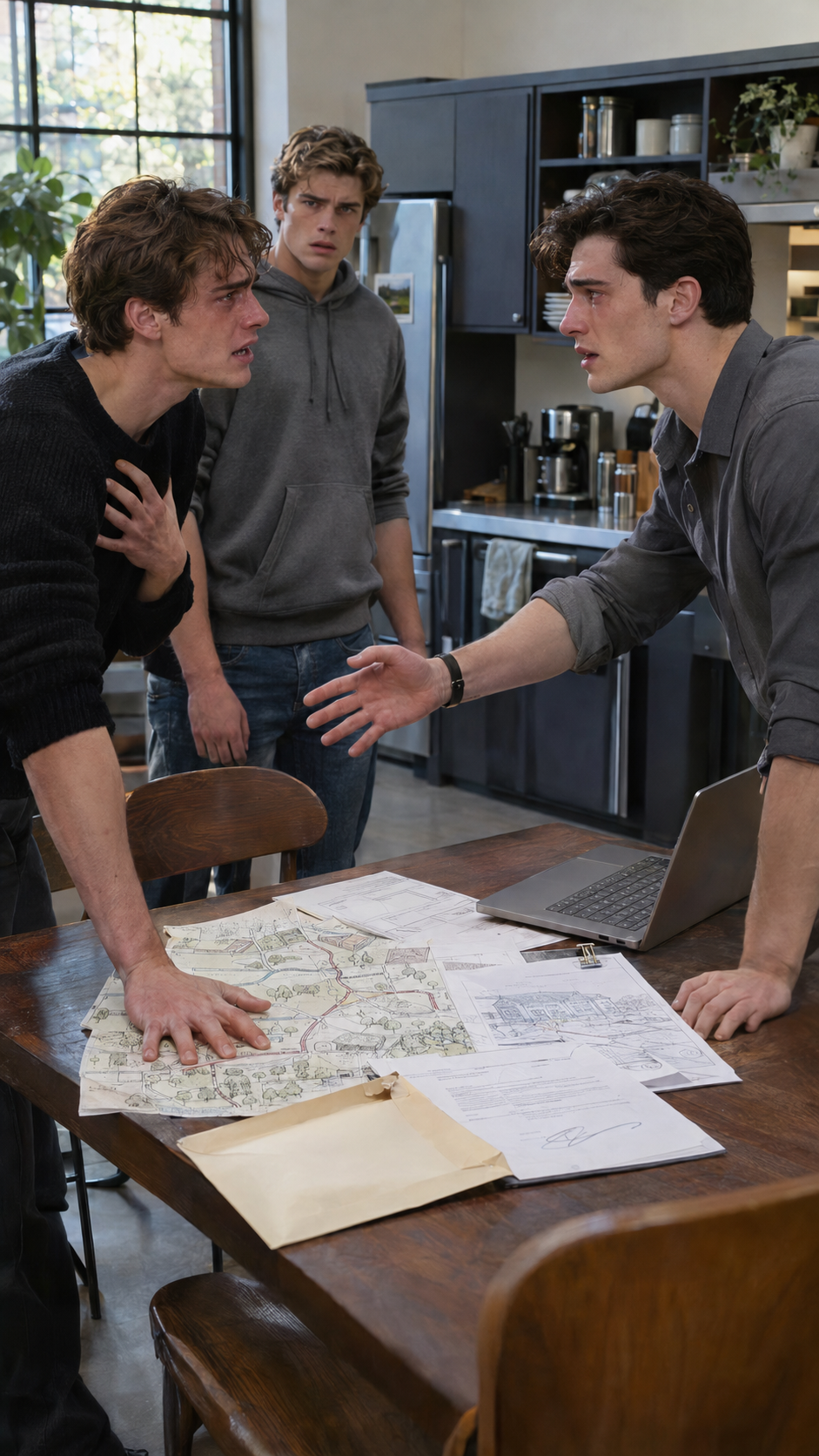
Chance’s lawn and snowplowing business had collapsed in August after a competitor from Rome took his contracts and the bank repossessed two mowers. Aaron and Chance couldn’t afford their Clinton rental when the lease expired December 31, so they were moving into my parents’ basement with the children. Mom had promised Dad the arrangement would last only until spring, and she wanted Chance’s parents to believe their son had sold his business profitably and was taking the winter off. Christmas was supposed to be their perfect family celebration, with Aaron’s family downstairs and Chance’s parents visiting, while I quietly disappeared.
Dad stared at the concrete floor. “I thought you knew about all this, son.” I looked at his swollen knees and the recliner that belonged beside his bedroom window. Instead of arguing, I picked up my work gloves and began loading the van again. This time, I took his bed, dresser, alarm clock, coffee maker, and chair, leaving Mom’s belongings behind.
Forty minutes after arriving in New Hartford, I had Dad’s bedroom assembled and his recliner beside the living room window. Mom followed me silently until I reached the door. “You’ll bring your father’s things, but not mine?” she demanded. “Dad asked me to help,” I answered. “You asked me to disappear.” She insisted the text had been private, but stopped speaking when Dad stepped into the hallway.
That night, Dad thanked me in a text, then asked whether I could help clear the old garage and basement before Friday’s closing. I knew there were decades of tools, boxes, and appliances still waiting. I also knew Chance had a perfectly usable trailer. I wrote, “Not for them, Dad. When it’s your move, call me. I’ll be there.”
Dad replied, “Okay.”
He put a period after it, just like always.
## Part 3: A China Hutch Brings Two Families’ Secrets Into Daylight
Friday morning, I returned to a bathroom floor job in Yorkville, grateful to be working for someone who appreciated me. At 10:40, Dad texted that Chance had arrived at the farmhouse with a borrowed trailer. Soon another message appeared: Aaron was carrying the lamps, and Chance had just hauled the washing machine up fourteen basement steps. “His back looks fine,” Dad added, and I laughed so loudly that my customer came to check on me.
By 11:52, the farmhouse was empty. At 12:03, the Lockwoods, a young couple expecting their first baby, received the keys. Dad said the woman cried when she walked into the kitchen, and I felt an unexpected ache knowing I hadn’t been there to say goodbye to my childhood home. Still, that house belonged to their future now, and I was finished sacrificing mine to keep everybody else comfortable.
Saturday morning, Aaron called to announce that she, Mom, and Chance would collect everything from my garage. She wanted help because Chance’s parents were visiting the new house that afternoon, and Mom needed everything arranged before they arrived. I told her I’d be working, but the garage would be open. At 9:40, they pulled up with Aaron’s minivan and Chance’s borrowed utility trailer.
Mom stepped out wearing her good winter coat and church boots, staring at the furniture as if I’d scattered it across the lawn. Aaron began loading boxes while Chance carried the lamps, then stopped beside Mom’s heavy dresser. “Give me a hand, bud,” he said. I kept working at my tile saw. “Sorry. Bad back, remember?” He glared, but he and Aaron carried it out together.
When they reached Grandma Stella’s china hutch, I made them remove every dish before lifting it. Aaron wrapped the plates carefully in newspaper while Mom watched from beside the minivan. Then an old blue Chevrolet hauling a stock trailer pulled into my driveway. Chance went pale when he recognized the driver: his father, Cass Casser, a dairy farmer from outside Waterville.
Cass climbed out wearing a weathered barn coat, followed by his wife, Ruth, carrying her usual homemade coffee cake. They’d arrived early for their visit and decided to help with the last load. Cass greeted me warmly, then glanced at Chance struggling beside the hutch and asked why I wasn’t helping. Before I could answer, Mom stepped forward with the practiced smile she used whenever she wanted an uncomfortable subject to disappear.
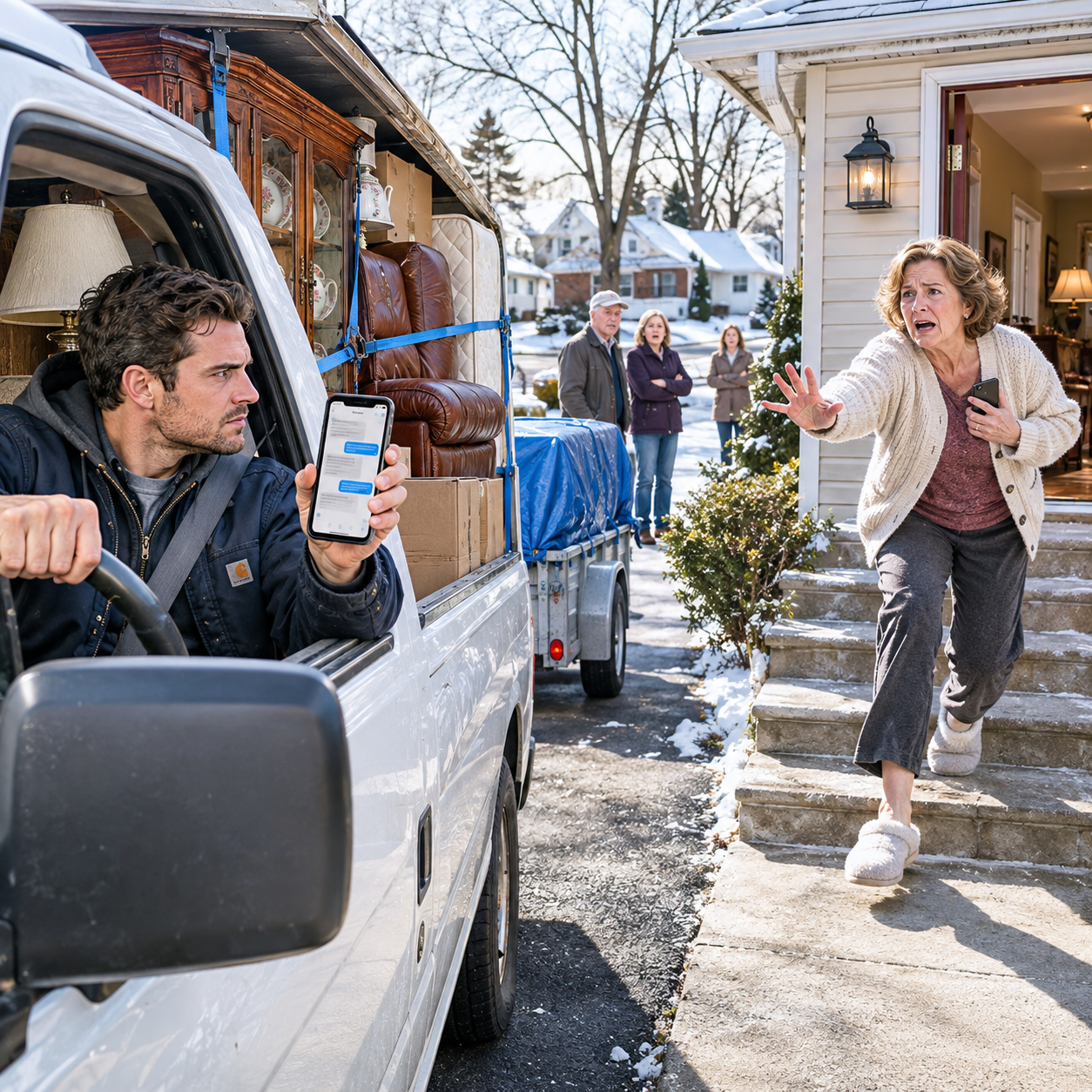
“Oh, it’s a silly misunderstanding,” she said. “I accidentally texted Neil that I wanted him finished moving before Aaron’s family moved into our basement. He took it personally and drove away with the furniture.” She gave a little laugh, expecting everybody to join her. Nobody did.
Ruth slowly lowered the coffee cake. “Aaron’s family is moving into your basement?” she asked. Mom’s smile froze, and Chance carefully set down his end of the hutch. Cass turned toward his son, looking bewildered. “Why would you need to live there? You told us you sold the business.” Chance stared at his boots before admitting that the business had failed, the bank had taken his equipment, and their lease was ending.
Ruth covered her mouth. “Since August? We’ve been telling people at church how well you were doing.” Aaron’s face tightened as she turned toward Mom. “You said you’d handle Neil. You promised he wouldn’t find out about the basement until New Year’s.” Mom snapped at her to be quiet, then turned on me with tears gathering in her eyes. “See what you’ve done?”
I switched off my saw and walked toward her. “I didn’t tell these people anything, Mom. I packed your furniture, protected Grandma’s china, and brought Dad his bed.” I pointed toward the boxes still waiting to be loaded. “You didn’t send that message to the wrong child. You just didn’t mean for me to read it.”
For once, Mom had nothing to say.
Cass removed his cap and looked directly at Chance. He said their farmhouse had four bedrooms, three of them empty, and there was plenty of space for Aaron and the children. He also needed reliable help with his dairy herd and would pay Chance a proper wage. “Milking starts at five in the morning and again at five in the evening,” Cass said. When Chance protested that he didn’t know how to milk cows, Cass replied, “You carried a washing machine up fourteen steps yesterday. Sherm told me. You’ll learn.”
Ruth handed me the coffee cake. “For your trouble,” she said gently, before announcing that Christmas dinner would be at their farm this year. Mom and Dad were welcome, but the plans she’d spent months arranging had vanished. After everyone finished loading the furniture, Mom stopped at my garage door and asked whether she could come to my house for Christmas. I told her Dad was always welcome, and when she asked about herself, I answered, “When you can tell me why there wasn’t room for me, you can ask again.”
She climbed into Aaron’s minivan without another word. Chance lingered long enough to accuse me of setting him up, but I simply pointed toward the empty garage. “I put tape on boxes, bud. You told your own story.”
He looked away and left.
## Part 4: An Empty Basement Teaches My Mother What Family Means
On December 20, Aaron, Chance, and their three children moved into Cass and Ruth’s farmhouse. Chance began working in the barn before sunrise, and Aaron told me he hadn’t touched a golf club since. Ruth said he was slowly learning to handle the cows, while Cass simply said he was getting there, which was high praise coming from that man. For the first time in months, Chance had honest work and a place to live without pretending he’d made a fortune.
The basement apartment Mom had secretly planned for them remained completely empty. She’d bought that enormous house believing she could arrange everyone exactly where she wanted them, including a son she could conveniently leave out of Christmas. Instead, on Christmas morning, she sat in her new house alone, surrounded by furniture I’d carefully delivered or protected. Dad had accepted my invitation to spend the morning with Maren and me.
He arrived at eight carrying the newspaper beneath his arm, wearing the brown winter coat he’d owned for as long as I could remember. Maren had made cinnamon rolls from scratch, and the kitchen smelled of coffee strong enough to wake the neighbors. Dad settled into the comfortable chair beside my front window and began reading the local zoning board news aloud, complete with unnecessary details about drainage permits. Maren laughed at his commentary, and watching them together, I suddenly knew I wanted to marry her.
Around ten, Dad folded his newspaper and cleared his throat. “I’d like you to build me a walk-in shower,” he said. “No step, grab bars, and the good tile. My knees aren’t getting any younger.” I told him I’d do it, but he interrupted before I could offer another favor. “And you’re sending me a real bill, Neil. With a real number. I pay my tile guy.”
I looked across the table at him. He wasn’t offering money because he didn’t trust me to help him. He was making sure I understood that my time had value, even when the person receiving it was family. For a man who’d spent his life delivering other people’s mail, Dad had found exactly the right message to give his son.
That afternoon, he picked Mom up and drove her to the Cassers’ farm for Christmas dinner. Ruth had prepared a long table in the farmhouse kitchen, with Aaron’s children talking excitedly about life on the farm. According to my sister, Ruth seated Mom at the far end beside the children because that was the only chair available. I didn’t laugh when Aaron told me, although the irony wasn’t lost on me.
Mom had sent me a Christmas message that morning. “Merry Christmas. To the right number this time.” I answered, “You too.” There was no explanation, no apology, and no invitation to talk. I wasn’t going to pretend those few words repaired everything, but I wasn’t going to turn them into another argument either.
In the second week of January, I started Dad’s shower. I measured carefully from the center, just as Felix Romano had taught me, and used Grandma Stella’s bent butter knife to remove a stubborn piece of old tile. When the job was finished, I sent Dad a proper invoice, and he paid it that same day. In the memo line of his check, he’d written, “Tile paid in full.” Naturally, he’d included a period.
Mom still hasn’t asked me about Christmas again, and I haven’t chased her for an apology. I hope one day she’ll understand that I didn’t leave because there wasn’t enough food, space, or furniture. I left because she decided my usefulness mattered more than my place in the family. If she ever wants to have that conversation, she knows where I live.
But the memory I keep returning to isn’t the police cruiser, the forgotten furniture, or even the look on Chance’s face when his parents learned the truth. It’s Dad standing at my front door on Christmas morning, preparing to leave with a cinnamon roll wrapped in foil in his coat pocket. He glanced back at the chair beside the window, then looked at me with an expression I hadn’t seen since I was little.
“Next year,” he asked softly, “is there room for me again?”
I slipped Grandma Stella’s old butter knife into my shirt pocket and put my hand on his shoulder.
“Dad, that chair is yours. There’s always room.”
THE END.
All characters and events in this story are fictional, created for storytelling and entertainment purposes. Thank you sincerely for reading. Your feedback and support are invaluable and motivate me to continue sharing more stories with you.