
Part 2: A closing packet exposed years of desperate family decisions
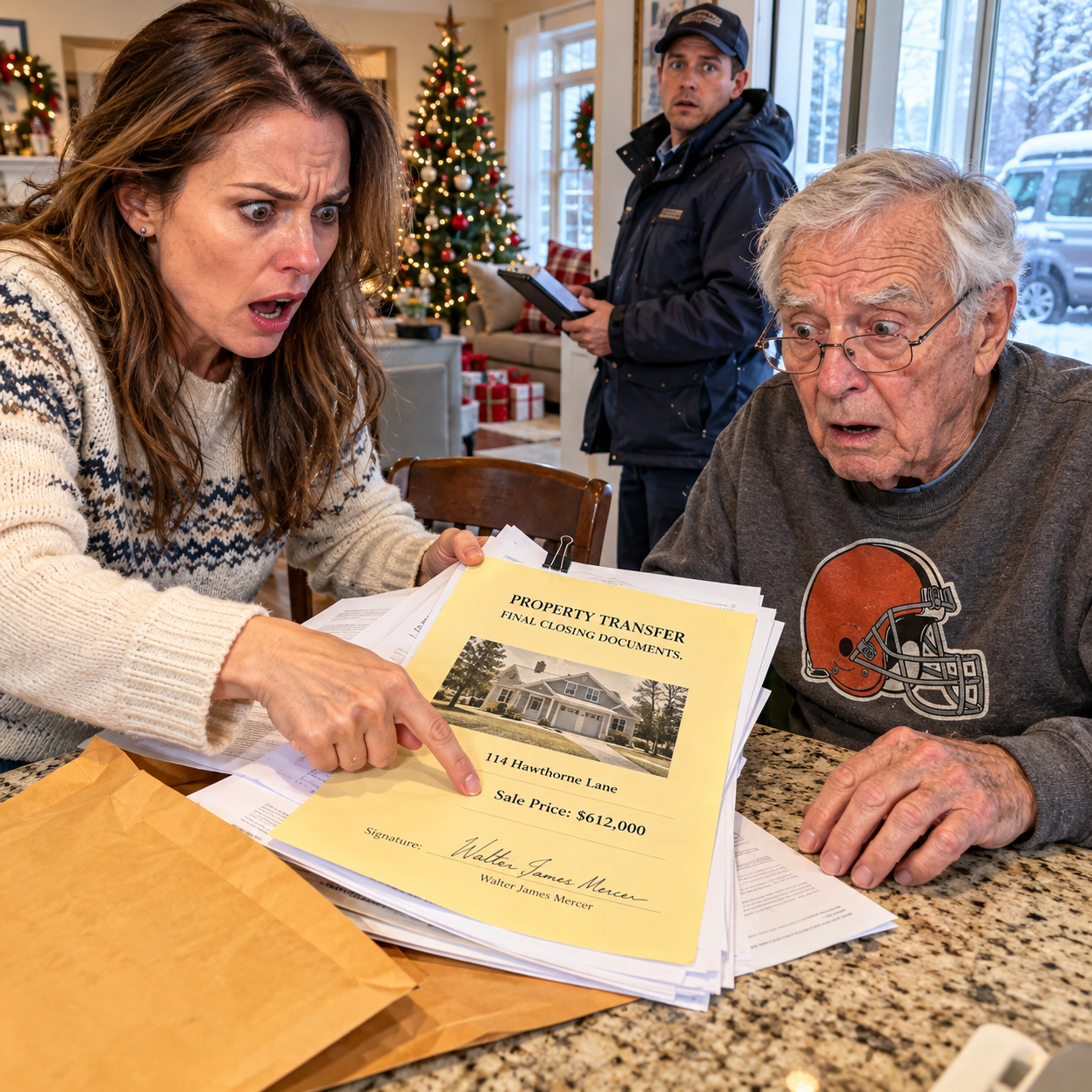
Grandpa and I spent Christmas Eve at the dining-room table with paperwork spread between the holiday centerpiece and my mother’s good china. He kept records the way men of his generation kept grudges: carefully, chronologically, and indefinitely. Within an hour he had produced property tax statements, bank folders, insurance notices, and an accordion file labeled IMPORTANT STUFF in black marker.
The important stuff told a worse story.
Eighteen months earlier, after Grandpa had minor heart surgery, he had signed a limited financial power of attorney allowing Dad to pay household bills if Grandpa was hospitalized. The document in Grandpa’s file contained restrictions. The version included with the sale packet contained an additional page granting broader authority over real property.
Grandpa adjusted his glasses. “I never saw that page.”
I examined the staple holes. The questionable page had been inserted cleanly enough that I could not prove anything, and I knew better than to make accusations from a dining-room table. “We’re not deciding what happened yet. We’re figuring out what the documents say.”
Grandpa gave me a sideways glance. “That something you learned in the Navy?”
“Community college administration is basically the Navy with worse parking.”
He laughed, and the sound helped.
Before returning to civilian life, I had spent twelve years in Navy logistics. Dad never understood why I refused the comfortable management job he had arranged for me afterward. He believed leaving his company meant rejecting the family; I believed joining a business where my brother would eventually become president and I would always be Dean Mercer’s difficult daughter sounded like an efficient way to ruin Thanksgiving forever.
The bank statements showed seven transfers from Grandpa’s savings into an account belonging to Mercer Industrial Supply. The first was $15,000. The largest was $72,000. Altogether, $184,500 had moved during fourteen months.
“Did you lend Dad money?”
Grandpa’s mouth tightened. “Twenty-five thousand. Last spring. He said the company was waiting on two customers to pay.”
I turned the next statement toward him.
Another withdrawal had occurred six weeks later.
Then another.
He took off his glasses and folded them slowly.
The vacation suddenly made more sense.
Dad had not taken everyone away because a cabin became available. He had arranged for the family members most likely to question him to be somewhere else while the closing papers moved forward.
That evening Mom finally called.
“Merry Christmas Eve,” she said too brightly.
I could hear children behind her and music somewhere farther away. “Where are you?”
A pause. “North Carolina.”
“I know.”
Another pause.
“Dad said I cancelled.”
Mom lowered her voice. “Mara, I don’t know what happened with the messages.”
“Yes, you do.”
She exhaled through her nose, the way she always had before asking me not to make something difficult. “Your father thought you and Grandpa might enjoy having some quiet time.”
“Mom, why is Grandpa’s house being sold?”
Nothing came through the phone except distant laughter.
I watched Grandpa straighten a stack of bank statements.
Finally Mom said, “Your father has been under enormous pressure.”
“That wasn’t my question.”
“The company had a terrible year.”
I closed my eyes briefly. “Does Grandpa know his money has been funding it?”
“I assumed Dean discussed that with him.”
“He didn’t.”
“Mara—”
“And did you know the house closes next week?”
This time her silence lasted long enough to answer me.
“Your father believes it’s the only way to stabilize things.”
I looked toward Grandpa. He was pretending not to listen.
“Then Dad can sell something that belongs to Dad.”
Mom’s voice sharpened. “Please don’t turn this into a war.”
“I’m sitting with an eighty-two-year-old man who thought his family wanted Christmas with him. You’re at a resort paid for by people who apparently couldn’t afford one.”
She whispered, “The trip was already booked.”
“On whose card?”
She did not answer.
After we disconnected, Grandpa shuffled into the kitchen and returned with two glasses of ginger ale. “Your grandmother used to put bourbon in this.”
“Why don’t you?”
“She took the bourbon with her when she died. Probably knew your father would need it more than me.”
I laughed despite myself.
Christmas morning was strangely gentle. Grandpa made pancakes shaped like continents, none recognizable. We opened presents beside the tree. I gave him a heated vest; he gave me my grandmother’s old recipe box, still smelling faintly of cinnamon and drawer wood. Neither of us mentioned the empty bedrooms upstairs.
Then Luke called.
He did not bother with Merry Christmas.
“What are you doing with Dad’s lawyer?”
I looked at Grandpa. “Dad’s lawyer called you?”
“He says you’re interfering with the closing.”
“The owner doesn’t want to sell.”
Luke sighed. “Mara, this is bigger than you realize.”
“Then explain it.”
For several seconds he said nothing. When he finally spoke, the defensiveness had drained from his voice. “We lost the Patterson contract in March. Then the warehouse expansion ran over budget. Dad personally guaranteed part of the loan.”
“And you?”
“I approved the expansion.”
There it was. Not theft for luxury. Not some villainous plan hatched over expensive whiskey. Fear. Pride. A father protecting the son he had trained to inherit everything, and a son making decisions he had been too ashamed to admit were failing.
Luke continued, “If we default, forty-six people could lose their jobs.”
“That doesn’t make Grandpa’s house company property.”
“I know.”
The answer surprised me.
“Does Dad know you know?”
Luke spoke more quietly. “Not exactly.”
I pressed the phone against my ear.
“He told everyone Grandpa agreed?”
“Yes.”
“And you believed him?”
“I needed to.”
That was the most truthful thing my brother had said to me in years.
By noon, Grandpa had called an attorney who had represented one of his old bowling partners. She agreed to review the documents electronically and advised him, very clearly, not to sign anything. She also asked Dad’s law firm to suspend the closing until the authority issue could be examined.
At 2:17 p.m., Dad finally texted me.
Do not involve outsiders in a private family matter.
I handed the phone to Grandpa.
He read it, placed it facedown, and reached for his coffee.
Then he said, “Tell your father his trip is over.”
Part 3: My father came home to face the family he managed
They arrived the afternoon after Christmas, seven hours earlier than planned. Luke’s SUV pulled in first, followed by Dad’s sedan. My niece and nephew climbed out looking exhausted and confused, carrying stuffed animals from the resort gift shop. Whatever happened between the adults, I refused to let the children become spectators, so Mom took them upstairs with Luke’s wife while the rest of us gathered around the dining table.
Dad remained standing.
His face looked gray beneath his winter tan. “Mara, you had no authority to stop that closing.”
Grandpa tapped the table once. “I did.”
Dad looked at him. “Dad, please.”
“No. You’ve been saying ‘Dad, please’ since you were nine and broke Mrs. Feldman’s window. Sit down.”
For once, Dean Mercer sat.
I placed copies of the transfers between us. Dad did not pretend they were unfamiliar. Luke stared at them, his jaw working.
Grandpa asked, “How much?”
Dad rubbed both hands over his face. “The company needs around three hundred thousand to get through February.”
“How much of mine have you used?”
“Dad—”
“How much?”
“One eighty-four.”
Grandpa nodded as though confirming the price of a roof repair. “And the house?”
“The sale would clear the short-term debt and give us working capital.”
“Us.”
Dad looked at him.
Grandpa leaned back. “Interesting little word.”
Mom stood near the doorway with her arms folded. “Dean, you told me Walter agreed.”
“I believed he would.”
“That isn’t agreement.”
Dad’s composure cracked then, not into rage but exhaustion. “What exactly did everybody expect me to do? Close the company? Tell forty-six families before Christmas that their paychecks were gone? Tell Luke the expansion I encouraged him to make destroyed what my father built?”
Luke looked up sharply. “You encouraged it?”
Dad stared at the tabletop.
“You told me you thought it was too risky.”
“I told the bank something different.”
Luke pushed his chair back several inches. “So you let me think this was all mine.”
“I was trying to protect you.”
“From what?”
“From becoming me.”
That stopped him.
Dad looked older than I had ever seen him. “I spent forty years being the man who solved things. Your grandfather solved things before me. People came into my office scared and left believing I had a plan. Then business went bad and every plan required money we didn’t have.” He swallowed. “Your mother knew about the first loan from Grandpa. Luke knew about the company losses. Nobody knew the whole thing because I kept telling myself I could fix it before anybody had to.”
Grandpa slid the altered power-of-attorney copy toward him.
“Did you add this page?”
Dad stared at it for several seconds.
“No.”
I studied his face.
He continued, “The company attorney prepared an updated version when we discussed selling. I told him you had agreed in principle. He must have assumed—” Dad stopped. “No. That’s cowardly. I told him enough to make him believe the authority existed.”
Grandpa’s expression did not change. “Why didn’t you ask me?”
“Because I knew what you’d say.”
“There you go.”
Dad looked toward me then. “And before you decide this was about choosing Luke over you—”
“I don’t have to decide that today.”
He frowned.
I had spent twenty years wanting my father to admit exactly how differently he treated us. Sitting across from him, I realized extracting that confession while his entire life collapsed would not heal anything.
“This is Grandpa’s decision,” I said. “Not mine.”
Grandpa folded his hands.
“The house doesn’t get sold.”
Dad’s lips parted, but Grandpa raised one finger.
“My savings stop funding the business. Tomorrow, I revoke your power of attorney. My lawyer will handle the accounts from here on.”
Dad stared toward the window.
Grandpa continued, “What you already took becomes a loan. A real one. Paperwork, interest, repayment schedule.”
Luke leaned forward. “I’ll cover half.”
Dad looked at him.
Luke shrugged miserably. “My name is on the expansion. I’m done letting you protect me from my own decisions.”
Mom lowered herself into a chair.
For several minutes, they talked numbers instead of blame. Dad owned a small commercial property outright. Luke had company shares he could surrender. The warehouse expansion could be partially leased to another business. None of it was painless. Employees might lose overtime; bonuses would disappear; Dad and Luke would take no salary for several months.
But Grandpa would keep his house.
Eventually Dad stood and walked to the tree. Several presents still waited beneath it, including the one I had brought for him.
“You really drove all this way thinking we’d be here?” he asked.
“Yes.”
He nodded once.
“I did tell you to come home.”
“You did.”
“And then I left.”
“Yes.”
He put both hands in his pockets. “I didn’t want you looking at the books.”
“I figured.”
A bitter little smile touched his mouth. “You always were annoyingly good at paperwork.”
“Thank the United States Navy.”
“I suppose I should’ve thanked somebody.”
He looked at Grandpa next.
“I’m sorry.”
Grandpa scratched his cheek. “You’re my son. I love you. Those are not the same words as ‘I trust you.’ You’ll have to earn that part back.”
Dad’s eyes turned wet, but he nodded.
That evening, nobody recreated Christmas. There was no grand feast and no photograph pretending we had repaired forty years between dessert and coffee. Mom reheated ham. Luke made mashed potatoes from a box because he had never learned how to make them from scratch. Dad washed dishes without being asked, which Grandpa watched with the suspicion of a man witnessing a rare astronomical event.
Before I left the next morning, Dad found me beside my car.
“I treated your life like the backup plan,” he said.
Snow slid from the garage roof behind him.
“When Luke struggled, I rushed in. When you struggled, I assumed you’d handle it.”
“I usually did.”
“That doesn’t mean you should have had to.”
I closed the trunk.
Dad looked toward the upstairs window where Grandpa was probably watching us. “I thought needing me meant loving me.”
For the first time, I understood something about my father that did not excuse him but made him recognizable. He had built his entire identity around being indispensable. Luke’s dependence felt like affection. My independence felt like rejection.
“You don’t have to rescue people to belong to them,” I said.
He nodded slowly. “I’m learning.”
I hugged him before I could overthink it. He held on awkwardly, then tightly, and released me before either of us could turn it into a promise we weren’t ready to make.
Grandpa came outside wearing the heated vest I had given him, fully zipped despite insisting the previous day that it made him look like “an electric blueberry.” He pressed something into my palm.
A brass house key.
“You already have one,” I said.
“Not to this house.”
I looked at him.
“I’m changing the locks.”
Dad, standing several feet away, gave a wounded little laugh.
Grandpa pointed at him. “You can have a key again when I stop checking my bank account after you visit.”
Dad actually smiled.
I slipped the key onto my ring.
The next Christmas was quieter. Dad was no longer president of Mercer Industrial Supply; Luke had taken over under supervision from an outside financial adviser. The company was smaller but alive. Grandpa had received eleven monthly repayments and complained that the interest rate his attorney chose was “too generous for thieves.”
Nobody laughed harder than Dad.
When I arrived that December, six cars filled the driveway.
Grandpa opened the door before I reached the porch.
Behind him, Dad was setting the table. Mom was arguing with Luke about gravy. My niece was hanging ornaments too low on the tree, and my nephew was stealing cookies from the cooling rack.
Dad looked over.
“You made it.”
“I said I would.”
He nodded toward the kitchen. “Your grandfather has been guarding your chair for twenty minutes.”
Grandpa called from the hallway, “Because this family has a history of giving away things that aren’t theirs.”
Dad closed his eyes.
I laughed and carried my bags inside.
The End .
All characters and events in this story are fictional, created for storytelling and entertainment purposes. Thank you sincerely for reading. Your feedback and support are invaluable and motivate me to continue sharing more stories with you.

