
Part 2: The house deed exposed the story my mother told
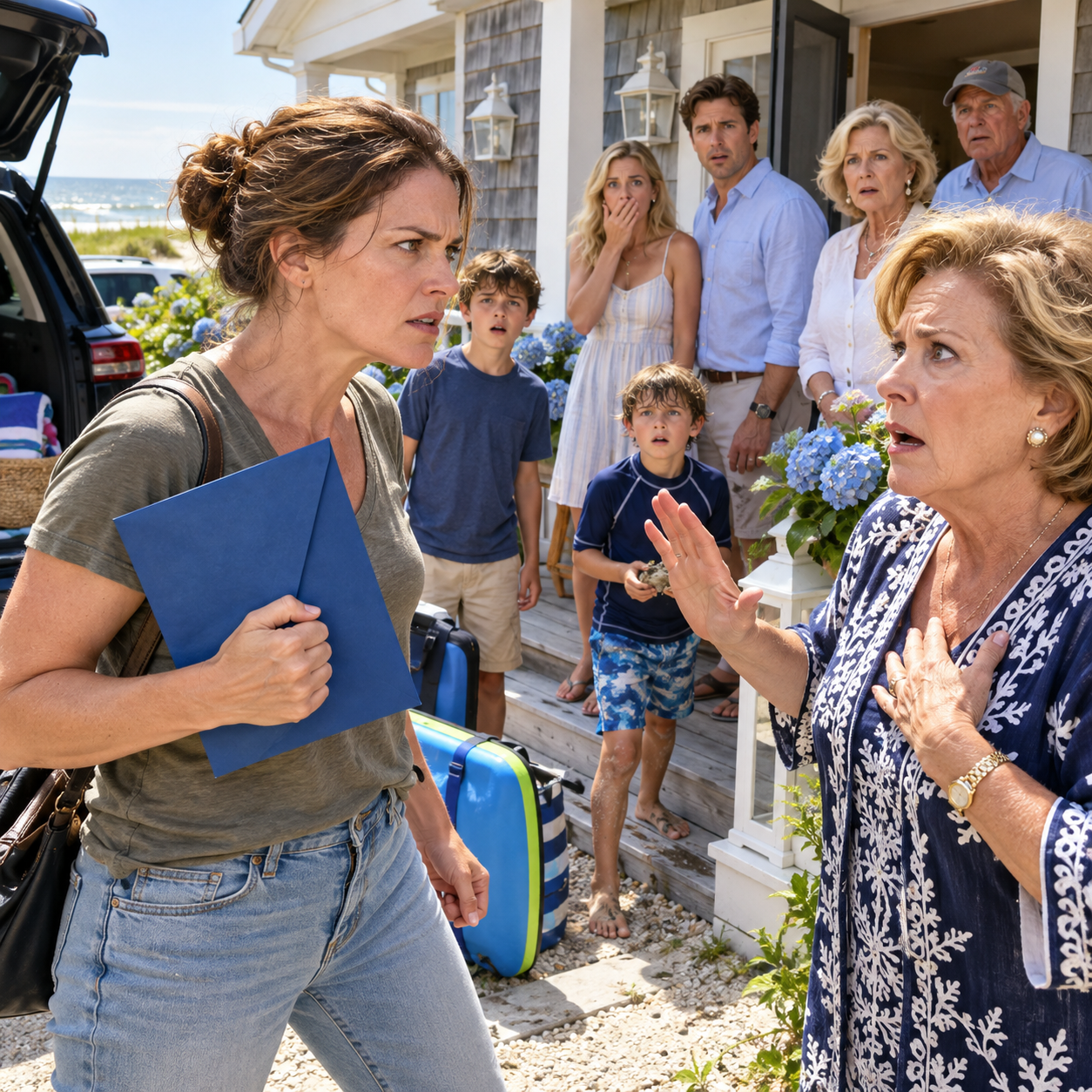
Vanessa appeared in the doorway wearing a pale linen dress and the expression of someone who had just discovered a rainstorm on her wedding day. “Claire,” she said, looking past me toward the boys, “seriously?”
Before I could answer, an elegant woman in her early sixties stepped onto the porch behind her. Caroline Wallace wore white trousers, silver earrings, and bare feet. “You must be Claire,” she said, extending her hand. “Andrew has told us about you.”
My mother spoke too quickly. “Claire was just leaving.”
Caroline’s eyebrows rose.
“No,” I said. “I’m not.”
Vanessa’s fiancé came through the screen door carrying a tray of iced tea, followed by his father, Thomas, a broad-shouldered man with a sunburned nose and a faded college cap. Andrew stopped when he saw me, then smiled cautiously. “Hey. You made it.”
“Apparently,” Vanessa muttered.
At that moment Luke came charging around the side of the house with seawater dripping from his shorts and both hands cupped around something. “Mom! Emergency!”
My mother flinched. “Luke, not now.”
“It’s not my emergency.” He opened his hands just enough to reveal a tiny hermit crab. “His shell has a crack.”
Thomas immediately set down his glass. “That is serious business.”
Luke studied him. “Do you know crabs?”
“I know cracked things.”
“That counts.”
Within thirty seconds, the wealthy hotel executive my mother had spent months trying to impress was crouched in the sand beside my eight-year-old discussing replacement shells. Caroline followed them without hesitation, holding her linen pants above her ankles. My mother watched from the porch as though reality had betrayed her.
Caroline glanced back at the cottage. “Judith, this place is wonderful. You said your father built it?”
“He did,” my mother said, recovering slightly.
“And he left it to you?”
There it was.
Vanessa’s eyes shifted toward Mom. Andrew looked down at the tray.
I could have corrected her immediately. Instead, I gave my mother time to answer.
She didn’t.
Caroline looked at me. “I’m sorry. Did I misunderstand?”
“My grandfather left the cottage to me,” I said. “My mother has the right to use it for the rest of her life, and she always will.”
Thomas straightened slowly. “That’s a generous arrangement.”
“My grandfather wanted it that way.”
My mother’s cheeks had turned pink. “It’s effectively a family property.”
“It has always been treated that way,” I said. “Until this week.”
Vanessa crossed her arms. “Do we really need to do this in front of everyone?”
Andrew finally spoke. “Do what?”
She looked at him. “Make Mom look dishonest.”
He frowned. “Did your mom tell my parents she owned the house?”
Vanessa did not answer.
My mother stepped in. “I simplified the explanation. Good grief, nobody here is committing fraud. I wanted your parents to enjoy themselves.”
Caroline’s face softened instead of hardening. “Judith, we were already enjoying ourselves.”
“You don’t understand.” My mother glanced at the flowers, the cushions, the gleaming rental car, all the evidence of how desperately she had tried. “You entertain governors. You own resorts. Vanessa is marrying into a world our family doesn’t know.”
Thomas gave a small laugh. “We own buildings near beaches. That doesn’t make us European nobility.”
My mother looked wounded, and for the first time I saw what was underneath the vanity. She was frightened. Not of Caroline, exactly, but of being measured and found ordinary.
Then Owen came up from the shore carrying one of Granddad’s old fishing poles. “Mom, somebody moved Grandpa Sam’s tackle box.”
My mother looked away.
“Where is it?” I asked.
“In the shed,” she said. “I needed the porch cleaned up.”
Owen’s jaw tightened. “He always kept it by the bench.”
I touched his shoulder. “We’ll put it back later.”
My mother heard the restraint in my voice. “Please don’t turn a tackle box into a symbol.”
“I’m not the one who cleared away every sign that children and fishermen ever lived here.”
Vanessa said, “Claire, enough.”
Caroline quietly picked up her tea. “Actually, I’d like to hear the rest.”
That surprised all of us.
I opened the blue envelope but left the deed inside. Instead, I removed Granddad’s letter and handed it to my mother. “This isn’t for Caroline or Thomas. It’s for you.”
She recognized his handwriting before she unfolded the page. Her mouth changed—not dramatically, just a small loosening that made her look older.
The letter was brief. Granddad wrote that he had given the cottage to me because I understood what the place was for. He reminded my mother that her lifetime access was not charity but love. Then came the line I had remembered all week: Don’t let anybody who belongs here feel like they need permission to come through the door.
My mother read that sentence again.
Vanessa shifted beside her. “Mom?”
“I know what it says.”
Caroline stepped toward the screen door. “We should give you some privacy.”
My mother folded the page carefully. “No. I’ve spent three months trying to make you think we were something we aren’t. You might as well see what we actually are.”
Thomas pointed toward Luke, who was now arranging shells in a row for the injured crab. “I was hoping that was the plan.”
My mother gave a weak, reluctant laugh.
That evening, the caterer arrived with tiny crab cakes, chilled soup, and place cards printed on thick cream paper. My mother stood at the kitchen counter looking at the trays while Luke pressed his nose to a container and asked whether anything was “normal food.”
Finally she removed her earrings. “Claire, is Granddad’s fish breading still in the tin above the refrigerator?”
“It expired three presidents ago.”
“You know the recipe.”
“I do.”
She nodded toward the grocery bags I had brought. “Then help me.”
We ate fried fish, corn, sliced tomatoes, and potato salad on mismatched plates because Thomas said the china looked like it required legal representation. Owen explained the chemistry of fireworks to Andrew. Luke made Caroline promise not to report his cracked-shell patient to “hotel management.”
Later, Vanessa found me alone at the outdoor sink rinsing dishes. “You could have told me,” she said.
“About the deed?”
“About everything.”
I turned off the faucet. “Would it have mattered?”
She picked at a loose thread on the dish towel. “I honestly thought Mom was asking you to skip one week because you hate formal stuff.”
“I don’t hate formal stuff. I hate being treated like evidence the family is trying to hide.”
Vanessa looked toward the porch, where our mother was listening to Thomas tell a story. “She does that to me too, you know. Just differently. I’m the daughter she displays.”
For once, neither of us argued about who had gotten the better version of our mother.
Part 3: We kept the house, but changed who felt welcome
The next morning, I found my mother on the porch before sunrise wearing one of Granddad’s old flannel shirts over her pajamas. She had put his tackle box back beside the bench. The rented white cushions were stacked neatly in a corner.
“I canceled the photographer,” she said.
“What photographer?”
“The one Vanessa didn’t know I hired.”
I stared at her.
“I thought we could get family portraits while Caroline and Thomas were here.” She rubbed her thumb over a scratch in the tackle box lid. “Something polished.”
“Mom.”
“I know.”
She looked toward the dunes. “When your father left, I spent years feeling like people could tell. At church, at work, at every school event. I always thought if the girls looked accomplished enough and the house looked nice enough, nobody would see that I was barely holding things together.”
My parents’ divorce had happened when I was fourteen. I remembered her crying exactly once, behind a locked bathroom door, then emerging with lipstick on.
“You never had to impress us,” I said.
“That’s not true. Children are the people you most want to impress.”
“No. Children are the people who need to know they don’t have to impress you.”
She looked at me then.
“I shouldn’t have said the boys were too much,” she said.
“You shouldn’t have tried to remove them from their own family traditions.”
“I was embarrassed by noise and sand because I thought Caroline would judge Vanessa through us.”
“And if she had?”
My mother gave a tired smile. “Then I suppose Vanessa would have learned something useful before marrying into the family.”
That was closer to an apology than my mother usually knew how to give, but I needed something practical too. “We need rules for the cottage.”
Her shoulders stiffened slightly.
“You can come whenever you want. Granddad gave you that right, and I would never challenge it. But you cannot tell me or the boys when we are allowed to be here. And if you invite overnight guests during weeks we usually use, we discuss it first.”
She looked down at the letter in her lap. “That seems fair.”
“And no more pretending you own it.”
A longer pause.
“Can I still call it my beach house sometimes?”
I laughed despite myself. “Around people who know you’re being sentimental.”
She reached across the space between our chairs and squeezed my hand once. My mother had never been a great hugger. That small squeeze meant more.
The Fourth passed without catastrophe. Luke’s hermit crab found a new shell and disappeared under the dock. Owen helped Thomas repair a loose porch board, and Caroline taught both boys a card game so complicated that she was accused of inventing rules whenever she lost.
That night we carried blankets onto the dunes. Fireworks opened over the water in red, green, and blue bursts, and Owen quietly named the elements responsible for the colors until Vanessa threw a handful of popcorn at him.
My mother sat beside me. “Your grandfather would have liked this.”
“He would have complained about the fireworks scaring the fish.”
She smiled. “Then he would have watched every single one.”
Vanessa and Andrew married the following May. There were no surprise photographers, no rented hydrangeas, and no attempts to disguise the family. Caroline asked whether the rehearsal dinner could be held at the cottage, not because it was impressive but because Andrew had talked for months about the evening we all ate fried fish on the porch.
My mother cooked Granddad’s recipe herself.
The larger change happened slowly. She began calling before making plans for the cottage. She stopped correcting Luke when he tracked sand across the porch and started keeping an old towel by the door instead. When Owen became a teenager and entered the stage of responding to adults with vowels instead of words, she learned not to take it personally.
Vanessa and I changed too. We stopped using our mother as the scoreboard for which sister had been loved more correctly. Sometimes she still slipped into old habits—praising Vanessa’s clothes before noticing I was in the room, asking me to “be reasonable” because she knew I usually would—but now I answered instead of swallowing it.
Three summers after that Fourth, a tropical storm tore several shingles from the cottage roof. I drove down expecting to handle the repairs alone and found my mother, Vanessa, Andrew, Caroline, Thomas, and both boys already there with tarps, toolboxes, sandwiches, and several strong opinions about ladders.
Thomas stood in the yard holding Granddad’s ancient hammer. “This thing belongs in a museum.”
Luke, now eleven, snatched it from him. “That’s family property.”
My mother laughed so hard she had to sit on the porch step.
I watched them for a moment—the sister I had resented, the mother who had once tried to edit my children out of a weekend, the wealthy in-laws she had been terrified to disappoint, and my sons arguing over who got to climb the ladder next.
The cottage looked nothing like the polished place my mother had tried to create that first summer. There were wet towels on the railing, fishing hooks in a coffee mug, muddy shoes by the door, and a dent in one screen where somebody had thrown a football badly.
It looked exactly right.
Later that afternoon, Mom brought me lemonade while I was writing a check for the roofer. She nodded toward the boys wrestling in the sand.
“They’re still a little much,” she said.
I looked at her.
She smiled. “Good thing this house was built for too much.”
The End .
All characters and events in this story are fictional, created for storytelling and entertainment purposes. Thank you sincerely for reading. Your feedback and support are invaluable and motivate me to continue sharing more stories with you.

