### Part 2: Their Financial Proposal Exposed Secrets My Son Had Ignored
The following Monday, I drove to the office of a real estate attorney named Margaret Collins. I’d used her firm years earlier when purchasing the house, and her assistant remembered me because I’d once brought homemade lemon cookies to their closing appointment.
Margaret examined the photographs on my phone, then asked several practical questions. Was the property paid off? Yes. Was anyone else’s name on the deed? No. Had I signed any agreement giving Daniel or Mallory an ownership interest?
“Absolutely not.”
She leaned back in her chair.
“Then they can’t simply transfer the property or borrow against it without your participation. A worksheet isn’t a deed. But I am concerned that they’ve begun making financial arrangements while assuming you’ll cooperate.”
I told her about the proposed apartment and the Social Security figures. Margaret listened without interrupting, occasionally writing something on a yellow legal pad.
“What worries me most,” I admitted, “is that my son sat there while his wife explained how they intended to relocate me.”
Margaret removed her glasses.
“Then before discussing property, you need to decide what relationship you’re willing to have with them while they’re living in your home.”
I spent the next several days gathering information.
My bank statements showed that my grocery expenses had increased considerably since Daniel and Mallory moved in. Utilities were higher, too, and the contributions Daniel had promised arrived irregularly. I didn’t resent buying food for family, but seeing the figures together made me recognize how much I’d quietly absorbed.
I found Daniel’s original text from eight months earlier.
We’ll be out before summer, Mom. I promise we won’t impose.
Summer had come and gone.
On Thursday afternoon, Daniel found me in the garage sorting old paint cans.
“Mom, Mallory says you’ve been distant.”
I screwed the lid onto a half-empty gallon of white paint. “I’ve had a lot to think about.”
“She really is trying to help.”
“Did you know she was preparing paperwork to put both your names on my house?”
He stopped beside the workbench.
“We talked to someone about financing.”
“That wasn’t my question.”
Daniel rubbed his forehead. “We wanted to know what might be possible.”
“Then why wasn’t I invited to that conversation?”
He looked toward the open garage door, where the first autumn leaves were collecting along the driveway.
“Because we figured you’d say no before hearing the benefits.”
I set the paint can down carefully.
“Daniel, when you expect someone to say no, that’s usually a reason to ask before making plans.”
He didn’t answer.
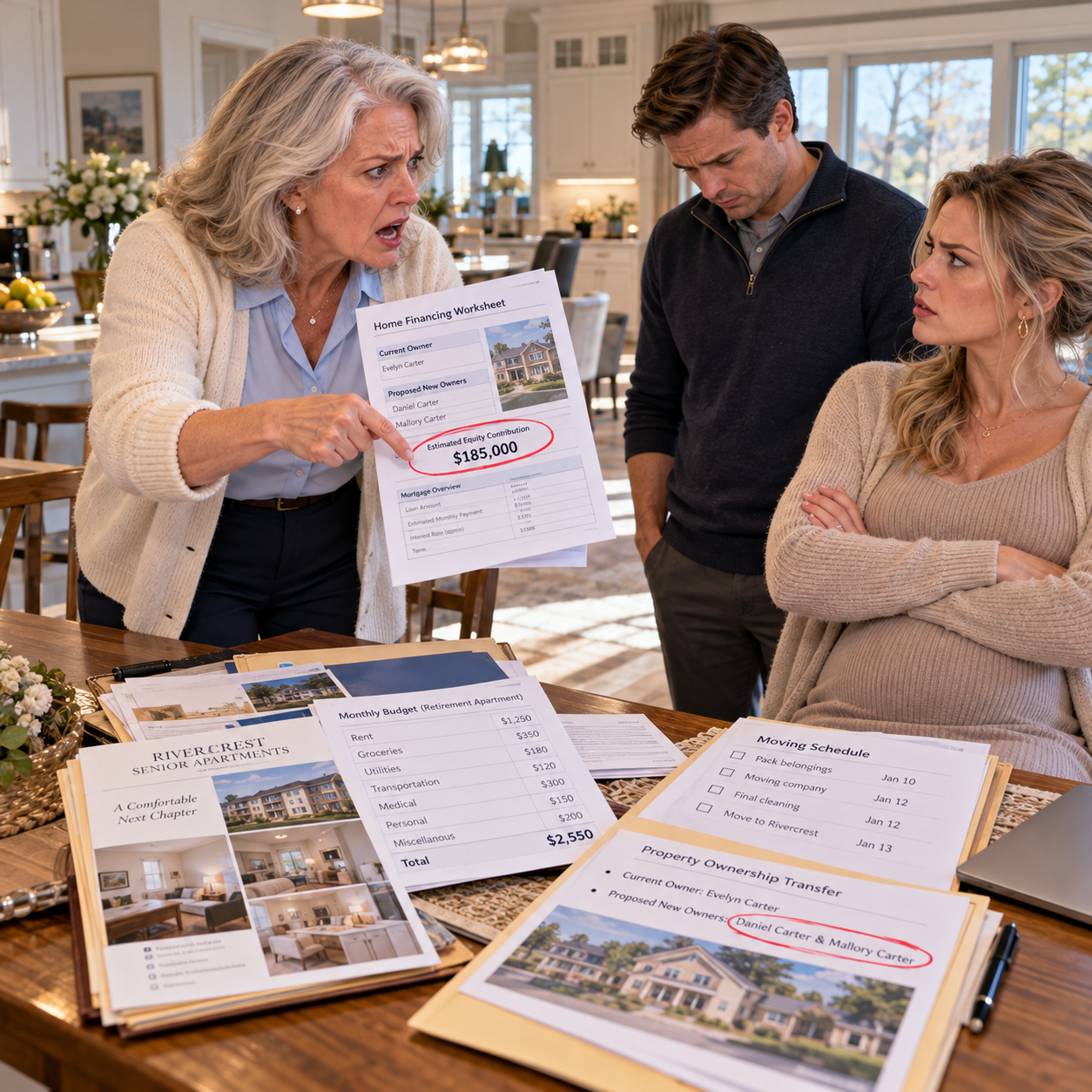
The next evening, I invited them both to sit with me at the kitchen table. I placed their folder beside one Margaret had prepared for me.
Mallory noticed the second folder immediately.
“What’s that?”
“Some paperwork of my own.”
I explained that I’d consulted an attorney and confirmed that I intended to retain sole ownership of my house. I also explained that our temporary living arrangement could not continue indefinitely.
Margaret had prepared a formal notice ending their occupancy according to the applicable requirements. It gave them thirty days to leave, with the legal process available if they refused.
Daniel stared at the letter.
“You’re asking your pregnant daughter-in-law to move out?”
“I’m asking two employed adults to find their own home.”
Mallory’s face reddened. “After everything we’ve planned around this baby?”
“Those plans never included asking whether I wanted to leave.”
She folded her arms. “I thought becoming a grandmother would matter more to you than a building.”
I glanced toward the garden outside the window, where Thomas and I had once discussed growing old together.
“Being a grandmother matters enormously,” I said. “But that doesn’t mean I stop being a person with a life of my own.”
Daniel lowered the letter.
“Mom, we can’t afford a house like this without help.”
“Then perhaps you shouldn’t be planning to own one like this.”
Mallory stood abruptly and carried her untouched tea to the sink. She placed the cup down hard enough to splash water onto the counter.
“Fine. We’ll figure something out.”
The following week was uncomfortable.
They stopped joining me for meals. Daniel came home late. Mallory spent hours upstairs on the phone, speaking quietly whenever I passed the landing.
Then, one Wednesday morning, I found Daniel sitting on the back steps before sunrise.
He was wearing yesterday’s shirt, holding a mug of coffee he hadn’t touched.
“Did you and Dad ever have a time when you didn’t trust each other?” he asked.
I sat beside him.
“We had times when we disappointed each other. That’s different from deliberately hiding things.”
He nodded, staring toward the vegetable beds.
“I’ve been thinking about the apartment we had before moving here,” he said. “How we were always short of money, even when I worked overtime.”
I waited.
“There’s a credit card I didn’t know about. She owes almost eighteen thousand dollars.”
I looked at him.
“And the mortgage plan?”
“She thought we could borrow against the house and pay off some debts while fixing it up. She said it would leave us with one payment instead of several.”
“Using my equity.”
He pressed his lips together.
“She said we’d make sure you were taken care of.”
I touched his shoulder, but I didn’t soften my answer.
“Your wife having debts doesn’t give either of you a claim to my savings.”
Daniel nodded.
A few days later, he came to my bedroom holding his phone.
He asked whether he could speak without Mallory hearing. I closed the door and motioned him toward the chair by the window.
“I found messages,” he said.
His hands trembled as he unlocked the screen.
Mallory had left a messaging account open on their shared tablet. Daniel recognized a man’s name from her freelance consulting work, someone she’d mentioned casually several times.
The messages were affectionate, unmistakably personal, and dated months before she’d announced her pregnancy.
There were references to hotel meetings and a weekend she had told Daniel she was visiting her cousin. One message from the man asked when she intended to tell her husband the truth.
Daniel scrolled back and forth, rereading the dates.
“She says it didn’t mean anything,” he whispered. “But she’s been lying about where she was.”
I wanted to find a sentence that would make my son’s expression less wounded.
There wasn’t one.
“Have you asked her about the baby?” I finally said.
He nodded.
“She says it’s mine. She got angry when I asked whether there was any possibility it wasn’t.”
He put the phone face down.
“I told her I couldn’t keep pretending everything was normal. She finally agreed to a prenatal paternity test.”
The test involved a blood sample from Mallory and a cheek swab from Daniel. They used an independent laboratory, and Daniel told me results would take several days.
I didn’t offer predictions.
Whatever the result, I already knew the family I’d believed we were becoming had developed cracks deeper than I’d understood.
Nine days later, Daniel knocked on my bedroom door.
He was carrying a white envelope.
“Mom,” he said, sitting beside the window, “I got the results.”
He handed me the report.
The conclusion was printed near the bottom.
Daniel was excluded as the biological father.
I read it twice, then handed it back.
He covered his face with both hands.
“She knew there was a chance,” he said. “She let me choose names. She let me tell people.”
I sat beside him while he struggled to find his next sentence.
“She admitted she thought having a baby and a house might finally make everything stable. She said she didn’t know how to fix what she’d done.”
For the first time, I understood the desperate determination behind the nursery sketches and financing proposals.
Mallory hadn’t simply wanted a larger home.
She’d been trying to build a secure future on top of several truths she was afraid to tell.
### Part 3: I Kept My House And Learned What Family Really Requires
Mallory left three days after Daniel received the test results.
She didn’t storm out or make another speech about my selfishness. She packed two suitcases and asked Daniel to carry them downstairs. When I came into the hallway, she was standing beside the front door, looking at the framed family photographs.
“I suppose you’re happy,” she said quietly.
I shook my head.
“No, Mallory. There isn’t anything about this that makes me happy.”
She looked tired. Her usual careful appearance had given way to a loose sweater, an untidy ponytail, and shadows beneath her eyes.
“I really thought we could make it work here.”
“That wasn’t a decision you could make for me.”
She swallowed.
“I was scared. The consulting work hasn’t been steady, and the bills kept getting worse. I thought if we had a place nobody could take away—”
“You tried to take mine.”
She looked down.
After a moment, she said, “You’re right.”
It was the first time I’d heard her acknowledge something without immediately explaining why she deserved an exception.
I moved aside so she could leave.
Daniel drove her to her sister’s apartment. When he returned, he sat at the kitchen table for nearly an hour, turning his wedding ring around his finger.
“I’m going to find my own place,” he said.
“I think that’s best.”
He nodded, although the words clearly hurt.
“I know I let this go too far, Mom.”
I sat across from him.
“You didn’t just let it happen. You helped plan it.”
He looked at me, then lowered his eyes.
“I know.”
That admission mattered more than an apology.
For weeks, Daniel had insisted that Mallory was simply enthusiastic about the baby. He’d repeated her arguments as though they were his own, avoided every uncomfortable question, and allowed me to believe that refusing them meant disappointing my future grandchild.
He wasn’t responsible for Mallory’s dishonesty about the pregnancy.
He was responsible for how he’d treated me.
During the next two weeks, Daniel rented a small apartment closer to work. He and Mallory began discussing separation with an attorney, and he arranged counseling to understand why he’d ignored so many warning signs in his marriage.
I didn’t ask for updates about every conversation.
I loved him, but I no longer wanted to be the person who solved his problems by sacrificing my own comfort.
On his final weekend at my house, I found him standing in the living room, looking at pale rectangles where Mallory had removed pictures to test new decorating arrangements.
“I could repaint those,” he offered.
I handed him a brush.
We worked through the afternoon, moving furniture away from the walls and spreading old newspapers across the floor. Daniel stood on a short ladder while I painted along the baseboards.
At one point, he held up a paint chip.
“Remember when Dad made me repaint the fence because I skipped the backs of the boards?”
I laughed.
“He said the neighbors might not see the mistakes, but we’d know they were there.”
Daniel smiled faintly.
Then he climbed down and sat on the ladder.
“I miss him.”
“So do I.”
He studied the brush in his hand.
“I think he’d be disappointed in me.”
“Your father could be disappointed without giving up on someone,” I said. “But he’d expect you to do better.”
Daniel nodded slowly.
Before leaving, he gave me a check covering part of the household expenses he’d failed to contribute. We agreed on small monthly payments for the remainder, not because I desperately needed the money, but because he needed to honor a commitment.
Our relationship didn’t return to normal immediately.
For a while, he called only on Sundays. We talked about his work, the weather, and the old truck he was trying to keep running. Sometimes there were long pauses, but neither of us rushed to fill them.
Eventually, he began visiting again.
He called first. He knocked instead of using his old key. And when I invited him to dinner, he brought groceries without being asked.
I learned from Daniel that Mallory had contacted the baby’s biological father. They were working through questions about support and future responsibilities. Her financial problems remained significant, and her marriage to Daniel was ending.
I felt sympathy for the difficulty of her circumstances, especially for the child who had done nothing wrong.
But I didn’t mistake sympathy for an obligation to surrender my home.
That winter, I began volunteering twice a week with a local housing assistance organization.
The work involved organizing donated household supplies, helping families complete forms, and occasionally driving people to appointments. I met women rebuilding their lives after layoffs, illness, divorce, and other losses.
One afternoon, the program coordinator, Rebecca, asked whether I’d ever considered participating in their short-term hosting program.
“We have families who need a temporary place while permanent housing gets arranged,” she explained. “Everything is screened, and hosts decide what arrangements they’re comfortable with.”
I thought about the two empty bedrooms upstairs.
For months, I’d been afraid that opening my home to someone again would mean surrendering control of it.
But Rebecca’s explanation sounded different. There were written agreements, defined time limits, support workers, and clear expectations.
After several conversations and a home assessment, I agreed to host a mother and her ten-year-old daughter for six weeks.
Their names were Hannah and Lily.
They arrived on a rainy Thursday carrying three bags, a cardboard box of kitchen supplies, and a stuffed rabbit with one missing ear.
Lily stood just inside the doorway, looking uncertain.
“Are we allowed to use the backyard?” she asked.
“Of course,” I told her. “There’s a little garden behind the shed. You can help me plant something if you’d like.”
Hannah gave me a grateful look.
“I promise we won’t get in your way.”
I led them upstairs.
“You don’t have to disappear to be welcome here,” I said. “We just need to respect each other’s space.”
During the following weeks, Lily helped me plant daffodil bulbs beside the front walkway. Hannah found steady work at a medical office, and Rebecca helped her secure a rental apartment near Lily’s school.
On their last morning, Lily handed me a drawing.
It showed my house beneath an enormous yellow sun, with flowers covering the front yard. Three stick figures stood on the porch, and a fourth figure appeared in an upstairs window.
“That’s your husband,” she explained. “Mom said you still talk about him sometimes.”
I smiled at the drawing for a long time.
“Thank you, sweetheart.”
After they moved, I placed it on the refrigerator.
Daniel noticed it during his next visit.
“Who’s the artist?”
I told him about Hannah and Lily, the flower bulbs, and the apartment they’d found.
He looked around the kitchen.
“You’ve been busy.”
“I have.”
He smiled.
“Looks like you’re using all this space after all.”
I handed him a cup of coffee.
“I always was.”
By spring, the daffodils had begun opening beside the walkway. The garden needed weeding, the porch railing needed another coat of paint, and the kitchen faucet had developed an irritating drip.
I made a list of repairs and taped it beside Lily’s drawing.
One Sunday morning, Daniel arrived carrying a new faucet cartridge and a bag of blueberry muffins. We worked beneath the kitchen sink together, occasionally laughing when the instructions made less sense than they should have.
Afterward, we sat at the same table where Mallory had once presented her one-bedroom budget.
Daniel glanced toward the garden.
“I’m glad you stayed, Mom.”
I stirred my coffee.
“So am I.”
He hesitated.
“Thanks for not giving up on me.”
I reached across the table and squeezed his hand.
“I never stopped loving you, Daniel. I just stopped allowing you to decide what loving you should cost me.”
He looked at our joined hands for a moment before nodding.
Later, after he left, I walked through my house with the windows open and the afternoon sun moving across the floorboards. The rooms still held traces of Thomas, Daniel’s childhood, my years of rebuilding, and the people who’d recently found temporary shelter here.
I realized the house had never been too large for my life.
Other people had simply assumed that because I was getting older, my life must be getting smaller.
I stepped onto the porch and looked at the daffodils Lily had helped plant. Their yellow heads were moving gently in the spring breeze.
I had spent eleven years making this place my home. I intended to spend whatever years remained living in it, caring for it, and deciding for myself whom to welcome through the door.
The house would never belong to someone simply because they wanted it more.
And I would never again confuse being needed with being valued.
The End .
All characters and events in this story are fictional, created for storytelling and entertainment purposes. Thank you sincerely for reading. Your feedback and support are invaluable and motivate me to continue sharing more stories with you.