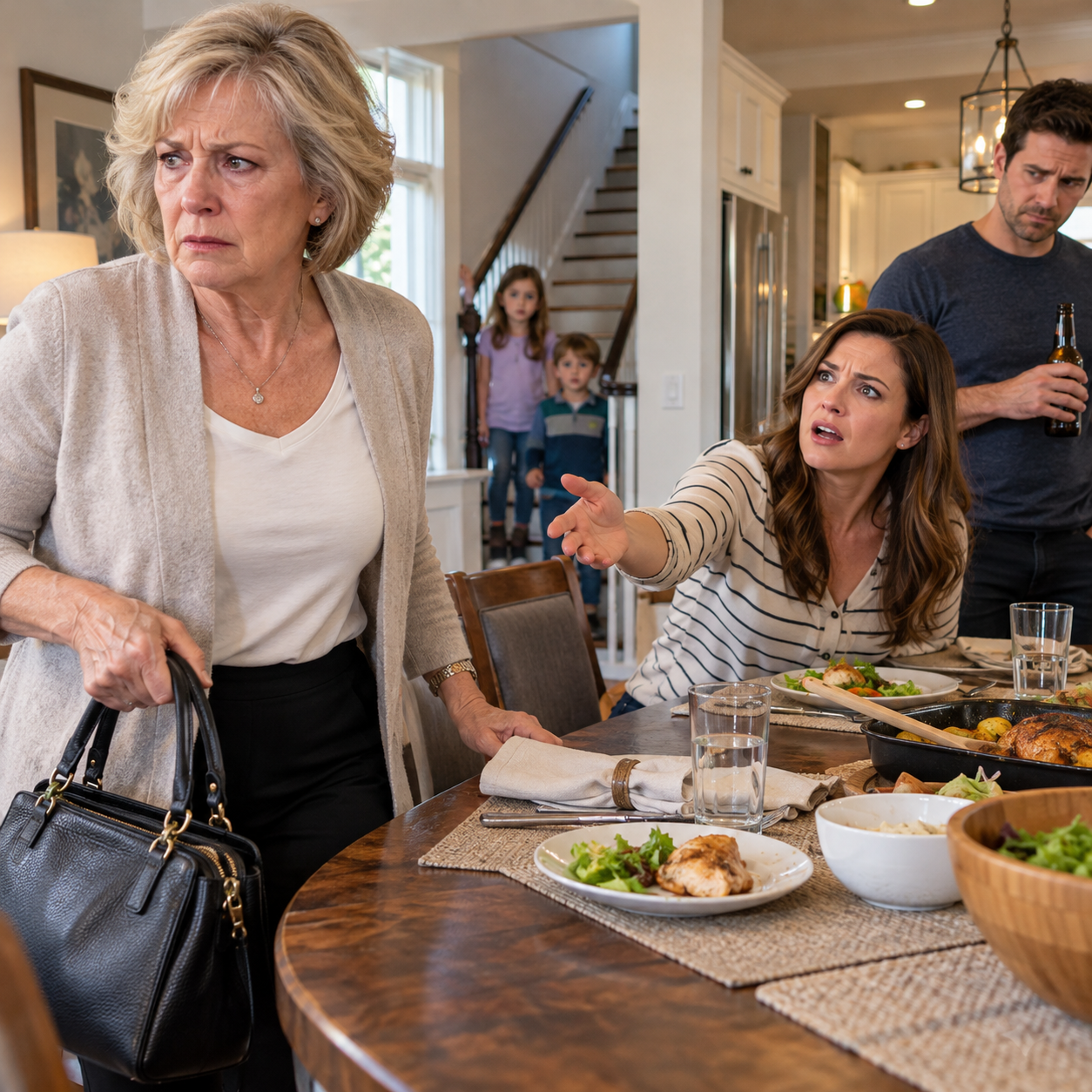
Part 2: When the payments stopped, years of entitlement came due
Tuesday morning, I attended the watercolor class I had postponed four times because Caroline usually needed me on Tuesdays. My phone stayed zipped inside my purse while I painted a lopsided lighthouse and listened to two women debate whether the instructor’s demonstration looked more like Maine or Oregon.
At noon, I checked my messages in the parking lot.
Mom, did something happen with the mortgage?
Mom, call me.
My grocery card was declined.
Ryan says the car payment didn’t clear either.
Are you seriously doing this?
The final message had arrived three minutes earlier.
We are coming over.
I drove home without hurrying.
My neighbor June was trimming dead flowers from a planter when I pulled into my driveway. She lifted one eyebrow toward the street. “Your daughter’s been here once already.”
“How long ago?”
“Twenty minutes. She tried a key.”
I looked at my new lock and smiled despite myself. “Good locksmith.”
June had known me for thirteen years and understood when not to ask for the entire history. “I’ll be out here murdering these geraniums if you need me.”
Caroline and Ryan returned ten minutes later.
The knocking began hard enough to rattle the framed photograph beside my door. I opened it with the chain engaged.
Caroline stood on the porch wearing yoga pants, a cashmere sweater, and the expression of someone who had encountered an error in a system she owned. Ryan was behind her with his phone in one hand.
“You changed the locks,” she said.
“Yes.”
“My key doesn’t work.”
“That was the intention.”
She stared at me for a second. “Mom, this isn’t funny. Every payment failed.”
“I know.”
Ryan stepped closer. “We got two separate notices this morning. The mortgage servicer is charging a fee.”
“That sounds inconvenient.”
Caroline pressed her fingers against her forehead. “Can you please stop acting like this is some little joke? You know we depend on those transfers.”
I studied my daughter’s face. She looked frightened beneath the anger, and some part of me wanted to open the door, put on coffee, and solve the problem before she felt another minute of fear. That reflex had shaped both of us more than I understood.
Then I remembered Friday night.
“You told me I was dead to you.”
She made an impatient sound. “I was angry.”
“You also told me to speak to your lawyer.”
“Oh, come on.”
“I assumed that meant our financial relationship was finished too.”
Ryan exhaled sharply. “Helen, nobody said anything about money.”
That sentence settled between us.
Caroline heard it too. Her eyes flicked toward him.
“No,” I said. “Apparently nobody did.”
She softened her voice. “Mom, I know I said something awful. I shouldn’t have. But the kids live in that house. You can’t punish them because you’re mad at me.”
“I’m not punishing anyone. I stopped paying bills that belong to two employed adults.”
“Our budget was built around your help.”
“Without my agreement.”
“You agreed three years ago.”
“For a few months.”
Caroline crossed her arms. “That’s not how it’s been.”
I reached to the entry table and picked up the envelope I had prepared that morning. Through the opening in the door, I handed it to her.
She pulled out four pages.
The first showed every payment I had made since Ryan lost his job. The second separated essential expenses from discretionary purchases. On the third, I had highlighted charges made on the emergency card during the previous twelve months: restaurant tabs, a weekend at a resort, outdoor furniture, salon appointments, and the breeder’s deposit for their golden retriever.
Ryan stopped scrolling through his phone.
Caroline reached the final line.
$126,418.73.
For once, she had nothing ready to say.
“I didn’t make that to shame you,” I said. “I made it because I had started lying to myself about what this arrangement had become.”
Ryan’s face colored. “So what are we supposed to do now? Sell the house?”
“That may be one option.”
“We’ll take a huge hit.”
“Then you’ll need to talk to someone qualified about your finances.”
Caroline looked up from the pages. There were tears in her eyes now, but her voice remained controlled. “You really planned this.”
“No. You planned it for me when you decided my home, my time, and my savings were available because I’m your mother.”
“That’s not fair.”
“Maybe not. But it’s true.”
She folded the spreadsheet so sharply it nearly tore. “The children are going to ask why you don’t come over anymore.”
“Tell them I love them and I’m available to see them.”
“You know that’s not what I mean.”
“Yes,” I said. “I do.”
Ryan muttered something under his breath about family responsibility. I looked directly at him. “I have fulfilled more than my share of family responsibility. Now you fulfill yours.”
Caroline’s face changed then. The anger receded just enough for embarrassment to show underneath. “I thought you wanted to help us.”
“I did.”
“Then why does it suddenly feel like you’ve been keeping score?”
“Because help is supposed to lead somewhere, Caroline.”
She looked down at the spreadsheet again.
I closed the door gently.
The next month was painful in quieter ways.
Caroline did not call, but she sent photographs of Lily’s school play without commentary. Ben left a voicemail from her phone asking whether I still had the dinosaur book he liked. I listened to it three times before responding directly to Caroline: I would like to see the children. Saturday afternoon at the library or the park. Your choice. No financial discussions in front of them.
She chose the park.
When I arrived, Lily ran into me so hard I nearly lost my balance. Ben immediately searched my handbag for crackers, as if the previous month had never happened. Caroline sat on a bench twenty feet away while I pushed them on the swings, listened to school stories, and read the dinosaur book beneath an oak tree.
For almost an hour, she said nothing.
Then, while the children chased pigeons, she spoke without looking at me. “We listed the house.”
I kept my eyes on Ben. “All right.”
“We got an offer.”
“That’s good.”
“It’s less than we wanted.”
I waited.
She rubbed her palms over her jeans. “We found a two-bedroom rental near Ryan’s office.”
“That should shorten his commute.”
Her mouth tightened at my refusal to participate in the tragedy she had prepared. “The deposit is six thousand dollars.”
There it was.
I turned toward her.
“I’m not asking you to start paying everything again,” she said quickly. “Just the deposit. We’re selling the house. We’re making changes.”
“No.”
Her jaw flexed.
“Mom—”
“No, Caroline.”
She looked at me for a long moment, then glanced toward her children. “You can afford it.”
“That has never been the question.”
This time she did not call me selfish. She stood, brushed leaves from the back of her jeans, and called Lily and Ben over because it was time to leave.
Before climbing into the car, Lily hugged me and whispered, “Mom says we’re moving somewhere smaller.”
I kissed the top of her head. “Smaller homes can still be good homes.”
Caroline heard me.
She did not answer, but neither did she contradict me.
Part 3: Losing my money forced us both to change
Six months after the Sunday text, Caroline asked if we could meet for coffee without the children.
I almost declined. Our visits had settled into a careful pattern: I saw Lily and Ben every other weekend, usually at the park, library, or my house. Caroline never came inside anymore, and I never offered. We had become polite in the way strangers are polite when they realize they may someday need to trust each other again.
Still, I agreed.
She arrived at the café before me and was sitting beside the window with a plain black coffee. The designer purse she used to carry everywhere was gone, replaced by a canvas tote with rolled floor plans sticking out of it.
“You’re working today?” I asked.
“Meeting a client after this.”
“That’s good.”
She nodded. “I have four regular clients now.”
There was no pride in her voice, but there was something sturdier.
Ryan had taken weekend shifts managing inventory at a building-supply store. They had sold the colonial, returned one leased vehicle, and moved into the two-bedroom apartment. Lily and Ben shared the larger bedroom, which Caroline had divided with bookshelves and curtains so each child had a private corner.
“They complain about sharing a bathroom,” she said. “Apparently this is suffering.”
I smiled.
She almost did too.
For several minutes we talked about the children. Then Caroline wrapped both hands around her cup. “I came across your spreadsheet while unpacking.”
I said nothing.
“I hated you for making it.”
“I know.”
“I thought you wanted me to feel humiliated.”
“I didn’t.”
“I know that now.”
Outside, a delivery truck pulled into a loading zone, briefly blocking the sunlight. Caroline watched it through the window until it moved.
“When Dad died, you became…” She stopped and started again. “You became the answer to everything. I didn’t even notice when I stopped asking whether something was reasonable. We needed money, I called you. The kids needed watching, I called you. Ryan was stressed, I called you. I told myself you liked being needed.”
“Sometimes I did.”
She looked at me.
“That’s part of what made it go on so long,” I said. “After your father died, being useful was easier than being lonely.”
Her eyes filled but she blinked the tears away. “Why didn’t you tell me?”
“I tried. I wasn’t very clear, and you weren’t very interested in hearing it.”
She gave a small, embarrassed nod.
“I’m not pretending I handled everything perfectly,” I continued. “I should have ended the open-ended payments long before I became resentful. I taught you there would always be another transfer.”
Caroline stared into her coffee. “I taught myself that too.”
That was the first apology I trusted, precisely because she had not phrased it like one.
After a while she said, “Ryan thinks you hate him.”
“I don’t hate Ryan.”
“He thinks you blame him more than me.”
“I blame two adults for decisions made by two adults.”
“He’s embarrassed.”
“Embarrassment can be useful.”
She gave me a look that was so much like Martin’s that I nearly laughed.
Then her expression grew serious. “I shouldn’t have threatened you with the kids.”
“No.”
“I knew exactly what I was doing when I said it.”
I let that sit between us.
She swallowed. “I was scared you’d say no, so I tried to make saying no hurt.”
That was painful to hear, but it was honest.
“I’m sorry,” she said. “Not because the payments stopped. I was furious about that, but we survived it. I’m sorry because I knew the thing you cared about most was being their grandmother, and I used that.”
I reached across the table, but instead of taking her hand, I rested mine beside it. The distinction mattered.
“I love you,” I said. “But I won’t go back to the relationship we had.”
“I don’t want to.”
“You may feel differently the next time money gets tight.”
“Probably.”
That made me smile. “At least you’re learning honesty.”
She laughed softly.
Two weeks later, I stood in my bedroom placing clothes into a suitcase while June sat in the armchair criticizing everything I packed. I had booked a three-week trip through Italy—the trip Martin and I had postponed for years because there was always something more practical to do with the money.
“You need the blue scarf,” June said.
“I have three scarves.”
“You have three mistakes and one blue scarf.”
My phone buzzed on the dresser.
For a moment, seeing Caroline’s name still created an old reflex in me. A bill. A crisis. A request.
Instead, the message contained a photograph.
Lily and Ben were sitting at a small kitchen table in the apartment, covered in flour. Ryan stood behind them holding a misshapen pizza crust, and Caroline had captured all three laughing.
Underneath, she had written: Friday pizza night. We make it now instead of ordering. The kids think Ryan’s terrible crusts are hilarious.
A second message followed.
Have a wonderful trip. Send the kids pictures of Rome.
I sat on the edge of the bed.
June glanced over. “Everything okay?”
“Yes.”
And for once, that answer did not mean I was swallowing something difficult to keep everybody else comfortable.
Before leaving for the airport, I walked through my townhouse checking windows and lights. The house was quiet, clean, and still entirely mine. On the kitchen counter sat the old family calendar I had eventually brought back out of the drawer.
The date of my return from Italy was circled.
Beneath it, I had written: Dinner with Caroline and kids—my place.
Not mortgage payment.
Not babysitting.
Not emergency transfer.
Dinner.
I locked the front door and carried my suitcase toward the waiting car. My daughter had once told me I was dead to her because she believed love meant unlimited access—to my money, my home, my labor, and eventually my obedience.
I had spent years confusing generosity with surrender.
What finally repaired part of our relationship was not the money I gave her.
It was the money I stopped giving.
The End .
All characters and events in this story are fictional, created for storytelling and entertainment purposes. Thank you sincerely for reading. Your feedback and support are invaluable and motivate me to continue sharing more stories with you.