Part 2: A Hidden Vial And The Medical Evidence My Wife Collected
A man in a dark suit rose from the third row before the investigators arrived. He introduced himself as Bernard Lusk, a clinical pharmacist from Savannah who had spent more than thirty years working with pharmaceutical compounds. He carried a slim folder and spoke with the careful precision of someone who understood the importance of every word.
“Dr. Whitaker contacted me four days ago,” he explained. “She asked me to analyze a sample obtained from an unidentified medication container.”
He opened the folder and showed Marian a laboratory report. The substance, he said, contained a potent benzodiazepine sedative at an unusually high concentration. He couldn’t identify the contents of the wedding vial simply by looking at it, but it appeared similar to the container he had previously examined.
Callum gave a short, disbelieving laugh.
“Are we seriously doing this in front of everyone?”
“I would have preferred never to do it,” Marian replied.
Harper reached for her mother’s sleeve. “Mom, please.”
Marian took her hand. “You can leave whenever you want, sweetheart. None of this requires you to stand here.”
My daughter swallowed, glanced toward Callum, and remained where she was.
Then Marian turned toward me.
“Three weeks ago, Harper came to my office because she was frightened by what was happening to her.”
I looked at Harper. She wouldn’t meet my eyes.
“She was exhausted, forgetting conversations, losing entire stretches of time. She thought she was having some kind of neurological problem. I arranged testing with an independent physician and a laboratory. Her toxicology results showed exposure to a benzodiazepine she had never been prescribed.”
I remembered the Sunday dinners, the missed appointments, the way Harper had sometimes stared at her phone as though she couldn’t remember why she’d picked it up.
“Why didn’t you tell me?” I asked.
Marian’s face tightened. “Because we were still trying to understand who was responsible.”
Harper finally looked at me.
“Dad, I kept forgetting things. Callum would tell me we’d already discussed something, and I’d believe him because I couldn’t remember. After a while, I stopped arguing.”
Callum raised both hands. “Harper, you know how overwhelmed you’ve been. We’ve talked about getting help.”
“Yes,” she said. “You kept telling me I needed help.”
He looked toward the guests. “This is a private medical issue. It’s being turned into something terrible because everybody is emotional.”
Marian reached into her clutch and removed several folded pages.
“Then perhaps you can explain this.”
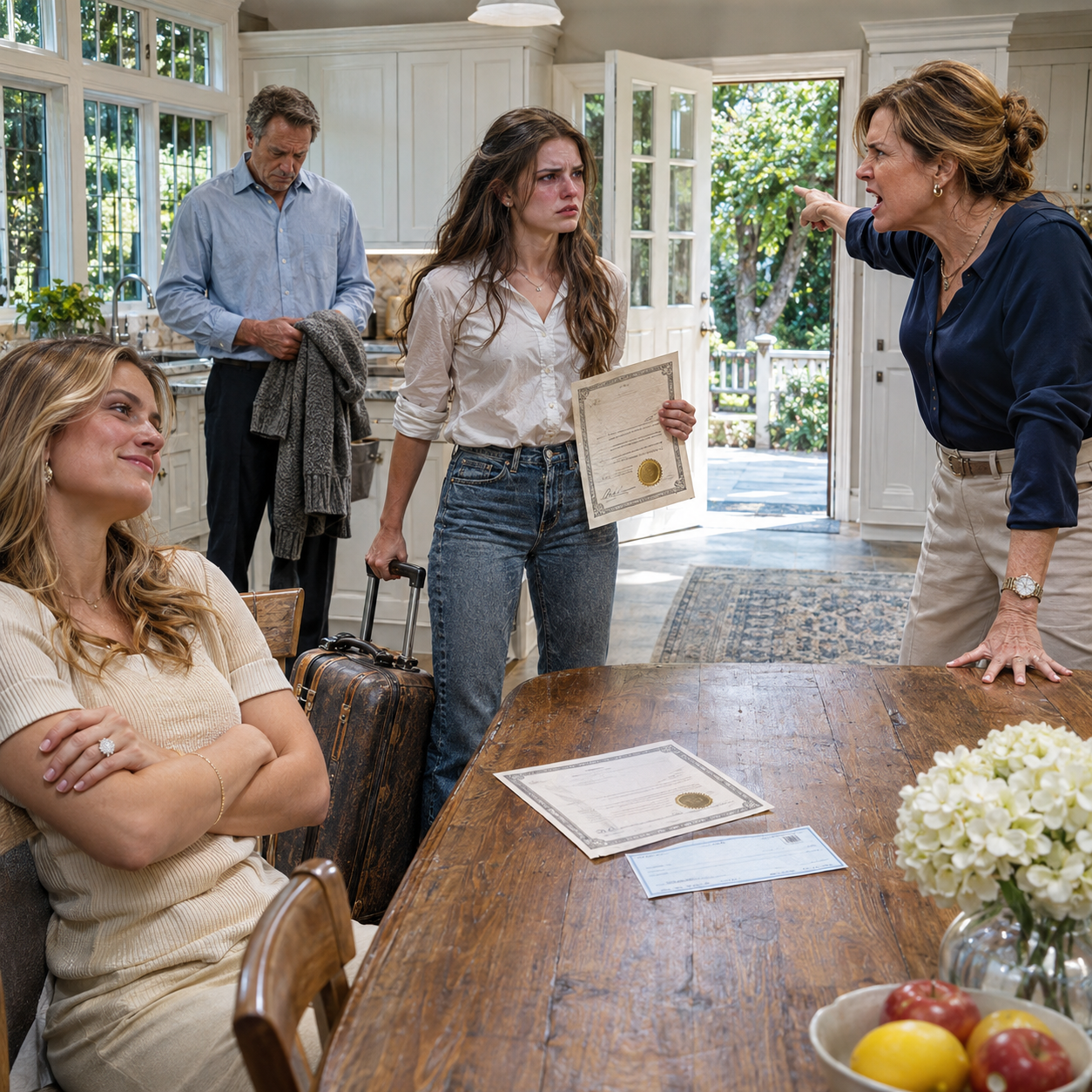
The document was a petition requesting that Callum be appointed co-trustee of the Whitaker Family Trust. It contained Harper’s signature and a notary’s seal.
My father had created that trust when Harper was born. He had been a quiet, practical man who wanted his granddaughter to have opportunities he hadn’t enjoyed. Through careful investments, the trust had grown to approximately two million dollars.
Harper was its beneficiary, but the principal remained protected until her thirtieth birthday. Any change in its management required specific approvals, and the document Marian held was an attempt to begin that process.
“I found it in Callum’s study,” Harper said. “He told me I’d signed it after dinner one night.”
“Did you?” I asked.
“I don’t remember signing anything.”
Callum’s jaw tightened.
“You wanted me involved in managing your finances. We’ve discussed that dozens of times.”
“I wanted help understanding investments,” Harper replied. “I didn’t ask you to take control of Grandpa’s money.”
At that moment, Patricia returned with a tablet and two investigators who introduced themselves as agents from the South Carolina Law Enforcement Division. They spoke quietly with Marian and our attorney, Phyllis Crane, who had been waiting nearby.
With the investigators present and the hotel’s permission, Patricia brought up surveillance footage from the service corridor outside the bridal suite.
The video was timestamped 6:52 that morning.
A figure approached the suite carrying a small bag. The person knocked, and Callum opened the door, already dressed in his tuxedo. He accepted the bag, exchanged a few words, and went back inside.
Archer Dre stood near the rear doors, watching the screen.
“That proves absolutely nothing,” he said.
“You’re correct,” Agent Moser answered. “It doesn’t show what was inside the bag.”
Patricia checked her delivery records. The hotel’s official floral arrangements, breakfast, and champagne had arrived through the main corridor later that morning. No delivery through the service stairs had been authorized.
Callum adjusted his cuff links.
“Someone brought me a personal item. That’s not a crime.”
“Then we’ll ask who brought it,” the agent said.
The answer seemed close enough to frighten someone. Near the bridesmaids’ seats, Sasha lowered her head and began twisting the bracelet around her wrist.
Harper noticed.
She stared at her best friend for several seconds, then turned toward Patricia.
“Can you connect something to the speakers?”
Patricia nodded cautiously.
Harper reached inside a concealed pocket in her dress and withdrew a small black recording device.
“I’ve been carrying this all morning,” she said.
Callum stopped adjusting his cuffs.
Harper looked at him with an expression I hadn’t seen from her in months.
“I want Dad to hear what you said when you thought I wasn’t listening.”
Part 3: The Secret Recording That Exposed The Betrayal Behind Her Marriage
Patricia connected the recorder to the ballroom’s sound system. Harper stood beside her mother while the investigators watched from a few feet away. I could see the small pulse beating in my daughter’s neck.
At first, we heard restaurant noise: silverware, indistinct conversation, the movement of chairs.
Then Callum’s voice emerged.
“She was asking too many questions at the Henderson dinner.”
Another voice answered. Archer’s.
“Because you didn’t follow the schedule.”
“I thought she needed to be more alert.”
“She needs to be alert enough to sign. Not alert enough to examine every page.”
There was a pause, followed by the clink of a glass.
Callum spoke again.
“Sasha’s handling the deliveries. She knows when Harper has meetings and when she’ll be home.”
Archer replied, “The trust paperwork needs to be completed before November fifteenth. Once those assets are committed to the partnership, separating them will be expensive enough to discourage anyone from trying.”
Callum said something too softly to understand.
His father answered, “You told me she trusted you. Make sure she keeps trusting you until we’re finished.”
Harper stopped the recording.
A woman in the second row covered her mouth. Somewhere behind me, someone muttered a curse. Several guests began gathering their belongings, but I barely noticed.
All I could think about was my father.
He had worked as a machinist for forty years. He’d saved carefully, invested modestly, and insisted that Harper’s inheritance should give her independence, not make her dependent on anyone.
And these men had apparently spent months devising a way to take it.
Callum stepped toward Harper.
“That conversation has been edited. You don’t understand what we were discussing.”
“Then explain it,” she said.
His eyes moved toward the investigators.
“You recorded a private business conversation without telling us.”
“I was sitting at that table,” Harper answered. “You invited me.”
Archer raised a hand toward his son.
“Don’t say another word.”
It was the first time I’d heard Archer sound anything less than completely certain of himself.
Marian put the recording device into an evidence envelope provided by Agent Moser. Then she turned toward Sasha.
“Sasha, I need to ask you something.”
Sasha’s face had lost all its color.
“Please don’t,” she whispered.
Harper looked between them.
“Sasha?”
Marian kept her voice steady. “How long have you been putting medication into Harper’s drinks?”
Sasha pressed her fingers against her mouth. Her shoulders moved as she struggled to breathe evenly.
Callum took one step toward her.
“Sasha, remember what we discussed.”
Agent Moser moved between them.
“Mr. Dre, stay where you are.”
Sasha began crying. Not loudly at first, just little broken sounds that she seemed determined to contain.
“Eight weeks,” she finally said.
Harper stared at her.
“What?”
“About eight weeks. Mostly in your coffee. Sometimes your water bottle at the studio.”
Harper stepped backward until her shoulders touched the wall.
“You made me coffee every morning.”
“I know.”
“You brought me lunch when I was too tired to go out.”
Sasha wiped her face with both hands.
“Callum told me you were having anxiety attacks and refusing treatment. He said his doctor had recommended something that would help, but you were too stubborn to take it.”
“Did you believe him?” Harper asked.
“At first.”
The words hung between them.
“At first?” Harper repeated.
Sasha looked down.
“I saw how tired you were getting. I asked him about it. He said the wedding pressure was making everything worse and that stopping suddenly would be harder on you.”
“Then why didn’t you ask me?”
Sasha’s eyes filled again.
“Because I knew you’d say no.”
Harper turned away.
The betrayal seemed to reach her in stages. First Callum, then Archer, and now the woman who had helped her select her wedding dress, organized her bridal shower, and sat beside her through every difficult moment of the engagement.
Sasha continued speaking to the investigator. She admitted Callum had supplied the liquid and instructed her when to use it. He had also promised to help her secure a better job through his father’s firm, something she desperately needed after months of financial trouble.
None of those explanations changed what she had done.
I crossed the room and stood beside Harper.
“Can I hold you?” I asked.
She nodded.
When I put my arms around her, she buried her face against my jacket.
“I thought I was losing my mind, Dad.”
I pressed my cheek against her hair.
“I wish you’d told me.”
“I wanted to. But every time I tried, I couldn’t figure out where to start.”
Across the room, Agent Moser began speaking privately with Callum and Archer. Phyllis handed him copies of the trust petition, toxicology reports, and correspondence Marian had collected over the previous three weeks.
I looked at my wife.
“You knew about the recording?”
She nodded. “Harper came to me first. After we got the test results, she wanted proof that no one could explain away. With Phyllis’s guidance, we arranged for her to record that dinner.”
“You let her go back to them?”
“She chose to go, Dean. We made a safety plan, and she had people nearby. I hated every minute of it.”
I looked toward Harper, who was listening quietly to the investigator’s questions.
“And today?”
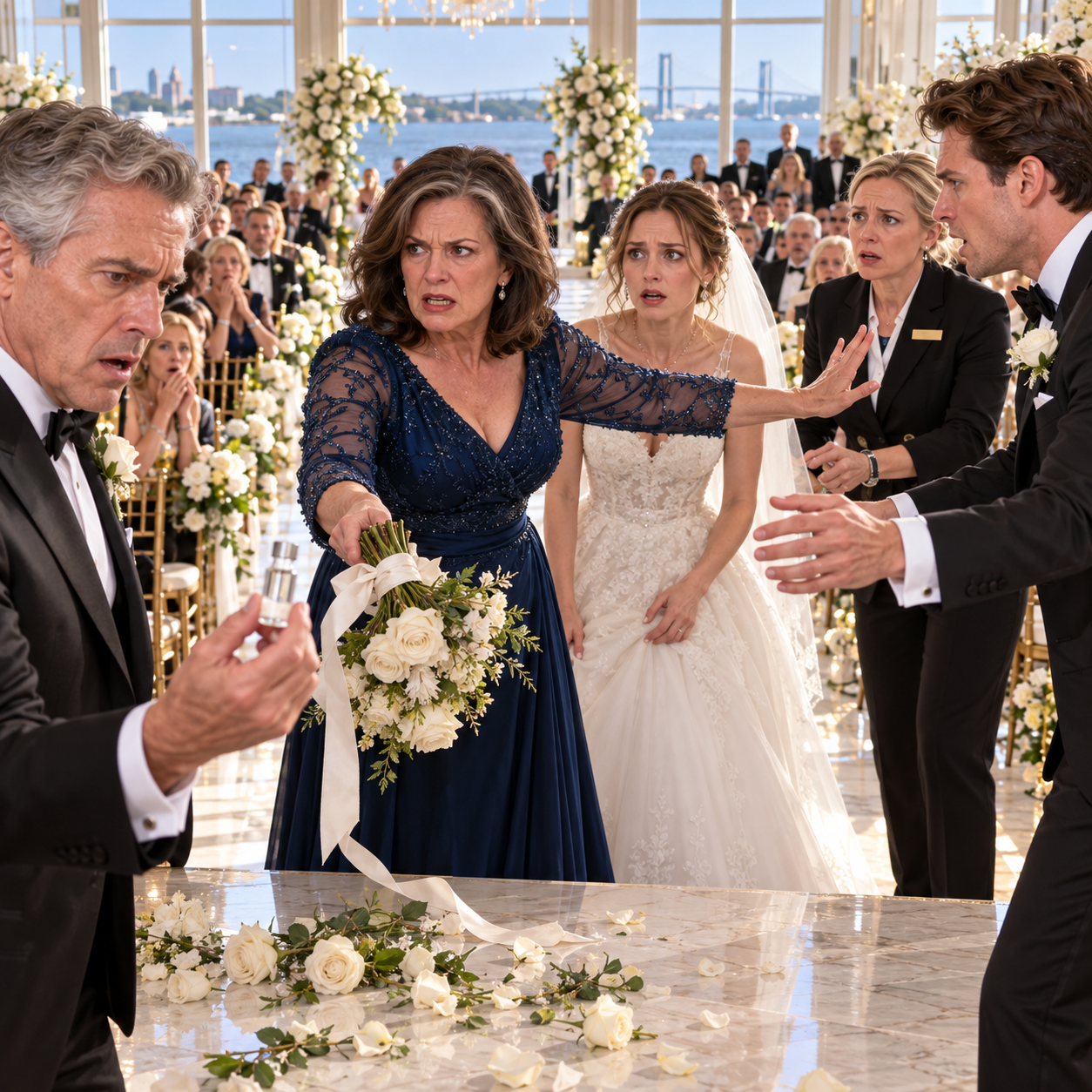
“She agreed to come here knowing the ceremony would probably be stopped. But she didn’t know about the vial in the flowers. Neither did I, until I saw it tucked between the stems when she passed our row.”
Marian took a breath.
“I kept you out of it because Archer was watching us. You have never been good at pretending everything is fine. He would have known something was wrong before we had a chance to preserve the evidence.”
I wanted to argue, but I remembered how readily I’d shaken Archer’s hand that morning.
My wife had been right about me.
Harper reached for my hand.
“Dad, Mom didn’t make me do this. I needed to hear Callum answer for it. I needed to stop feeling like I was imagining things.”
I squeezed her fingers.
“Then I’m staying right here.”
As the investigators began their formal interviews, Harper looked toward the altar one last time.
The white roses were still perfect. The wedding candles were unlit. Her empty place beside Callum seemed strangely ordinary.
She removed her engagement ring and placed it in a small dish on the nearby gift table.
Then she turned away.
Part 4: When The Truth Emerged, My Daughter Reclaimed The Life They Stole
The hotel staff quietly guided the guests out through the side doors. Patricia arranged for Harper to use a private room while investigators collected evidence. By early afternoon, the wedding decorations were being dismantled, and the reception dinner for four hundred people had been canceled.
Harper sat on a sofa with her shoes off, her wedding gown gathered around her knees. Marian brought her water, then sat beside her without trying to fill the quiet.
I pulled up a chair.
For several minutes, we simply stayed together.
Finally, Harper looked at me.
“Are you embarrassed?”
I stared at her. “About what?”
“All those people. Grandpa’s money. Everything.”
I moved my chair closer.
“Sweetheart, your grandfather left you that trust because he wanted you to have choices. And nothing that happened today takes away who you are.”
She studied my face.
“I still loved him yesterday.”
“I know.”
“Part of me keeps remembering the good things.”
“Those memories don’t disappear just because you’ve learned something terrible.”
She leaned her head against Marian’s shoulder.
“I don’t know how to trust myself anymore.”
Marian brushed a loose strand of hair away from her face.
“Then don’t demand that of yourself today. We’ll start with making sure you’re healthy and safe. The rest can come slowly.”
The vial recovered from the bouquet was later tested through proper laboratory procedures. Investigators documented its contents alongside the earlier substance analysis and Harper’s medical results. The recordings, hotel footage, financial documents, and witness statements became part of a much larger investigation into the Dres’ efforts to gain control of her inheritance.
Formal charges followed. Callum pleaded not guilty, and Archer hired separate counsel as investigators examined the proposed partnership transactions. The legal proceedings moved slowly, especially after authorities began reviewing financial records involving several businesses connected to Dre Capital Management.
Sasha cooperated with prosecutors and ultimately received a suspended sentence. She moved to Asheville to live with her sister. She never contacted Harper again, and Harper made no attempt to reach her.
The trust petition was challenged and invalidated. My father’s money remained protected for his granddaughter, and Phyllis helped us put additional safeguards in place.
But the hardest part of recovery had nothing to do with money.
Harper sometimes woke up convinced she’d forgotten an important appointment. She double-checked emails she’d already read and became anxious whenever someone told her they remembered a conversation differently. With medical follow-up, counseling, and time, those habits gradually began to loosen their hold.
One afternoon in January, I found her at our kitchen table drawing a pattern of magnolia leaves.
“Working on something?” I asked.
“Maybe.”
She tilted the sketchbook toward me. It was a textile design, intricate and beautiful, with deep green leaves curling around pale flowers.
“I’ve been thinking about that studio again.”
“The one on King Street?”
She nodded.
“I looked at the space online yesterday. It’s still available.”
I sat down opposite her.
“What are you waiting for?”
She considered that question for a long moment.
“I think I’ve gotten used to asking somebody else whether my plans make sense.”
I smiled. “Well, you picked the wrong person to ask. I still think every building needs another support beam.”
That made her laugh, and for the first time in months, she didn’t immediately look away afterward.
By April, Harper was ready to sign a lease.
The storefront was small, with two bright rooms, exposed brick, and an enormous front window overlooking King Street. The floors needed refinishing, and the rear door stuck when the weather turned humid. I pointed out several repairs, but Harper walked through the space with growing excitement.
“We can put the cutting table there,” she said. “Shelves along that wall. And maybe a couple of chairs for customers.”
“We?” I asked.
She turned toward me, smiling.
“You’re my volunteer construction consultant.”
“I charge by the hour.”
“I’ll buy you lunch.”
“That’s a terrible business arrangement.”
“Good thing you’re retired from negotiations.”
Marian stood near the window watching us. She laughed softly, then wiped at the corner of one eye before either of us could comment.
Harper signed the lease the following Tuesday.
She named the business Whitaker Textile Studio.
There was no grand opening party, no hundreds of guests, and no elaborate arrangements. A few friends came with pastries and flowers. Marian brought coffee, and I hung the wooden sign Harper had painted herself.
Standing beneath it, my daughter looked up at her own name.
“I think Grandpa would’ve liked this,” she said.
“He would’ve asked to see your books first,” I told her.
She laughed. “Then he definitely would’ve liked it.”
Later that evening, Marian and I drove home through Charleston with the windows partly open. The air smelled of jasmine, and the last sunlight was catching the iron gates along the old streets.
For a while, neither of us spoke.
Then Marian lowered her phone.
“Do you still wish I’d told you everything before the wedding?”
I considered the question.
“Yes,” I admitted. “But I understand why you didn’t.”
She watched the passing houses.
“I was afraid I’d lose both of you,” she said. “Harper was frightened, and I didn’t know how far those men would go once they realized we were looking into things.”
I reached across the console and took her hand.
“You didn’t lose us.”
She threaded her fingers through mine.
“No,” she said. “We were lucky.”
I knew what she meant. We had caught the deception before Harper’s inheritance was transferred, but we couldn’t give her back the weeks of confusion and fear. Or the friendship she had trusted. Or the future she had imagined with the man waiting at the altar.
Six months earlier, I had stood in a ballroom holding a glass vial, wondering how a father who spent his career finding hidden weaknesses could have missed the trouble developing inside his own family.
I still think about that question.
But these days, when I visit Harper’s studio, I see her working beneath the big front window, surrounded by fabrics and sketches and plans that belong entirely to her. She makes decisions without asking permission. Sometimes she makes mistakes, and she laughs about them afterward.
There is a photograph on my office windowsill now. It shows Harper standing outside her studio between Marian and me, the new sign visible above our heads.
Her smile is slightly crooked because I’d made a ridiculous comment just before the camera clicked.
It’s the same smile she had when she was seven, when she discovered she could ride her bicycle without me holding the seat.
I used to think protecting my daughter meant making sure she never fell.
Now I understand that love also means recognizing when someone has taken away her ability to stand on her own, and helping her find it again without taking control of her life.
On her wedding day, Harper walked toward a man who had tried to steal her independence.
Today, she walks into a business bearing her own name, unlocks the door with her own key, and decides for herself what the day will bring.
And whenever I see her there, I remember my father telling me that the strongest structures aren’t the ones that never experience pressure.
They’re the ones that are given the support they need to stand.
The End .
All characters and events in this story are fictional, created for storytelling and entertainment purposes. Thank you sincerely for reading. Your feedback and support are invaluable and motivate me to continue sharing more stories with you.