
Part 2: A False Debt Turned Our Family Celebration Into A Reckoning
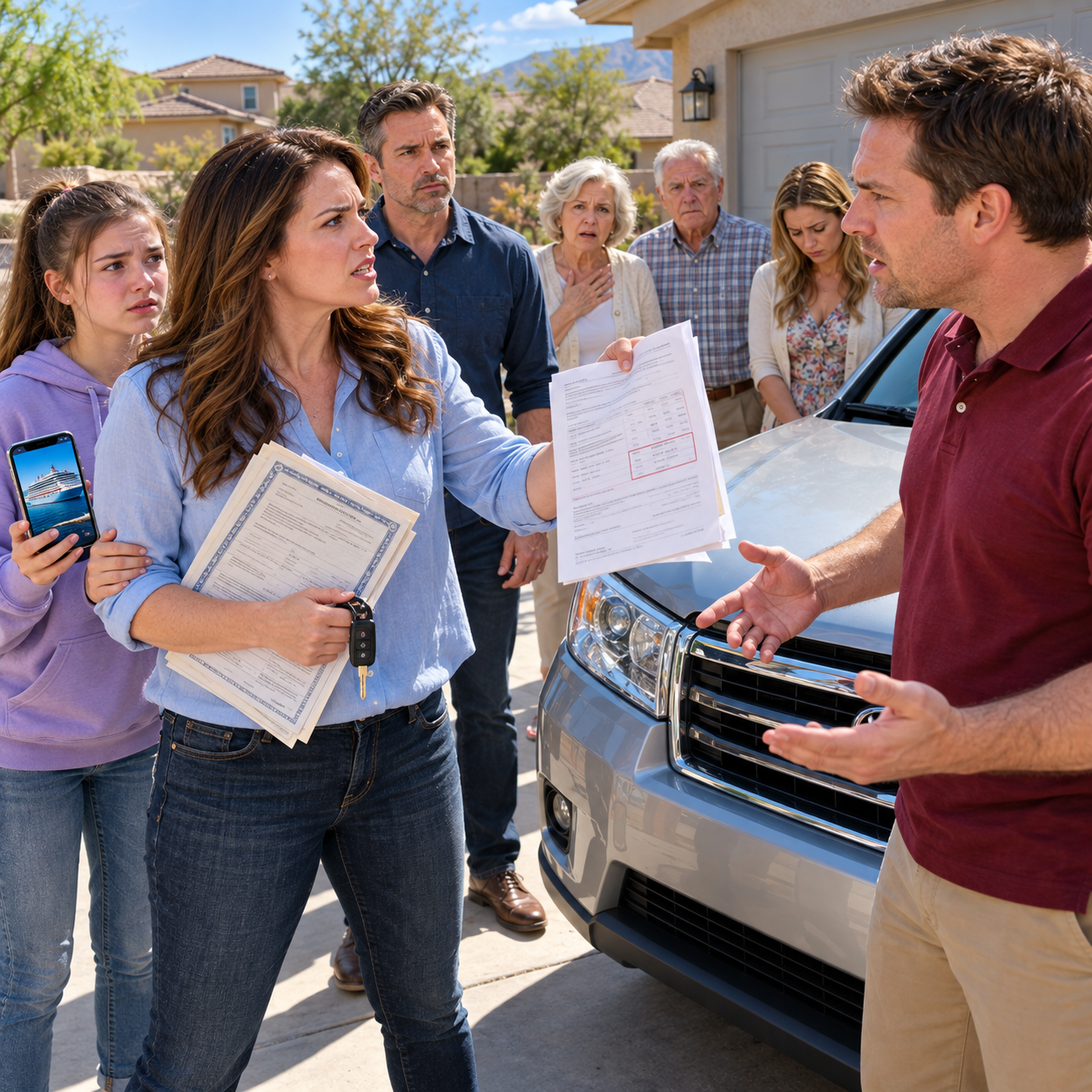
Callie stood beside me while I examined the notice. Grant had calculated 594 days of supposed storage at six dollars per day, then added $1,200 for new tires. The arithmetic was correct, which made the dishonesty almost impressive. He’d borrowed my vehicle, driven it daily, and now wanted me to pay him for the privilege of having it returned.
“Is this because he doesn’t want me on the cruise?” Callie asked. I told her it wasn’t her responsibility, but she pointed to the dates and said, “He sent this after you asked for the car back.” She was right. I asked her to go finish her homework, then called my oldest friend, Corey, an attorney who had known Grant since he was young enough to borrow lunch money.
Corey asked me to read the notice aloud. She explained that a legitimate storage lien generally required circumstances very different from a brother borrowing his sister’s SUV. Grant wasn’t operating a storage business, and I had never contracted with him to store or repair anything. Still, she warned me not to assume an invalid claim couldn’t cause trouble. “We challenge it through the court,” she said. “And until then, don’t go over there and turn this into an argument in the driveway.”
On October 27, we filed our challenge at the Pima County justice court, seeking to prevent any transfer while the dispute was reviewed. I missed two organizing appointments that morning, and one client decided to hire someone else. Corey helped me collect evidence, including county property records showing that the address Grant called his storage facility belonged to our parents, Norman and Judy. We also requested certified telephone records for March 2, 2024, the morning Grant originally borrowed the SUV.
That evening, Grant posted in our family group chat that I was suing him over a vehicle I’d supposedly given him. He added that everyone should pray for me, then announced he wouldn’t discuss the matter further. Dad responded with two words: “What gift?” Nobody answered, although I noticed Mom had read the conversation.
Mom called two days later. She wanted me to drop the dispute before the bridal shower she was hosting in November, saying our family had already endured enough embarrassment. I reminded her that the SUV had been mine since 2021 and that Grant had borrowed it because he needed help. “It’s only a car, honey,” she replied. I looked at the stack of registration payments on my desk and wondered when being dependable had become an obligation to surrender whatever someone else needed.
On November 15, thirty guests gathered at my parents’ house for my bridal shower. Ross’s relatives mingled with longtime neighbors beneath pastel balloons, while Aunt Wendy arrived carrying a karaoke machine she’d insisted would make the afternoon memorable. The Highlander was parked prominently along the curb, where every arriving guest passed it. Grant stood near the dessert table with Courtney, barely speaking to me until he tapped a spoon against his glass.
“I think people should know my sister’s suing me over a car she gave me,” he announced. “I tried to handle it privately, but apparently that wasn’t good enough.” Ross lowered the gift bag he was opening, and I could see several guests looking between us, uncertain whether Grant expected applause or sympathy. I kept my hands folded around my water glass.
Mom’s neighbor, a retired nurse named Helen, asked why Grant was paying storage fees on a gift he’d supposedly received. Grant shifted his weight and said the real problem was that I’d been making trouble ever since the cruise reservations. When Helen mentioned Callie’s removal, he waved a hand toward Mom. “She didn’t want another teenager in the cabin. I was just handling things for her.”
Mom turned away from the cake she’d been cutting. “I never told you to remove Callie,” she said, laying down the knife. Grant tried to remind her of a conversation at the kitchen table, but she shook her head. “I told you she was coming with us. You said Disney had made a mistake.”
Callie, who had been sitting near Ross’s cousin, took out her phone. Grandma had forwarded her an email Grant originally sent as proof of the supposed booking error. The notification was dated September 19, and the wording was unmistakable: the guest had been removed by the lead guest on the reservation. Callie held the screen toward her grandmother and said, “That’s Uncle Grant, isn’t it?”
Mom read it twice. When she looked up, Grant was staring at Courtney, who had lowered her eyes to the carpet. Dad asked whether Grant had also been charging Jolene storage fees for parking the Highlander in a garage he didn’t own. Grant muttered something about fairness, but Dad answered, “You don’t get to call my property yours because you’re living here.”
The shower didn’t recover its cheerful rhythm. Corey quietly collected the names of relatives who’d heard Grant’s statements, while Wendy abandoned karaoke and helped Mom clear plates. I found Callie afterward in the hallway, staring at the email on her phone. “I wasn’t trying to embarrass him,” she said. I kissed the top of her head and told her the truth didn’t become unkind simply because somebody wished she’d kept it hidden.
Part 3: The Records My Brother Ignored Finally Spoke For Themselves
On December 12, Grant’s court documents arrived in a thick envelope. He had included a receipt for four tires, a typed log listing daily storage charges, and a statement declaring the Highlander an outright gift. I spread everything across our dining table while Callie worked nearby on a school project. Ross made coffee and left us alone, knowing I’d need time to examine each page.
The storage log was Grant’s biggest mistake. It claimed my Highlander had remained at our parents’ house every day since March 2024, but Courtney had posted family photographs from Lake Havasu over Memorial Day weekend. Callie remembered the pictures and found one showing Grant’s two boys beside the SUV, its license plate clearly visible. Corey added the photograph to our evidence, along with the dates and the original post.
That same evening, Callie received a message from Grant. “You ruined the trip for everybody. You know that, right?” She brought me her phone without answering, although her fingers trembled slightly as she handed it over. I saved the message, then told my brother in writing that he was no longer to contact my daughter directly about the dispute. His disagreements with me were not hers to carry.
For several weeks, I worked extra hours, packed lunches instead of buying them, and reviewed the court documents every evening. Our wedding plans remained modest, and Ross never complained about the financial strain, although I sometimes caught him calculating expenses at the kitchen table. He reminded me that selling the SUV was still my choice once it was returned. I appreciated that he never told me what I ought to forgive.
The hearing took place January 16. Grant represented himself, looking uncomfortable in a suit he’d worn to church for years, while Corey sat beside me with carefully labeled exhibits. Our parents attended, along with Courtney, who had spent the previous month avoiding most family conversations. The judge listened as Grant insisted I had given him the Highlander because I knew how badly he needed transportation.
Corey presented the title bearing my name, the county property records, the photograph from Lake Havasu, and the certified telephone log. She asked Grant whether he owned the house where he’d supposedly been providing storage, and he admitted he did not. Then the judge examined the call records showing that Grant had contacted me at 9:41 on the morning he’d borrowed the car. Two minutes later, a message had arrived from his number.
Corey asked permission to read it aloud.
“Thanks, sis. I’ll treat your Highlander like it’s mine and hand it back the day I’m on my feet.”
Grant rubbed his forehead. “That’s what I meant by giving it to me,” he said, then stopped when he noticed the judge looking at him. Corey asked how promising to return something could establish that he’d received it as a gift. He had no explanation beyond saying family arrangements were complicated.
The judge took the matter under advisement. Eleven days later, a written ruling arrived declaring the lien void and ordering Grant to pay court costs. I read it at the kitchen counter, where the entire ordeal had begun, and called Corey. She congratulated me, but recommended arranging a civil standby with a deputy when I retrieved the vehicle, given Grant’s previous threats.
On January 30, Ross and I drove to my parents’ house in separate cars. A deputy waited at the curb, reviewed my title and the ruling, and accompanied me to the Highlander. Grant appeared on the porch as I unlocked it with the spare key I’d kept since 2024. He insisted I couldn’t simply drive away, even after the deputy explained that the ownership dispute had been resolved.
When I started the engine, Grant pulled out his phone and attempted to report the vehicle stolen. The deputy stood nearby, listening as Grant described the SUV before calmly pointing out that its titled owner was present with a court ruling. Grant ended the call without finishing his accusation. Behind the front window, Courtney watched with one hand pressed against the curtain.
As I prepared to leave, she opened the window and called my name. “He said Callie would keep asking about the car on the cruise,” she said. “At dinner, in front of everybody. He didn’t want to explain why he still had it.”
I looked toward Grant, standing beside the porch steps with his phone in his hand. After everything he’d written about protecting his sons’ vacation, the truth was painfully ordinary. He’d excluded a fourteen-year-old because he feared she might ask an honest question about something he was ashamed to explain.
Part 4: I Paid For Our Passage And Found Something More Valuable
Four days later, I drove the Highlander to CarMax with Callie beside me. The appraisal came back at $27,500, enough to cover the remaining cruise balance with $1,900 left over. I accepted the offer, then emptied the glove compartment and collected the little things left behind: an umbrella, some receipts, and a faded hair tie. I had purchased that SUV after rebuilding my life from divorce, and signing away its title felt less like winning than surrendering something I’d once been proud to own.
Callie asked whether we could keep the spare key label I’d written when Grant first borrowed the car. It still said “Grant—temporary,” the ink slightly faded after almost two years. I peeled it off and placed it inside the binder, between the original purchase documents and the court ruling. Then we drove home in the Corolla.
Ross and I married on April 18 in a small ceremony surrounded by people who loved us without asking what we could provide. Dad walked me down the aisle, Mom cried through her reading, and Callie helped me straighten my veil before the ceremony began. Grant attended with Courtney but kept his distance. Nobody made speeches about forgiveness, and I was grateful for that.
On June 12, Callie and I arrived at the Vancouver cruise terminal shortly before noon. Ross had stayed in Tucson for a training week at his new job, promising to hear every detail when we returned. Thousands of passengers moved through the terminal, and Grant’s family stood near the front of a long line with Mom and Dad. Grant wore a captain’s hat, smiling as his boys argued cheerfully over which activity they wanted to try first.
A concierge host approached us near a separate entrance and greeted Callie by name. My daughter looked at me in surprise as the woman explained that our suite included priority boarding. Someone collected our luggage, and another attendant offered Callie lemonade. She held the glass with both hands, glancing toward the ordinary boarding line.
Grant noticed us as we approached the private walkway. His expression changed when he recognized the concierge sign above the door, but he said nothing. One of his boys asked whether they could use our line next time, and Courtney gently told him to stay with his father. I would have kept walking without another glance if Mom hadn’t stepped away from the ropes.
She crossed the terminal toward us, leaving Dad to watch their luggage. When she reached Callie, she took her granddaughter’s hand and bent close enough to speak privately. “You were the first grandchild I ever took boating, remember?” she said, reminding Callie of an afternoon on Grandpa’s leaky fishing boat years before. Callie laughed, then leaned into her grandmother’s shoulder.
Mom asked whether she could accompany us to the entrance before returning to Dad. The concierge host agreed, and Callie walked between us, talking excitedly about the ship. For the first time in months, she wasn’t watching anyone’s expression to see whether she belonged.
The cruise wasn’t perfect. We sometimes disagreed about activities, ate too much dessert, and spent one rainy afternoon watching movies in the suite. But Callie and her grandparents shared meals, photographs, and long conversations, and Grant couldn’t erase her presence from any of them. She returned home with a sunburned nose, a suitcase full of souvenirs, and a confidence I hadn’t seen since before his first message.
On July 11, the family gathered for a backyard barbecue at my parents’ house. Ross helped Dad grill burgers while Wendy arranged folding chairs beneath the patio shade. Grant stayed near the fence for much of the afternoon, then approached Mom and asked whether everyone could finally forget the whole business. She told him forgetting wasn’t the same as repairing what he’d damaged.
Courtney stood beside him, looking tired. She said she’d been examining other paperwork he’d handled and that they needed to discuss their finances privately. Grant started to object, but Dad arrived carrying a small carbon-copy receipt book and the keys to his old minivan. He announced that Grant and Courtney would begin paying $650 monthly rent, effective July 1, under an arrangement he and Mom had already discussed.
Grant stared at the book. “Dad, we’re your family.”
“Of course you are,” Dad replied. “And you’ve been living here without contributing while telling a court this house belongs to you.” He handed Grant the pencil attached to the book. “If you want to be treated like a responsible adult, we’ll start by writing things down.”
Grant hesitated, then recorded his first payment. Dad took the yellow copy and slipped it into his shirt pocket without another word. Wendy chose that moment to turn on her karaoke machine, announcing a particularly appropriate song about paying money owed. Grant groaned, and even Courtney managed a tired smile.
I didn’t join in the teasing. I’d spent too many months fighting to recover something that never should have been taken, and I knew a receipt book couldn’t repair the trust we’d lost. Instead, I walked over to Callie, who was helping Grandma arrange watermelon slices on a platter. She looked up and asked whether we could frame one of their cruise photographs for her bedroom.
It showed three generations standing together against the bright blue ocean, Mom’s arm around Callie’s shoulders and my hand resting on hers. I told her we’d find a frame the next day. Across the yard, Dad was explaining the minivan’s stubborn ignition to Grant, and Wendy’s singing drifted through the open patio doors.
For the first time, I wasn’t responsible for solving my brother’s problems. I had a husband who stood beside me, parents finally learning to set boundaries, and a daughter who understood she didn’t have to make herself smaller to keep peace in the family.
And when Callie reached for my hand beneath the table, I knew the most important thing we’d brought home from that cruise wasn’t a souvenir. It was the certainty that she had every right to take up space in the world, whether her uncle made room for her or not.
The End .
All characters and events in this story are fictional, created for storytelling and entertainment purposes. Thank you sincerely for reading. Your feedback and support are invaluable and motivate me to continue sharing more stories with you.


