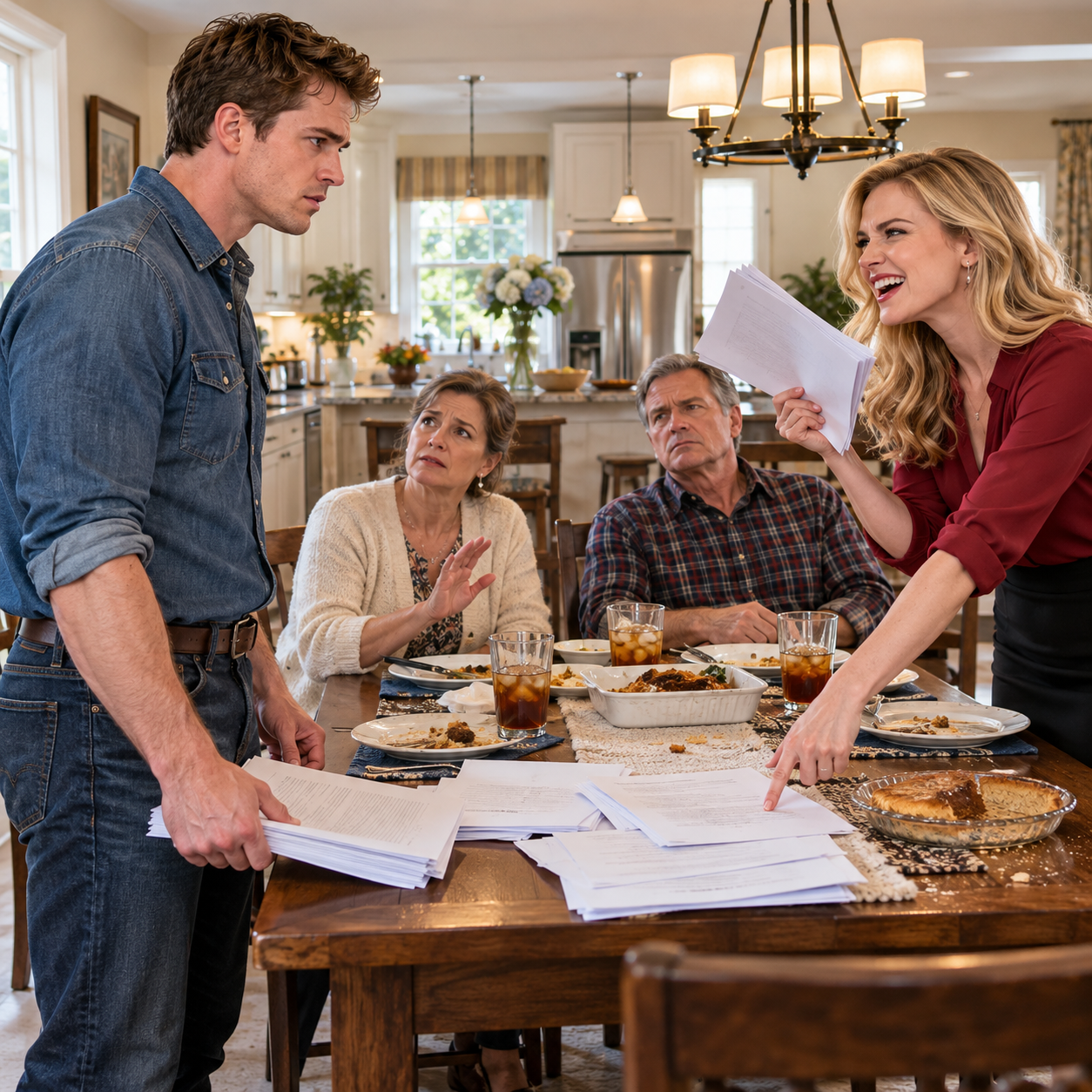
Part 2: My Biggest Achievement Became The Celebration My Family Abandoned
Margo sold my novel to a publishing house in January 2025. The advance wasn’t enough to quit my job, and I had no intention of doing so, but it was more money than I’d ever earned sitting at a desk. I paid off my own pickup, deposited the remainder, and reported for work Monday morning as usual. My foreman, Arch, congratulated me and then handed me a work order for a damaged transformer.
My family received the news with considerably less enthusiasm. Dad wanted to know whether the publisher was legitimate, Mom warned me against becoming conceited, and Meredith spent dinner silently cutting her pot roast into pieces smaller than necessary. Later that evening, she posted a message congratulating her little brother and joking that she hoped he’d remember who taught him how to use punctuation. Several relatives congratulated her too, as if my book were a project she’d supervised.
The novel was released the following April, and Twila, who owned a small independent bookstore near Nadine’s, arranged a Saturday signing. My coworkers arrived with their wives, neighbors brought copies for their grandchildren, and people I’d never met asked questions about how power outages were repaired. Erin stood near the back beside a display of cookbooks, smiling whenever someone shook my hand. Mom stayed ten minutes, Meredith had grading to finish, and Dad watched a Cardinals game at home.
Then, in June, Margo called with news I couldn’t quite comprehend: my novel had reached number eleven on a national bestseller list. Erin shrieked when I told her, nearly dropping the carton of milk she’d been putting away. Mom congratulated me in the same careful voice she used when someone showed her pictures from a vacation. Before ending the call, she asked me not to mention the achievement too often around Meredith because my sister was having a difficult year.
At Mom’s birthday dinner in July, Aunt Verla asked me to autograph a copy for her grandson. Meredith watched from the couch and remarked that commercial success didn’t necessarily mean literary quality. “It’s the kind of thing people buy at airports,” she said, smoothing her skirt. “Nothing wrong with that, obviously.” Aunt Verla told her she’d enjoyed the book, and Meredith smiled without looking at her.
I signed the boy’s copy and changed the subject. I’d spent too many years trying to convince my sister to recognize something she had already decided not to see. Besides, I had better things to celebrate: I was turning thirty in August, my book had remained on the bestseller list for six weeks, and I was finally ready to introduce Erin properly to my extended family. We’d been together more than two years, but I’d kept her at a distance from the people who had made me afraid to show anyone my writing.
I reserved the Elks Lodge hall for August 15, ordered barbecue for forty, and mailed invitations to thirty-eight relatives. My parents promised that all three of them would attend, and Mom even asked whether Dad needed to wear a tie. Erin bought a new blue dress and wrote my mother a card, saying how much she looked forward to meeting her. By the beginning of August, twenty-nine relatives had confirmed, enough for me to imagine an evening that might finally feel uncomplicated.
There was one thing troubling me, though. Near the end of July, Margo forwarded an email Meredith had sent her on July 9. My sister had introduced herself as my first editor, claiming she’d taught me the fundamentals of storytelling and helped shape my development as a novelist. She’d attached three chapters of her own unfinished manuscript and requested representation.
Margo explained that she’d already declined the submission, but wanted to verify whether Meredith’s claim about editing my work was accurate. I replied that Meredith had read fifty pages before publication and dismissed the manuscript as garbage. Margo thanked me for clarifying. I didn’t confront Meredith, partly because I assumed the rejection would end the matter and partly because I wanted one family celebration without an argument.
On August 15, I arrived at the lodge two hours early. Roy, the elderly lodge secretary, helped me set out white tablecloths, paper plates, and a stack of complimentary copies of my novel near the entrance. Each family member could take one home, and I’d brought a pen to sign them. At six o’clock, the brisket was ready, the birthday cake sat beneath a plastic cover, and every chair was empty.
At six-fifteen, I checked the parking lot. By six-thirty, I had called my parents and Meredith, then tried several cousins, receiving nothing but voicemail. At seven, I sent a message to the family group asking whether everybody was all right. My phone remained on the table beside a folded napkin while the buffet warmers hissed softly against the back wall.
Erin arrived around seven-thirty after closing the library. She stopped inside the doorway, holding a small gift bag and the card she’d written for Mom, and looked from the empty tables to the untouched food. I tried to apologize for the evening, but she put her things down and pulled out the chair beside mine. “That brisket smells wonderful,” she said. “Are we really going to let forty people’s dinner go to waste?”
We ate beneath the decorations we’d hung that afternoon. Roy eventually brought aluminum foil and helped us package the leftovers, pretending not to notice that I hadn’t touched my cake. As we were leaving, he pressed my shoulder and wished me a happy birthday in a voice that sounded almost paternal. Erin drove us home because I’d spent most of the evening staring at my phone.
The following morning, she showed me a Facebook photograph posted by Meredith. My parents stood on a dock at Table Rock Lake, surrounded by nearly every relative I’d invited, with drinks raised toward the camera. Behind them hung a banner celebrating Dad’s sixtieth birthday, which had been the previous day. Meredith’s caption described a surprise family weekend at two rented lake houses and cheerfully blamed their absence from social media on having no cell service.
I later learned she’d organized the entire trip through a separate family group chat that excluded me. Several cousins assumed my party had been rescheduled, but my parents knew the original date and had driven to the lake anyway. I examined the picture for several minutes, noticing Mom’s matching sunglasses with Dad, Meredith standing beside the birthday banner, and the cousins who’d promised to attend my dinner.
That evening, I opened my banking app and canceled Dad’s automatic $640 transfer. Then I removed my checking account from Meredith’s $410 student loan payment. After three years of paying both bills, the cancellation took less than five minutes.
On Monday morning, Mom texted, “Devon, did something happen?”
I answered, “No, Mom. I finally understood.”
Part 3: My Sister Demanded A Favor Before Her Oldest Lie Surfaced
On Thursday morning, someone knocked hard enough to rattle the glass in my front door. Dad stood on the porch with Mom behind him, gripping her purse, while Meredith waited on the steps wearing oversized sunglasses. Dad’s truck payment was due that day, and I understood why they’d arrived together. I invited them inside, although nobody seemed interested in sitting down.
Dad asked whether I intended to leave him responsible for the entire truck payment without warning. “You had three years of help,” I told him. “I had thirty-eight people promise to come Saturday, and not one warned me they weren’t coming.” Mom explained that Meredith had arranged the lake weekend for Dad’s birthday and that refusing to attend would have ruined the surprise. When I reminded her she’d promised to come to my celebration, she replied, “Sweetheart, yours was mostly about the book. You can celebrate a book whenever you want.”
Meredith removed her sunglasses and accused me of using money to punish the family. She mentioned her $26,000 annual income, the difficulty of finding a permanent teaching position, and the way she’d planned her budget around my assistance. Then her tone changed. “Look, there’s something else,” she said. “I need you to call your agent and recommend my novel. I’ve spent eleven years developing it, and after everything I’ve done for your writing, you owe me an introduction.”
I pulled up Margo’s email on my phone and turned the screen toward her. “You contacted her July ninth, Meredith. You told her you edited my book.” She stared at the screen without reaching for it, and I explained that Margo had declined her manuscript before confirming the truth with me. Mom looked toward Meredith, waiting for an explanation, but my sister merely said she’d been trying to make a professional connection. Dad suggested I could still put in a good word.
“No,” I said. “Not with Margo, not with the truck, and not with the loan.” Meredith demanded to know how one missed birthday party could justify treating family this way, and I told her it wasn’t one birthday party. As they moved toward the door, she turned and said I’d always been too sensitive about criticism. “I was eleven,” I answered, remembering the green notebook. She looked away before I closed the door.
That weekend, storms from Kansas damaged dozens of utility poles, keeping my crew working through two exhausting days. Afterward, I rented the lodge again for August 29, inviting coworkers, friends, Erin’s parents, and the people who had actually celebrated my book. Erin suggested displaying some of my childhood stories, so I opened three cardboard boxes Mom had returned when she converted my old bedroom into a sewing room. Beneath Little League photographs and school papers, I found the green spiral notebook.
Erin took the notebook to the library, where she remembered an anthology of old county writing-contest winners. She called me during my lunch break and asked me to come see something. That evening, she placed the 2008 anthology beside my notebook on an oak table in the local history room. Meredith’s prizewinning story, titled “The Storm,” described a boy searching for his grandfather’s missing beagle during a thunderstorm.
I read the opening paragraph twice before touching the notebook beside it. The printed story followed my childhood manuscript almost word for word, except that Rufus had become Buster and Meredith had incorporated her handwritten corrections. Erin had identified forty-one matching changes, including the replacement ending my sister had written in red. The story that earned Meredith her first literary recognition was the same story she’d called garbage when I was eleven.
Part 4: The Childhood Notebook Revealed Who Had Truly Written Her Success
On August 29, the lodge was crowded before six. Arch arrived wearing a pressed shirt, Nadine brought homemade pies, and Twila carried a sign announcing the celebration of Joplin’s bestselling lineman. Erin arranged my old notebooks on a table near the entrance beneath a card reading “Where It Started.” The green notebook lay open to its first page, with Meredith’s red handwriting visible above my childhood sentences.
Shortly after seven, Roy approached me and quietly said my parents were standing near the entrance. Meredith had come with them, looking uncomfortable in a dark dress, and Mom was carrying a birthday gift. I learned later that two of Dad’s lodge friends had questioned him about missing my original celebration, prompting Mom to insist the family attend this one. She offered me the gift, explaining that they wanted to make things right.
Before I could respond, Meredith approached the display table and recognized the green notebook. She stared at the first page, then looked toward me. I asked the three of them to follow me into the adjoining kitchen, where Erin joined us while I retrieved the county anthology from my truck. I laid both books on a stainless-steel counter, opening them to their matching stories.
“Mom, you remember the newspaper clipping in your hallway?” I asked. She nodded, and I pointed to the anthology. “This is the story Meredith won with. And this is the notebook I wrote it in.” Mom compared the opening passages, turning the pages slowly enough to study Meredith’s red corrections. Then she asked her daughter whether she’d submitted my writing under her own name.
Meredith pressed her fingers against the edge of the counter. “He was eleven,” she answered. “He wasn’t going to enter it himself.” Dad looked from one page to the other and asked whether the judges knew it wasn’t entirely her work. Meredith said she’d improved the story, that she had been fourteen and desperate to prove herself, and that nobody could reasonably expect her to undo something from childhood. She sounded less certain with each explanation.
“You didn’t just take the story,” I told her. “You spent the next nineteen years making sure I believed I couldn’t write.” Meredith opened her mouth, then closed it, and Mom covered her face with one hand. I reminded them of the framed clipping, the dinners when Meredith dismissed my work, and the letter claiming she’d been my editor. When Dad started to interrupt, I asked him to finish reading the notebook first.
He studied the pages until he reached the ending. “We were so proud of that prize,” he said quietly. Mom lowered her hand and looked toward Erin, who was standing beside the doorway. I introduced the woman who had believed in my book before anyone else, explaining that she’d written Mom a card for the celebration the family had skipped. Meredith’s eyes filled as she accused me of humiliating her, but I didn’t argue.
“I wanted you to see what happened,” I said. “That’s all.” I picked up my notebook, left the anthology on the counter, and returned to my guests. Erin joined me a moment later, slipping her hand into mine as Nadine cut another pie and Arch argued cheerfully with Roy about the Cardinals. My family departed without another confrontation, leaving the unopened gift beside the entrance.
In the weeks afterward, Dad resumed paying for his own truck, and Meredith found weekend work at Twila’s bookstore to cover her student loan. Twila mentioned that Meredith quietly restocked my novel whenever new shipments arrived. Mom removed the framed newspaper clipping from the hallway, but she didn’t call, and I decided I could live with that distance. I never posted the story online or contacted Meredith’s college.
By autumn, I’d submitted my second novel to Margo. In its acknowledgments, after thanking Erin, Arch, Nadine, Twila, Roy, and my crew, I included one final sentence acknowledging my sister as the first person to read my work in 2008. Margo called and suggested I leave it exactly as written. I didn’t need Meredith to read it, apologize, or admit anything more.
I still write at Nadine’s every morning before work, and Erin usually arrives shortly after six. One morning, I left the opening chapter of my third novel beside her coffee while I went to the counter. When I returned, a yellow sticky note was attached to the first page, bearing two words in her familiar handwriting: “Not garbage.” I folded it carefully, slipped it into my wallet, and sat down to write the next chapter.
The End .
All characters and events in this story are fictional, created for storytelling and entertainment purposes. Thank you sincerely for reading. Your feedback and support are invaluable and motivate me to continue sharing more stories with you.