
## Part 2: An Old Farmer Reveals the Truth Behind the Stolen Recipe
Saturday morning, Twilight stood beside me in the kitchen while I grated frozen butter into a stainless-steel bowl. We followed Pearl’s instructions exactly, right down to the teaspoon of vinegar and the warning against stretching the dough, but our first crust shrank so badly it barely covered the pan. Twilight stared at it, then laughed despite herself. On our second attempt, she pressed the pastry gently into place and marked the edge with her thumbs and a fork, creating the same distinctive pattern drawn on Pearl’s card.
By lunchtime, we were driving toward Obadiah Hightower’s farmhouse with a warm pie resting between us. The ninety-one-year-old farmer opened his door slowly, leaning against a wooden cane, and his expression changed when he saw the crust through the glass dish. He invited us inside without asking why we’d come, then sat at his kitchen table while Twilight carefully set the pie before him. “Where’d you learn that edge?” he asked, touching one of the fork marks. When I showed him the index card, his weathered hand stopped moving.
“Pearl wrote that in 1974,” he said, studying the familiar handwriting as though his wife had just stepped into the room. He explained that Pearl had baked for the church long before Lerene Whitaker joined the cookbook committee, and that the two women had once shared recipes across the fence separating their family properties. Lerene loved Pearl’s buttermilk pie, especially the filling, but when the committee printed its first cookbook, the recipe appeared under Lerene’s name with Pearl’s handmade crust removed. Obadiah opened a drawer beside the stove and pulled out a folded letter, its edges worn soft. It was Lerene’s apology, written years later, admitting she’d allowed everyone to believe the recipe was hers because she’d been too embarrassed to correct them.
He placed a finger on the final paragraph, where Lerene had offered to have Pearl’s name restored in a future printing. “Pearl said, ‘Keep the name, Lerene. It’s just a pie, but I’ll keep the crust,’” he told us, his voice cracking slightly. His wife hadn’t wanted to destroy a friendship over a recipe, but she’d tucked her original card into the church’s library copy so someone might eventually discover the truth. “She wasn’t waiting for revenge,” he said. “She just wanted somebody to remember she’d been here.”
The following Sunday, Brother Truitt arranged a meeting in Melba’s parlor, where seven church women gathered around the coffee table while Obadiah sat beside the fireplace. Melba stiffened when I laid out the cookbook, the index card, and Lerene’s letter, and for one terrible moment I thought she would accuse me of humiliating her in front of her friends. Instead, she read the letter twice, then looked at Brandy. “Your grandmother gave me that recipe when I married into the family,” she whispered. “She told me it was ours.”
Brandy pressed a hand against her mouth while Verie, the oldest member of the cookbook committee, compared the handwriting with Pearl’s surviving Christmas cards. The room fell silent when she confirmed the match, and Melba slowly removed her glasses. “I’ve been holding that pie up in front of everybody for thirty years,” she said, looking toward Obadiah. “And I’ve been making Josephine’s pie a joke for twelve of them.”
Obadiah leaned forward, his cane resting across his knees. “Then you’ve got a chance to do something different,” he said, and the gentleness of his answer seemed to hurt Melba more than an accusation would have. She reached for the cookbook and asked Verie what they could do about the printed mistake. “We can tell the truth,” Verie answered, and Brother Truitt nodded from his chair by the window.
Before the evening was over, every remaining copy of the cookbook had been carried into Melba’s parlor. Seven women, a pastor, and a ninety-one-year-old farmer crossed out Lerene’s name beneath the buttermilk pie and wrote Pearl Hightower’s in its place, one book at a time. Melba worked hardest, even switching hands when her fingers cramped, while Brandy cried and laughed at the same time. At ten o’clock, Obadiah lifted the final corrected copy and said, “Pearl would’ve liked this, if you spell her name right.”
A new explanatory page went into all 212 cookbooks that winter, written by Verie and typed by me while Melba stood over my shoulder correcting my commas. It included the story of the fence, Lerene’s apology, Pearl’s answer, and the complete crust instructions, including the peculiar fork marks. When Obadiah quietly donated five hundred dollars in Pearl’s name to the Thanksgiving auction fund, Brother Truitt announced that the church could prepare sixty-one food baskets instead of its usual forty. Melba didn’t touch the microphone that day; she simply sat beside me, watching as volunteers packed groceries for neighbors who would never know whose pie had helped put food on their tables.
## Part 3: A Wooden Recipe Box Changes Three Generations of Women
A week after the meeting, Brandy called my house for the first time in fourteen years. She asked whether I would teach her Pearl’s crust, and when I agreed, she went quiet before admitting something she’d never told anyone in the family. Every November since she was fifteen, Melba had made her practice that buttermilk filling until the surface came out perfectly smooth, sometimes forcing her to start again if a single crack appeared. “And here’s the worst part,” Brandy said with a miserable little laugh. “I hate buttermilk pie, Josephine. I’ve always hated it.”
That Tuesday night in December, Brandy came to my kitchen wearing an old sweatshirt and carrying a bag of flour. Twilight showed her how to grate frozen butter, and Brandy stretched her first crust so hard it shrank halfway down the pie dish. She muttered something that would’ve scandalized Brother Truitt, then laughed when Twilight explained that dough had to be handled gently. Her second crust came out crooked but beautiful, and she took the finished pie home with a look of wonder I hadn’t seen on her face before. The next morning, she called to tell me she’d eaten half of it herself, and for the first time in her life, she’d actually enjoyed buttermilk pie.
Obadiah began attending church every Sunday after that, with Garland collecting him because his hip had grown troublesome. He sat in the fourth pew beside Verie, arguing cheerfully about the weather, and in January he invited Twilight and me back to his farmhouse. A fire burned in the kitchen stove, and a polished walnut box sat on the table, its brass plate engraved with Pearl’s name. “Pearl and I never had children,” he told us, pushing the box toward me. “She always said these recipes should go to somebody who’d look closely enough to understand them, and after you, Josephine, I reckon they belong to this girl.”
Inside were more than four hundred handwritten cards, some stained with butter and others covered in notes Pearl had added over thirty years. Twilight touched them with the reverence most teenagers reserved for expensive jewelry, then asked Obadiah whether she could visit and learn what the instructions meant. “You’d better,” he replied, placing his weathered hand over hers. From then on, she spent every other Saturday in Pearl’s kitchen, baking one recipe at a time while Obadiah told stories and she recorded his memories in pencil. Whatever she made, he ate a generous piece and declared it very nice before adding, “Now make it again, and don’t stretch it.”
In spring, Melba asked me to teach Pearl’s crust to twelve teenagers in the church kitchen, and she surprised everybody by signing up herself. Brandy came, too, along with Koi, who somehow made the best crust in the class and credited the vinegar. Melba’s pastry shrank just like Brandy’s had, and she laughed until she needed a chair, her embarrassment finally becoming something she could share instead of hiding behind someone else’s. After the teenagers left, she stayed to wipe down the counters and handed me Lerene’s old recipe card, the one she’d guarded for decades. “Put it behind Pearl’s in that walnut box,” she said. “That’s where it belongs.”
I hesitated, but Melba pressed the plastic sleeve into my palm and glanced toward the empty fellowship hall. Earlier that week, I’d reminded her of a struggling neighbor whose mortgage payment she’d once helped cover without telling another soul, and how that kindness had mattered more than a hundred church auctions. “I’ve been thinking about what you said,” she whispered. “Nobody ever held that mortgage payment up at a microphone, did they?” Her eyes glistened as she looked at the card. “I’d rather people remember me for that than for five dollars.”
That evening, I placed Lerene’s card behind Pearl’s, exactly as Melba had requested. Obadiah studied the two pieces of handwriting side by side and smiled faintly. “Those women were always better together,” he said. For the first time, I understood that restoring Pearl’s name hadn’t required erasing Lerene’s. It had simply required everyone to stop pretending the truth belonged to only one person.
## Part 4: One Final Thanksgiving Auction Restores a Forgotten Woman’s Honor
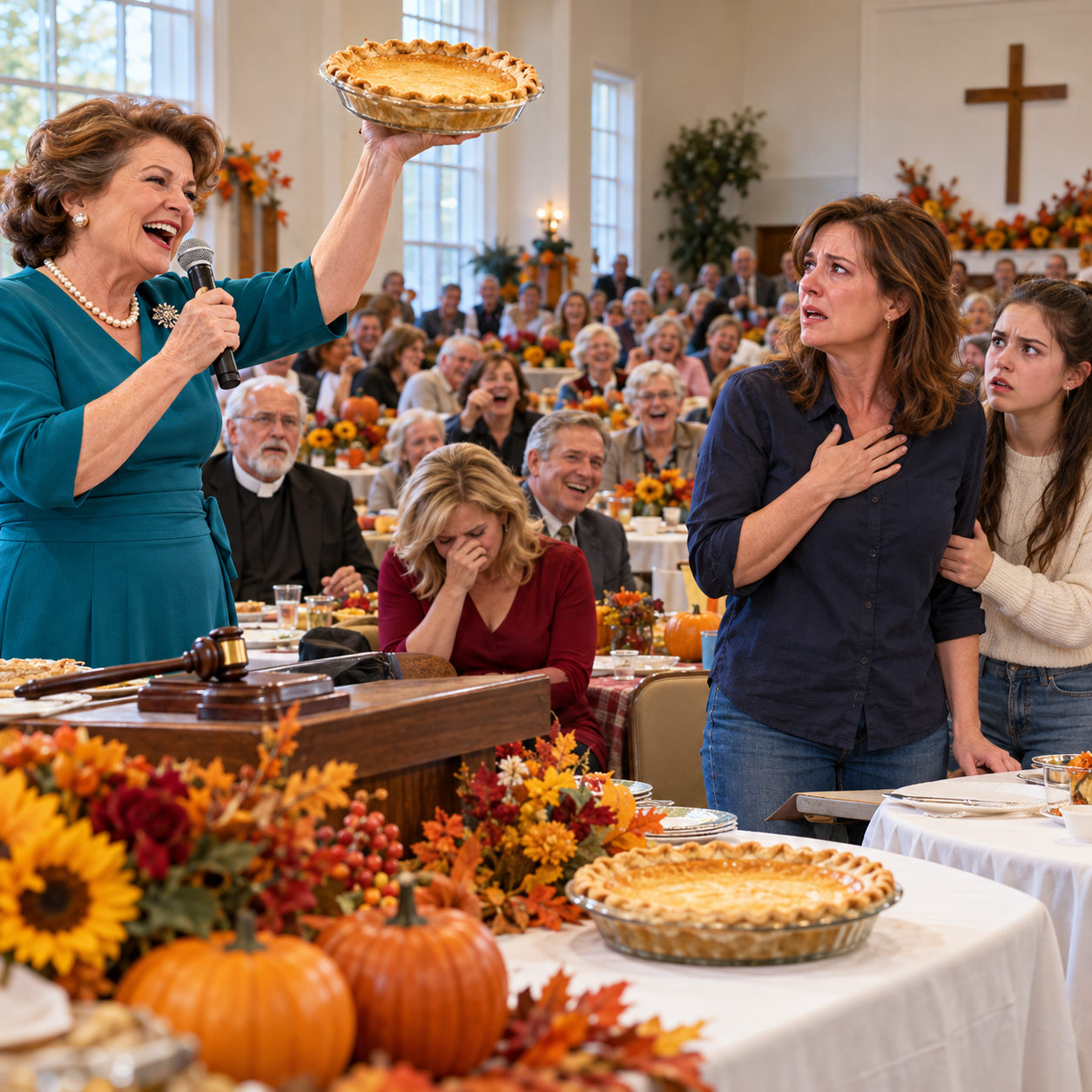
When November returned, more than a hundred and fifty people crowded into Friendship Baptist’s fellowship hall, including visitors from churches two towns away. Word had spread about Pearl’s recipe, the corrected cookbooks, and the old farmer who’d given five hundred dollars in honor of his wife. Melba stood behind the microphone in her familiar Sunday dress, her wooden gavel resting beside a neat row of pies. Brandy’s buttermilk pie came up first, its homemade crust slightly lopsided, and Melba let the bidding rise naturally instead of buying it herself. Elvin won it for a hundred and ten dollars, which made Brandy beam with pride.
Then Melba lifted my pie and turned it slowly so everybody could see the delicate edge. Thumb, thumb, fork. The room quieted as she cleared her throat, and I felt Twilight’s hand slip into mine beneath the table. “Next, we have a pie from my daughter-in-law, Josephine,” Melba announced. “It’s Pearl Hightower’s buttermilk pie, made with Pearl’s own crust, and Josephine’s the woman who cared enough to find out where it came from.”
She paused, looking directly at me, and her voice softened. “Do I hear five dollars?” The hall burst into laughter, but this time the joke belonged to everybody, including me. From the fourth table, Obadiah Hightower, ninety-two years old and wearing his white shirt buttoned to the collar, raised one crooked finger. “Five hundred,” he said. “That’s as charitable as I get.”
Melba struck the gavel so quickly she nearly dropped it. “Sold!” she cried, and the room erupted in applause, with Brandy standing beside Elvin and Twilight wiping tears from her cheeks. For the first time in twelve years, people were clapping for my pie instead of laughing at it. Melba came around the table afterward, took both my hands, and whispered, “I should’ve done that a long time ago.” I squeezed her fingers and told her what I believed Pearl would’ve said: “You did it when you finally understood why it mattered.”
Last week, Twilight baked Pearl’s coconut cream pie, card number 209, for Obadiah’s birthday. She made the meringue herself, carried it carefully to his farmhouse, and watched him eat two generous pieces before he smiled and gave his usual verdict. “Very nice, young lady. Now make it again.” The barn-shaped mailbox at the end of his lane had received a fresh coat of paint from Garland that fall, and the lettering shone against the white wood: O AND P HIGHTOWER.
Driving past that mailbox, I thought about all the years Melba had built her pride around a borrowed recipe, never knowing the woman she’d inherited it from had borrowed it first. I thought about Pearl, who hadn’t demanded applause or revenge, but had tucked her handwritten card into a church cookbook and trusted that somebody, someday, might care enough to find it. The greatest thing Melba ever did wasn’t selling a pie for five hundred dollars, and the greatest thing Pearl ever made wasn’t buttermilk filling or pastry. It was the chance for three generations of women to learn that kindness doesn’t require an audience, and that giving someone credit doesn’t take anything away from you.
I hadn’t gone looking for justice when I opened that old cookbook. I’d only wanted to learn how to make a decent crust. But sometimes the smallest things we inherit carry the biggest truths, and sometimes the people who change our lives are the ones whose names almost disappeared.
THE END.
All characters and events in this story are fictional, created for storytelling and entertainment purposes. Thank you sincerely for reading. Your feedback and support are invaluable and motivate me to continue sharing more stories with you.


