Part 2: Old Closing Papers Expose the Price of Being Grateful
David Rosen, the property attorney I met the following afternoon, did not promise to save my condo. He was a soft-spoken man in his fifties whose office overlooked a busy intersection near Rittenhouse Square, and he spent most of our appointment asking questions I couldn’t immediately answer. After examining the deed, he explained that the ownership percentages were legally significant, regardless of who had made the mortgage payments. My payment records might support a claim for reimbursement or other relief, but they would not automatically erase Patricia’s and Sophia’s interests.
“Did you understand that they were becoming owners when you signed?” he asked.
“No. Patricia said their names were necessary because she had helped me qualify.”
David wrote something down. “Then we need evidence of what you were told, not just what you understood. There may be grounds to challenge how the interests were obtained, but we need to establish the circumstances.”
His caution was strangely reassuring. Patricia had always spoken as though confidence itself made a statement true, while David separated what we knew from what we still had to prove. He asked me to request the closing file, retrieve my bank statements, preserve family messages, and avoid signing anything new. He also suggested that I wait before confronting my mother, since an emotional argument could make it harder to establish exactly what had happened.
Three days later, Patricia invited me to dinner.
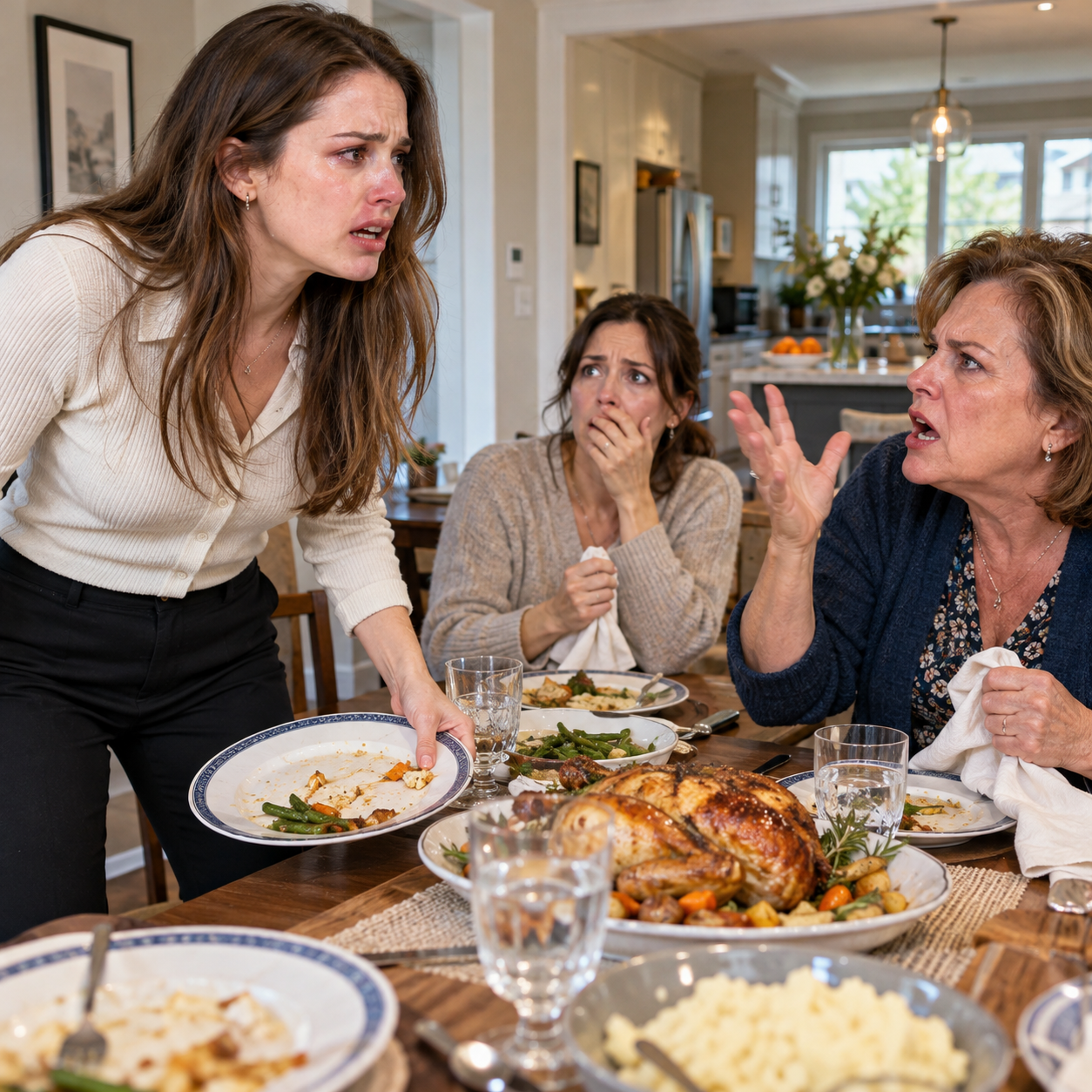
Sophia opened the door wearing the exhausted expression I had begun seeing more frequently since her separation. Eli was asleep upstairs, and the dining table had been set with our mother’s good dishes, the blue-rimmed plates reserved for birthdays and important conversations. Patricia served roast chicken, asked about my job, and praised the promotion I’d received earlier that year. We had nearly finished eating before she folded her napkin and mentioned that Sophia’s financial situation had become difficult.
“I’ve been thinking about how fortunate you are, Natalie,” she said. “You have a steady career, your own place, and no children depending on you.”
“I’ve worked hard for those things.”
“Of course you have.” She reached for her water glass. “But Sophia needs stability right now, and the condo would give her room to start over. We thought perhaps you could transfer your ownership interest to her.”
Sophia examined her plate. “I’d keep paying the expenses once I got settled,” she added, though she had no savings and was already behind on two credit cards. Patricia continued speaking about fairness and family responsibilities, occasionally mentioning the money she had supposedly lent me. When I asked whether they had considered selling the interests they already owned, she looked genuinely offended.
“After everything we’ve done for you, you’re talking about buying us out?”
“I’m asking what arrangement you’re proposing.”
“We’re proposing that you help your sister.”
I looked toward Sophia. “Do you actually want to move into my home?”
Her eyes lifted briefly. “I want Eli to have somewhere we don’t have to worry about rent.”
That answer hurt more than a rehearsed accusation would have. I believed Sophia was frightened, and I knew my mother had spent years assuring her that someone else would eventually solve whatever problem she faced. Still, Sophia understood whose home she was being offered. I folded my napkin and said I would not discuss transferring property without independent legal advice.
Patricia’s expression hardened. “I hoped you had grown out of making everything difficult.”
I stood and carried my plate into the kitchen because my hands needed something ordinary to do. “I’ll let you know what my attorney says,” I answered.
Two days afterward, the title company’s archived closing file arrived electronically. David and I reviewed emails showing that Patricia had contacted the closing office before my appointment and specifically requested the ownership percentages. One message from the closing coordinator asked whether I understood that the other two buyers would receive permanent interests in the property. Patricia had answered that she had explained the arrangement to me and that everyone agreed.
The message did not prove what Patricia had told me privately, but it contradicted her claim that the title arrangement was something the lender had required. David asked whether anyone else had witnessed our conversations about the down payment. I remembered my biological grandfather, Edward Collins, whom Patricia had discouraged me from visiting throughout my childhood. He had called occasionally and sent birthday cards, but she always seemed to have a reason our visits needed to be postponed.
Edward lived outside Philadelphia in a tidy brick house where the living room smelled of cedar polish and coffee. He was seventy-eight now, with a hearing aid and a careful way of moving that made me aware of how much time we had lost. When I explained the down payment, he studied my face before asking a question that seemed unrelated. “Did Patricia ever tell you what happened to the money your parents left?”
I told him she had said their estate barely covered funeral expenses.
Edward pressed his lips together and went to a hallway cabinet. He returned with a document folder secured by a faded elastic band, containing insurance statements, probate correspondence, and records concerning money held for my benefit after my parents’ deaths. My maternal grandmother had also left a modest inheritance, intended to help me finish school and establish an independent life. Edward had kept the documents because he distrusted the way Patricia handled questions about my parents’ estate, although he admitted he hadn’t known where the money ultimately went.
My name appeared repeatedly on the pages. There were account balances, old statements, and a distribution record identifying Patricia as the custodian of funds that had legally belonged to me. One transfer, made shortly before my condo purchase, matched the forty-eight-thousand-dollar down payment almost exactly. I placed the documents on Edward’s coffee table and told him I’d been making monthly repayments to Patricia for years.
He removed his glasses. “She charged you for your own money?”
“I thought she was helping me.”
Edward rubbed his forehead and looked toward a framed photograph of my parents on the mantel. “I should have asked harder questions when you turned eighteen,” he said. “I kept thinking you’d find your way back to me when you were ready, and I didn’t want to make things worse.”
I stayed for another hour, listening to stories about my mother that had nothing to do with money. She had loved old houses, he told me, and she kept a notebook of rooms she wanted to restore someday. He showed me a photograph of her standing outside a weathered farmhouse, laughing with a paintbrush in her hand. Before I left, he placed the photograph and copies of the financial records inside a clean envelope.
Back at David’s office, we reconstructed the transaction as carefully as the documents allowed. The original custodial account records showed funds designated for me, while the bank trail linked those funds to Patricia’s account and then to the condo purchase. David cautioned that we still needed a complete accounting of the custodial money, but the evidence gave us a substantially stronger basis to contest the ownership arrangement and seek repayment. He sent Patricia and Sophia a formal notice of representation and requested that future discussions about the property go through their attorneys.
The following morning, my phone filled with missed calls. Sophia left a message asking whether I intended to take our mother to court, and Patricia sent a text accusing me of humiliating the family. I forwarded both messages to David and continued working on my presentation drawings, although I barely absorbed what I was doing. By late afternoon, he forwarded a newly obtained bank record confirming the source of the down payment, along with the closing email in which Patricia had requested her and Sophia’s ownership shares.
Part 3: The Family’s Hidden Debt Finally Forces an Honest Reckoning
Patricia hired an attorney within two weeks, and negotiations began with demands that I acknowledge her contribution to the purchase. David responded with the inheritance records, my repayment history, and an accounting of the mortgage, taxes, and improvements. When negotiations stalled, he filed a civil action seeking appropriate relief concerning the ownership interests and money involved. I understood by then that a lawsuit could become expensive, uncertain, and painfully slow, but I was no longer willing to surrender my home merely to keep everyone comfortable.
The first unexpected change came from Sophia. She asked to meet at a coffee shop near my office, and I agreed after checking with David about what I could safely discuss. She arrived carrying a folder and looking as though she hadn’t slept properly in weeks. Without ordering anything, she pushed a printed email across the table.
It was from Patricia, dated shortly before my closing. In it, my mother told Sophia that adding her to the deed would provide financial security because I would eventually marry or move somewhere larger. The email instructed Sophia not to bring up the arrangement unless I asked. Sophia stared at the paper while I read it, twisting her wedding ring around the finger where she still wore it.
“I knew my name was going on the deed,” she admitted. “Mom said you knew too. I didn’t ask you because I thought it would be awkward, and because I liked knowing I had something.”
“You knew you hadn’t paid for it.”
“Yes.”
She looked at me then, her eyes wet but steady. “And when I needed money, I convinced myself it was reasonable to use it. I’m sorry, Nat. I don’t expect that to fix anything.”
I wanted to comfort her out of habit, but I couldn’t make her confession easier without pretending it had cost me nothing. I told her I understood why she was frightened about Eli, and that I would always care about him. I also told her that allowing my mother to take my home was not something I could excuse as a desperate parenting decision. Sophia nodded and gave me the remaining emails in her folder.
Three months later, we met for a settlement conference in a small office with beige walls and a conference table scarred by years of use. Patricia sat opposite me, wearing a navy cardigan she had owned for years, her attorney beside her. Sophia was there with separate legal advice, and David had arranged our documents into numbered folders. Nobody raised their voice during the opening discussion, which somehow made the proceedings feel more serious.
David explained the evidence: the recorded ownership interests, the misleading explanations, the custodial funds used for the down payment, and the payments I had made to Patricia afterward. He did not claim a court had already established fraud or guarantee how a judge would decide every issue. Instead, he laid out the financial and legal risks of continuing the dispute. My mother’s attorney asked for a private conference, and we spent forty minutes waiting while a clock ticked above the office door.
When Patricia returned, she looked tired.
“I was afraid,” she said, addressing the table rather than me. “After my husband left, I spent years worrying about keeping Sophia secure. Natalie always managed things so well. She was the one who would be all right.”
I watched her smooth a wrinkle in her cardigan. “You used money my parents left me,” I said. “Then you let me repay it to you.”
Patricia’s eyes moved toward David. “I used that account for family expenses over the years. I thought of it as money I had managed.”
“That doesn’t explain why you called it your loan.”
For a moment, she appeared ready to repeat one of the familiar speeches about sacrifices and gratitude. Instead, she pressed her hands together and admitted she had wanted the condo interests to serve as a safety net for herself and Sophia. She believed I would eventually have a better career, a husband, and another house, while Sophia might never have those advantages. She had treated my independence as permission to claim what I had built, and she offered no convincing explanation for hiding the documents.
Sophia spoke quietly from the end of the table. “Mom, Natalie doesn’t have to lose her home because my marriage ended.”
Patricia looked at her daughter with an expression I had rarely seen, somewhere between disappointment and recognition. “I was trying to protect you.”
“I know,” Sophia said. “But it wasn’t ours to take.”
We did not reach a final agreement that afternoon. Over the following weeks, however, Sophia agreed to convey her ownership interest back to me without compensation, acknowledging that she had never contributed financially. Patricia eventually agreed to do the same as part of a broader settlement addressing the disputed inheritance funds, the repayments I had made to her, and the parties’ legal claims. Her repayment obligation was structured in installments because she lacked sufficient savings to pay everything immediately.
There were documents to revise, title requirements to satisfy, lender questions to resolve, and releases that had to be coordinated with the transfers. David made certain the settlement protected me if Patricia missed her payment obligations, and we did not dismiss the court action until the required ownership documents had been executed and recorded. Almost seven months after I went back for my forgotten bag, I stood in his office holding an updated recorded deed. My name was the only owner’s name on it.
I didn’t celebrate with champagne or make a triumphant announcement online. I went home, put the deed in the filing cabinet, and cooked dinner with Adrian while rain tapped against the kitchen windows. He asked whether I felt better, and I considered the question as I sliced tomatoes at the counter. “I feel relieved,” I told him. “I’m not sure relief and happiness are the same thing.”
My relationship with Patricia remained distant. She made the scheduled payments through her attorney, but our occasional messages concerned practical matters rather than family gatherings. I had stopped waiting for her to explain why she believed love required obedience, and she seemed unable to apologize without returning to everything she had done for me. Perhaps we would speak differently someday, but I no longer felt responsible for making that happen.
Sophia and I found a slower way forward. She obtained a steadier position at a medical billing office, worked out a manageable payment plan with her creditors, and moved into a smaller apartment closer to Eli’s school. I still visited my nephew, and eventually Sophia began joining us for occasional dinners, although we did not pretend the betrayal had disappeared. One evening, while washing dishes in my kitchen, she told me she had spent her whole life assuming someone would rescue her, and she was trying to learn how to stand without taking from someone else.
Edward became part of my life again, too. On Sundays, he sometimes visited with pastries from a bakery near his house, and we sorted through old family photographs at the dining table. He told me about my father’s terrible jokes, my mother’s habit of singing while she painted, and the little blue bicycle I had ridden before my parents died. Those memories gave me something Patricia’s version of my childhood never had: a history that belonged to me without requiring repayment.
One afternoon, nearly a year after the ordeal began, I finally replaced the cracked frame around my mother’s farmhouse photograph. I hung it in the second bedroom above my drafting desk, where sunlight reached it in the late afternoon. My work bag rested on the chair beside me, filled with drawings for a renovation project that would turn an abandoned school into affordable apartments. I liked imagining future families walking into those rooms and discovering that the doors opened to places they could call their own.
That evening, Sophia called to ask whether Eli could bring his new dinosaur drawings over on Saturday. I said yes, then returned to my desk and looked around the condo I had nearly lost. Nothing about it was perfect: the hallway floor still creaked, the bathroom faucet needed replacing, and the kitchen window stuck whenever the weather turned cold. But for the first time, I understood that having a home wasn’t about proving I deserved one to the people who had raised me. It was about being able to close the door at night and know that I no longer had to ask anyone’s permission to belong there.
The End .
All characters and events in this story are fictional, created for storytelling and entertainment purposes. Thank you sincerely for reading. Your feedback and support are invaluable and motivate me to continue sharing more stories with you.