
## Part 2: A frightened neighbor reveals the money behind Pamela’s intimidation.
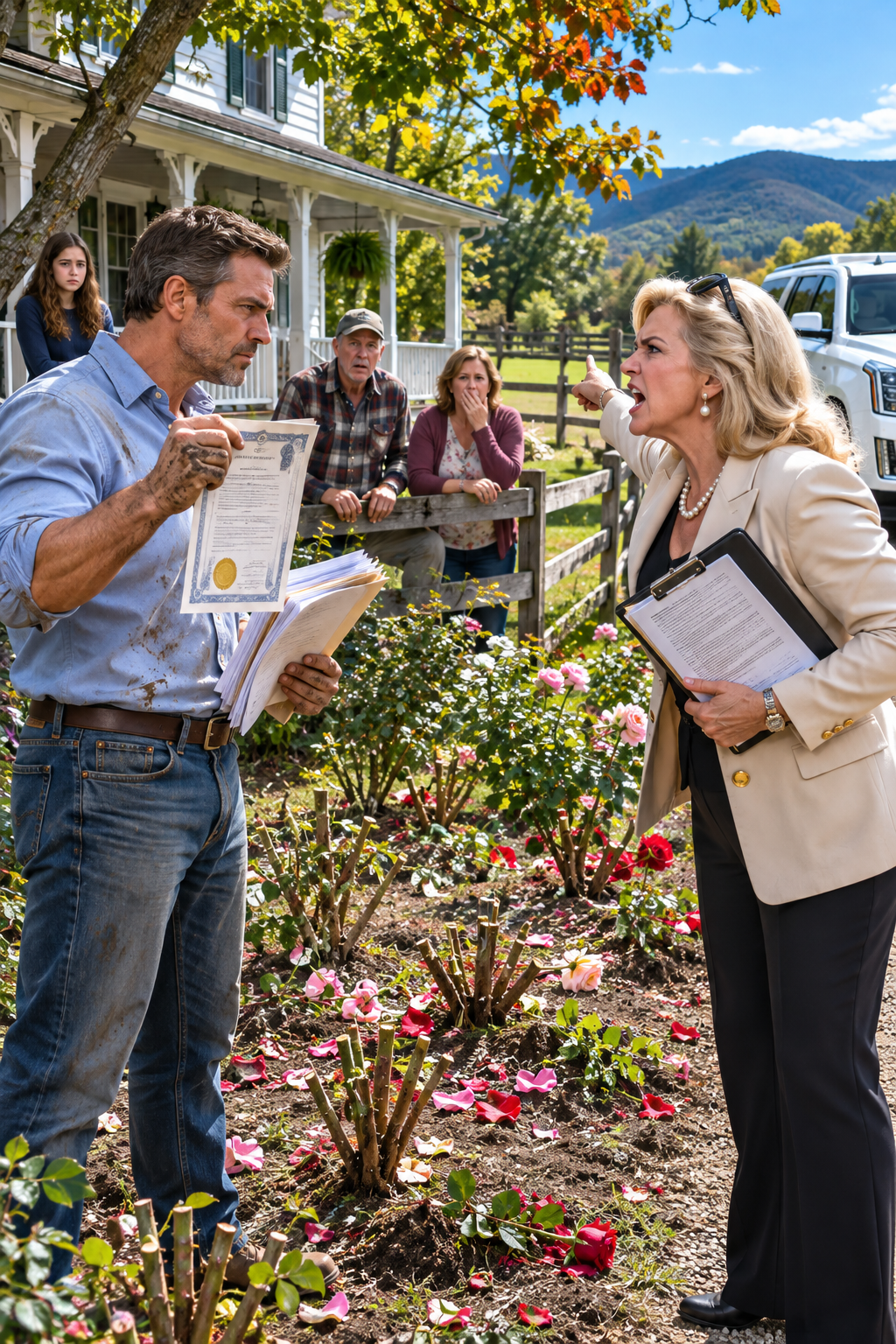
The threats spread beyond my property when Pamela circulated a petition demanding that county officials declare my farmhouse unsafe. Forty-one residents signed it, and soon rumors reached Ellie’s school that I was running an illegal business and storing dangerous materials on our land. One afternoon, she came home with red eyes and sat on her bed without removing her shoes. “They’re calling our house a dump,” she said, staring at the floor. “They say you’re some kind of criminal.”
I sat beside her and took her hand. “People can say terrible things when they don’t know the truth, sweetheart, but that doesn’t make those things true.” She looked at me with the same gray eyes Catherine had, and I promised her I would find a way to stop it. The county board dismissed Pamela’s petition after reviewing our clean inspection records, but the victory felt small when I saw how much damage had already been done.
Teresa Gunderson, a retired-looking librarian with silver hair and a steady voice, came to my house that week. She lived inside Ridgemont Estates and told me three families had moved away after prolonged conflicts with Pamela. “It starts with a fence or a garden flag,” she explained, “and then come the fines, threats, and letters about liens.” I asked why no one had challenged her, and Teresa glanced toward the road before answering. “Most people are afraid they’ll lose their homes.”
Over the following days, I spoke with eleven homeowners in diners, parking lots, and the county library. Hank had paid $2,500 over a kayak stored behind his house, while another family had surrendered $4,000 after a dispute involving their son’s basketball hoop. A young couple named Burnett had paid $1,200 for a trampoline, and two other families had sold their homes rather than continue fighting. The same name appeared at the bottom of every threatening letter: Pamela Whitmore.
One Thursday evening in October, Wallace Pruitt knocked on my door carrying a manila envelope. He was seventy-one, a retired accountant who had served on the HOA’s financial review committee for six years, and his hands shook slightly as he sat at my kitchen table. “Judge Whitfield,” he began, using the title almost no one in the neighborhood knew, “I believe she’s been stealing from us.” He pushed thirty-one pages of spreadsheets, invoices, and bank records across the table.
Wallace showed me maintenance bills running nearly three times the local market rates, including an $18,000 annual pool contract and a $22,000 pavilion repair that had never occurred. Most of the inflated invoices came from Ridgemont Services Group LLC, a company owned by Pamela’s husband, Craig. Wallace had traced payments into a personal checking account the couple shared. Over nine years, approximately $341,000 had disappeared from the association’s operating funds.
“She needs the money to keep coming,” Wallace said, tapping a column of figures. “Her reserve fund is nearly empty, and forty-seven households can’t support these expenses forever.” He pointed toward my property survey on the counter and explained that forcing me to sell my twelve acres cheaply could give the Whitmores a valuable acquisition and a way to expand their scheme. Suddenly, Catherine’s ruined roses, the false complaints, and Pamela’s obsession with my membership made terrible sense. This had never been about protecting neighborhood standards.
I submitted Wallace’s evidence to the appropriate state investigators, requested available county records, and upgraded my security system to eight cameras with local and cloud backups. I also installed motion-sensitive floodlights and a concealed trail camera inside a birdhouse overlooking the roadside. Teresa hosted a small gathering where eight residents compared their fines, letters, and payments, and I encouraged them to preserve every document. By the end of the meeting, Hank’s hands were trembling with anger as he realized where his $2,500 might have gone.
The first fire came on a Monday night in November. I heard a dull thump beyond the back porch, followed by a crackling sound that sent me running outside with my phone. The old tool shed was burning, flames tearing through the roof while the smell of gasoline drifted across the yard. I called 911 and watched firefighters battle the blaze until all that remained was a blackened frame and the ashes of tools I had used to build Catherine’s garden.
The fire marshal’s dog detected accelerant in several locations, and investigators classified the blaze as intentionally set. Pamela arrived the next morning carrying a casserole dish covered in aluminum foil, her face arranged into an expression of sympathetic concern. “Oh, Garrison, these old houses can be so dangerous,” she said, glancing toward the wreckage. “You really should have had the wiring checked.” I accepted the casserole without correcting her, because the fire marshal had already explained that faulty wiring wasn’t responsible.
That night, the hidden trail camera showed a man approaching the shed carrying a red container. His face was obscured, but the truck parked along Dogwood Ridge Road was a black Dodge Ram bearing the Ridgemont Services Group logo. I copied the footage and preserved it, then added two stronger infrared cameras covering the driveway and the front porch.
Nineteen days later, at 2:14 in the morning, our smoke alarm screamed through the house. By the time Ellie and I reached the lawn, flames were pouring through our living room windows, and she was shivering beneath my arm. I wrapped her in my jacket, called 911, and watched firefighters rush toward the home I had promised would always be safe. She pressed her face against my chest and whispered, “Please tell me they can save Mom’s picture.”
## Part 3: Security footage exposes the arsonists and brings Pamela before my bench.
The firefighters saved most of the farmhouse, but the front porch, foyer, living room, and Ellie’s bedroom were destroyed. Her mother’s scarf, perfume, birthday cards, and wedding photograph had been kept in a box beneath her bed, and Ellie stared at the ruined second-floor window as if she could somehow see the missing things through the smoke. I sat beside her in my truck while the fire marshal examined the porch, and she finally fell asleep with a blanket tucked beneath her chin. Only then did I open the camera recordings.
At 2:07 a.m., Craig Whitmore’s truck appeared on the infrared footage. I watched him step onto my porch carrying a gasoline container, spread the fuel near the entrance, and ignite it before returning calmly to his vehicle. His face, license plate, and company decal were clearly visible, and there was no mistaking the man. I copied the recording onto multiple drives and handed the evidence to Deputy Jeffcoat and the Virginia State Fire Marshal’s office.
The fire investigation moved quickly once investigators had the recording and the evidence from both scenes. On a freezing Tuesday morning in early December, deputies and state officers arrived at the Whitmores’ five-bedroom colonial on Ridgemont Court. Craig opened the door in a bathrobe, saw the warrant, and surrendered without a struggle. Pamela rushed into the foyer demanding to know why officers were arresting her husband.
“Do you know who I am?” she shouted as neighbors watched from their driveways. “I’m the president of this homeowners association!” Deputy Jeffcoat held her gaze without raising his voice. “Ma’am, we know exactly who you are.” Craig was taken away while Pamela stood in her doorway, still calling the investigation a personal vendetta.
Facing serious criminal charges, Craig agreed to cooperate with investigators and described how Pamela had directed both fires. The shed had been intended as a warning, while the farmhouse fire was supposed to frighten me into abandoning the property. She believed she could purchase it at a reduced price, bring it under the HOA’s control, and use the land to extend her financial scheme. During his recorded interview, Craig admitted she had told him nobody would care about one aging farmhouse and its quiet owner.
Meanwhile, the financial investigation expanded into the Whitmores’ business accounts. Investigators seized invoices, computers, bank statements, and records showing years of payments from Ridgemont Estates to Craig’s company. Wallace’s calculations proved remarkably accurate, and the evidence supported charges relating to embezzlement, fraud, falsified records, and the conspiracy surrounding the fires. Pamela was arrested, and the same neighbors who had once feared her threatening letters began preparing statements of their own.
The cases were filed in Augusta County Circuit Court, where three judges handled rotating assignments. Pamela’s financial-crimes case was initially assigned to the newest judge on the bench, a procedural circumstance that would require immediate correction because of my personal involvement. I notified court administration of the conflict, but the formal disclosure still had to be placed on the record at the scheduled hearing. For months, Pamela had addressed me as though I were a helpless homeowner, and now she was about to learn why I had always been so careful with evidence.
On a snowy Wednesday morning in January, Pamela entered the courtroom wearing a navy blazer and the same pearl earrings she had worn while arguing before the county board. Her lawyer carried a thick folder, two local reporters sat in the gallery, and Teresa, Wallace, Hank, and eight Ridgemont homeowners occupied the benches behind them. Pamela kept her chin high as she approached the defense table, whispering something to her attorney. Then she looked toward the judge’s bench.
Our eyes met, and I watched recognition move across her face. She blinked once, gripped the table, and turned toward her lawyer, her mouth opening without producing a sound. “That’s him,” she whispered loudly enough for the nearest spectators to hear. “That’s the man from the farmhouse.”
I looked down at the case file, then spoke in the same measured voice I used for every proceeding. “For the record, I have a direct personal connection to the defendant and the matters underlying this prosecution.” Pamela’s lawyer stood immediately, but I raised a hand and continued. “I am recusing myself from this case, and it will be reassigned to Judge Carla Pemberton.”
The clerk recorded the order while Pamela stared at me as though the courtroom itself had shifted beneath her feet. I gathered my papers, rose from the bench, and left through the side door without another glance. I had no right to judge a case in which my family was a victim, and I wasn’t about to compromise the prosecution for a moment of personal satisfaction. The truth was already in the evidence, and another judge would hear it.
Outside the courtroom, Wallace approached me with tears in his eyes. “You could have said something to her,” he told me, adjusting the strap of his worn leather briefcase. I shook my head and watched snow settle against the courthouse steps. “She spent months pretending she had power over people,” I said. “I don’t need to pretend anything.”
## Part 4: The trial reveals Pamela’s crimes, and our family finds peace.
Pamela’s trial began the following April, with Judge Pemberton presiding over four days of testimony. Wallace explained the financial records, investigators traced money through Ridgemont Services Group, and homeowners described years of threats that had made ordinary life feel like a series of punishments. Craig’s testimony connected Pamela’s demands to the arson scheme, while the recordings and fire investigators’ findings showed what had happened to our property. I testified only as a witness, answering the lawyers’ questions while Ellie remained away from the proceedings.
Pamela tried to present herself as a misunderstood community leader who had trusted the wrong people. Her attorney argued that Craig had acted independently and that the financial discrepancies were accounting mistakes, but the evidence told a different story. The bank records connected the couple to the missing money, and Craig’s account was supported by correspondence and other records investigators had collected. When the court heard Pamela’s recorded threats against my property, she lowered her eyes for the first time I had ever seen.
The jury convicted her on the charges presented, and Judge Pemberton sentenced her to fourteen years in prison for her financial crimes and participation in the arson conspiracy. Craig, who pleaded guilty and cooperated with prosecutors, received ten years. During his sentencing, Judge Pemberton looked directly at him and spoke about the fifteen-year-old girl sleeping upstairs when he ignited the porch. “Your wife may have urged you to do this,” she said, “but you were the man who started the fire, and that choice belongs to you.”
Craig stared at the floor, and I saw his shoulders collapse under the weight of those words. I had imagined that hearing a sentence pronounced might finally remove the anger I’d carried since the fire, but my thoughts went instead to Ellie sleeping in a temporary bedroom with the lights on. No prison term could restore the nights she’d spent afraid of smoke or give her back the things Catherine had left behind. Justice mattered, but healing would require something different.
The Ridgemont Estates HOA was placed under court-supervised receivership while its finances were examined and reorganized. Auditors identified the fraudulent payments and improper penalties, and nineteen families ultimately received a combined $67,000 in restitution. Hank recovered his kayak fine, the Burnetts received reimbursement for their trampoline dispute, and other residents began reopening boxes of records they had kept hidden for years. For the first time, people were discussing their neighborhood without lowering their voices.
Teresa Gunderson was elected interim HOA president by a vote of thirty-nine to two. She dismantled the old architectural review committee, published the association’s financial ledger for homeowners to inspect, and reduced annual dues by forty percent after the accounts were brought under control. At the first open board meeting, she adjusted her glasses, looked around the crowded room, and smiled. “Transparency is the opposite of tyranny,” she said. “I think it’s time we tried some.”
The Brennan family, who had moved away after a dispute involving their garden shed, returned the following summer. Their son started attending Ellie’s school, and soon he and his friends were showing up at our place to play in the fields and help carry bags of mulch. Sometimes I heard Ellie laughing from the porch and stopped whatever I was doing, afraid that even noticing the sound might make it disappear. It had been so long since laughter filled our house that I had nearly forgotten how ordinary happiness could feel.
Insurance covered the main reconstruction, and the civil settlement from the Whitmores helped us replace what it couldn’t. We kept the old farmhouse’s footprint, oak floors, and wraparound porch, though the new supports included fire-resistant steel. Ellie chose the paint for her bedroom herself, a soft blue Catherine had once mentioned liking. When the contractors finally handed me the keys, I stood on the porch and realized I was no longer looking at the place where someone had tried to destroy us.
Two weeks after we returned, Ellie came downstairs carrying something wrapped in a paper towel. She had been sorting through salvaged debris for days, refusing to explain what she was searching for, and now her hands trembled as she placed the bundle on our kitchen table. Inside was Catherine’s wedding photograph, its frame melted and its edges charred. But beneath the damaged glass, the center remained visible: Catherine and me, smiling beneath a dogwood tree on the happiest day of our lives.
I ran one finger along the blackened corner of the picture. Ellie watched my face, then swallowed and said, “I told you we hadn’t lost everything.” I pulled her close, and for the first time since the fire, we cried without trying to hide it from each other. The next morning, we drove to an antique shop in Staunton, bought a new wooden frame, and hung the photograph beside our front door, where everyone who entered could see it.
Part of the civil settlement went toward establishing the Catherine Whitfield Community Fire Safety Fund. With help from the county fire department, we supplied free smoke detectors, extinguishers, and safety inspections to families who couldn’t afford them. In our first year, sixty-three homes received equipment, and Wallace volunteered to manage the accounts with the same painstaking attention that had exposed Pamela’s theft. Every time he handed me a financial report, he smiled and said Catherine would have approved.
The rose garden survived both fires, and by June, all forty-seven bushes were blooming again. I placed a wooden bench in the center with a brass plaque reading, “Catherine’s Garden — For Everyone Who Needs a Quiet Place.” Neighbors began visiting with books, strollers, and cups of coffee, sitting beneath the maples while the evening sun washed across the Blue Ridge. What had once been a private memorial slowly became a place where people brought their own grief and found a little peace.
One warm evening, Teresa arrived with a plate of cookies while Ellie and the Brennan children chased fireflies through the garden. She settled into the porch chair beside me and watched the children laugh beneath the roses. “Pamela always said this neighborhood needed a firm hand,” she observed, breaking a cookie in half. “Someone who wasn’t afraid to enforce the rules.”
I watched Ellie pause beside the garden bench, gently touch the plaque bearing her mother’s name, and run back to her friends. “What it needed,” I said, “was a place where people could stop being afraid.”
Teresa smiled and handed me the other half of her cookie. For a while, neither of us spoke, and the quiet felt like something we had earned rather than something we were hiding inside. Beyond the porch, forty-seven roses moved softly in the summer breeze, while the wedding photograph hung safely behind us near the front door. Pamela Whitmore had tried to take everything from my family because I refused to surrender what was legally mine, but the greatest thing we had saved was never the land or the house.
It was our ability to make a home again.
THE END.
All characters and events in this story are fictional, created for storytelling and entertainment purposes. Thank you sincerely for reading. Your feedback and support are invaluable and motivate me to continue sharing more stories with you.

