
### Part 2: A locked driveway exposes the cost of their selfish deception
That night, I slept on a narrow cot in the guest room, the only bedroom the workers hadn’t touched. Every time the wind rattled the exposed framing, I remembered Ralph measuring the kitchen windows and laughing because he’d cut the first piece of trim too short. By five-thirty, I had stopped trying to sleep. I carried my camping stove onto the back deck, heated water for coffee, and watched the pale morning light spread over the Atlantic.
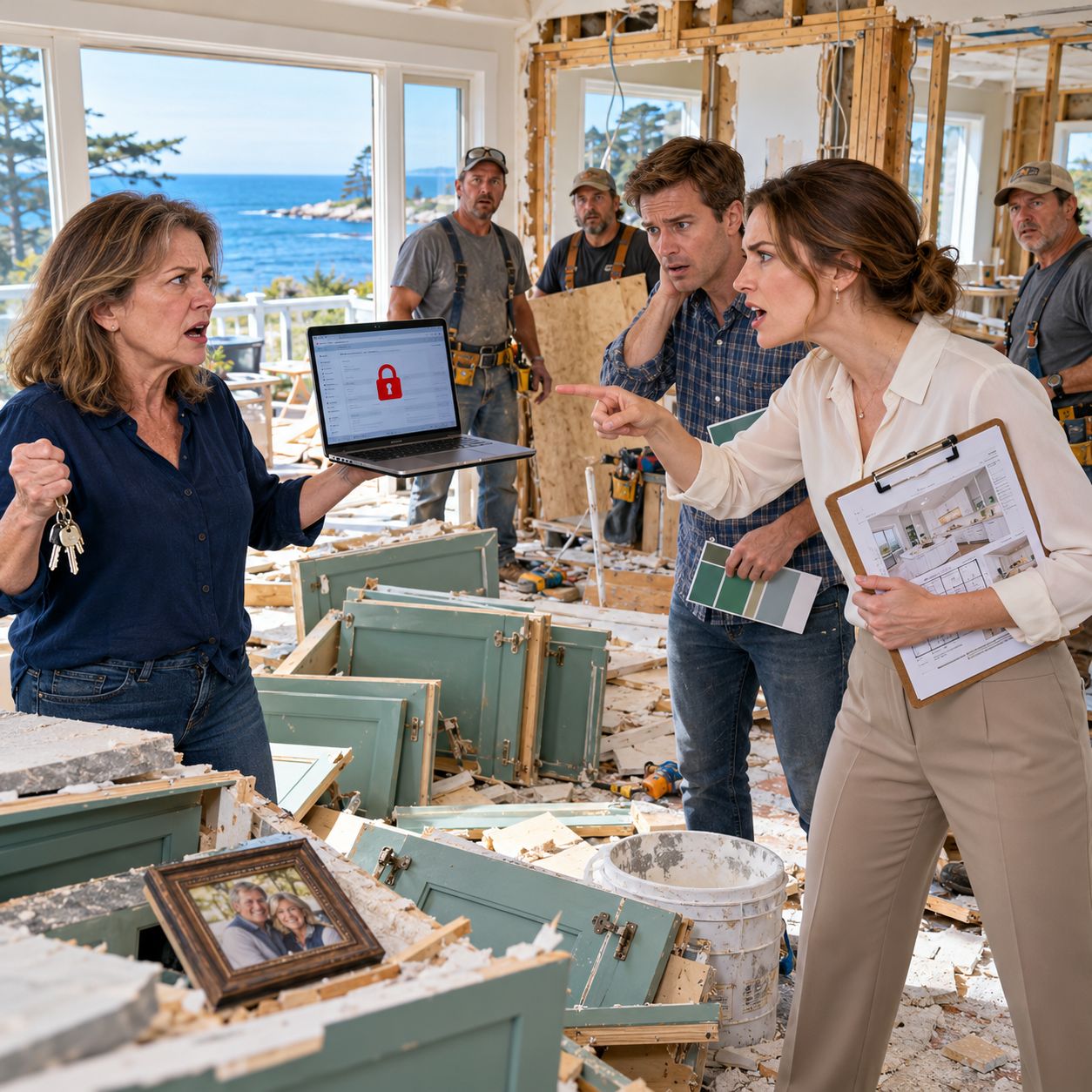
At six-fifteen, I drove my SUV down the gravel driveway between the wild roses and spruce hedges. I parked it sideways across my iron entrance gate and locked the doors. Any contractor arriving with a truck full of materials would have to turn around. Then I walked back toward the house, holding my coffee while gulls circled above the shoreline.
At precisely seven, a diesel engine rumbled outside the gate.
Allison came charging down the driveway, followed by Jason. “Move your vehicle!” she shouted. “Murray has work to do!”
Murray climbed out of his truck carrying an invoice. “Before anybody starts anything,” he called, “I need yesterday’s demolition payment. Three thousand dollars.”
“Pay him,” Allison ordered Jason.
My son pulled out his debit card and passed it through the gate. Murray entered the amount into his portable reader, waited, and frowned. He tried again before turning the screen toward Jason. “Declined. Insufficient funds.”
“That’s impossible,” Allison snapped. “We had eight thousand dollars in checking!”
Jason wouldn’t meet her eyes. “I put down the deposit on those cherry cabinets yesterday.”
“How much?”
He mumbled the amount, and I watched Allison’s furious expression turn into disbelief. Murray handed them the invoice through the bars. “Mail me a check,” he said, climbing back into his truck. “I’m not getting caught in the middle of this.”
His truck disappeared around the bend, leaving the two of them staring at the closed gate.
I returned to the guest room and opened my novel, but ten minutes later Allison was pounding on the door. “Joan, open up! We need to discuss this.”
I opened it just far enough to see them standing together. “You’re right about one thing,” I told her. “The house can’t remain like this. But neither of you will be supervising the repairs. I want you to collect your belongings and leave.”
“We have rights!” Allison protested. “You can’t throw us out!”
“You haven’t been given a lease, and you’ve never paid rent,” I replied. “You’re family members who were allowed to visit, not people I agreed could occupy this house. If you won’t leave voluntarily, I’ll get proper legal help.”
She folded her arms. “My parents will be here tonight. We’re staying.”
At noon, I found them sitting on the dusty living room sofa, still refusing to pack. Allison had apparently decided that if she occupied the house long enough, I would surrender. Just then, my daughter Lauren walked through the front door with her overnight bag.
She had driven down from Halifax after receiving my call the previous afternoon. One look at the ruined kitchen was enough to make her drop her bag. “You’ve got to be kidding me,” she whispered.
Jason started explaining, but Lauren walked past him and picked up his duffel bag from the hallway. She carried it to the porch and set it outside. When she returned for Allison’s suitcase, Allison grabbed its handle.
“Don’t touch my things!”
“Then pack them yourself,” Lauren replied. “You don’t get to destroy Mom’s house and pretend you’re doing her a favor.”
I took Lauren aside and told her I intended to secure the house before leaving for lunch. I shut down the electrical supply to the damaged rooms, closed the well-pump valves, and unplugged the Wi-Fi router. With exposed wiring and demolition dust everywhere, I didn’t trust the place to operate unattended. I told Jason and Allison that the utilities would remain off until the house was safe and that they needed to arrange somewhere else to stay.
Lauren carried the router to the car, then looked at me with a faint smile. “Lunch?”
We drove to Mahone Bay, where we sat beside a restaurant window overlooking the street and ordered fish and chips with a pot of hot tea. For the first time since arriving, I tasted my food. My phone vibrated repeatedly beside my plate, displaying message after message from Jason. I turned it facedown.
When we returned around seven, the house was dark. Jason sat on the living room floor while Allison paced beside the window, speaking desperately into her phone.
“Mom, please listen,” she said. “The contractor left. No, the house isn’t ready. I know you already gave up the apartment. You’ll have to find a motel.”
She ended the call and faced me with tears of anger in her eyes. “My parents are spending the night in some roadside motel because of you!”
“Your parents are in a motel because you promised them a home that wasn’t yours.”
Jason slowly stood. “Mom, why are you doing this to us? We’re family.”
I looked directly at him. “You took money I trusted you with and used it to tear apart the home your father and I built. You didn’t ask permission. You didn’t even tell me. What part of that was love?”
He stared at the floor for a long moment.
Then he turned to his wife. “Get the bags, Allison.”
### Part 3: One stolen keepsake and two unsuspecting parents reveal deeper lies
By eight-thirty, Lauren and I were standing on the porch watching Jason and Allison carry their belongings down the gravel driveway. Allison dragged a large plastic storage tote that I didn’t remember seeing when they arrived. She moved quickly, avoiding my eyes as Jason opened the trunk of their sedan beyond the gate. Something about the way she gripped that container made me follow them.
“What’s in the box?” I asked.
“Kitchen stuff,” Allison replied. “Things that would’ve been ruined by the dust.”
I placed my hand on the lid before she could load it into the trunk. She stiffened, but I released the plastic latches and lifted the top. Inside was my red stand mixer, wrapped in the beach towel Ralph had bought me for our thirtieth wedding anniversary. Beneath it lay two heavy brass lamps that had stood on his desk for forty years.
For a moment, I couldn’t breathe. Ralph had used those lamps when he worked late, and I had often found him asleep beneath their soft light, his reading glasses slipping down his nose. They were among the few ordinary things that still made me feel his presence. Now my daughter-in-law was trying to take them away.
“There’s no kitchen anymore,” Allison muttered. “I was protecting them.”
“Then why were they packed in your car?”
She looked away.
Jason stared into the container with a mixture of shame and disbelief. “Allison, I didn’t know you took those.”
I lifted the mixer into Lauren’s arms and gathered the lamps against my chest. “You can go now,” I said quietly.
Jason looked as though he wanted to say something, but nothing came. He closed the trunk and drove away while Allison stared straight ahead through the windshield. I watched their taillights vanish around the bend before turning back toward the house.
That night, Lauren helped me restore the water supply and electricity to the areas we could safely use. Under the lights, the damage appeared even worse than it had in daylight. Plaster covered the floors, exposed studs divided the rooms, and the kitchen smelled of sawdust and severed pine. But the house was finally quiet, and nobody inside it was pretending to own what belonged to me.
The next morning, I drove into Bridgewater and stopped at Home Hardware. A notice on the bulletin board led me to Mr. Henderson, a retired carpenter who lived only two roads away. He arrived with his two grown sons, examined the damage, and promised they could make the place safe before beginning proper repairs. By lunchtime, a dumpster stood in my driveway, loose wiring had been secured by a qualified electrician, and the three men were clearing away broken drywall.
I was shaking dust from a rug when a silver Buick pulled up outside the gate.
An older couple stepped out, hesitating beside the car. I recognized them immediately from Jason’s wedding photographs. Donald and Sharon, Allison’s parents, looked exhausted and frightened. I put the rug aside and walked down to meet them.
Donald removed his ball cap. “Joan, I don’t know how to begin apologizing.”
I unlocked the gate and invited them onto the porch. Sharon stopped when she saw the bare framing visible through the front windows. Her hand flew to her mouth, and tears filled her eyes.
“Allison told us you had agreed,” Donald said slowly. “She said you were moving into a condominium in the city and wanted us to have this place.”
I stared at him. “She told you I was moving?”
Sharon nodded. “She said you were downsizing. She even told us you wanted the house renovated before we arrived so we’d feel comfortable.”
Donald’s voice trembled. “We sold our house in Dartmouth because we believed her. Then we gave up the apartment we were renting while everything was being arranged. We honestly thought you wanted us here.”
For the first time, I understood the full extent of Allison’s deception. Her parents hadn’t simply accepted a generous offer. They had rearranged their entire lives around a promise I’d never made.
“I’m sorry you’ve been put in this position,” I said. “But I haven’t sold or given away my home. I have no plans to move.”
Donald reached inside his jacket and withdrew a thick envelope. “There’s two thousand dollars here. We saved it for moving expenses, but please use it to repair some of the damage.”
I looked at his weathered hand holding the money. Then I gently pushed the envelope back toward him. “Keep it, Donald. You’ll need it for another place. The people who caused this damage are the ones who need to make it right.”
Sharon wiped her cheeks. “We never would’ve agreed to this if we’d known.”
“I believe you.”
After they drove away, I sat alone on the porch beside Ralph’s old brass lamp. I had expected an argument and discovered two more people who had been deceived. But sympathy for Allison’s parents couldn’t repair my walls or restore the money Jason had used.
That afternoon, I gathered the bank statements, photographs, contractor invoices, and every message I had received.
Allison had built her plans on lies.
I was going to answer with evidence.
### Part 4: Legal consequences reveal the truth and restore my independence
Mrs. Kennedy, my lawyer in Bridgewater, studied the photographs without interrupting. She was a careful woman who wore narrow reading glasses and had the remarkable ability to make silence feel like a question that demanded an answer. When I finished explaining, she placed the papers into neat piles. Then she asked me to bring her the property deed.
The ownership records showed exactly what Ralph and I had intended: Joan Marie Gardner, sole registered owner. Jason’s name appeared nowhere. Mrs. Kennedy also examined the joint bank account, the unauthorized construction agreement, and the invoices accumulated during the demolition. She explained that Jason’s access to the account complicated the banking dispute, but it did not give him permission to renovate property he didn’t own.
There was another problem Allison had apparently never considered. Major structural renovations required municipal approval, and no permit had been obtained for the work. Mrs. Kennedy documented the violations and helped me begin the necessary process to make the property safe and resolve the resulting penalties. I also brought the records to the local RCMP detachment so the circumstances could be formally reported.
I didn’t ask anyone to punish my son simply because I was angry. I wanted accountability, compensation, and a legal record of what had happened. For the first time in my life, I was handling a family betrayal without trying to soften its consequences for everyone except myself.
Three weeks later, Jason and Allison arrived at Mrs. Kennedy’s office.
Jason looked thinner than when he’d left the beach house. Allison wore a dark blazer and carried an expensive handbag, but the confidence she’d displayed with her clipboard was gone. They sat opposite me at a long polished table while Mrs. Kennedy laid out the figures. There were the building-supply charges of approximately four thousand dollars, Murray’s unpaid three-thousand-dollar demolition invoice, the work done by Mr. Henderson and his sons, the estimate for replacing the kitchen, and the costs associated with the unauthorized construction.
The total came to a little over forty-one thousand dollars.
“That’s ridiculous,” Allison said. “We were improving the property.”
Mrs. Kennedy turned a page. “You demolished part of a house you did not own. Whether you intended to improve it doesn’t eliminate the damage.”
Jason kept staring at the total. “Mom, we can’t pay that all at once.”
“I know,” I said. “That’s why there’s a repayment schedule.”
Mrs. Kennedy slid the agreement toward them. It required monthly payments over eight years, with provisions securing the obligation against any future inheritance entitlement Jason might receive. The arrangement was part of a negotiated settlement rather than an immediate demand for money neither of them possessed. Both had the opportunity to seek independent advice before accepting it.
Allison read the first page and shoved it away. “You’re treating us like criminals.”
I looked at her hands, remembering the clipboard and tape measure. “You told your parents I was giving them my house. You told contractors you could authorize work on it. You packed my husband’s lamps into your car without asking me. Which part of that do you think I should ignore?”
For the first time since I’d met her, Allison had no immediate answer.
Then Jason picked up the pen.
His hand shook as he signed. When he finished, he pushed the document toward his wife. She stared at it for several seconds, then signed too.
Nobody applauded. Nobody smiled. It was simply the moment when consequences finally replaced excuses.
The cherry cabinets Allison had ordered never arrived. Their deposit was nonrefundable, and the supplier refused to return it. Lauren later told me that Jason had advertised their sedan for sale to help manage the repayment obligation. I didn’t take pleasure in any of it, but I didn’t rescue them from it either.
Over the next several weeks, Mr. Henderson and his sons restored the damaged walls. I chose plain white kitchen cabinets, sturdy countertops, and simple brass handles. They weren’t as beautiful as the green pine Ralph and I had painted, but they were practical, bright, and properly installed. I kept one small piece of the old painted cabinetry and mounted it inside a new cupboard, where I could touch it whenever I wanted to remember the life we’d shared.
Two months after that terrible afternoon, I was standing in the finished kitchen when my phone buzzed.
It was Jason.
“Mom, I’m sorry. Allison and I have started counseling. I know what I did was wrong, and I’m trying to understand why I thought it was okay. I want to make things right. Can we talk?”
I read the message twice. A part of me still remembered the little boy who used to run down that same hallway shouting for me when he heard thunder. Another part remembered the grown man who had stood beside his wife while strangers destroyed his father’s home. Both memories were true, and neither erased the other.
I typed my reply slowly.
“I’m glad you’re getting help. I hope you keep working on yourself. I need more time, Jason. When I’m ready, we’ll talk.”
Then I put the phone on the counter and carried my tea outside.
The ocean was calm that afternoon, and the wind brought the familiar scents of saltwater and spruce through the garden. The new locks worked, the walls were sound, and Ralph’s brass lamps stood safely in the guest room. Somewhere beyond the trees, a gull cried, and for a fleeting moment I could almost hear my husband’s laugh.
I thought about how many years I had spent believing that being a good mother meant making everything easier for my children. I had forgiven thoughtless remarks, covered unexpected bills, and accepted apologies that came without change. Somewhere along the way, Jason had mistaken my willingness to help for a promise that everything I owned would eventually become his.
I still loved him. That hadn’t changed, and I suspected it never would. But loving my son did not require surrendering my savings, my memories, or the house where Ralph and I had planned to grow old together.
As the sun dropped toward the water, I took out the little square of green-painted wood I’d saved from our old kitchen. On its back, almost hidden beneath a layer of dust, were Ralph’s initials and the year we’d renovated it. I remembered him carving them there with his pocketknife and joking that one day, somebody would discover who’d done all the hard work.
I laughed softly, then pressed the wood against my heart.
Ralph had left me more than a beach house. He had left me a life worth protecting.
And after everything that had happened, I finally understood something I wished I’d learned years earlier: keeping peace with other people should never mean abandoning peace with yourself.
I had driven five hours looking for quiet.
Instead, I found the courage to close a door that should never have been left open.
For the first time in a long while, I wasn’t afraid of disappointing anyone.
I was home.
THE END.
All characters and events in this story are fictional, created for storytelling and entertainment purposes. Thank you sincerely for reading. Your feedback and support are invaluable and motivate me to continue sharing more stories with you.


