## Part 2: One unexpected invitation brings a forgotten family back together.
That Saturday morning, I met Deb at a little coffee shop near downtown Omaha.
She was in her early sixties, with silver-streaked hair and the same sharp cheekbones as Marlene. But where Marlene’s expressions always seemed carefully arranged, Deb laughed with her entire face.
We ordered coffee and shared an enormous cinnamon roll.
Halfway through, Deb set down her fork.
“You probably want to know why my sister stopped inviting me.”
“Only if you want to tell me.”
She looked out the window for a moment.
“Six years ago, our mother died.”
I watched her fingers tighten around her coffee cup.
“Mom worshipped at the same little church for forty years. She taught Sunday school there. Sang in the choir. Everyone knew her.”
Marlene had wanted to hold the memorial service at her own house. Deb believed their mother would have preferred the church.
The family discussed it and voted.
They chose the church.
“Did you and Marlene have a terrible argument?” I asked.
Deb shook her head.
“That’s the strangest part. I didn’t raise my voice. I just disagreed with her in front of everyone.”
She smiled sadly.
“That was enough.”
From that day forward, Deb and her children had effectively vanished from Marlene’s holiday guest lists.
“And Dad?” I asked.
“She still invites him, of course. Sometimes she sends him to visit me on Easter, as though she’s lending me a serving platter.”
I thought about Grandpa Jean watching the doorway during Thanksgiving prayers.
Then I told Deb why I’d been uninvited.
When I finished, she put her cup down.
“Oh, honey,” she whispered. “You told her no.”
Those five words explained more about my marriage than three years of holiday dinners ever had.
By Sunday, my guest list had grown.
Deb was bringing her two adult children. Theo and Maya were coming. Maya asked if her sister, who was visiting from out of town, could join us.
Then I invited Tom, my widowed neighbor, who had spent the previous Thanksgiving eating alone on his front porch.
“Are you sure you have room?” he asked.
“Not remotely,” I admitted. “But come anyway.”
I also sent Marlene a text.
“I understand you’ve decided I shouldn’t attend your dinner. I’ll be hosting Thanksgiving at our house instead. Everyone is welcome, including you.”
The message showed as read.
She never answered.
Nine days before Thanksgiving, an unfamiliar number appeared on my phone.
“Hello?”
“Is this Allison?”
An elderly man’s voice, deep and slightly unsteady.
“Grandpa Jean?”
“Deb says she’s coming to your place on Thanksgiving.”
My stomach tightened.
Here it comes, I thought. The family patriarch is going to tell me I’ve gone too far.
Instead, he went quiet.
When he finally spoke, his voice sounded different.
“I haven’t spent Thanksgiving with both my daughters in six years.”
I swallowed.
“You’re welcome here, Grandpa. You know that, right?”
Another pause.
“Would you have a chair with arms? My back gives me trouble.”
I pressed my hand over my mouth.
“I’ll find you the best chair in the house.”
“And I still say grace.”
“Of course you do.”
He ended the call without saying goodbye.
Later, Evan told me that was Jean’s peculiar way of showing affection.
I never asked anyone to abandon Marlene’s dinner. But family news travels faster than bad weather across Nebraska.
Grandpa Jean mentioned his plans to Uncle Jim. Jim and his wife decided to come, too. Their two college-aged children heard about it and wanted to join.
Theo’s mother called after learning that he and Maya were coming. She cried quietly and asked whether I needed another casserole.
By Monday before Thanksgiving, nineteen people had accepted.
By Wednesday evening, twenty-one guests were coming.
Twenty-two, counting me.
Our house was eleven hundred square feet.
Our dining table seated six.
I stood in the living room looking at the furniture and wondered whether I’d lost my mind.
Then we started moving things.
The couch went into our bedroom. Folding chairs came from church, Tom’s garage, and a kind woman on a neighborhood app who insisted we could borrow six of hers for free.
I brought my padded office chair downstairs for Grandpa Jean and draped a soft blanket over the back.
Deb arrived Wednesday with a second roasting oven after I’d called her in a panic about cooking a turkey, a ham, and six side dishes with one oven.
Maya promised homemade biryani, a Thanksgiving tradition in her family.
Tom offered to smoke a turkey in his backyard.
And Evan?
He carried chairs, cleared furniture, and helped load groceries into the refrigerator.
But he said almost nothing.
Late Wednesday night, he stood in our crowded living room looking at the mismatched chairs.
“Mom knows Grandpa’s coming here, right?”
“I told her everyone was welcome.”
Evan nodded.
He knew exactly what that meant.
For the first time in years, his grandfather would spend Thanksgiving with Aunt Deb.
For the first time since Theo married Maya, both of them would be welcomed without conditions.
And for the first time, a family holiday would happen without Marlene deciding who deserved a seat.
Evan stood there a long time.
Then he said, “I’ll be back tomorrow before eight.”
He was still going to his mother’s house.
I nodded and went back to setting out plates.
This time, I wasn’t going to beg anyone to choose me.
## Part 3: Twenty-two guests arrive while my husband’s family faces empty chairs.
Thanksgiving morning, I woke before sunrise to the smell of coffee and the terrifying realization that I had invited twenty-one people into a house barely large enough for twelve.
By nine, my kitchen looked like a restaurant during a power outage.
Casseroles covered every counter. Someone’s dinner rolls were balanced on the washing machine. Deb was directing traffic between the oven and the dining room.
At eleven, Tom appeared at the back fence holding an enormous smoked turkey in a foil-covered roasting pan.
“Special delivery,” he announced, raising it like a trophy.
We laughed so hard I nearly dropped the oven mitts.
Evan left shortly after one.
He kissed my cheek, but neither of us said much.
I watched his car disappear down the street, then closed the door.
I wasn’t going to let his decision spoil the day.
By three o’clock, our house was overflowing.
Uncle Jim had claimed a folding chair beside the refrigerator. College students sat on the stairs, balancing paper plates on their knees. Maya’s biryani disappeared so quickly that two cousins started arguing over the last spoonful.
A baby slept safely in a carrier in the quiet laundry room while relatives took turns checking on her.
And Grandpa Jean sat in my office chair, looking around as though he’d stumbled into something he’d been missing for years.
Deb knelt beside him.
“Comfortable, Dad?”
He patted her hand.
“Best seat I’ve had in a long time.”
I turned toward the kitchen before either of them noticed my eyes filling.
Later, Evan told me what had been happening at Marlene’s house.
He arrived shortly after two.
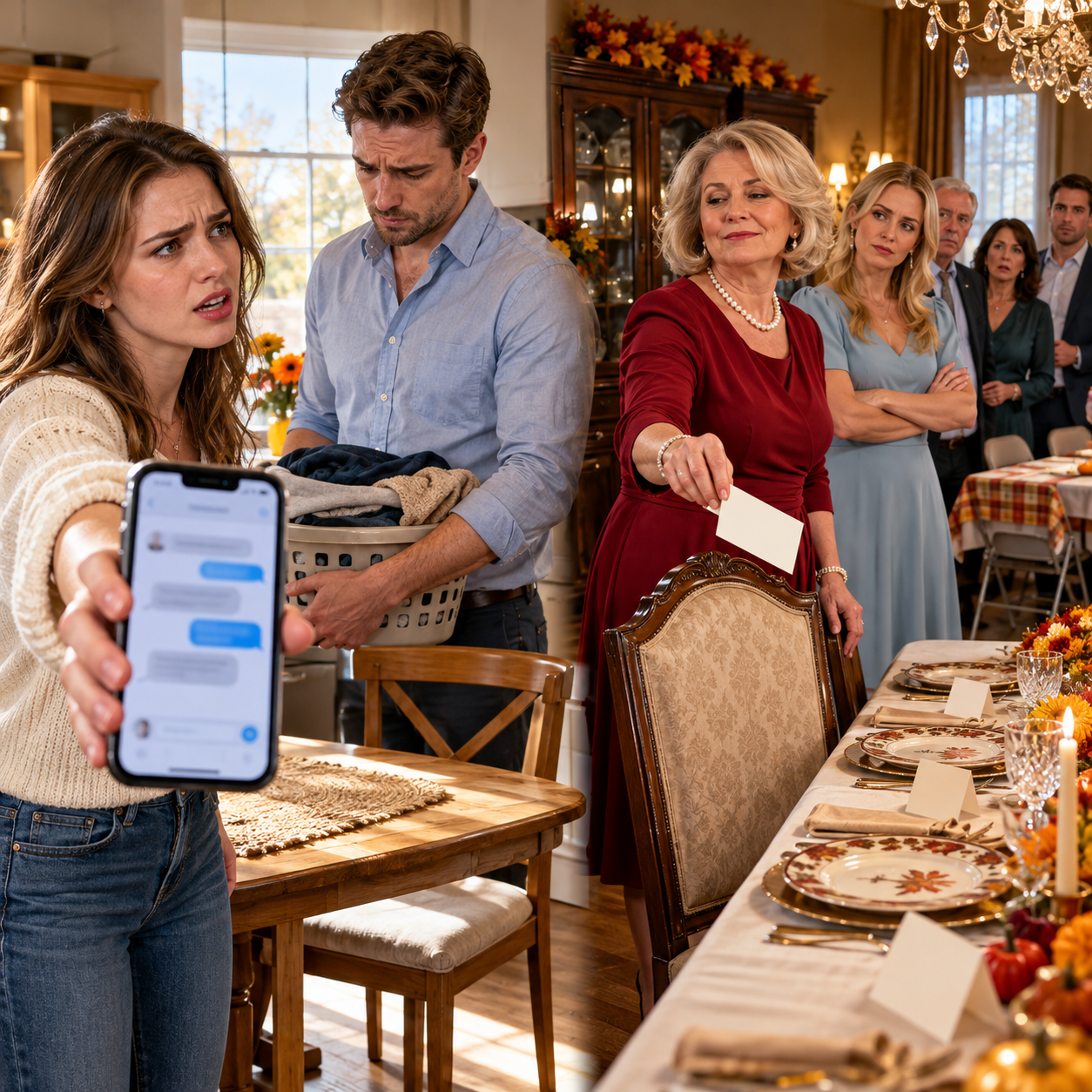
Her dining table was immaculate. Twenty-four places were set beneath the chandelier, each marked with one of her carefully written calligraphy cards.
Grandpa Jean’s name sat at the head.
Uncle Jim’s card was there. So were the cards for the college students and relatives who had already arrived at my house.
Marlene had prepared twenty-four places.
Only four people appeared.
Marlene. Her husband, Ron. Their daughter, Paige.
And Evan.
At three-thirty, Ron quietly set down his fork.
“Marlene, your father’s not coming.”
“He’ll probably stop by for dessert,” she replied.
Ron reached across the table, lifted Jean’s place card, and slipped it into his shirt pocket.
Nobody said another word.
Marlene carved her twenty-two-pound turkey while insisting that extra leftovers were a blessing.
Meanwhile, at my house, Grandpa Jean raised his hand.
“Before we eat, I’d like everyone together.”
It took several minutes to quiet the room.
Deb stood beside his chair. Maya moved closer and took his other hand.
Twenty-two people crowded into my living room and hallway, their heads bowed beneath the warm ceiling lights.
Grandpa began the prayer I’d heard three Thanksgivings in a row.
His voice trembled slightly.
When he reached the part about gratitude for family, he stopped.
He looked at Deb.
Then at Maya.
Finally, his eyes found mine.
“Thank you,” he whispered, “for bringing us together again.”
Nobody moved.
Then he cleared his throat.
“Now somebody pass me those sweet potatoes before they disappear.”
The room erupted with laughter.
A moment later, one of our old folding chairs buckled beneath Uncle Jim. He landed harmlessly on the carpet, laughing harder than anyone.
Someone helped him up.
Another person found a sturdier chair.
And we kept eating.
Around five, a cousin posted a short video of Grandpa’s prayer in the family group chat.
At Marlene’s dining table, Paige watched it.
“Oh my goodness,” she murmured. “Grandpa’s saying grace at Allison’s house.”
Evan leaned over.
On the screen, his grandfather sat surrounded by smiling faces. Deb held one hand, Maya the other, and every inch of our tiny house seemed filled with people.
Marlene glanced at the video, then looked away.
Evan told me later that something finally broke through his lifelong habit of keeping the peace.
His mother had been offered a place among twenty-two people who loved her.
But she preferred sitting with three others at a table for twenty-four, rather than entering a room where she wasn’t in charge.
At 7:15 that evening, our doorbell rang.
I opened the door.
Evan stood on the porch holding a large homemade pie.
His eyes were red.
And for once, he wasn’t asking me to understand his mother.
He was asking me to listen.
## Part 4: A husband’s confession and one unexpected gift change Thanksgiving forever.
Evan looked past my shoulder.
He could hear laughter spilling from the kitchen. Someone was arguing about football. Grandpa Jean was calling for another cup of coffee.
My husband stared at the crowded hallway.
“I should’ve been here,” he said.
I didn’t answer.
He looked down at the pie.
“Mom sent this. She told me not to tell you.”
Of all the things I expected Marlene to send to my house, an apology disguised as dessert wasn’t one of them.
I stepped aside.
Evan walked into our living room and stopped.
His grandfather was smiling. Aunt Deb was laughing with Uncle Jim. Theo and Maya were sitting together on the stairs, passing leftovers between them.
People who hadn’t shared a holiday in years were talking like they’d never been separated.
Evan turned toward me.
“I thought if I stayed out of the argument, nobody would get hurt.”
His voice cracked.
“But you were getting hurt. And I kept pretending that wasn’t happening.”
I felt the anger I’d carried for six weeks rise into my throat.
“Why did it take twenty empty chairs for you to see that?”
He nodded slowly.
“Because I spent my whole life being afraid of disappointing her.”
He swallowed.
“And I let you pay for it.”
I looked at the man I’d married.
For years, he’d confused silence with kindness. He’d believed keeping his mother happy was the same as keeping his family together.
Now he was standing in a hallway crowded with the family she’d pushed away.
“I don’t need you to fight your mother,” I told him. “I need you to stand beside me when she decides I’m the problem.”
“I know.”
“Do you?”
He reached for my hand.
“I do now.”
I wanted to believe him.
But trust doesn’t grow back because somebody says the right thing once.
So I took the pie from his hands and carried it into the kitchen.
“There’s room on the stairs,” I said.
He gave me a small, grateful smile.
He sat beside Theo.
For the next hour, I watched my husband have an actual conversation with his cousin. They talked about work, marriage, childhood summers, and all the family gatherings they’d missed.
Grandpa Jean ate two slices of Marlene’s pie.
He declared it excellent.
Nobody argued.
By ten, the guests had gone home carrying containers of leftovers. Deb kissed my cheek before leaving and whispered, “Your grandmother was right. You made room.”
The house looked as though a small parade had marched through it.
Evan and I stacked chairs in the dim living room.
As he folded the last one, he said, “I booked our Christmas flights.”
I stopped.
“What?”
“Arizona. December twenty-second through the twenty-eighth. I checked with your mom this afternoon.”
I stared at him.
“You already bought them?”
He nodded.
“Did you tell Marlene?”
“I called her from the driveway before I rang the bell.”
I waited.
“She said it was fine.”
We looked at each other.
Then, despite everything, we laughed.
“Fine?” I repeated.
“In that voice,” he said.
Then he grew serious.
“I told her we weren’t changing our plans. I said I loved her. And then I hung up.”
He shook his head in disbelief.
“I’m thirty-four years old. I think that’s the first time I’ve ended a conversation with my mother before she decided it was over.”
I walked over and wrapped my arms around him.
Not because everything was fixed.
Because for the first time, he was trying to fix the right thing.
A week after Thanksgiving, Paige texted me.
“Any chance the little house is hosting Christmas Eve?”
I smiled at the screen.
“We’ll be in Arizona with my parents.”
A sad-face emoji appeared.
Then another message.
“Maybe next year?”
I answered, “We’ll see.”
December brought a few changes.
Marlene called Deb.
They spoke for twenty minutes. There was no dramatic reunion, no grand apology, and no sudden forgiveness for six years of exclusion.
But they spoke.
Grandpa Jean called to tell me about it.
“Your mother-in-law and Deb talked yesterday,” he announced.
“Really?”
“Twenty minutes.”
Then he hung up.
I laughed so hard my father came into the room to see what was wrong.
Evan and I spent Christmas in Arizona.
Dad was recovering steadily, and Mom was delighted to have us home. We ate dinner at their small kitchen table, played cards, and watched old Christmas movies.
Nobody assigned seats.
Nobody kept score.
On Christmas Eve, an envelope arrived addressed to me.
The return address was Marlene’s.
Inside was a single rectangular piece of cream-colored cardstock.
My name was written across it in elegant calligraphy.
Allison.
It was one of her Thanksgiving place cards.
There was no letter. No explanation. Not even an apology.
I sat holding that little card, remembering three years of folding tables, embarrassed smiles, and pretending I didn’t mind.
Once, I would have treated it like a prize.
Proof that I had finally earned my place at Marlene’s beautiful table.
But something had changed.
I thought of Grandpa Jean holding Deb’s hand. Of Maya laughing on the stairs. Of Tom carrying a smoked turkey across the fence. Of Evan finally choosing to stand beside his wife.
I thought about twenty-two people squeezed into a house too small for their laughter.
And I realized Marlene had accidentally taught me something important.
A name card can tell you where you’re permitted to sit.
It cannot tell you where you belong.
I tucked the card into my purse.
Not because I was planning to return to her dining room, and not because I wanted to punish her.
I kept it as a reminder that people can change, but a real apology requires more than beautiful handwriting.
Maybe next Thanksgiving, Marlene would walk through my front door.
Maybe she’d bring her famous pie.
Maybe she’d sit beside her sister and finally have the conversation they should have had six years earlier.
I’d welcome her.
But I would never again accept a place at the children’s table simply because someone wanted to remind me who was in charge.
That Thanksgiving, I didn’t steal Marlene’s family.
I opened my door, and the people who had been waiting outside finally came in.
For years, I’d thought belonging meant being invited.
Now I knew better.
Sometimes belonging begins the moment you stop asking permission to make room for yourself.
And the most beautiful Thanksgiving table I’d ever seen wasn’t covered in expensive china or silver.
It was crowded with mismatched plates, borrowed chairs, and twenty-two people who finally understood that nobody had to earn the right to be loved.
THE END.
All characters and events in this story are fictional, created for storytelling and entertainment purposes. Thank you sincerely for reading. Your feedback and support are invaluable and motivate me to continue sharing more stories with you.