
## Part 2: Grandma’s final recording revealed the secret behind Mom’s forged signature
At four the next afternoon, I climbed the stairs to Alden Pruss’s office above an old storefront on Main Street. He was seventy-eight, wore a tie even when nobody expected him to, and had handled wills for half of Franklin County. His longtime secretary, Willa, poured coffee without asking what I wanted. “Your grandmother was quite a woman,” she said, leaving his office door slightly open.
Alden enlarged my photograph on his computer. He studied the signature, then opened a folder containing Grandma’s earlier checks. The difference was almost embarrassing. “Your mother filed this deed Monday,” he explained. “She’s asking the court to rule that Mirna transferred ownership before dying, which would keep the house outside her estate.” He removed his glasses. “She filed without a lawyer. That’s probably why she didn’t understand what she’d started.”
He told me what had actually happened at the hospital. On Wednesday, Grandma had called to report that Charla and Dylan visited her with a document transferring the house to Dylan for his children. They’d asked her to sign it, and she’d refused. Grandma wanted Alden there the following morning, accompanied by Willa, while I was away showering.
“She knew she couldn’t sign a statement herself,” Alden said. “So, with Willa present, I recorded her account.” He put his phone between us and pressed play. For the first time since April, Grandma’s voice filled the room.
“This is Mirna Rash. I’m in the hospital in Ottawa. My hands don’t work, but my head does, so don’t let anyone tell you otherwise.” I closed my eyes as she continued. “Tuesday, my daughter Charla brought a paper asking me to give Dylan my house. I said no. She asked again. I said I’d already made my will, and I meant what it said.”
Her breathing crackled through the speaker. Somewhere behind her, a hospital cart rattled across the floor. “And Alden, even if I wanted to sign, I couldn’t. Kent has to hold my fork for me. If someone shows you a paper with my signature from this week, I didn’t write it.”
Then came a pause that seemed to stretch across the six months since her funeral. “Charla isn’t a bad girl. She’s just always believed this house owed her something. Give her one chance to make it right. Then do what the will says.”
Alden stopped the recording. Willa had helped him document Grandma’s statement, and both had signed written accounts of what they witnessed. “She didn’t want you to know unless Charla actually used that document,” he explained. “She hoped her daughter would put it away and forget the whole thing.”
I stared at the desk. Grandma had protected me without telling me, and she’d tried to protect Mom, too. “What was the provision she mentioned at Thanksgiving?” I asked. Alden pulled out the will, turned to page four, and slid it across the desk.
The sentence was written in plain English: Anyone attempting to take property Grandma had left to someone else would forfeit their own inheritance to the First Methodist food pantry.
“Your mother’s forty thousand dollars,” Alden said. “And Dylan’s grandfather’s truck. If the court enforces the provision, both are at risk.”
I looked up sharply. “Can she really lose everything over this?” Alden explained that the court would determine whether the clause applied, including whether there had been a legitimate, good-faith dispute. A document carrying a signature Grandma couldn’t physically have made would be difficult to defend. Filing a knowingly false document could also have more serious legal consequences.
I imagined my seventy-year-old mother standing before a judge. I imagined Grandma asking me not to destroy her daughter over a house. “I don’t want to pursue criminal charges,” I said. Alden nodded, as if he’d expected exactly that answer.
Then he explained the escape Grandma had arranged. If Mom and Dylan promptly withdrew the filing, he could ask the judge to treat the matter as resolved without imposing the inheritance penalty. If they insisted on proceeding, he would submit Grandma’s recording and the witness statements.
“She wanted them to choose,” Alden said.
I folded the copy of the will and pushed it back. “They’re bringing a moving trailer Friday morning. Could you be on the porch at eight?” He smiled faintly. “I’ll be there.” From the next room, Willa called, “And I’ll bring the coffee.”
Thursday, I returned to work flushing hydrants. My supervisor noticed I’d tasted one sample twice, which I’d never done before. At lunchtime, Dylan texted, asking whether I’d be gone when the trailer arrived. I replied, “I’ll be here.” That night, I repaired the porch light, set out two chairs, and ate supper with Grandma’s old fork, the one with the bent tine she’d refused to replace.
For the first time in months, I understood why she’d kept it.
## Part 3: Friday’s confrontation forced my family to choose truth or greed
Friday morning broke bright and cold over Locust Street. Alden’s tan Buick arrived at 7:40, with Willa beside him carrying a thermos. I brought out a third chair, and we waited beneath the porch light I’d repaired the night before. At 8:05, Dylan’s truck rolled toward the driveway, pulling a borrowed flatbed trailer loaded with dismantled bunk beds.
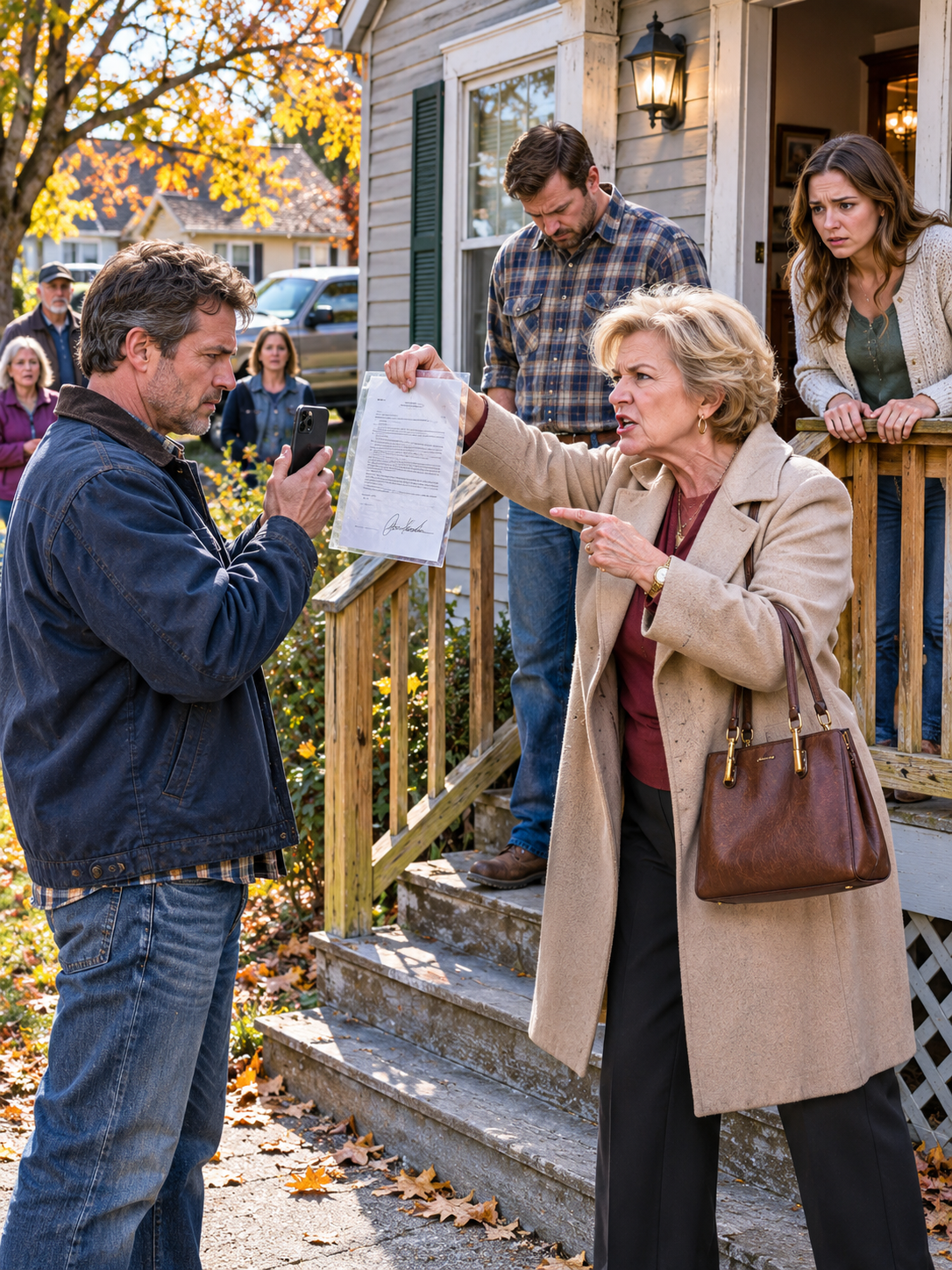
Mom spotted Alden before the truck stopped. She stepped out, stared at his briefcase, and marched toward the porch. “What is he doing here?” she demanded. Dylan climbed down more slowly, while Shayla stayed beside the truck. Thankfully, Paisley and Colt were spending the morning at their other grandmother’s house.
“Morning, Charla,” Alden said.
Mom looked straight at me. “Kent, we had a deal.” I rested my hand on the railing Grandpa Cle had built. “You told me I had to leave by Friday. I said I’d see you Friday. That’s not a deal.” Her expression hardened, but I continued. “Grandma wanted you to hear something before you make another decision.”
I placed my phone on the railing and started the recording.
Grandma’s voice came through clearly, tired but unmistakable. Mom remained motionless through the introduction. When Grandma described Charla bringing the deed, Mom’s fingers tightened around her purse. When Grandma said she’d refused to sign, Dylan looked at his mother in bewilderment.
Then Grandma’s voice said, “Kent has to hold my fork for me.”
Dylan sat heavily on the second porch step. He stared at the boards, his face drained of color. Mom looked away toward the empty street, but the recording wasn’t finished. When Grandma spoke about a daughter who believed the house owed her something, Mom lowered her head.
The recording ended. Wind rattled the chains hanging from Dylan’s trailer.
“That could be anybody,” Mom said finally.
Willa leaned forward. “It was Mirna, Charla. I was standing beside her.”
“She was on medication!” Mom snapped. “She didn’t know what she was saying!”
I looked directly at her. “If Grandma was too confused to speak on Thursday, how could she have understood and signed your deed on Tuesday?” Mom opened her mouth but said nothing. Her silence felt louder than the recording.
Shayla finally approached the steps. Her hands trembled as she looked from Mom to Dylan. “I didn’t see Grandma sign anything,” she whispered. Mom swung toward her, but Shayla continued. “I was in the hallway with the children. You told me later she’d signed it. At your kitchen table, you said I could witness it because I’d been at the hospital.”
Dylan covered his face. “Mom, what did you do?”
“I did it for your family!” she shouted. “Your lease was ending. You needed somewhere to live.”
“I had a lease I could renew,” Dylan answered, rising. “You told me not to renew it because this house was ours.” Shayla turned toward him, shocked to learn that detail herself. Mom glanced from one face to another, searching for support she could no longer find.
Alden stood and opened his briefcase. “Charla, Dylan, Mirna asked me to offer you one opportunity. Withdraw the court filing today, and I’ll ask the judge to resolve this without enforcing the forfeiture provision. Continue, and I will present this recording and our sworn statements.”
Mom frowned. “What forfeiture provision?”
He handed her the will, opened to page four.
I watched her read. Then she read the same paragraph again, slowly, her face changing as the meaning settled in. The house wasn’t the only thing at stake anymore. Her forty-thousand-dollar inheritance could go straight to the church pantry.
“Mother would never do that to me,” she whispered.
“She wrote it two years ago,” Alden said. “And she deliberately made it easy to understand.”
Dylan immediately stepped forward. “I want out of this. Mr. Pruss, I’ll withdraw whatever I signed.” Alden told him the courthouse was only a few blocks away and advised him to seek independent legal guidance about correcting the filing. Dylan looked at me with the frightened expression he’d worn as a boy after breaking Grandpa’s favorite fishing rod.
“I didn’t know she couldn’t hold a fork, Kent,” he said. “Mom told me it was just pneumonia. I was only in her room a few minutes before she sent me for a soda.” I remembered Grandma’s account and believed he hadn’t understood the full truth. “Then fix what you can,” I told him.
Dylan turned to Mom. “Come with us.”
But she stood frozen, clutching the will. “She promised me this house in 1979,” she insisted.
“Then why did you put Dylan’s name on the deed instead of yours?” I asked.
She couldn’t answer.
“You thought a judge would believe Grandma wanted the children to have it,” I said. “But Grandma had already decided. She left you forty thousand dollars, her china, and a chance to walk away from this.”
Mom looked toward the windows she’d once imagined filling with new curtains. Dylan and Shayla waited beside the truck, its trailer still loaded with furniture destined for rooms they would never occupy.
Then Mom straightened her shoulders. “I’m not withdrawing anything. That recording won’t hold up. I’ll find a real lawyer.”
She handed the will back to Alden and walked toward the truck.
At 8:50 that morning, Dylan went to the courthouse and formally began withdrawing his support for the disputed filing. Mom refused to withdraw her claim.
Three days after she ordered me out, she had made the decision that would cost her $40,000.
## Part 4: Grandma’s final surprise turned betrayal into forty thousand meals
December brought the ruling. The Franklin County court rejected the purported deed, recognized Grandma’s estate plan, and enforced the forfeiture provision against my mother. The house remained mine, Dylan retained his inheritance after withdrawing his challenge, and Mom’s forty thousand dollars went to the First Methodist food pantry.
She called the evening of the decision. I recognized her breathing before she spoke. “Are you happy now, Kent?” I stood at Grandma’s kitchen sink, watching water run into the green mug. “No, Mom,” I said. “You could have stopped this.”
“You’re blaming me for what your grandmother did?”
“I’m telling you that she gave you another chance. You had all Friday morning to take it.”
Mom remained silent. Then the call ended.
She’d consulted three attorneys after the porch confrontation. Each had examined the will and asked about Grandma’s recording. None had given her the assurance she wanted. Yet even knowing what she stood to lose, she never withdrew the claim.
The consequences reached Dylan’s family, too. He’d surrendered his rental in September because Mom had promised him Grandma’s house, and his landlord had already arranged for new tenants. With nowhere else ready, Dylan, Shayla, Paisley, and Colt moved into Mom’s two-bedroom condo in Topeka.
I thought about her immaculate white couch, the one nobody was allowed to sit on wearing jeans. Now two children lived beside it, along with a mountain of their belongings and the grandmother who had insisted they needed a bigger home. Shayla later told me the couch survived, though not without considerable protest from Mom.
In January, Shayla phoned and apologized for signing as a witness without seeing Grandma sign. Her voice broke when she admitted she’d been afraid to contradict Charla. “You told the truth on that porch,” I said. “You could’ve stayed quiet, but you didn’t.”
By spring, she’d found a one-story rental in Ottawa, with no stairs at the entrance. Dylan received Grandpa Cle’s old maroon 1994 Ford truck, with more than 160,000 miles on it. In May, he brought it over and asked me to inspect the brakes. We worked together in the driveway, talking about ordinary things because neither of us yet knew how to talk about what had happened.
His eight-year-old son Colt followed me into the kitchen afterward. “Dad says you drink water from fire hydrants,” he announced, looking horrified. I explained my job and let him taste water from Grandma’s sink instead. He shrugged. “It tastes regular.”
“Tastes like Grandma’s house,” I corrected him.
Colt took another sip. “That’s what regular tastes like.”
I laughed harder than I had in months.
Mom still sends birthday cards. There are no messages inside, only her signature with the same ornamental curl she’s used for decades. I keep them in a drawer, though I can’t explain exactly why. Perhaps Grandma taught me that loving someone doesn’t mean pretending they haven’t hurt you.
But the last surprise came from Grandma herself.
A week after the court ruling, Alden invited me to accompany him to the First Methodist food pantry. We drove there in his Buick, carrying an envelope containing the money from Mom’s forfeited inheritance. The pantry occupied the same church basement where we’d eaten ham sandwiches and green gelatin after Grandma’s funeral.
Arleta, the woman who ran the pantry, was folding grocery bags at a long table when we arrived. She was about seventy, with silver hair and the steady hands of someone accustomed to making too little stretch far enough. Alden gave her the envelope, and she unfolded the letter inside.
When she saw the amount, she lowered herself onto a folding stool.
“Forty thousand dollars?” she whispered.
Alden nodded.
Arleta looked at me, studying my face. “You’re Kent, aren’t you?”
“Yes, ma’am.”
Her eyes brightened with recognition. “Your grandma told me somebody might bring money someday.”
I stared at her. “When?”
“About two years ago. She was still wearing that brace after breaking her wrist.” Arleta pointed toward a spot beside the pantry shelves. “She stood right there and told me something very strange.”
I waited.
“She said, ‘Arleta, someday there might be money for this pantry. If it comes, it’ll come from my daughter. Make sure you thank her.'”
Alden let out a short laugh. Then he removed his glasses, wiped them, and looked toward the floor.
I stood there imagining Grandma in her blue cardigan, two years before her death, already understanding what Mom might someday try to do. She’d prepared a way to protect her wishes, given her daughter every opportunity to respect them, and arranged for something good to happen even if everything went wrong.
Arleta calculated that the donation could provide roughly twenty-six thousand meals for struggling families in Franklin County. She folded the letter carefully, then reached for a sheet of church stationery.
“I think your grandmother meant what she said,” Arleta told me.
She wrote my mother a thank-you card.
It thanked Charla Hail for her generous forty-thousand-dollar contribution to the First Methodist food pantry, explaining how many local families her gift would help. Arleta showed me the card before sealing the envelope. I read it twice.
I wondered whether Mom would recognize the meaning behind those words, or whether she’d see only another reminder of what she believed had been taken from her.
Then I remembered Grandma saying Mom never read past the first page.
This time, the whole letter fit on one.
I don’t know if Mom ever answered it. I don’t know whether she’ll ever understand that Grandma’s final decision wasn’t really about punishing her. It was about respecting the life Grandma had built, the wishes she’d clearly expressed, and the people who still needed help after she was gone.
I still live on Locust Street. The furnace makes its familiar noise around two in the morning, and the back porch still slopes slightly toward the yard because I repaired it once and couldn’t bear to leave it completely straight. Every morning, I fill Grandma’s favorite green mug, not the other green mug, and taste the water at the kitchen sink.
At supper, I use her old fork with the bent tine. She spent her last days needing my hand around hers to hold a fork, yet somehow, she’d managed to hold the truth together long enough to protect everyone who was willing to listen.
Sometimes, when sunlight catches the kitchen window just right, I can almost hear her asking, “How’s my water, Kent?”
And I give her the same answer I gave for four years.
“Tastes like your house, Grandma.”
Only now, I understand why she always smiled.
THE END.
All characters and events in this story are fictional, created for storytelling and entertainment purposes. Thank you sincerely for reading. Your feedback and support are invaluable and motivate me to continue sharing more stories with you.

