### Part 2: Fifty-Five Missed Calls Exposed Lies My Son Could Not Explain
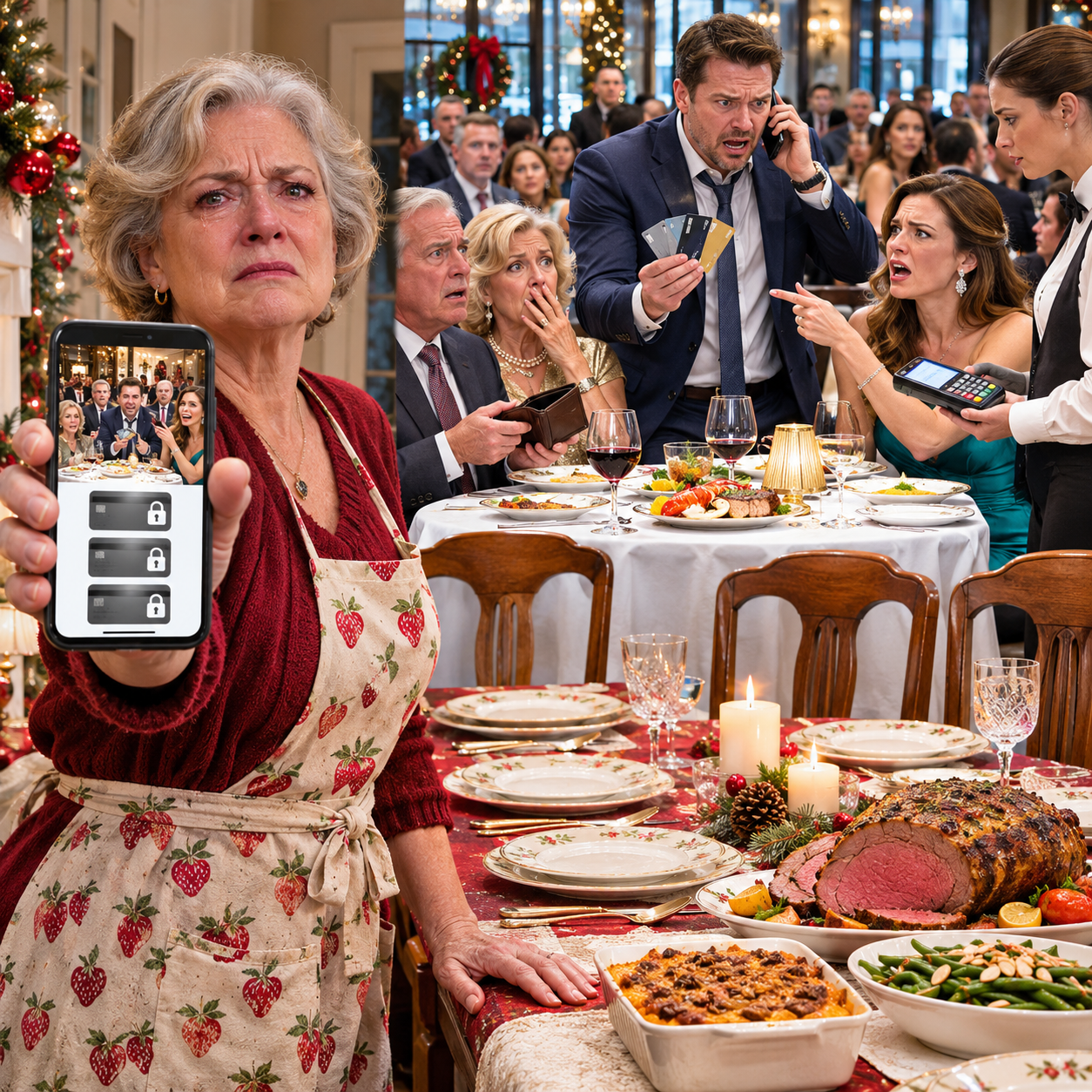
I learned the details of that restaurant disaster several days later, and they were even worse than I imagined. Their waiter had presented a bill for $1,386, covering steaks, seafood, and expensive wine. Gavin confidently handed over his first card, smiling at Richard as though money were no concern. When it declined, he tried the second, then marched to the bar to test the third, only to hear the same dreadful answer.
Richard finally paid the entire bill himself. My son began calling me while Sloan hissed instructions beside him, demanding that he keep trying until I answered. Neither of them asked whether I had eaten Christmas dinner or whether the food I had prepared was ruined. Their only concern was rescuing Gavin’s reputation before the evening ended.
At nine the following morning, I was sealing the eleventh container of leftovers when my screen door slammed. Gavin strode into the kitchen wearing yesterday’s wrinkled shirt, his face flushed with anger. “You owe Richard $1,386,” he announced. “I want that money in his hands by Friday.”
I placed the container on the counter. “Good morning, Gavin. I didn’t order that dinner, and I certainly wasn’t invited to eat it.” He accused me of humiliating him, insisting that a respectable man was supposed to provide for his in-laws. I looked directly into his eyes and asked how respectable it was to leave his mother waiting beside six untouched plates.
“Richard was sick,” he snapped.
“Was he sick before or after he finished his steak?” I asked, showing him Sloan’s photograph. “And how did you get a Christmas reservation at a restaurant that requires booking days ahead?” Gavin began answering, accidentally mentioning when Sloan had made the reservation, then stopped mid-sentence. His silence told me everything: he had known about their plans long before calling me at three.
When I confronted him about deliberately keeping me waiting, he dismissed the entire day as one wasted meal. “You’re home all day anyway. What did cooking really cost you?” he demanded. Then he offered a bargain: reopen one credit card, reimburse Richard, and he would consider the matter settled. Otherwise, he threatened to tell our relatives that I had deliberately sabotaged Christmas because I despised Sloan.
I opened his Christmas messages and turned the screen toward him. There were his instructions, complete with timestamps, telling me repeatedly to keep dinner warm. “Tell everyone whatever story you want,” I said. “But you cannot change what you wrote.” He stared at the evidence, grabbed his jacket, and left without another word.
My neighbor Nora Sullivan appeared shortly afterward carrying an empty casserole dish. She listened as I explained the abandoned dinner, the photograph, and the fifty-five calls, then insisted on taking several containers home. “Good food belongs with people who appreciate it, Dorothy,” she said, pulling me into a hug. For the first time since Christmas morning, I laughed.
That evening, Sloan published a vicious accusation online. She claimed I had kept Gavin financially dependent so I could control his marriage, describing me as a bitter woman who punished anyone refusing to worship her. Relatives began calling, including a cousin who lectured me about family loyalty. Then my late husband’s sister, Diane, telephoned and demanded to hear my side before deciding whom to believe.
I sent Diane three things: Gavin’s original Christmas invitation, his messages telling me to wait, and Sloan’s photograph showing exactly where they had been. An hour later, Diane called Gavin while keeping me on the line. “Why did you let your mother prepare Christmas dinner when you knew you weren’t coming?” she demanded. Gavin stumbled through explanations, admitted Sloan had arranged the restaurant, and disconnected when Diane refused to accept his excuses.
Diane called back to apologize. Another friend, Grace Thompson from church, asked whether I was eating properly and taking care of myself, a question that nearly brought me to tears. But the most unexpected call came from Richard Caldwell himself. His voice was unusually quiet when he asked, “Dorothy, may I come over? There are some things about Christmas that you deserve to hear.”
### Part 3: My Daughter-in-Law’s Father Revealed the Secret Behind Their Lavish Dinners
Richard arrived Sunday afternoon holding his hat against his chest. He stood awkwardly in my living room, refusing to sit until I insisted, then explained that Sloan had told him and Patricia I preferred not to cook Christmas dinner. According to his daughter, I had welcomed their restaurant plans and was relieved to have the evening to myself. Richard admitted he had believed her completely.
“There was no stomach trouble, Dorothy,” he said, staring at the carpet. “And when Gavin started shouting about frozen cards, I finally understood whose money had been paying for our celebrations.” He described the waiter, Rachel, who had handled the declined payments discreetly, and confessed that for two years Gavin had proudly insisted on treating the Caldwells to expensive dinners. Richard had even praised his son-in-law’s generosity to friends at his club.
I brought him my blue folder. As he examined the restaurant charges, resort bills, and expensive purchases, his expression slowly collapsed. He recognized Patricia’s birthday dinner, the anniversary celebration, and the elaborate wine Gavin had ordered while boasting about his success. “I thought my daughter married a responsible provider,” Richard whispered. “Instead, I’ve been eating at your expense.”
His apology was the first I had received from anyone involved in that Christmas dinner. He promised that Gavin would personally reimburse the $1,386 restaurant bill, and said Patricia was devastated by what she had learned. Before he left, I handed him a container of my husband’s sweet potatoes to share with her. Richard held it carefully and said, “You deserved a full table, Dorothy. I am deeply sorry we helped leave it empty.”
The following morning, I visited Calvin Brooks, the attorney who had handled my husband’s estate. He examined the financial records, listened to the circumstances, and explained the distinction between freezing Gavin’s cards and removing him permanently as an authorized user. Because the accounts belonged to me, I could withdraw his spending privileges without surrendering my own accounts. Calvin advised me to preserve the evidence and obtain written confirmation of any changes.
Then he addressed the money. The $60,000 I had given Gavin and Sloan over three years would be difficult to recover because much of it had been informal family assistance without documented repayment terms. The card charges were different because Gavin had expressly agreed to repay them, although pursuing recovery would depend on the evidence and applicable law. Calvin also explained that spending made while Gavin was authorized was not automatically criminal fraud simply because he had broken his promises.
“I’m not suing my son,” I told him. Calvin nodded, closed the folder, and promised to keep copies in case I changed my mind. I asked for a little more time before permanently removing Gavin from the accounts. There was one thing I desperately wanted to know: could my son visit his mother without asking for money?
On New Year’s Eve, I celebrated at Helen and Frank Parker’s house. Frank poured his notoriously strong eggnog while Helen retold the disaster of their 1979 wedding cake, making me laugh until my sides hurt. For several wonderful hours, nobody mentioned Gavin, credit cards, or Christmas dinner. Driving home beneath the cold stars, I realized how unfamiliar peaceful happiness had become.
On January 6, Gavin appeared at my front door carrying grocery-store roses. He looked exhausted, and his voice trembled when he asked to come inside. We sat across from each other over steaming cups of tea while he admitted that Sloan had booked the restaurant, that he had knowingly lied about Richard’s illness, and that he had asked about the cards because he intended to use them. For the first time, he offered an apology without blaming me.
I felt something soften inside my chest. The boy who once brought me crushed dandelions was still somewhere inside the troubled man sitting across from me. I told him I appreciated his honesty, and for several minutes we spoke almost like a mother and son again. Then he glanced toward the hallway, turned his wedding ring around his finger, and asked whether I could reopen just one credit card to help him and Sloan through the following month.
### Part 4: One Final Request Changed Our Family’s Future Forever
I stared at Gavin across the kitchen table, watching the steam disappear from our untouched tea. He promised that this time would be different, that he would repay every dollar and only needed temporary help. The roses lay on my counter, still wrapped in crackling plastic. I realized that he had not even allowed us to finish one cup of tea before turning his apology into another financial request.
“Tell me something, Gavin,” I said quietly. “If I never reopen those cards, will you still come here to see me?” He looked down at his wedding ring and began explaining why he and Sloan needed assistance. I stopped him gently. “I didn’t ask what you need. I asked whether you want your mother when she has nothing to give you but her company.”
He couldn’t answer. Finally, he stood, murmured that he couldn’t deal with this conversation, and collected his coat. I didn’t follow him to the porch or beg him to stay. I watched him drive away, then returned to the kitchen and called the card issuer.
A representative named Megan Collins confirmed my identity and listened as I requested Gavin’s permanent removal as an authorized user from all three accounts. She carefully explained that his supplementary cards would be cancelled and that he couldn’t independently restore his access. I authorized every removal and requested written confirmations. When the call ended, I picked up the roses, trimmed their stems, and placed them in my mother’s blue vase.
The flowers were beautiful, even though the apology that brought them had failed its most important test. I put them in the middle of the dining table anyway. Gavin was still my son, and I still loved him, but I no longer intended to purchase the privilege of being treated like his mother.
The months passed without another rescue payment from me. I maintained my home, attended church, visited friends, and learned to distinguish genuine emergencies from problems other adults expected me to solve. Occasionally, I took out the blue folder and examined the three cancellation confirmations. They reminded me that an agreement could be broken, but a boundary could still be kept.
When the next Christmas arrived, I set my table for six again. This time, the place cards carried names I had chosen freely: Dorothy Hargrove, Helen Parker, Frank Parker, Nora Sullivan, Grace Thompson, and Calvin Brooks. A golden turkey rested beneath its foil while candles glowed against my mother’s polished silver. In the kitchen, my husband’s beloved sweet potatoes browned beneath their pecan crust.
Helen and Frank arrived first, bringing a pecan pie that Frank carried like a priceless heirloom. Nora appeared with cranberry relish, Grace brought warm homemade rolls, and Calvin arrived with chocolates and sparkling cider. Nobody had requested a special menu or sent me an expensive shopping list. They had simply accepted my invitation and shown up smiling.
We gathered around the table as Frank carved the turkey. Grace laughed at his exaggerated complaints about the carving knife, while Helen threatened to replace him with Nora if he didn’t behave. Calvin asked for a second helping of sweet potatoes and listened while I explained how my husband used to steal the crunchy topping. For once, remembering him made me smile without feeling that something precious was missing.
Nora lifted her glass. “To Dorothy, who finally gets to enjoy her own Christmas dinner while it’s hot.” Everyone laughed and raised their glasses, and I looked around at five faces that expected nothing from me except friendship. No one checked the time, complained about the food, or looked toward the door for somebody more important.
Then my phone vibrated.
Gavin had sent a message asking whether he and Sloan could visit because Christmas didn’t feel right without me. My heart stirred with an old, familiar hope. Before I could answer, another message appeared: money was tight again, and they needed a loan to get through the following month.
I stepped into the kitchen, where the clock ticked above the stove and the warm smell of cinnamon lingered in the air. There was my final revelation, not about Sloan or Richard or even the Christmas before, but about my son. Twelve months had passed, and he was still treating a visit to his mother as the beginning of a financial negotiation.
I typed carefully: “I love you, Gavin. I won’t lend you money, and tonight I have guests. If you want to see me, call tomorrow and we’ll arrange a visit. You are welcome in my life, but my money is no longer available.”
I sent the message without checking whether he had read it.
When I returned to the dining room, Helen glanced at my face and quietly asked whether everything was all right. I looked at the candles, the nearly empty serving dishes, and the friends who had come because they genuinely wanted to spend Christmas with me. “Everything is fine,” I told her, and for the first time in a very long while, I meant every word.
Frank passed me the sweet potatoes, making certain I received an extra spoonful of the crunchy topping. He called it my husband’s Christmas share, and everyone smiled as I accepted it. Outside, the streetlights came on, but I no longer watched the driveway for headlights or measured my worth by who might arrive.
The previous Christmas, I had prepared six places for people who never came. This Christmas, six chairs were occupied by people who never would have left me waiting.
I didn’t stop being Gavin’s mother when I cancelled those cards. I stopped confusing his dependence on my money with his love for me. I could forgive him if he ever truly changed, and I could welcome him to my table without returning the financial privileges that had damaged us both.
That Christmas, I finally understood something my husband had tried to teach me for years: a home isn’t made warm by how much one person sacrifices. It becomes warm when everyone inside contributes kindness, honesty, and respect.
I looked around my table once more, lifted my glass, and smiled.
Every chair was filled. Every guest belonged. And for the first time in years, so did I.
THE END.
All characters and events in this story are fictional, created for storytelling and entertainment purposes. Thank you sincerely for reading. Your feedback and support are invaluable and motivate me to continue sharing more stories with you.