
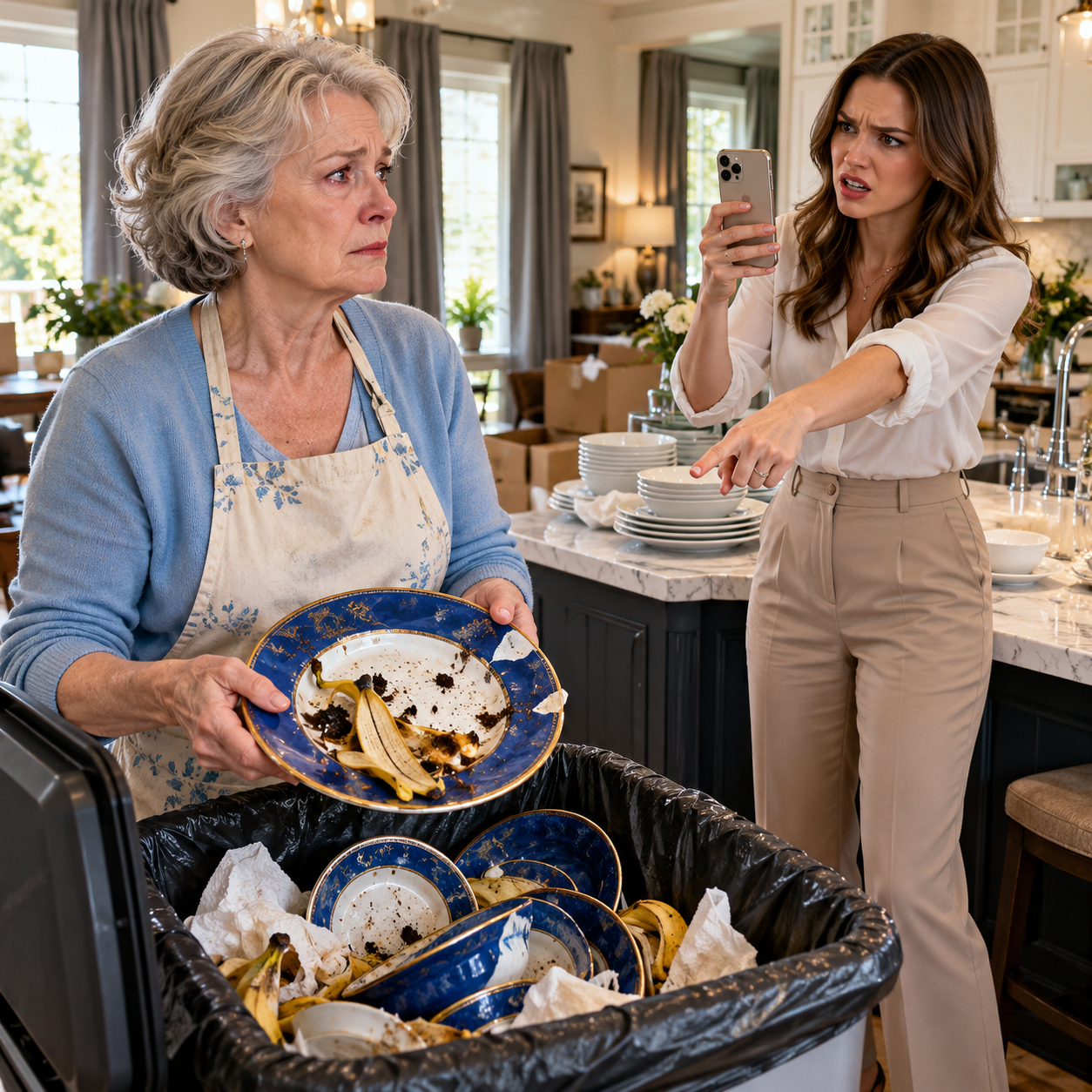
### Part 2: A Missing Credit Card Revealed The Price Of Family Silence
That evening, Evan came home smelling of sawdust, exhaustion written across his face. He kissed Vanessa, lifted my granddaughter from her play mat, and asked whether I’d had a good day. I watched him settle into the chair where Robert used to read the newspaper. “Evan, do you know where my credit card is?” I asked. His fingers paused against the baby’s blanket before he shrugged. “Vanessa might have used it for groceries. I’ll ask her.” He disappeared into the kitchen, leaving me with the uncomfortable realization that he’d stopped treating my belongings as mine, too.
The next morning, I brewed coffee with brown sugar and cinnamon, exactly the way Robert had always liked it. Through the window, our roses climbed along the garden fence, pink blossoms opening beneath the October sunlight. Vanessa entered wearing her robe and scrolling through her phone. “Mom, I found a cleaning service that can empty the basement tomorrow,” she announced. “We need that space for a proper playroom, and nobody wants all that dusty old furniture.”
I set my coffee down carefully. “Nobody is touching the basement.” Vanessa looked up, genuinely surprised. “Why? It’s just old stuff.” I pictured Robert’s bookshelf, his woodworking tools, and the Christmas decorations we’d collected since Evan was a toddler. “Because it belongs to me,” I answered. “And you and Evan need to start looking for another place to live.”
Her mouth opened, then closed. “You’re joking.” When I didn’t smile, she gave a sharp, disbelieving laugh. “You can’t throw your own family out because you’re upset about some dishes.” I looked at her steadily. “This isn’t about dishes anymore.” She called me unreasonable and marched upstairs, but I remained at the table until my coffee went cold.
At ten o’clock, Renee arrived wearing a navy pantsuit and carrying a leather briefcase. She hugged me so tightly that I nearly cried, then sat beside me while I opened the old household notebook where Robert and I had recorded every expense. Across a clean page, I’d written three words: Protect my home. Beside it were photographs of the discarded dishes, the damaged furniture, and months of bank statements.
Renee examined the transactions without speaking. Her pen stopped beside a charge for $1,800 labeled home aesthetics. “Aunt Marion, did you authorize this?” she asked. I shook my head. “Vanessa bought new white dishes and household decorations. She never asked me.” Renee continued down the page, finding charges for expensive clothing, cosmetics, online subscriptions, and purchases that had nothing to do with groceries or caring for a baby.
One charge matched the designer handbag I’d seen Vanessa carry into my kitchen. My stomach tightened as Renee turned the statement toward me. “She bought that with my card?” I whispered. Renee placed her hand over mine. “We need to contact the card issuer, secure the account, and document which purchases you didn’t authorize. The spending is one issue, but getting your home back requires a separate legal process.”
For the next two hours, she explained written notice, proof of residence, and the importance of following the local rules rather than changing locks or forcing anyone out. She helped me prepare a thirty-day notice and a separate written demand for an accounting of the charges within fifteen days. I also called the card company, reported the missing card, and began disputing purchases I hadn’t approved. When Renee finished organizing the documents, she looked into my eyes. “You’re allowed to love them without financing everything they want.”
After she left, I carried the folder into Robert’s old study. His desk still bore a shallow scratch from the year Evan had tried to carve his initials into it with a pocketknife. I placed the notice beside a photograph of my husband smiling in the garden, then sat down and cried for the first time since finding the dishes in the trash.
I wasn’t crying because I wanted to punish Vanessa. I was crying because I’d spent eight months protecting everyone’s comfort except my own.
That evening, Vanessa returned from shopping with another cluster of glossy bags. “Busy day?” I asked as she passed the doorway. “Very,” she answered cheerfully. “Shopping is practically therapy.” I glanced toward the folder waiting on Robert’s desk. “Tomorrow morning, we’re having a family meeting.” She stopped halfway up the stairs and narrowed her eyes. “You really need to stop being so dramatic, Mom.”
I didn’t answer. After she disappeared, I made copies of the statements and arranged them in order, each charge carrying its own date and amount. For the first time, the truth didn’t depend on whether Vanessa admitted what she’d done. It was sitting in black ink on paper, and tomorrow my son would have to look at it.
### Part 3: My Son Finally Saw The Lies Hidden Behind Her Smile
The next morning, I placed the folder at the center of the kitchen table and opened every curtain I could reach. Evan came downstairs first, wearing his work clothes and rubbing sleep from his eyes. He stopped when he saw the bank statements spread beside the photographs. “What’s all this, Mom?” he asked. I pulled out the chair opposite mine. “Sit down, Evan. There’s something you need to understand about what’s been happening in this house.”
Vanessa appeared moments later, her hair still damp from the shower. She glanced at the papers and frowned. “Is this another lecture about your old plates?” I turned the first statement toward her. “It’s about the money you’ve been spending without my permission.” Her expression changed when I pointed to the $1,800 household purchase, followed by the designer handbag, cosmetics, and personal subscriptions.
Evan leaned forward. “Vanessa, you told me Mom offered to pay for the decorations.” She looked at him sharply. “She said we could make ourselves comfortable.” I held his gaze. “I invited you to live here temporarily. I never agreed to pay for expensive shopping trips.” He studied the statements again, his face slowly losing color. “You also told me she wanted the smaller bedroom because the stairs were getting difficult for her.”
For a moment, neither woman spoke. Then Vanessa looked away.
“That’s not what happened,” I said quietly. “Vanessa told me you needed our bedroom for the baby, and you stood beside her while she said it.” Evan pressed his fingers against his forehead. I watched him remember that afternoon, the way he’d stared at the floor while I gathered my belongings. “I thought you were okay with it,” he whispered. “You never complained.”
“I shouldn’t have needed to complain to keep my own bedroom.”
Vanessa pushed her chair backward. “This is ridiculous. We’re family, and families help each other. Everything in this house is ancient. Those plates, that furniture, even the way you live. We’ve been trying to help you move on.” Her words struck harder than I expected, but I kept my hands flat against the table. “You weren’t helping me move on,” I said. “You were deciding which parts of my life deserved to survive.”
I slid the written notice toward Evan. “I’ve spoken with Renee and prepared everything properly. You have thirty days to move out, and I expect a written repayment arrangement for the unauthorized charges within fifteen days.” Vanessa stared at the document as though it were written in another language. “You actually went to a lawyer? Over a few purchases?” I pointed to the statements. “This is thousands of dollars, Vanessa. And even if it were fifty dollars, it would still be my money.”
Her face flushed. “You’d really throw out your own son’s family? After everything we’ve done for you?” I looked around the room at the gray curtains, the white storage unit, and the empty space where Robert’s favorite chair once stood. “Tell me what you’ve done for me,” I said. “And please don’t include spending my savings.”
Evan lowered his head. Vanessa opened her mouth, then closed it before reaching for the folder. “Fine. Maybe Robert would have understood why this place needed—”
“Don’t say his name.”
My voice was louder than I’d intended. The room fell silent except for the baby monitor resting beside the coffee maker. “Robert spent forty-five years building a life with me,” I continued. “You don’t get to use his memory to justify taking that life apart.”
Vanessa looked toward Evan, expecting him to intervene. Instead, he stood and turned to her. “Enough, Vanessa. Mom’s right.” She stared at him. “You’re choosing her over your wife?” Evan shook his head slowly. “I’m choosing to stop pretending this is normal. You told me she approved those purchases. You told me she wanted us in the master bedroom. None of that was true.”
Vanessa snatched up her phone. “You’ll both regret treating me like this,” she said before disappearing upstairs.
A moment later, my granddaughter began crying. Evan remained beside the table, his shoulders bent beneath something heavier than exhaustion. “Mom, I’m sorry,” he whispered. “I knew you were unhappy, but I didn’t want to make things worse between us.” He picked up the statement containing the handbag purchase. “I didn’t know about all of this.”
I touched his arm. “You knew enough to ask questions, son. You just didn’t want the answers.” His eyes filled, but he didn’t argue. “We’ll find somewhere else,” he said. “And I’ll make sure you’re repaid.”
When he went upstairs to comfort his daughter, I gathered the papers and returned them to their folder. My knees trembled, and the kitchen suddenly seemed much larger than it had that morning.
That evening, I sat on the porch with a cup of tea. The crickets were singing beneath the roses, and I remembered Robert telling me years earlier, “Don’t ever let someone rearrange your soul just to make room for themselves.” I looked through the window at the kitchen where I’d finally stood up for myself.
“I heard you, Robert,” I whispered. “It just took me a little longer than it should have.”
### Part 4: A Final Goodbye Revealed What My Husband Had Left Behind
Two weeks later, a moving truck pulled into my driveway beneath a pale morning sky. Evan and Vanessa had found a small rental across town, and although their formal notice allowed more time, they’d decided to leave early. For fourteen days, cardboard boxes had filled the hallway, packing tape had squealed through the rooms, and conversations had ended whenever I appeared. I didn’t celebrate their departure, but I didn’t try to stop it either.
Vanessa carried my granddaughter downstairs while Evan loaded the last suitcases into the truck. She stopped in front of me, looking exhausted. “Well,” she said, “you got what you wanted.” I studied her face, remembering the grateful young woman who’d stood on this same doorstep eight months earlier. “No, Vanessa,” I answered. “I got what I needed. There’s a difference.”
She shifted the baby against her shoulder, then unexpectedly reached into her handbag. For a second, I thought she was reaching for her phone. Instead, she placed my missing credit card on the hallway table.
“I should have asked,” she said quietly.
I looked at the card, its familiar silver numbers catching the light. She had known exactly where it was all along. “Yes,” I answered. “You should have.” Vanessa swallowed and glanced toward the front door. “I thought if we made the place feel like ours, we wouldn’t have to worry about moving again.” Her confession settled between us. She hadn’t merely been changing my decorations; she’d been trying to make my home feel like a place she already owned.
I didn’t shout. “You could have built a home with us without taking mine away,” I said. She lowered her eyes and carefully handed me the baby. My granddaughter touched my cheek with her small, warm fingers, and I kissed her forehead. Whatever had happened between the adults, this child would always have a grandmother who loved her.
Evan returned carrying the final box. “I’ve worked out a repayment schedule with Renee,” he told me. “I’ll send the first payment Friday.” He hesitated before adding, “I’m sorry I made you feel like you had to fight me for your own home.” I hugged him, feeling how much older he seemed than the boy who’d once fallen asleep against my shoulder after a long school day. “I don’t need you to choose between your wife and your mother,” I whispered. “I need you to remember that loving someone doesn’t mean agreeing with everything they do.”
After they drove away, I stood in the driveway until the truck disappeared around the corner. Then I went inside, closed the door, and heard the lock click into place. The silence wasn’t empty anymore. It was mine.
That afternoon, I carried the gray curtains downstairs and pulled my beige ones from their storage box. I opened the windows, washed the familiar fabric, and let sunlight spread across the living room. While searching the basement for Robert’s bookshelf, I found it beneath an old quilt, scratched but intact. Evan had carefully wrapped its corners before moving it downstairs, and when I lifted the quilt, the familiar smell of polished wood brought tears to my eyes.
As I tilted the shelf to inspect one of its legs, I noticed words carved into the underside. I’d never seen them before, although the bookshelf had stood in our living room for decades.
For Marion, who gave this house its heart. Love, Robert.
I lowered myself onto a basement stool and traced the letters with my fingertips. Robert had hidden that message where nobody would see it during an ordinary day. He’d probably carved it while finishing the bookshelf, never imagining that forty years later I’d discover it at the precise moment I needed reminding that I mattered.
I sat there a long time, holding the shelf steady while tears slipped down my cheeks. Then I wiped my face, fetched a screwdriver, and began carefully reassembling the small section that had loosened in storage. By sunset, Robert’s bookshelf stood exactly where it belonged.
The following morning, I took my rescued wedding dishes to a local ceramic artisan who specialized in kintsugi, the Japanese practice of repairing broken pottery with gold-colored seams. She examined the chipped edges and carefully set the plates across her worktable. “These have been loved for a very long time,” she observed. “Forty-five years,” I said. “I don’t want them replaced. I just want them safe enough to keep.”
When I collected them several weeks later, delicate gold lines traced their repaired cracks. They were no longer flawless, but each plate seemed to carry its history more openly. I brought them home, washed them gently, and arranged them in the cabinet beneath the window. That night, I set one at my usual place and ate dinner with the curtains open and Robert’s photograph beside the flowers.
Evan began calling every Sunday. At first, our conversations were awkward, filled with questions about the weather and his daughter’s latest accomplishments. But he kept calling, and I kept answering. He made the promised payments, began taking greater responsibility for his household, and eventually told me Vanessa was trying to understand the damage she’d caused. I didn’t offer instant forgiveness, but I didn’t close the door on the possibility of change.
One Sunday, Evan arrived carrying pastries from my favorite bakery. My granddaughter was learning to crawl, and he spread a blanket on the living room floor so she could explore safely while we drank coffee. He looked around at the restored bookshelf, the beige curtains, and the cobalt-blue plates shining inside the cabinet.
“Looks like home again,” he said.
I smiled. “It always was home, Evan. I just forgot I was allowed to decide what stayed in it.”
Before he left, he placed one of the repaired plates carefully on the kitchen counter. “Dad would have liked that,” he said, following a golden seam with his eyes. I looked at my son, then at the plate Robert had once chipped while laughing beside the sink.
“Yes,” I answered. “I think he would.”
After they left, I carried my coffee onto the porch and watched the evening sunlight touch the roses. Inside, the house held everything that mattered: my husband’s memory, my family’s history, and the quiet certainty that I could love people without surrendering myself to them.
For years, I’d believed keeping a family together meant never saying no. But the truth was simpler and harder. Some things can be repaired only after we stop pretending they aren’t broken.
I lifted my cup toward the open doorway, where the golden seams of my wedding dishes caught the last light of the day.
And for the first time in eight months, I didn’t feel like a guest in my own life.
THE END.
All characters and events in this story are fictional, created for storytelling and entertainment purposes. Thank you sincerely for reading. Your feedback and support are invaluable and motivate me to continue sharing more stories with you.


