
## Part 2: A Forged Signature Reveals The Betrayal Behind Christmas Dinner
I enlarged the signature until the blue strokes filled my computer screen. The first letter curved unnaturally, and the final letters leaned at an angle I had never used. Justin had copied my name, but he hadn’t bothered to study how I actually wrote it. Beneath the signature was a loan opened in January, secured against the house where my family had just declared me unwelcome.
The transaction history was worse. In February, $62,000 had gone to a contractor, the same month Kelsey proudly displayed her marble kitchen island on social media. Two payments of $20,000 had gone to a car dealership in March, and the remaining withdrawals had nearly exhausted the credit line. The contractor’s paperwork carried Kelsey’s signature, her email address, and her instructions approving the renovations.
I printed the application, transaction history, and invoices, then placed them inside a folder marked BURLINGTON FRAUD. For one horrible moment, I wanted to call Justin and demand an explanation. Instead, I looked at Judy’s photograph beside my desk and remembered something she used to tell me when our boy got into trouble: “Find out what happened before you decide what to do.”
At seven on Christmas morning, I called Angela Sanders, a lawyer I knew from a construction dispute years earlier. She listened without interrupting, then asked me to email every document. Four minutes after opening the files, she called back. “Bruce, this isn’t a disagreement over family money. Someone appears to have forged your signature to obtain substantial credit, and we’re going to notify the lender immediately.”
She explained the steps she would take to challenge the debt, request restrictions on further withdrawals, and protect my interest in the property. She also reminded me that I remained responsible for the legitimate mortgage obligations until the ownership and loan arrangements could be resolved. Then she mentioned Kelsey’s SUV lease, another obligation carrying my name as a co-signer. “We’ll deal with that separately,” she said. “But don’t rescue them from any consequences without speaking to me.”
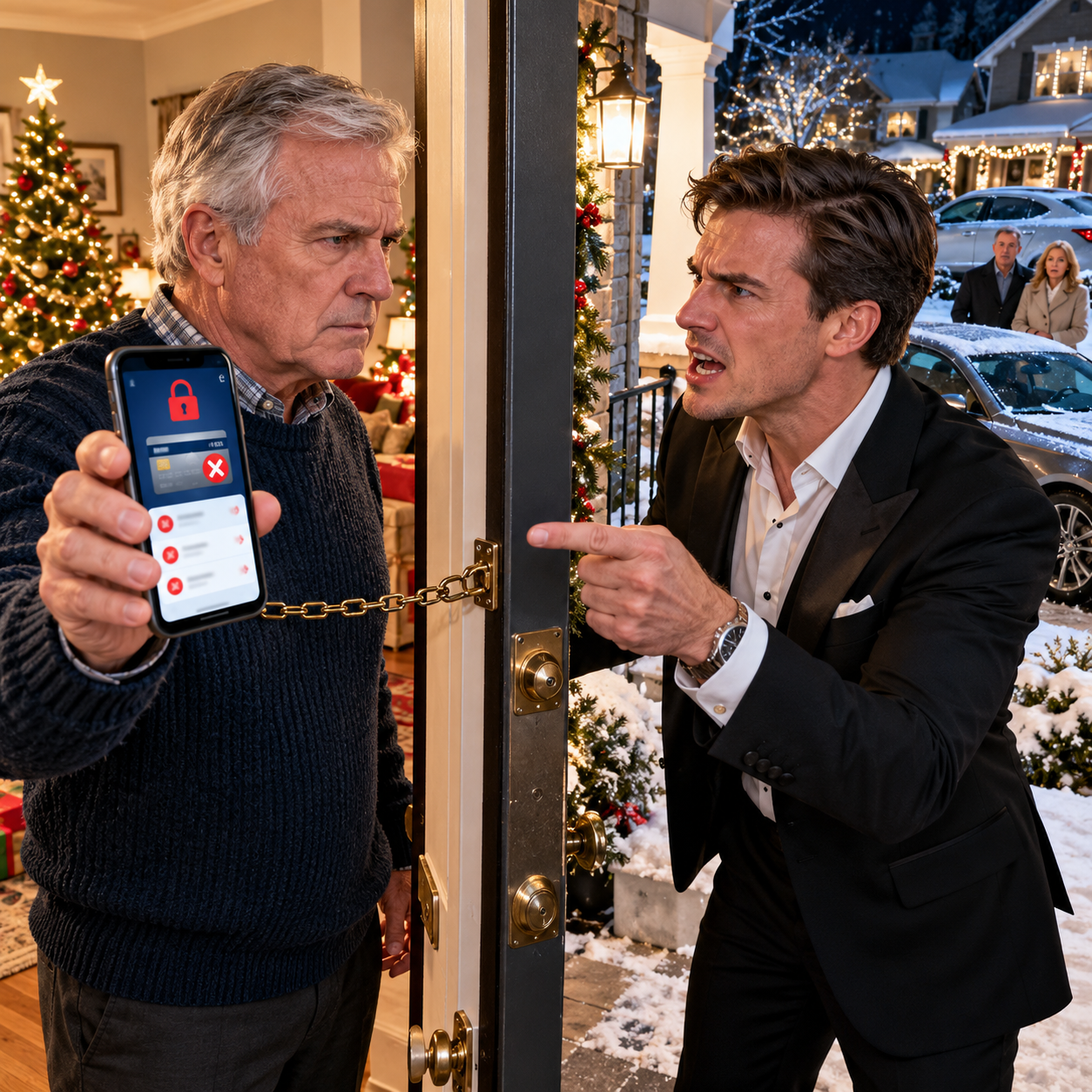
By midmorning, I had the documents Angela recommended delivering. I drove twenty-two minutes to Burlington, where Justin’s sedan, Kelsey’s white SUV, and her parents’ black Lexus filled the driveway. I rang the bell rather than using my key. Through the glass, I could see the Christmas tree glowing beside a dining table crowded with food.
Justin opened the door and went pale. “Dad? You can’t just show up.” I held up the folder. “This concerns a house I legally own with you. We need to talk.” Behind him, Kelsey was wearing a green silk dress and pouring mimosas while describing a ski vacation in Whistler.
When she saw me, both glasses slipped from her hands and shattered against the hardwood floor. “Bruce! We told you not to come!” Michael Tucker, her father, stood from the dining table with his napkin in his hand. “Bruce, this is a private family gathering,” he said stiffly.
“I understand, Michael.” I stepped inside after Justin moved aside and set the folder on the table. “I’m not here for breakfast. I’m here because my son borrowed nearly $120,000 against this property using a signature that isn’t mine.”
The room became perfectly still. Justin reached toward the papers, but I slid them back. “The lender already has copies. My lawyer has formally challenged the application, and these transactions are being investigated.”
Kelsey’s expression changed. “I don’t understand. Justin handled all the financial things.” I turned a contractor invoice toward her. “Then perhaps you can explain why your name is on this kitchen renovation.”
Her eyes darted toward her husband. “You told me you had it handled!” she snapped at Justin. “You said your father never checked the statements! You said he’d been confused since Judy died and wouldn’t notice!”
Michael slowly lowered himself into his chair. Joyce, Kelsey’s mother, pressed a hand over her mouth. Justin stared at his wife as if she had just handed me the final missing piece.
“Thank you, Kelsey,” I said quietly. “That answers an important question.”
I explained that Angela would be addressing the house, the disputed credit, and the limits of their permission to occupy the property through the proper legal process. Any required notices would be served formally. The financial support, however, was finished.
Joyce disappeared upstairs and returned with Ezra and five-year-old Violet, who had been playing safely in their room. I knelt beside them, admired Ezra’s Lego fire station, and promised that Grandpa loved them both. Violet wrapped her arms around my neck, completely unaware that the adults downstairs had just destroyed the Christmas morning they’d planned.
Michael and Joyce took the children home with them. At the front door, Joyce squeezed my wrist and whispered, “We didn’t know, Bruce.” I believed her.
Kelsey stormed out shortly afterward, announcing that she wanted a divorce and had known nothing about the loan. Justin remained beside the untouched Christmas ham, tears running down his cheeks. “Dad, I’ll pay everything back. Please tell your lawyer this was a misunderstanding. I could lose my career.”
I looked at the marble island behind him. “You didn’t borrow my money, Justin. You borrowed my identity.”
He reached for my arm, but I stepped away.
As I drove home, I realized the Christmas message had not created our family’s problems. It had simply made me look closely enough to discover them.
## Part 3: A Desperate Attempt To Steal My Retirement Exposes Everything
Three days after Christmas, my brokerage sent a security alert while I was washing my breakfast dishes. Someone had repeatedly tried to enter my retirement account using an old password. When I checked my email, I discovered its password had been changed minutes earlier, and recovery requests were arriving through channels Justin had once helped manage. My son wasn’t finished taking from me.
I opened the bottom drawer of my desk and removed an offline laptop and the hardware security key I’d registered years before. Justin knew my childhood street, my first dog’s name, and half my old passwords, but he didn’t know about the separate recovery address I kept for emergencies. I regained access through that route, secured my email, and contacted my brokerage’s fraud department. Within minutes, restrictions were in place requiring in-person verification before any withdrawals or transfers.
The security records identified an office network associated with Cunningham Group, the engineering firm where Justin worked as a senior project manager. I saved the available logs and sent them to Angela. She called immediately. “Bruce, preserve everything. Don’t confront him. The police need to examine this.”
That afternoon, Detective Ryan Perry met me at the Halton Regional Police station. His interview room smelled of stale coffee, and he initially listened with the patient expression of a man accustomed to complicated family disputes. Then I placed the forged loan documents beside the retirement-account alerts and Kelsey’s Christmas Eve demand for $5,000. He read her threat twice.
“She actually wrote this?” he asked. I turned my phone toward him. “And I still have the original conversation.” He carefully recorded the details and explained that investigators would need to obtain independent records from the financial institutions and employer.
Two days later, Justin was arrested during a client presentation at Cunningham Group. Detective Perry later told me officers had entered the glass-walled conference room and taken his computer and phone for examination under the appropriate legal authorities. His colleagues had watched him leave in custody. I sat alone in my kitchen that evening, staring at a childhood photograph of Justin holding a wooden bridge we’d built together.
I had wanted accountability. I had not expected it to feel so much like grief.
That same week, Kelsey called with a trembling, unusually gentle voice. “Bruce, I’m frightened. Justin has ruined everything, and the children need stability. I think you should transfer the Burlington house into my name.” I asked her why she believed that was reasonable, and her sweetness vanished. “Because I have the children. Sign the deed, and you can see them every weekend. Refuse, and I’ll move to Vancouver. You’ll never see them again.”
I had already begun recording the conversation, as Angela had advised me to preserve any further threats using lawful means. “You’re asking me to trade my property for access to my grandchildren?” I asked. “Exactly,” Kelsey replied. “And I want your answer by Friday.”
After she hung up, I sat perfectly still before forwarding the recording to Angela. She had uncovered additional contractor correspondence showing Kelsey had negotiated the renovation price and approved the payments. The documents undermined her claim that Justin had concealed everything from her. Angela passed the new evidence to Detective Perry.
Kelsey retaliated by seeking an emergency protective order and restrictions on my contact with the children. In her sworn statement, she portrayed me as confused, aggressive, and increasingly unstable. The hearing took place the following Tuesday at the courthouse in Milton.
Kelsey arrived wearing a faded cardigan, dabbing her eyes with a tissue. I wore a dark suit Judy had bought me for our anniversary and sat beside Angela as Kelsey’s lawyer described a helpless mother frightened by a vindictive elderly relative. Angela presented the documentary evidence and the police report, then requested permission to introduce the recording.
When Kelsey’s voice filled the courtroom, I watched her grip the edge of the table.
“Sign the deed, and you can see them every weekend.”
The judge listened to the full context before questioning both sides. The records did not support the picture Kelsey had painted, and the attempt to use the children as leverage raised serious concerns. Her requested restrictions against me were denied.
After reviewing the available evidence about the children’s circumstances and hearing from the involved adults, the court made interim arrangements placing Ezra and Violet in Michael and Joyce’s care. My access was formally protected, including regular visits every second Saturday and Christmas arrangements. Kelsey’s contact was subject to supervision while the broader matters proceeded.
I covered my mouth for a moment, struggling to speak.
In the courthouse corridor, Joyce caught both my hands. “They’ve been asking about you, Bruce,” she whispered. “Ezra thinks you stopped coming because he did something wrong.”
My knees nearly gave way. “Tell him I’ll be there Saturday. Tell him nothing that happened was his fault.”
Over the following weeks, I arranged an education fund for both grandchildren, administered by an independent trustee and restricted to legitimate educational and care expenses. No parent or grandparent could simply withdraw the money. Judy and I had worked too hard for those children to become bargaining chips again.
When I signed the final paperwork, Angela looked across her desk and said, “You’ve protected them without handing anyone another blank check.”
For the first time since Christmas Eve, I felt that I had finally understood my wife’s last request.
## Part 4: Justice Comes At A Price Before Christmas Restores My Family
Justin pleaded guilty to forgery, fraud over $5,000, and unauthorized computer access. The evidence had established a pattern that could no longer be explained away as financial desperation or misunderstanding. Angela also pursued a civil claim to recover the money obtained through the forged credit agreement. Several weeks before sentencing, Justin called me from custody.
“Dad, please,” he whispered. “My lawyer says a letter from you could help. If you withdraw the civil claim and tell them I was under pressure, maybe they won’t be so hard on me.” I sat beneath Judy’s photograph, remembering the times I’d paid his parking tickets, covered overdue bills, and rescued him from decisions he refused to own. “I won’t lie to the court, Justin,” I said. “And I’m not giving up the claim.”
“But I’m your son!”
“I know.” My voice cracked despite my effort to steady it. “That’s what makes this so painful. You knew how much I trusted you, and you used that trust to take what wasn’t yours.”
He began crying, then angrily accused me of destroying his future. I let him finish before answering. “I spent years protecting you from consequences. It didn’t make you stronger, and it didn’t make you kinder. I won’t keep doing it.”
At sentencing, the judge described Justin’s conduct as a calculated abuse of trust against his grieving father. He received a thirty-month custodial sentence and a restitution order addressing the losses. His engineering career was also effectively over, with his professional standing and ability to practice facing serious consequences through the licensing process.
As officers led him away, Justin turned toward the public gallery. I looked back at him without raising a hand. I couldn’t pretend he was innocent, but neither could I erase the memory of the boy who once asked me to teach him how bridges stood up.
Kelsey’s case proceeded that spring. By then, the white SUV had been repossessed following the lease default, and the Burlington house was being prepared for sale under arrangements worked out with the lender and legal counsel. Her expensive clothes were gone, and she arrived in court wearing a plain gray jacket with her hair tied tightly behind her head.
She pleaded guilty to fraud-related offenses and extortion arising from the evidence of her financial participation and threats. The court examined the contractor invoices, her messages, and the recorded demand for the deed in exchange for access to my grandchildren. When she was given an opportunity to speak, Kelsey turned directly toward me.
“Bruce, I never wanted any of this,” she said. “Justin pushed me into it. I was scared, and I made terrible choices. Please tell them you forgive me.”
I had spent months imagining that moment, but when it arrived, I felt no satisfaction in watching her cry. I saw a woman who had confused security with possession and love with control, and two children who would carry the consequences long after the courtroom emptied. When my turn came to speak, I stood slowly and faced the judge.
“I can’t offer forgiveness today,” I said. “What matters to me is that Ezra and Violet are safe, loved, and never made responsible for what their parents have done. I don’t want them taught to hate their mother. I want them to grow up knowing that love isn’t something anyone can demand money for.”
Kelsey received a twelve-month custodial sentence followed by two years of probation, alongside financial restitution obligations. Her supervised contact arrangements with the children remained subject to the family court’s oversight. When she began sobbing, Joyce lowered her head, and Michael stared silently at the floor.
Outside, Joyce touched my elbow. “Thank you for not turning them against her.” I shook my head. “Someday they’ll be old enough to ask what happened. We’ll tell them the truth without making them responsible for it.”
The Burlington house sold that April. The real estate agent insisted the marble kitchen was its greatest feature, and I found myself almost laughing at the irony. After rejecting several investment offers, I accepted a bid from a high school teacher and a nurse who had spent seven years saving for their first home. They wrote me a letter describing the Christmas dinners they hoped to host there.
I read their letter twice before signing the sale papers. My share of the proceeds went toward settling the legitimate mortgage obligations and addressing the disputed lending losses while the restitution process continued. The house had once represented everything I believed I owed Justin. Watching another family take possession, I realized I could release the house without abandoning the grandchildren who had lived there.
The following December, one year after the message that changed everything, I woke to fresh snow along the windowsills of my Oakville home. I made coffee, switched on the lights around Judy’s old Christmas tree, and placed four mugs beside the kitchen kettle. There were no lavish gifts waiting under the branches, no expensive reservations, and no payments scheduled to rescue anyone from their own choices.
At ten o’clock, the doorbell rang.
I opened the door to find Michael and Joyce standing on the porch, both smiling, with Ezra and Violet bundled in bright winter coats. Ezra was holding a large shopping bag against his chest. “Grandpa!” he shouted, hurrying inside. “We got you something!”
Violet threw her arms around my waist while Joyce helped Ezra remove the package. Beneath the wrapping paper was a wooden presentation box containing a vintage model locomotive. I recognized it immediately, right down to the tiny brass details and the manufacturer’s number printed beneath the engine.
It was the same $400 train I’d returned to the hobby shop the previous Christmas Eve.
I looked at Joyce, unable to speak. She smiled gently. “I went back to the shop. The cashier remembered you, and somehow they still had it. Ezra wanted to give it to you himself.”
Ezra tugged my sleeve. “Grandpa, Grandma Joyce said you used to build trains with Daddy when he was little. Can you show me how?”
I knelt beside him, opened the box, and carefully lifted out the locomotive. “Of course, buddy. But first, we need to build a proper track.”
Within minutes, we had pushed the coffee table aside and spread curved sections of track across the living room rug. Ezra sorted the connectors while Violet arranged miniature trees beside the rails. Michael helped secure a stubborn piece of track, and Joyce brought out hot chocolate. Nobody hurried us, nobody complained about the mess, and nobody asked me for a single dollar.
When the train finally began circling the Christmas tree, Violet leaned against my shoulder. “Grandpa, can we name it Judy?”
I looked toward the photograph of my wife on the mantel. Her familiar smile seemed to reach across the room, past the empty years and the disappointment I had thought would never end.
“I think that’s the most beautiful name in the world,” I whispered.
The train passed beneath the lowest branches, its tiny headlamp shining over the silver rails. Ezra clapped, Violet laughed, and I felt something in my chest loosen for the first time in a year. My phone lay face down on the shelf, silent and forgotten.
Later, when Joyce began setting the table for Christmas dinner, Ezra took my hand and pulled me toward the chair beside his. “Grandpa, this is your seat,” he said. “I saved it for you.”
I sat down, brushed a tear from my cheek, and squeezed his little hand.
I had spent three years believing Judy wanted me to give our son everything he asked for. But looking around that table, I finally understood that protecting a family wasn’t the same as paying for one. Sometimes love meant giving generously, and sometimes it meant refusing to let generosity become a weapon.
Kelsey had once told me I needed to earn the right to sit with my family.
A seven-year-old boy had just shown me the truth.
At a table filled with real love, nobody should have to buy their place.
THE END.
All characters and events in this story are fictional, created for storytelling and entertainment purposes. Thank you sincerely for reading. Your feedback and support are invaluable and motivate me to continue sharing more stories with you.


