
Chapter 2
Linda argued for ten solid minutes.
School expenses were different, she said. Trevor actually needed the $47. Kyle and I were deliberately twisting her words.
I listened calmly.
“You said the reason didn’t matter when Grandma gave Kyle his game.”
“That was a toy.”
“My birthday card wasn’t a toy.”
“That was months ago.”
“So equality expires?”
“Rachel.”
“I’m just trying to understand the rule.”
Dad closed his eyes for a moment.
Then he handed Trevor $47.
He handed Kyle another $47.
Finally, after looking at me for several long seconds, he handed me $47 too.
Linda barely spoke to me for three days.
I thought that might end her equality campaign.
Instead, she began creating exceptions.
A week later, she bought Trevor an expensive pair of sneakers he had been begging for. He raced upstairs to show them to us.
Kyle admired them.
Then he asked Linda, “What days are mine?”
Trevor laughed.
Linda didn’t.
“What are you talking about?”
“The shoes. Which days do I get them?”
“They’re Trevor’s shoes.”
“So personal things don’t have to be shared?”
“Obviously.”
I looked up from my book.
“Good to know.”
Linda pointed at me. “Don’t start.”
“I didn’t say anything.”
Kyle nodded seriously. “Would a video game count as personal?”
Her jaw tightened.
“That’s different.”
“What about gift cards?”
“Enough.”
A few days later, Trevor’s grandmother sent him $20 in a birthday card.
Linda gave it directly to him.
I asked, “Do family gifts belong to whoever receives them now?”
She closed her eyes.
“That came from his grandmother.”
“Dad gave me the Barnes & Noble card.”
“You are not getting Trevor’s money.”
“I don’t want Trevor’s money.”
That was the truth.
Neither Kyle nor I wanted to take anything away from Trevor. We wanted him to keep his gifts, his toys, his candy, his birthday money, and everything else that belonged to him.
We wanted the same right.
“I’m asking what happens the next time somebody gives me money,” I said.
Linda snapped, “Your gifts are yours.”
Nobody spoke.
She realized what she had said.
Kyle smiled.
“Can we get that in writing?”
Linda walked out of the room.
I almost felt sorry for her.
Almost.
The next real battle involved my desk.
One Saturday, Trevor was visiting a friend. I carried my algebra book, notebook, and laptop into his bedroom.
He had a small plastic activity table beside his window. I pushed his crayons to one side and spread my things over the other half.
Linda found me ten minutes later.
“What are you doing?”
“Studying.”
“In Trevor’s room?”
“Yes.”
“Why?”
“I’m using my half of his table.”
“You don’t have a half.”
I looked at her.
“So bedrooms are private?”
“Of course bedrooms are private.”
“Mine isn’t.”
She stopped.
I gestured around Trevor’s room.
“He needs art space, so he gets half my desk. I need study space, so I’m using half his table.”
“That is completely different.”
“How?”
“He’s six.”
“Age matters now?”
Her cheeks reddened.
“You’re mocking me.”
That was the most honest thing Linda had said in months.
The moment her rule applied to Trevor, apparently following it became mockery.
Dad came home in the middle of the argument.
Linda met him downstairs.
“Rachel has taken over Trevor’s room.”
I followed her.
Dad looked alarmed.
“What happened?”
“I’m studying at his table.”
Dad frowned. “You have a desk.”
I stared at him.
“Do I?”
Something about my voice made him pause.
I walked upstairs.
They followed.
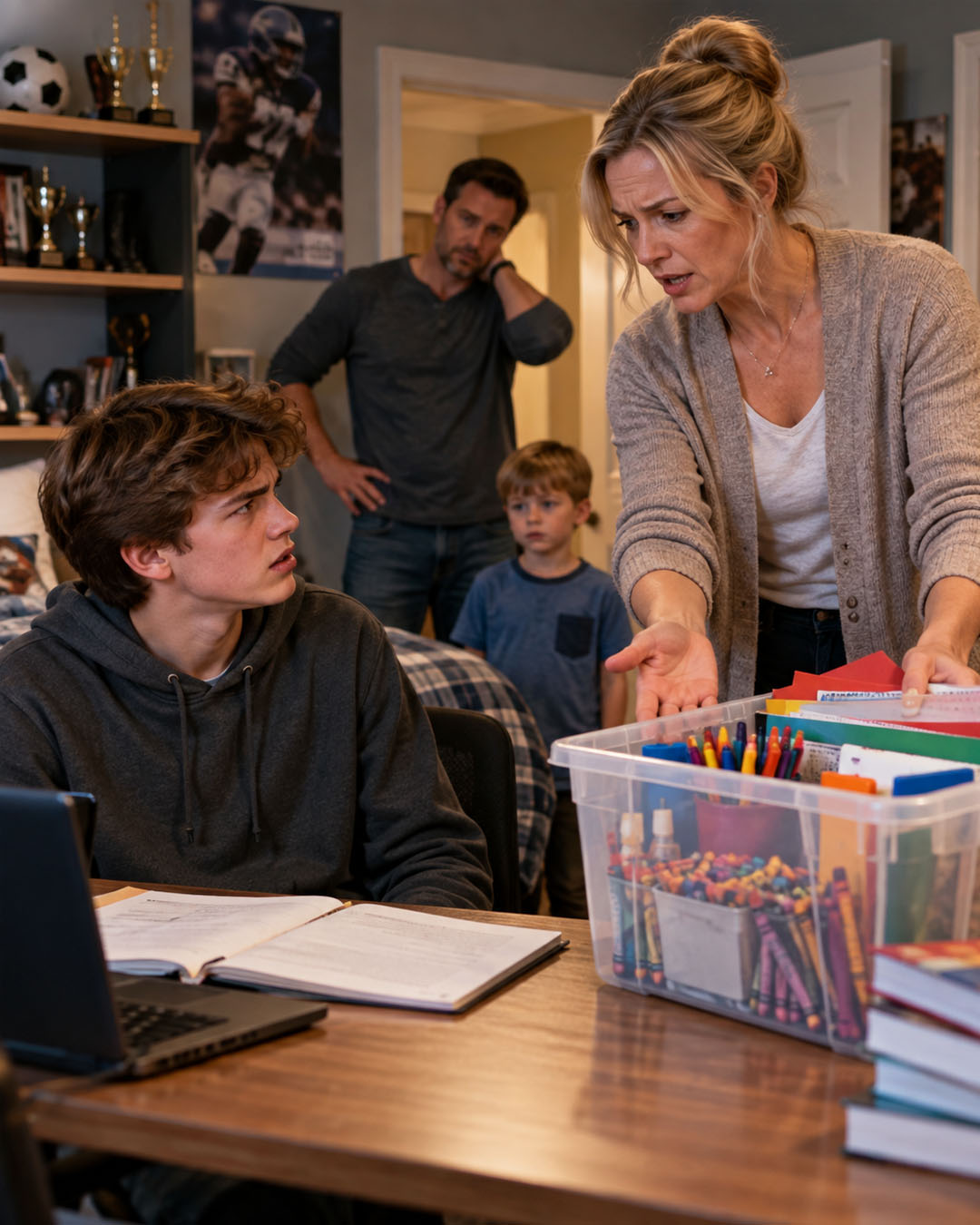
The blue tape was still running down the center of my desk. Trevor’s side had crayons, markers, construction paper, stickers, coloring books, and toy dinosaurs. Half the drawers were filled with art supplies.
My half held a laptop, three textbooks stacked on one another, a calculator, and a notebook hanging halfway off the edge.
Dad stood in my doorway.
“This is what you’re using for school?”
“Yes.”
Linda crossed her arms.
“She has plenty of room.”
I opened a drawer.
More construction paper.
Then another.
Coloring books.
Dad stared at the desk.
“You gave away the drawers too?”
“He needed storage.”
Dad reached for the painter’s tape.
Linda’s expression changed.
“What are you doing?”
He began pulling it off.
“Giving Rachel her desk back.”
“David.”
“She’s failing algebra.”
“That has nothing to do with this.”
“She has never failed a class.”
“She needs better study habits.”
Dad stopped and looked at her.
“She needs somewhere to study.”
Linda’s face tightened.
“So now Rachel’s needs matter more than Trevor’s.”
Nobody answered for a moment.
Then I said, “That’s the problem.”
Both adults looked at me.
“Every time anybody tells Trevor no, you turn it into us saying he doesn’t matter.”
Linda’s voice became icy.
“I am trying to make sure my son feels like part of this family.”
“And you do that by taking things from us.”
“I’m teaching you to share.”
“No. You’re teaching us that anything we own can become Trevor’s if you decide he needs it.”
“That isn’t true.”
Kyle had appeared in the hallway.
“It kind of is.”
Linda spun toward him.
He raised his hands.
“Trevor’s stuff never becomes ours.”
Dad rubbed his forehead.
Normally, that was the moment when he would tell us to keep the peace.
This time, he didn’t.
He picked up Trevor’s plastic bin.
“We’ll put this downstairs.”
Linda looked stunned.
Dad carried it to the dining room.
I got my desk back.
My grades didn’t recover overnight, but I could finally work again. Within a month, my D became a C. Then a B-minus. My biology grade climbed too.
Dad noticed.
Linda never commented.
Then Trevor’s seventh birthday arrived.
His grandparents came. His aunt came. Grandma came. Dad’s sister brought cupcakes, and the living room filled with balloons and wrapping paper.
Trevor received a basketball hoop, clothes, building sets, books, and several gift cards.
Then his grandparents handed him a new handheld gaming system.
Trevor practically shouted with joy.
I was genuinely happy for him.
Kyle looked at me.
I knew that look.
“Don’t,” I whispered.
He lasted thirty seconds.
“So what’s the schedule?”
The room went quiet.
Linda looked up.
“What schedule?”
“For the game system.”
I covered my face.
Kyle continued with impressive seriousness.
“I got Monday, Wednesday, and Friday with my game. Trevor got Tuesday, Thursday, and Saturday. Are we switching this time?”
Linda’s face reddened.
“This is Trevor’s birthday present.”
Kyle nodded.
“So birthday presents belong to whoever’s birthday it is.”
Dad stopped opening a package.
Grandma looked from Kyle to Linda.
“What happened to your game?”
Nobody answered quickly enough.
Kyle did.
“You gave me that PlayStation game last year.”
“I remember,” Grandma said.
“Linda made me give Trevor half the week.”
Grandma frowned.
“What?”
“We were trying to encourage bonding,” Linda said quickly.
Trevor, who was busy turning on his new system, looked up.
“I didn’t like Kyle’s game.”
Grandma’s eyebrows rose.
I had to bite the inside of my cheek.
Then Trevor’s other grandmother handed him a birthday card containing $100.
Linda immediately said, “Let me put this somewhere safe.”
I had not planned to say anything.
But the words came out anyway.
“So birthday money is personal now?”
Linda froze.
Dad closed his eyes.
“I don’t want his money,” I said immediately. “I just want to know if that’s the rule.”
“You’ve been waiting all day to embarrass me.”
“No. I told Kyle to stop.”
“Then stop talking.”
“Last year, on my birthday, you said my gift wasn’t really mine because Trevor was family. Today is Trevor’s birthday, and everybody suddenly understands that his gifts belong to him.”
The room became painfully quiet.
Before, these arguments had happened behind closed doors.
Now Grandma was watching.
So were Linda’s parents, Dad’s sister, and two family friends.
Linda stared at me.
“You’re trying to ruin a little boy’s birthday.”
“No.”
I turned to Trevor.
“I don’t want your money. Your presents are yours.”
He nodded cautiously.
Then Dad spoke.
“She’s right.”
Linda stared at him.
“David.”
“No.”
His voice was calm, but something had changed.
“We never should have split Rachel’s birthday gift.”
Grandma nodded.
“No, you shouldn’t have.”
“And we shouldn’t have made Kyle share his game on a schedule.”
“No,” Grandma said. “You absolutely shouldn’t have.”
Linda stood.
“I’m not doing this in front of Trevor.”
She walked into the kitchen.
Nobody followed.
Trevor looked at me.
“Do I have to share my game?”
“No.”
He relaxed.
Kyle leaned over.
“Definitely not.”
That was the strange thing.
Winning against Linda never required hurting Trevor.
It required proving that nobody should have been treated that way in the first place.
Chapter 3
After everyone left, Dad called us into the kitchen.
Trevor was upstairs playing his new game. Linda sat at the table with her arms crossed. Her eyes were red, although I couldn’t tell whether she had been crying or was simply furious.
Dad sat across from her.
“We need to settle this.”
“I agree,” Linda said sharply.
Dad looked at me.
“Rachel, tell me what you think the problem is.”
Linda immediately interrupted.
“She thinks I favor Trevor.”
Dad looked at her.
“I asked Rachel.”
That was new.
I took a breath.
“I don’t think the problem is that you want things equal. I think the problem is that your rule was never equal.”
Linda rolled her eyes.
“When I got birthday money, Trevor got half.”
She opened her mouth.
Dad raised one hand.
“When Kyle got a game,” I continued, “Trevor got half the time even though Trevor didn’t want it.”
Kyle nodded.
“When Trevor gets birthday money, it’s his.”
“Because it comes from his family,” Linda said.
“Dad is my family.”
Linda went silent.
“When Trevor needed somewhere to color, he got half my desk and half my drawers. When I used half of his little table, you said I was invading his room.”
“That is not the same thing.”
“That’s what you always say.”
Nobody spoke.
I had rehearsed this argument in my head dozens of times, but now that I finally had my father’s attention, I didn’t want to waste it.
“You didn’t make Trevor equal to us,” I said.
Linda stared at me.
“You made everything we had partly his while everything he had stayed completely his.”
Kyle nodded.
“My game. My headphones.”
I turned toward him.
“Your headphones?”
“Last month she told Trevor he could use them with his tablet.”
Linda snapped, “They were just sitting there.”
Kyle almost laughed.
“They were sitting on my dresser. That’s where my stuff sits.”
Dad covered his face with both hands for a moment.
When Linda finally spoke again, her anger had changed.
“You two don’t understand.”
Her voice was quieter now.
“Trevor came into this family where you already had everything.”
I watched her carefully.
“You had years alone with your father. You have grandparents who have known you since you were born. Family traditions. Photos everywhere. Inside jokes. Bedrooms that were already yours.”
She glanced toward the stairs.
“He walked into a house where everyone else had history.”
For the first time, I understood what Linda thought she had been doing.
She wasn’t trying to make us miserable.
She was terrified that her son would always feel like an outsider.
Understanding that did not make her choices fair.
But it made them human.
“I didn’t want him growing up feeling less important,” she said.
“Then give him things that belong to him.”
She looked at me.
“Make traditions with him. Let Dad build a relationship with him. Let us build one too.”
I pointed toward the ceiling.
“But giving him half my birthday present doesn’t make him my brother.”
Kyle leaned forward.
“It makes me mad at him for something he didn’t even do.”
That landed harder than anything else we had said.
Linda looked at him.
“Trevor never asked for half my game,” Kyle continued. “You gave it to him.”
The kitchen went silent.
Dad finally spoke.
“I should have stopped this earlier.”
Linda’s head turned toward him.
“You agreed with me.”
“I know.”
“You said you understood.”
“I did understand why you were worried.”
He sighed.
“But every time the kids complained, I told them to keep the peace because that was easier than arguing with you.”
He looked at me.
Then at Kyle.
“That wasn’t fair.”
I had waited months to hear those words.
They didn’t make everything better.
But they mattered.
Linda looked hurt.
“You’re all acting like I was trying to steal from them.”
“I don’t think you were,” Dad said. “But good intentions don’t automatically make a bad rule good.”
Linda looked down at the table.
For once, nobody used the word equality.
Dad created new household rules that night.
Birthday gifts belonged to the person who received them.
Money from relatives belonged to the person who received it.
Personal belongings remained personal unless the owner chose to share.
Shared household items were truly shared.
Bedrooms were private spaces.
Chores would be assigned by age and ability rather than forced into identical amounts.
If one child had an expense because of school, sports, or another activity, that did not mean everyone automatically received the same dollar amount.
Linda objected to nearly every rule.
Dad did not back down.
The strangest part was that Trevor barely noticed.
The next afternoon, he sat at the dining room table with his crayons and drew a picture of a shark wearing a cowboy hat.
He did not ask about his half of my desk.
He did not demand Kyle’s game.
He did not complain that my books were mine.
He had never needed Linda’s system.
She had.
Life became calmer.
Not perfect.
Linda still slipped sometimes.
One afternoon, I was eating a candy bar when she asked, “Did you get one for Trevor?”
I looked at her.
She stopped.
“Never mind.”
Another time, Dad brought Kyle home a new baseball glove because his old one had split along the seam.
Linda opened her mouth.
Then she closed it.
Trevor asked, “Can I see it?”
Kyle handed it over.
Trevor tried it on, punched the pocket a few times, and handed it back.
“Cool.”
“Thanks.”
That was sharing.
No schedule.
No lecture.
No demand.
Just one kid letting another kid look at something because he wanted to.
A few months later, my birthday arrived again.
I had been thinking about it more than I wanted to admit.
Not because I expected anything expensive.
I simply wanted to know whether the rules would survive the moment when Linda had an opportunity to fall back into old habits.
At dinner, Dad handed me a card.
Inside was a $50 Barnes & Noble gift card.
Exactly what he had given me the year before.
I looked at him.
He smiled.
“Thought we could try this again.”
I laughed.
“Thanks, Dad.”
Linda sat across from me.
Her eyes flicked toward the card.
Then toward me.
For half a second, nobody spoke.
Kyle could not resist.
“Aren’t we splitting it?”
Dad nearly choked on his drink.
Trevor looked interested.
Linda stared at Kyle.
“No.”
He blinked innocently.
“No?”
“It’s Rachel’s birthday present.”
Kyle nodded slowly.
“Oh.”
I looked at Linda.
“Good. Just checking.”
She gave me a look.
Not exactly angry.
More like she knew she had earned that one.
Trevor leaned toward me.
“What books are you getting?”
I told him about a mystery novel I wanted and a fantasy series Grandma had recommended.
“Can I come to the bookstore?”
That surprised me.
“You want to?”
“Yeah.”
“Sure.”
So the following Saturday, Trevor came with me.
He brought his own money.
That detail made me smile.
I bought three books because, for the first time, I had the entire gift card.
Trevor bought another ridiculous children’s book that made him laugh before we had even reached the checkout line.
On the drive home, he sat in the back seat reading.
I watched him in the mirror.
And something surprised me.
I didn’t resent him.
For months, I had thought I did.
But once Linda stopped using him as the reason I couldn’t have boundaries, he was simply Trevor.
A slightly annoying little brother who asked too many questions, left crayons uncapped, laughed loudly, and somehow believed every road trip required snacks.
Kyle eventually started letting him watch while he played PlayStation.
Not because anybody required it.
Trevor just liked sitting beside him sometimes.
And when Trevor asked to try, Kyle handed him the controller.
No alternating days.
No schedule taped to the wall.
No forced equality.
Just ordinary sharing between brothers.
Chapter 4
Linda and I never had some dramatic reconciliation where she admitted I had been right about everything.
That wasn’t her personality.
Even years later, she referred to that period as “our difficult adjustment.”
I once called it “the dictatorship of fairness.”
Dad laughed so hard he nearly spilled his coffee.
Linda did not.
But she never divided another birthday gift.
She never took our money and redistributed it.
She never gave Trevor our belongings without asking.
Most importantly, she stopped treating every difference between children as proof that somebody was being mistreated.
Over time, she began to see what Dad had finally understood.
Fair does not always mean identical.
When I needed money for a school debate competition, Dad paid the fee without handing matching cash to Kyle and Trevor.
When Kyle needed new cleats for baseball, nobody demanded shoes of equal value.
When Trevor had a birthday, he got birthday presents.
When I had one, I got mine.
Nobody suffered.
In fact, Trevor seemed happier once the pressure disappeared.
He no longer had to accept things he had never requested. He no longer stood in the middle of arguments wondering why his mother was handing him half of someone else’s gift.
Our relationship with him improved because he was finally allowed to become our brother naturally.
There was one afternoon I remember especially well.
Trevor was around 8 by then. He had built a complicated Lego spaceship in the living room and was extremely proud of it.
Kyle walked past.
“That’s actually pretty cool.”
Trevor beamed.
“You want to help me make another one?”
Kyle hesitated.
Then he sat down on the carpet.
Twenty minutes later, I joined them.
Nobody had ordered us to bond.
Nobody had created an equal-time schedule.
Nobody told us that loving Trevor required giving something up.
We simply spent an afternoon together.
Dad watched from the kitchen.
Linda did too.
I caught her looking at us once.
She didn’t say anything.
She didn’t need to.
About a year after the aquarium incident, Trevor came home with another field-trip form.
This time his class was visiting a science museum.
He dropped the paper on the kitchen counter.
“Mom, I need $32.”
Linda reached for her purse.
Kyle was sitting beside me doing homework.
He looked at me.
I looked at him.
Neither of us spoke.
Linda noticed.
Slowly, she turned toward us.
“No.”
Kyle widened his eyes.
“We didn’t say anything.”
“You were going to.”
“I wasn’t.”
“You absolutely were.”
I folded my hands.
“We’ve matured.”
Dad began laughing into his coffee.
Trevor looked confused.
“Why are they smiling?”
Linda handed him the $32.
“Long story.”
Kyle said, “It’s about equality.”
Linda pointed at him.
“Not one word.”
Trevor shrugged, took his permission slip, and walked away.
Dad continued laughing.
Even Linda eventually smiled.
That was when I knew the lesson had finally stuck.
Her original rule had survived as long as the cost always landed on somebody else.
My birthday money.
Kyle’s game.
My desk.
Our time.
Our belongings.
The moment the same logic required Linda to hand out extra cash, divide Trevor’s possessions, surrender his bedroom space, or defend the rule in front of other adults, exceptions suddenly appeared everywhere.
School expenses were different.
Shoes were personal.
Birthday gifts belonged to the birthday child.
Bedrooms were private.
Money from relatives belonged to whoever received it.
In other words, Linda spent weeks inventing the exact boundaries Kyle and I had wanted from the beginning.
She just needed to experience her own rule from the other side before she could see them.
As I got older, I understood something else too.
Linda’s biggest mistake had not been loving Trevor too much.
A parent should want a child to feel secure in a new family.
Her mistake was believing security could be created by taking something from somebody else.
You cannot make one child feel included by teaching another child that nothing truly belongs to them.
You cannot create closeness through resentment.
You cannot demand generosity until it becomes an obligation and still call it kindness.
And you cannot build a peaceful family by forcing the quietest people to absorb every unfairness.
Dad learned that too.
Years later, when I was getting ready to leave for college, he helped me carry boxes to my car.
We were alone in the driveway when he stopped.
“I owe you an apology.”
I looked at him.
“For what?”
“You know what.”
I did.
He rested one hand on the trunk.
“I should have stepped in sooner. I kept asking you and Kyle to be mature because you were easier to reason with.”
I smiled faintly.
“Keep the peace.”
He winced.
“Yeah.”
“That phrase used to make me crazy.”
“I know.”
He looked toward the house.
“I thought avoiding arguments meant I was keeping the family together.”
“And?”
“It turns out avoiding a problem just lets somebody else carry it.”
I nodded.
That might have been the most honest thing Dad ever said about those years.
Then Trevor came running out of the house carrying one of my old paperback books.
“Rachel!”
“What?”
“Can I keep this?”
I recognized it immediately.
It was the first novel I had bought with the second $50 bookstore gift card.
I pretended to consider it.
“You know my stuff is personal.”
Trevor froze.
Then he saw my smile.
“Oh, come on.”
I laughed.
“Yeah. You can keep it.”
He grinned.
“Thanks.”
Linda stood in the doorway behind him.
She heard the exchange.
For a second, our eyes met.
Then she smiled too.
Not because Trevor had finally received something that belonged to me.
Because this time, I had chosen to give it.
That was the difference she had struggled so hard to understand.
Forced sharing creates resentment.
Chosen sharing creates connection.
Years later, I barely remember what I bought with most of those gift cards. I cannot remember the name of the algebra test I failed or what color sneakers Trevor wanted so badly.
But I remember that strip of tape across my desk.
I remember Dad peeling it away.
And I remember the strange power of finally using Linda’s own logic until she was forced to confront what it really meant.
I did not beat her by becoming selfish.
I did not take Trevor’s birthday money or demand his toys.
I simply insisted that any rule called fair had to remain fair when it applied to everybody.
Once Linda understood that, we no longer needed the rule at all.
We had something better.
Boundaries.
Choice.
Respect.
And eventually, a real family.
THE END.
⚠️ All characters and events are fictional. Do not imitate or apply them in real life. 😌😌😌


