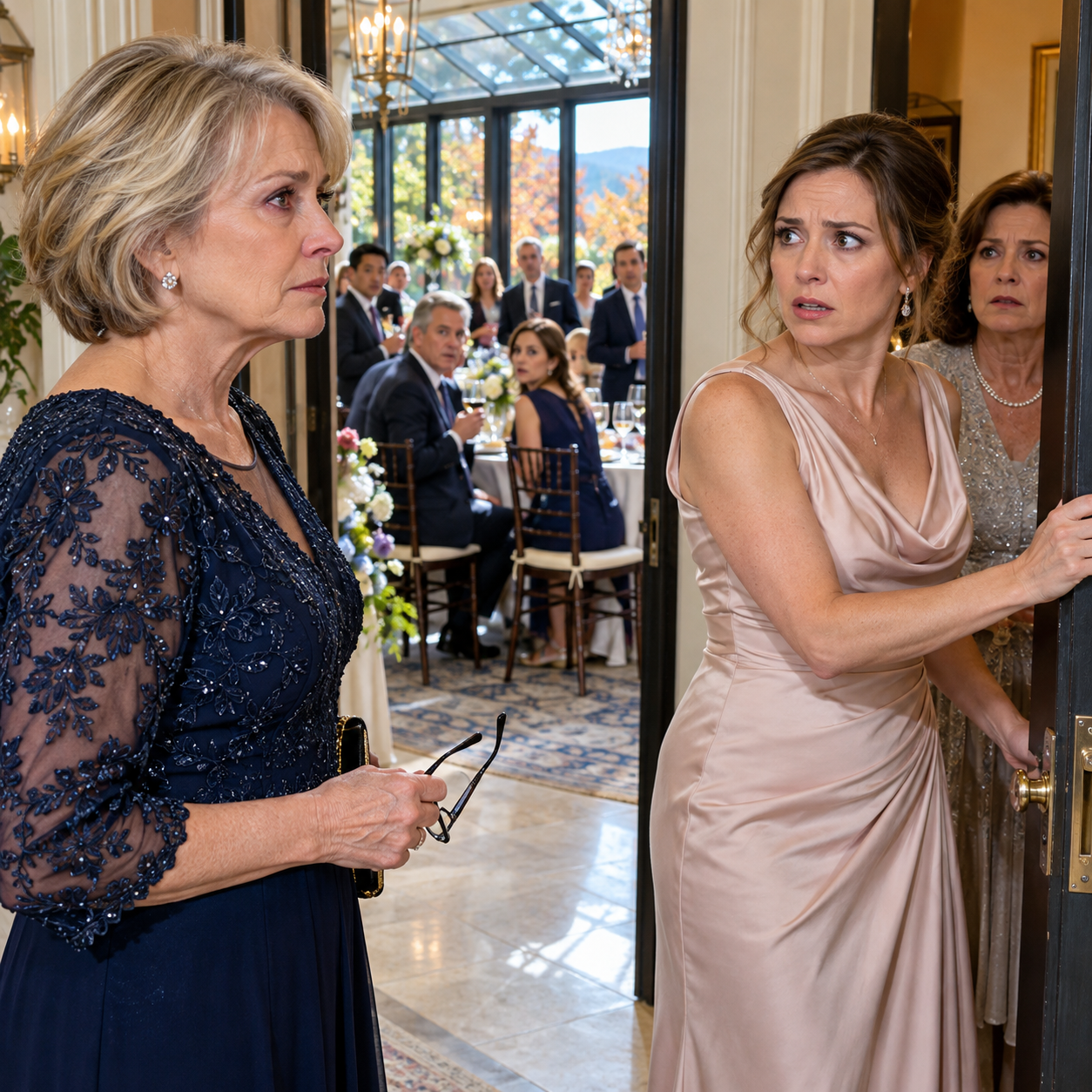
Part 2: Stepping back exposes what my generosity had been funding
Evan came to my house Thursday during his lunch break wearing hospital scrubs beneath a navy jacket. He carried two coffees, one exactly the way I liked it, and stood in my kitchen while I cut an apple into slices neither of us ate. “Lauren said you seemed upset Tuesday,” he said carefully. “You disappeared before I could introduce you to Dr. Patel.”
“Did Lauren tell you why?”
He rubbed the paper sleeve around his coffee. “She thought you got tired.”
“That isn’t what I asked.”
His eyes came up. Evan had always been terrible at deception, even harmless deception, because he became excessively reasonable. “She said the night was a lot for everybody. Her mom was stressed about the photographs. Lauren was trying to keep things organized.”
I nodded. “Did she tell you I heard them talking?”
The coffee stopped halfway to his mouth.
That told me enough.
I repeated the conversation without embellishing it, including Lauren’s request that I step away from the photographs. Evan listened with the same expression he used when reading a difficult scan, his attention narrowing as though concentration could somehow alter what was in front of him. When I finished, he said, “I don’t think she meant you weren’t wanted.”
“What do you think she meant?”
He looked toward the window. “I don’t know.”
“That’s a more honest answer.”
He asked what I planned to do, and I told him I hadn’t decided. I also told him I would not be keeping Sophie that weekend because I had made plans. That part wasn’t true yet, but twenty minutes after he left, I booked myself two nights in a cabin near Brevard where Thomas and I used to hike.
Friday morning, I called the bank.
I did not empty accounts, demand repayment, or punish my granddaughter for something she had never done. The education contribution I had already made belonged to Sophie, and I left every dollar exactly where it was. What I stopped was the automatic monthly transfer from my own checking account, and I canceled the $18,000 I had intended to give Lauren for a butler’s pantry she had described as “the final piece” of a kitchen renovation that had apparently acquired several final pieces.
My banker, Denise, clicked twice on her keyboard. “You understand you can restart either instruction anytime?”
“I understand.”
“And the renovation money was never legally committed?”
“No. It was something I planned to give.”
“Then it remains yours.”
The simplicity of that sentence stayed with me.
I spent the weekend walking beneath red and gold maples, eating soup in a small restaurant where nobody needed me to cut food, carry a booster seat, review a contractor estimate, or rearrange my afternoon. On Sunday I finally checked my phone. Evan had sent three messages, Lauren two, and Judith one.
Lauren’s first message read, Did you forget about Sophie?
The second arrived twelve hours later. Evan says you went out of town. I wish you had communicated. We had to rearrange everything.
I almost laughed at the word communicated.
Evan’s final message was different. Mom, call me when you’re ready. Lauren got an updated contractor invoice and apparently she thought you were covering part of it. I told her she needed to talk to you herself.
Monday evening I called him. “How much is the pantry?”
“Thirty-four thousand.”
I set down the envelope I had been opening. “For a pantry?”
“It includes cabinets, plumbing, a wine refrigerator, built-ins. I don’t know. That’s not really the point.”
“No, it isn’t.”
He exhaled. “Mom, Lauren says you offered eighteen.”
“I said I might help when she showed me the original estimate. I never signed a contract, and the contractor never received money from me.”
“I know.”
“Then what’s the problem?”
The pause lasted long enough for me to hear a door close on his end. “The problem is they approved the work assuming your money was coming.”
“They?”
“Lauren and the contractor.”
I leaned back in my chair. “Did Lauren tell the contractor I was paying?”
Another pause.
“She listed you as a family contributor.”
That was the first moment the situation became larger than a hurtful remark at a party. I asked Evan to send me the estimate. Ten minutes later, a PDF appeared in my inbox, and halfway down page three, beneath the payment schedule, was a line that read: Family Contribution — Marianne Bennett — $18,000 anticipated prior to material order.
No signature. No authorization. Just my name placed neatly inside someone else’s financial plan.
The following Saturday, Evan came over alone. He looked exhausted, and when I asked whether Lauren knew he was there, he said, “Yes, and she isn’t happy about it.”
We sat at the kitchen table where he had done algebra homework twenty-five years earlier. “She thinks you’re using money to make a point,” he said. “She says one private comment shouldn’t erase years of family.”
“Years of family are exactly why this matters.” I slid the printed estimate toward him. “Your wife put my name into a renovation budget before I agreed to fund it. She schedules my weekends before asking whether I’m available. She wanted me less visible at the dinner I paid for, then called two days later expecting childcare. Tell me which part of that arrangement sounds like family and which part sounds like infrastructure.”
Evan rubbed his forehead. He did not defend her immediately, and the absence of defense carried more weight than any argument could have.
“I think we got used to you always saying yes,” he said.
“That includes you.”
“I know.”
There it was—not an apology grand enough to repair everything, but a truth large enough to begin.
Two weeks later Lauren texted asking to meet. Her message was carefully worded: I think there has been a misunderstanding that has gotten bigger than it needed to be. I’d like to clear the air.
I read it twice before answering.
Lunch. Just us.
She agreed.
Part 3: An honest lunch redraws the boundaries of our family
Lauren chose a quiet Italian restaurant downtown, perhaps because neutral ground felt safer. She arrived five minutes early in a charcoal coat, placed her phone face down beside her water glass, and began with ten minutes of conversation about Sophie’s school project and Evan’s schedule. I let her do it because people often need to circle a difficult subject before they can land on it.
Finally she folded her napkin in half. “I’m sorry you heard what I said.”
“That’s different from being sorry you said it.”
Her mouth tightened. “I knew you were going to say that.”
“Then you’ve been thinking about it.”
She looked toward the front window. “My mother gets competitive around you.”
That surprised me enough that I said nothing.
Lauren continued. “She thinks Evan prefers you. She thinks Sophie prefers you. At family events she feels like she has to fight to matter, and I spend half my time reassuring her.” She gave a small, embarrassed shake of her head. “Tuesday night she kept telling me you were taking over the photographs, and I was tired, and I said something cruel because agreeing with her was easier than dealing with her.”
It was not a flattering explanation, but it was believable.
“You still asked me to move away.”
“I know.”
“And afterward you told Evan I left because I was tired.”
“I didn’t want to explain what happened.”
“That protected you.”
“Yes.”
The word came quietly.
Our server brought lunch, and for several minutes we ate without talking. Then Lauren said, “The money made everything worse.”
“The money revealed something that was already wrong.”
She put down her fork. “I shouldn’t have put your name on the contractor estimate.”
“No.”
“I thought because you had offered—”
“I said I was considering helping.”
“I know that now.”
“You knew it then.”
She winced, and I let the sentence stand. I had no interest in humiliating her, but smoothing every uncomfortable edge was how we had arrived there.
After a while she said, “When Sophie was born, you were there constantly. Then the house, the babysitting, the school account. Somewhere along the way I stopped thinking of those things as choices you were making. They became part of how our life worked.”
“That is exactly what happened.”
Her eyes filled, though she did not cry. “And I resented you for being important while depending on you for being important.”
That was the first thing she said that afternoon that I had not already worked out for myself.
I sat back. “Lauren, I am not trying to replace your mother. I am not competing with you. I don’t need to sit beside Evan in every picture, and I certainly don’t need to manage your household. But I will not make myself smaller so someone else feels larger.”
She nodded.
“And I’m not restoring the old arrangement.”
Her gaze moved to mine.
“I will see Sophie because I love her, not because I am on call. If you need childcare, ask me, and sometimes I’ll say yes and sometimes I’ll say no. I’m not financing the pantry. I’m also not restarting the monthly college transfer right now. The account already contains more than enough to keep growing, and when Sophie is older, I may contribute differently.”
Lauren absorbed each sentence without interrupting.
“What do you want from me?” she asked finally.
“Honesty. Courtesy. And no accounting system in which my value increases when you need something and decreases when I enter a photograph.”
A sad smile crossed her face. “That sounds awful when you say it that way.”
“It felt worse living it.”
We did not leave lunch transformed into best friends. She did not rush around the table to hug me, and I was grateful she didn’t try. At the door, she said, “I’m sorry, Marianne. Not that you heard it. I’m sorry I said it, and I’m sorry I treated you like help I didn’t have to thank.”
“Thank you.”
That was enough for that day.
The months afterward were quieter than the years before them. Evan and Sophie came for dinner twice a month, Lauren joined when she wanted to, and nobody treated her absence as an insult or my presence as an obligation. I began taking Sophie to a pottery studio every other Thursday, a standing afternoon that belonged to us because we both wanted it, not because someone had filled my name into an empty square on a childcare calendar.
I also accepted a part-time consulting position with an architectural firm that needed an experienced cost auditor. I had spent thirty years managing commercial construction budgets before retirement, and the first morning I walked into their office with a laptop bag over my shoulder, I realized how much of myself had been sitting unused while I organized everyone else’s emergencies. The money was pleasant, but the better part was hearing people ask my opinion because they wanted my expertise rather than my availability.
Evan came by one Sunday in January while Sophie was shaping clay at my kitchen table. Lauren was visiting Judith in Charlotte, and after Sophie ran upstairs to wash gray clay from her hands, Evan remained by the sink drying a coffee mug that was already dry.
“What?” I asked.
He gave me the sheepish expression he had worn since childhood whenever he had something difficult to admit. “Lauren and I started counseling.”
I waited.
“She brought up the dinner herself. The counselor asked why she had been so worried about her mother’s feelings that night but not yours.” He stared at the dish towel in his hands. “Then she asked me why I didn’t notice any of this sooner.”
“That sounds uncomfortable.”
“It was.”
“Probably useful, then.”
He laughed softly. After a moment he said, “I was angry when you stopped helping. I told myself it was because you were punishing us. But I think I was angry because suddenly I could see how much you had been doing, and seeing it meant admitting I had been taking advantage of it too.”
I reached across the counter and squeezed his wrist.
“You don’t have to forgive me immediately,” he said.
“This isn’t a courtroom, sweetheart.”
“I know.”
“And forgiveness isn’t the same as returning to the way things were.”
He nodded. “I know that too.”
That spring, Evan received the formal photographs from his promotion dinner. He brought me one in a simple wooden frame: the three of us together before everything had gone wrong—Evan in the middle, Lauren on one side, me on the other, Sophie grinning in front with two missing teeth. Judith was just outside the frame because she had stepped away to speak to someone.
I studied it for a while.
“Do you want it?” Evan asked.
“Yes.”
I placed it on the shelf beside Thomas’s photograph.
The picture no longer bothered me. Neither did the memory of that hallway, although I doubted I would ever forget it. Lauren had wanted one mother to become less visible so everyone else would know where to look, but the strange gift of that evening was that I finally looked at my own life clearly.
I had mistaken constant availability for love and generosity without boundaries for kindness. My family had helped me make that mistake because it benefited them, but they were not monsters, and I was not a victim sentenced to remain useful forever. We were ordinary people who had allowed an unhealthy arrangement to become normal until one careless sentence exposed it.
These days, when Lauren asks whether I can keep Sophie, she begins with, “Are you free?” Sometimes I am. Sometimes I have work, dinner plans, a hike, or nothing more important than a book I want to finish, and I say no without providing evidence for why my time belongs to me.
Last month, Lauren hosted Evan’s birthday at their house. When the family gathered for a photograph, Judith started arranging everyone and said, “Maybe mothers on opposite sides so it isn’t crowded.”
Lauren looked at her, then at me.
“No,” she said, almost casually. “Marianne, stand beside Evan. That’s where you belong.”
I took my place without triumph, and no one disappeared to make room for me.
The End .
All characters and events in this story are fictional, created for storytelling and entertainment purposes. Thank you sincerely for reading. Your feedback and support are invaluable and motivate me to continue sharing more stories with you.