
### Part 2: An Uninvited House Tour Exposed My Son’s Financial Secret
I called my closest friend, Carolyn, that Thursday afternoon. She was seventy-one, a retired family-law mediator from Hamilton, and one of the few people who knew how deeply Peter’s death had changed me. She arrived carrying a small tin of biscuits and listened while I described the birthday visit, the proposed bedroom arrangement, and Renee’s message. When I finished, she placed her tea on the table without making a sound.
“Irene, they don’t believe you have a choice,” she said.
“I know.”
“Then you need to show them that you do.”
Her words stayed with me throughout the following week. I didn’t send an angry message or make a dramatic telephone call. Instead, I waited to see whether Thomas would ask permission before bringing his mother-in-law into my home.
He didn’t.
Gail arrived from Calgary on the fourteenth and stayed at their Burlington condo. Thomas called that evening to tell me she was looking forward to seeing my house, as though it had already been decided that she would eventually live there. The following Saturday, all three appeared at my front door. Before I had even offered to take her coat, Gail stepped past me, removed her scarf, and looked upward at the original tin ceiling.
“Well, isn’t this something?” she said. “Renee told me it was beautiful, but I didn’t expect all this space.”
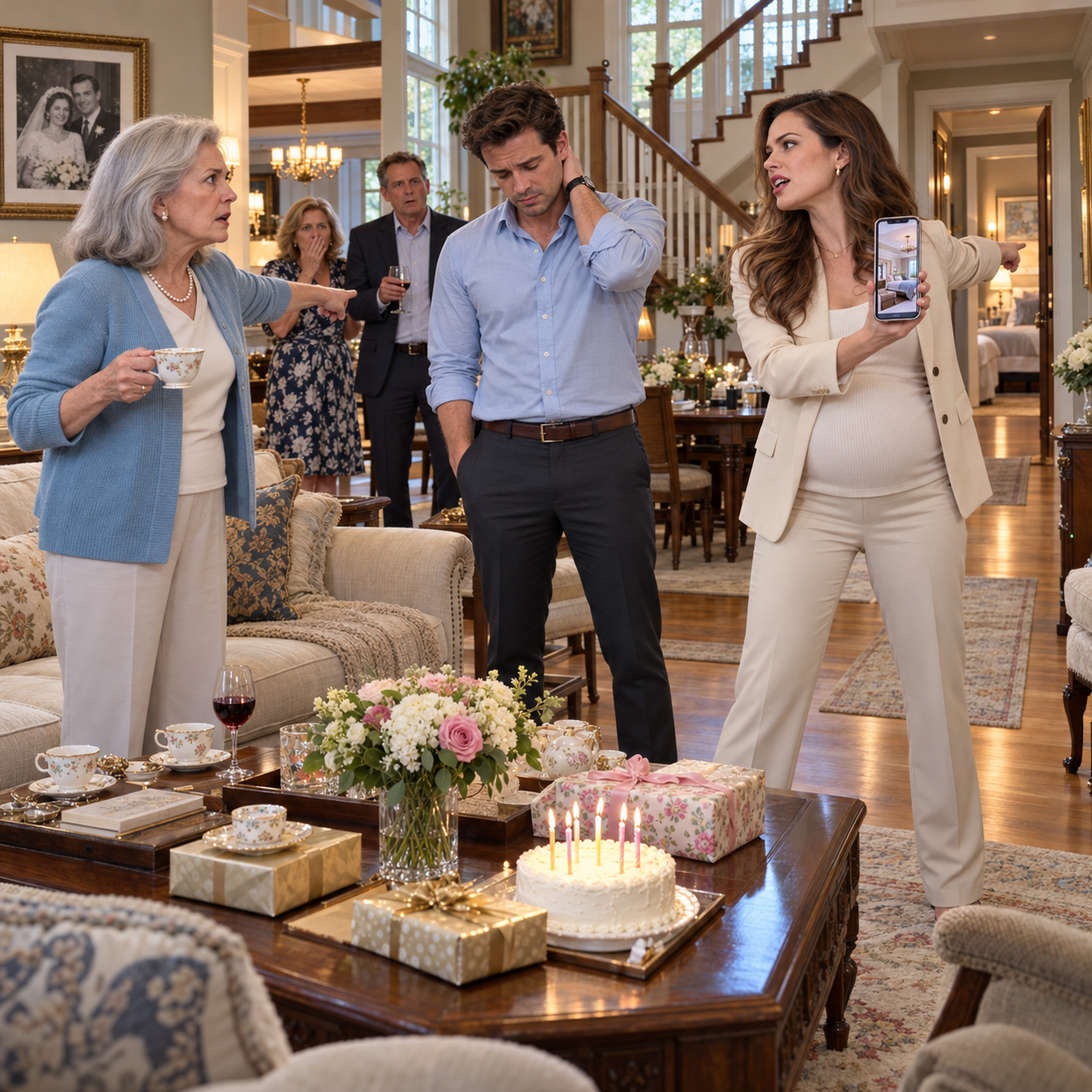
Renee immediately began conducting what looked disturbingly like a real estate showing. She opened the butler’s pantry and described the coffee station she wanted installed. In the library, she pointed toward the teal walls and announced that the color would have to change. “Too dark for a nursery,” she explained, speaking to Gail rather than to me.
I stood in the doorway, staring at the wall Peter had chosen. He had held six paint samples against that plaster before finding the exact shade he wanted. Renee was discussing its removal while standing three feet from the woman who owned it.
Thomas approached me quietly. “It’s a lot of house for one person, Mom.”
“It’s exactly enough house for me.”
He exhaled. “Renee’s exhausted. The pregnancy has been difficult, and Gail needs somewhere comfortable to stay.”
“Then why doesn’t Gail stay with you?”
His eyes shifted toward the floor. “That’s part of the problem.”
I waited until he looked up again.
“What problem, Thomas?”
He rubbed the back of his neck. Their Burlington condo had lost value, and the mortgage balance was now higher than they could expect to receive from selling it. Renee had temporarily stopped working, and the photography business wasn’t bringing in money. Their available credit had already been stretched, leaving them struggling with monthly payments.
“So you want to move here because you’re in financial trouble,” I said.
“We’re trying to make something work for everyone.”
Before I could respond, Gail’s voice carried down the hallway.
“Renee, come look! This master suite is enormous!”
We walked toward the sound and found my daughter-in-law standing beside the bed Peter and I had purchased for our twentieth anniversary. Gail was examining the bathroom while Renee stood near the dresser, holding her phone. They had already begun discussing furniture arrangements.
“My mother gets the master suite,” Renee announced confidently. “Irene can use the smaller room upstairs. That gives everyone enough privacy.”
Gail nodded. “We’ll need to move this heavy furniture. It takes up too much room.”
I touched the dresser with my fingertips. Inside its top drawer was Peter’s old wristwatch, which I still couldn’t bring myself to give away. Behind me, Thomas remained silent.
“Renee,” I said, “this is my bedroom.”
She gave a small, impatient sigh. “We’ve discussed this. The other room will be perfectly comfortable.”
“No,” I replied. “You’ve discussed it. I haven’t agreed.”
Thomas finally spoke. “Mom, please. We drove all this way.”
I turned toward him. “Then I’m afraid you’ll have to drive back.”
The hallway fell silent. Renee stared at me, her mouth slightly open, while Gail slowly folded her arms. Thomas looked from his wife to me, apparently searching for the version of his mother who would surrender simply to avoid an argument.
I walked downstairs, opened the front door, and stood beside it.
Nobody moved at first. Then Renee took her mother’s arm and led her toward the porch, her expression stiff with disbelief. Thomas was the last to leave.
When the door closed, I stood alone with my hand resting against the wall Peter had repaired years earlier. I could almost hear him asking what I intended to do next.
I walked directly into my study and telephoned Francis Whitmore, the solicitor who had handled our estate planning.
“Francis,” I said, “I need every document relating to my house, Peter’s estate, and the money I gave my son.”
For the first time since my birthday, I wasn’t wondering whether I had the right to say no.
I was preparing to make sure nobody could pretend they hadn’t heard it.
### Part 3: A Lawyer’s Letter Forced My Son to Face the Truth
Francis met me Monday morning in her Oakville office, where she spread the property documents across a polished wooden desk. She had worked with Peter and me for years, and she knew exactly what that house represented. I explained everything, including the planned move, the proposed bedroom exchange, and the $60,000 I had given Thomas. She listened carefully before turning the property deed toward me.
“The house belongs entirely to you, Irene,” she said. “Peter’s share transferred to you through his estate. Your son has no ownership interest.”
“And the money I gave him?”
“Those payments were documented as gifts, not loans. You cannot simply demand repayment, but they also create no equity interest in your property.”
I looked at the documents, relieved by how clearly the law distinguished generosity from ownership. Francis offered to prepare a formal letter confirming that I had not authorized anyone to occupy my home or change its ownership. I asked her to address it directly to Thomas. Then I updated my powers of attorney, naming Carolyn as the person I trusted to handle important decisions if I ever became unable to make them myself.
That evening, Thomas called.
“Mom, Renee’s really upset about Saturday,” he said. “She thinks you were cold.”
“I was clear, Thomas. Those are different things.”
He fell silent. I invited him to dinner on Wednesday, just the two of us, and told him we needed an honest conversation. He agreed, although I could hear the reluctance in his voice.
On Wednesday evening, I prepared roast chicken, potatoes, and the green beans Thomas had loved since childhood. He arrived carrying no flowers, no gifts, and none of the practiced cheerfulness he had displayed on my birthday. We ate at the dining table beneath the old brass light fixture Peter had restored. For a while, we talked about the pregnancy, and I could see genuine excitement breaking through my son’s anxiety.
Then I put down my fork.
“I know you’re struggling financially,” I said. “I know the condo is worth less than the mortgage, and I know Renee’s business has suffered.”
He stared at his plate.
“I also know you thought moving into my house would solve several problems at once.”
“Mom, we’re not trying to steal your house.”
“Then why did your wife tell me where I would sleep?”
His expression hardened. “You’re making this sound worse than it is.”
I opened the folder beside my chair and slid Francis’s letter across the table.
He glanced at the heading, then at the signature beneath it. For the first time that evening, his composure faltered.
“I’ve protected my ownership and updated my legal documents,” I explained. “Nobody is moving into this house without my consent.”
“You went to a lawyer? Because of us?”
“Because you behaved as though my consent didn’t matter.”
He pushed his chair back slightly. “We’re your family.”
“Yes,” I said. “And I’ve given you $60,000 over two years because I wanted to help you build a secure life. I never asked for it back. But helping you financially doesn’t mean I must surrender my home.”
His face reddened. “That’s not fair.”
“What isn’t fair is asking me to give up the bedroom I shared with your father so Gail can have a larger bathroom.”
For several seconds, neither of us spoke. Thomas lowered his eyes to the letter again, and I saw something familiar in his expression. He looked like the twelve-year-old boy who had once returned from a camping trip covered in mud, proudly presenting me with a stone because its shape reminded him of a wolf. I’d kept that stone on my windowsill for twenty years.
“What are we supposed to do?” he finally asked.
“Talk to your mortgage broker. Speak to your employer about additional work. Find a living arrangement you can actually afford. And be honest with Gail about what you’re able to provide.”
He rubbed his forehead. “Renee thought this would make everything easier.”
“Easier for whom?”
He had no answer.
I reached across the table and rested my hand near his. “I want to be your mother, Thomas. I want to know my grandchild. I want ordinary Sunday dinners and phone calls. But I will not spend the rest of my life proving my love by giving things away.”
He stared toward the kitchen window.
“Did Renee push too hard?” he asked quietly.
“That’s something you need to discuss with your wife. Both of you made this decision without me.”
He nodded, slowly this time. After another minute, he folded Francis’s letter and slipped it into his jacket. When he stood to leave, he looked exhausted rather than angry.
At the door, he turned back.
“I love you, Mom.”
“I love you too,” I answered. “That’s why I’m asking you to stand on your own feet.”
I watched his car disappear down the street, unsure whether I had saved our relationship or finally broken it.
But when I walked back inside, nothing in my house had been moved. Peter’s watch remained in its drawer, and my bedroom was still mine.
For that evening, it was enough.
### Part 4: A Wooden Cradle Revealed What Family Truly Meant
Five days later, Thomas called with news I hadn’t expected. He and Renee had found a manageable two-bedroom rental in Aldershot, where Gail could have a room of her own. He was also speaking with his employer about handling a larger project portfolio beginning in the new year. There was no request for money, no suggestion that I reconsider, and no complaint about my legal letter.
“I’m glad you’ve found a solution,” I told him.
“Yeah,” he replied. “We should’ve looked at other options sooner.”
Renee didn’t contact me for three weeks. When she finally called, her voice was polite but guarded, and she asked whether I had saved anything from Thomas’s infancy that might be useful for the baby. I promised to check the storage room. That afternoon, I opened the cedar chest in the small north-facing bedroom they had wanted me to occupy.
Beneath neatly folded blankets lay a wooden cradle Peter had made when I was pregnant with Thomas. He had sanded every rail by hand, rounding the edges until they were smooth enough for a baby’s fingers. I remembered watching him work late into the evening, stopping occasionally to place a palm against my stomach whenever the baby kicked.
I sat on the floor beside the chest, unable to speak.
The very room they had selected as my smaller, less important bedroom contained something none of them knew existed. It held the cradle their unborn child could sleep in, made by a grandfather she would never meet. Peter had left behind something for the next generation, although he had never imagined how much time would pass before it was needed.
I cleaned the cradle carefully and drove it to Burlington that Saturday.
Renee opened the apartment door and stared as I carried it inside.
“What is that?”
“Your baby’s cradle,” I said. “Peter made it for Thomas before he was born.”
She approached slowly, tracing one finger along a polished wooden rail. Thomas came out of the kitchen and stopped when he recognized it. For a moment, he simply stared, then reached down and touched a familiar curve in the wood.
“Dad made that,” he whispered.
“Yes. And I think he’d want his grandchild to use it.”
Gail appeared from the back room and admired the craftsmanship. Renee remained beside the cradle, looking at it with an expression I hadn’t seen before. Her hand rested on the edge as though she was frightened of damaging something precious.
Then she looked up.
“I didn’t know you’d kept things like this,” she said.
“There’s quite a lot about this house you don’t know.”
She swallowed. “Thomas said you were lonely here after Peter died. I think we convinced ourselves moving in would help you too.”
I looked at my son. He didn’t deny it.
“I am lonely sometimes,” I said. “But loneliness doesn’t mean I want someone else making decisions about my life.”
Renee lowered her eyes.
“We were scared,” she admitted. “The mortgage, the baby, my mother needing somewhere to live. I started thinking about what would fix everything, and I stopped thinking about what it would cost you.”
It was the first time she had acknowledged that her plan had required a sacrifice from someone other than herself. I appreciated the admission, but I didn’t pretend it erased what had happened. Instead, I accepted the tea Gail offered, and we sat together at their small kitchen table.
Nothing was magically repaired that afternoon. Renee still seemed uncomfortable, and Thomas was noticeably quiet. But when I left, the cradle stood beside the wall, ready for a child who would soon make our complicated family larger.
In March, my granddaughter Alice was born.
I held her for the first time in a hospital rocking chair beside a window overlooking a concrete parking structure. Her tiny fingers opened and closed against the blanket, and I remembered the morning Thomas was born. I remembered Peter crying as he held our son, telling me he had never imagined someone so small could make a man feel so fortunate.
Now Peter was gone, and his granddaughter was breathing softly against my chest.
Thomas stood near the window, watching us. After several minutes, he walked over and sat beside me.
“Mom, I’ve been meaning to say something.”
I looked up.
“You were right about the house,” he said. “I let Renee and Gail believe you’d practically agreed, even though you hadn’t. I thought once everyone was here, you wouldn’t want to disappoint us.”
The confession hurt more than I expected. It meant my son had known all along that my answer might be no. Instead of respecting that possibility, he had tried to make refusal feel impossible.
“I wish you’d trusted me enough to tell me the truth,” I said.
“I know.” His voice shook. “I’m sorry.”
I looked down at Alice, who had fallen asleep with her fist curled near her cheek. There were so many things I could have said about disappointment and obligation, so many old grievances I could have reopened. But the man beside me was no longer asking me to solve his life for him, and I could see how difficult admitting the truth had been.
“I know you were frightened, Thomas,” I said. “But you don’t need to make me smaller to make your life bigger.”
He wiped his eyes and nodded.
Six months later, our family had found a different rhythm. I drove to Burlington most Sundays, bringing homemade soup when the weather turned cold and fresh salads when summer arrived. Sometimes Gail joined us for coffee, and although we would never be the easiest of friends, we managed to treat each other with respect.
Renee slowly became warmer. She sent me photographs of Alice sleeping in Peter’s cradle, and occasionally called to ask about recipes or the flowers in my garden. Thomas took on additional responsibilities at work and began speaking about finances without expecting me to rescue him.
And my house remained exactly where it belonged: in my care.
The teal library walls still caught the afternoon light. The old glass still bent the garden into wavering shapes, and the hydrangeas Peter had wanted to plant bloomed beautifully each August. Some evenings, I sat in his favorite chair and listened to the quiet, discovering that peace was not the same thing as emptiness.
One Sunday, Thomas brought Alice to visit me in Oakville. He carried her through the rooms he had once planned to rearrange, then stopped at the library doorway. She reached toward the bookshelves, fascinated by the colors, and he laughed.
“I forgot how much Dad loved this room,” he said.
“He really did.”
Thomas looked around, then turned toward me.
“I’m glad you kept everything the way you wanted.”
I smiled. “Some things are worth keeping.”
He placed Alice in my arms and went to make us tea. I carried her to the window seat, where the afternoon sun warmed her little pink cheeks. Through the rippling glass, the garden looked almost like a watercolor painting, and for an instant, I could picture Peter standing beside us.
I hadn’t needed to surrender my home to keep my family. I had needed to insist that love and respect belong in the same room.
And the most beautiful thing was that Alice would grow up knowing her grandmother’s house, not as something her parents had claimed, but as somewhere she would always be welcomed.
I kissed the top of her head and whispered the lesson I hoped she would remember long after I was gone.
“Sweetheart, you can give someone your whole heart without giving away your place in the world.”
THE END.
All characters and events in this story are fictional, created for storytelling and entertainment purposes. Thank you sincerely for reading. Your feedback and support are invaluable and motivate me to continue sharing more stories with you.


