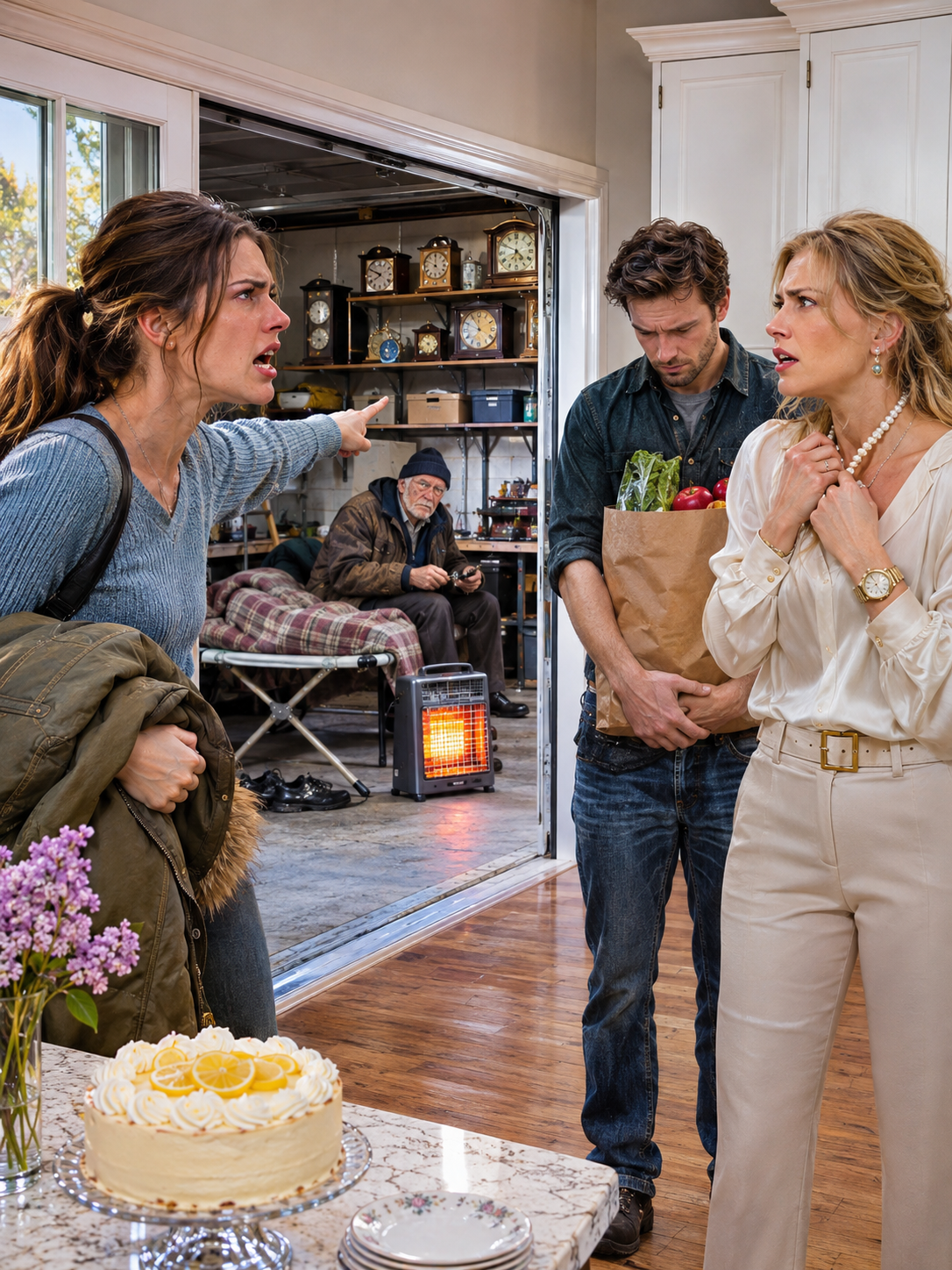
I lowered the lemon birthday cake onto the hallway table when my sister-in-law told me my grandfather was sleeping in the garage. She was wearing my dead grandmother’s pearl necklace. Outside, the temperature was barely above freezing. When I opened the garage door, I found the man who had raised me sitting on an army cot, trembling in his winter coat.
## Part 1: My Birthday Surprise Exposed a Betrayal Hidden Inside Our Family Home
“Please don’t make a fuss, Tessie,” Grandpa whispered when he saw my face. He was eighty-five years old, twenty pounds thinner than I remembered, and holding a tiny screwdriver between fingers so cold they could barely grip it. Behind him, forty clocks sat motionless on wooden shelves, their familiar ticking replaced by the hum of a cheap space heater. I had flown eleven hundred miles to surprise him for his birthday, but the surprise waiting for me would change our family forever.
My name is Tess Weller, and I’m thirty-four years old. I work as a flight nurse, transporting critically ill patients aboard medical helicopters and airplanes, where keeping calm can mean the difference between life and death. I’ve held pressure on bleeding wounds during violent turbulence and listened to heart monitors scream thousands of feet above the ground. Yet nothing in my training prepared me for finding my grandfather abandoned in his own garage.
Grandpa Sam had raised my younger brother, Luke, and me after our parents died in a car accident on an icy highway. I was nine, Luke was seven, and Grandpa was a sixty-year-old widower who had spent three years in the Army before building a clock-repair business on Elm Street. He arrived at the hospital wearing his only good suit, took our hands, and brought us to the little gray house on Birch Lane that he and Grandma Helen had bought in 1964. He learned to braid my hair, cooked more eggs than any family should reasonably eat, and never once made us feel like burdens.
Every night, Grandpa wound the small clock beside my bed and told me, “As long as this clock is ticking, somebody’s looking out for you.” When I left for nursing school, he pressed that clock into my hands at the bus station, and I’ve carried it everywhere since. Two years ago, he broke his hip after slipping on ice, and I immediately offered to leave my position and come home. He refused, insisting I had patients who needed me, and Luke volunteered to move in with his wife, Amber, to help him recover.
I sent six hundred dollars every month toward Grandpa’s care, grateful that my brother had finally stepped up. At first, our Sunday phone calls sounded ordinary, but gradually Amber began answering, claiming Grandpa was sleeping or too tired to talk. Whenever I reached him, he repeated the same reassuring words: “I’m fine, sweetheart. You’ve got people to save.” Looking back, I wonder how someone trained to recognize distress missed the quiet surrender in his voice.
That October, unexpected leave allowed me to arrive two days earlier than anyone expected. I bought Grandpa’s favorite lemon cake from the bakery on Elm Street and took a cab to Birch Lane, imagining his smile when I walked through the door. Instead, I found our grandmother’s lilac bush cut down, Grandpa’s handmade bookshelves painted gray, and every clock missing from the walls. The silence was so unfamiliar that I stopped in the hallway, certain I had entered the wrong house.
Then I found Amber standing in Grandpa’s bedroom, holding Grandma Helen’s pearls against her throat. “Oh, Tess, you should have called,” she said, without the slightest embarrassment. When I demanded to know where Grandpa was, she shrugged and explained that he’d moved into the garage because the stairs were difficult and he liked having his workbench nearby. Our house was a single-story ranch, and there wasn’t a staircase anywhere.
The garage door opened onto air cold enough to sting my lungs. Grandpa sat between a lawn mower and cardboard boxes, bundled in a winter coat and wool hat, with two thin blankets covering an army cot on the concrete floor. His clocks lined the walls like prisoners, and an orange extension cord powered the only heater in the uninsulated space. When I knelt beside him, I found his hands red and cracked, his breathing shallow, and his skin frighteningly cold.
“How long?” I asked, wrapping my jacket around his shoulders. He looked away before admitting he’d been sleeping there since the previous winter, supposedly because Amber’s mother needed storage space inside the house. When I asked who handled his Army pension and Social Security, he told me Amber managed everything because she’d convinced him the finances were too complicated. This was a man who could repair a century-old watch without looking at instructions, yet someone had persuaded him he couldn’t understand his own bank account.
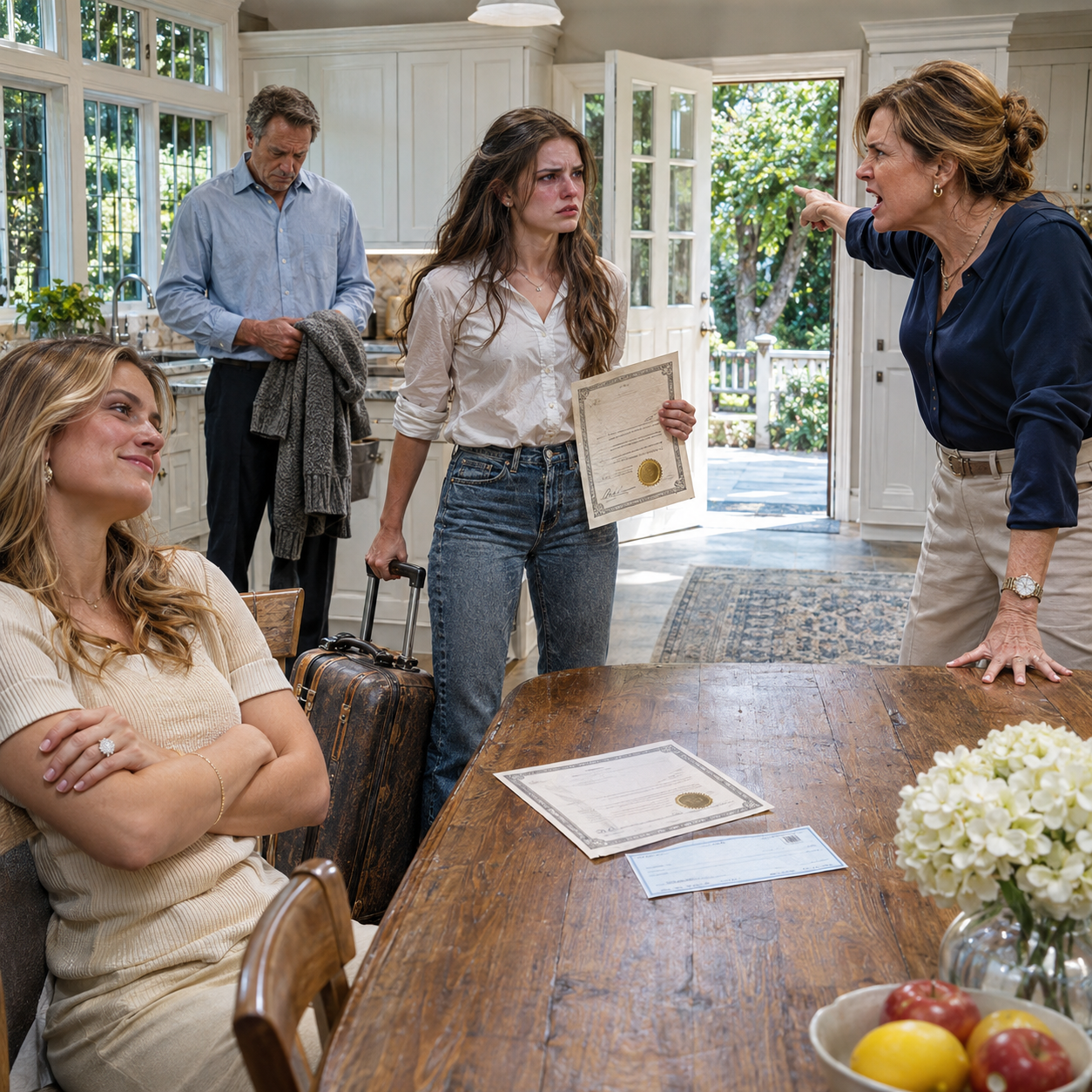
I walked back into the kitchen just as Luke arrived carrying groceries, and his face drained of color when he saw me. “You’re not supposed to be here until Christmas,” he stammered, before blaming Amber and calling Grandpa’s arrangement temporary. Amber stepped beside him, still clutching the pearls, and snapped that I knew nothing about caring for an elderly man because I merely sent checks while they did the difficult work. “This is our home now,” she declared, and Luke stared at the grocery bag instead of correcting her.
I looked from my brother to the woman wearing our grandmother’s jewelry, then answered in the same quiet voice I use during medical emergencies. “Thank you, Amber. That’s all I needed to hear.” Within minutes, I had Grandpa bundled into a cab and headed toward the hospital, where doctors diagnosed mild hypothermia, early pneumonia, and serious weight loss. When the physician said she was required to report the neglect, I handed her my phone number and told her to document everything.
Grandpa squeezed my fingers from beneath his hospital blanket and whispered, “I don’t want Luke getting into trouble.” I kissed his forehead, remembering all the nights he’d sat beside my childhood bed when I was frightened. “Neither do I,” I told him, “but I won’t let them hurt you to protect themselves.” Then I opened my notebook and began writing down everything I’d seen, because love had brought me home, but evidence was going to keep him safe.
## Part 2: A Hidden Paper Trail Revealed Who Had Stolen Grandpa’s Dignity
Before sunrise Friday, I contacted Adult Protective Services and sent photographs of the garage, the cot, the heater, and Grandpa’s medical records. Then I called Mrs. Akoy, a legal aid attorney who specialized in protecting older adults from financial exploitation. She arrived at the hospital carrying a worn leather briefcase and spent nearly an hour speaking privately with Grandpa. When she finally emerged, her expression was grim, but her voice remained steady.
“Your grandfather understands his affairs perfectly well,” she told me. “Someone has been making decisions for him without his informed consent.” Inside his room, she asked Grandpa one final question: “Mr. Weller, whose name is on the deed to your house?” He straightened against his pillows and answered, “Mine, ma’am. Helen and I bought it in 1964, and I’ve never sold it to anybody.”
That simple answer changed everything. Amber had spent almost a year acting as though she owned the house, while the actual owner slept on concrete beside a lawn mower. Mrs. Akoy verified Grandpa’s ownership and prepared a formal thirty-day notice requiring Luke and Amber to leave, along with instructions protecting Grandpa’s right to use his own bedroom. She warned me that restoring his finances and recovering missing money would take longer.
Together, we began examining his accounts, and the first statements made my stomach turn. Grandpa’s pension and Social Security deposits had been redirected into an account Amber controlled, along with the six hundred dollars I’d sent every month. Instead of paying for his care, the money had supported a leased SUV, expensive decorations, restaurant purchases, and a vacation in Cancun. I stared at one vacation charge while remembering Grandpa apologizing for the cold because he thought his family couldn’t afford to heat the house properly.
“Did Luke know?” I asked Mrs. Akoy. She placed the statements into a folder and replied, “We need evidence before deciding who knew what, Tess.” I understood her caution, but I couldn’t forget the way my brother had lowered his eyes when Amber called Grandpa’s house their home. Financial theft was one betrayal; knowingly allowing the man who raised you to freeze was another.
That Friday afternoon, I drove to the VFW hall on Route 9, a brick building where Grandpa had enjoyed Tuesday coffee with his fellow veterans for fifty years. He had repaired the clock above their bar without charging a penny back in 1978, and it still kept perfect time. Six men sat beneath it when I entered, their conversations stopping as I introduced myself. A small gentleman named Walt, wearing a faded navy cap, immediately asked, “How’s Sam? We’ve been trying to reach him for months.”
I explained what I’d found, including the garage, the winter coat, and the medical diagnosis. Walt gripped the edge of the bar as I told him Amber had claimed Grandpa was confused and didn’t want visitors. One man shook his head, remembering how Sam had once repaired his wife’s wedding watch after every jeweler in town had declared it hopeless. Another stared at his coffee and murmured, “He came to my wife’s funeral when nobody else did.”
When I finished, the room remained silent. Walt finally removed his cap, studied the worn stitching inside, and asked what I needed. “Grandpa is coming home Sunday,” I answered, “and I need his bed moved back into his bedroom, along with his clocks.” Walt pulled his cap onto his head, looked toward the men beside him, and said, “What time, sweetheart?”
“Nine o’clock.”
He nodded once. “Then you’d better leave room for some trucks.”
I thought he meant two or three friends with pickup beds large enough to carry furniture. I had no idea that Walt was about to make fourteen phone calls, or that every man receiving one had been waiting for a chance to bring Sam Weller home.
## Part 3: Fourteen Pickup Trucks Arrived to Restore What Betrayal Had Taken
Sunday morning arrived beneath a pale blue October sky, with frost still clinging to the grass along Birch Lane. Grandpa sat beside me in the passenger seat, wearing a clean coat and holding his discharge papers, while the lawyer’s folder rested on my lap. We had barely stopped in front of the house when the rumble began behind us. One pickup appeared, then another, until fourteen trucks lined the street.
Fourteen elderly men climbed out wearing veteran caps, windbreakers, and the solemn expressions of people arriving for an important duty. Some walked with canes, and one eighty-nine-year-old man had brought his oxygen tank and his grandson to help with the lifting. Walt stepped from the first truck and approached Grandpa’s window, pressing his palm gently against the glass. “Morning, Sam,” he said when I rolled it down. “We figured your clocks needed a little attention.”
Grandpa stared at the men gathering along the sidewalk. His lips moved without producing a sound, and then he whispered, “They all came?” Walt smiled. “You think we’d let you move furniture without supervising?” For the first time since I’d found him in the garage, Grandpa laughed.
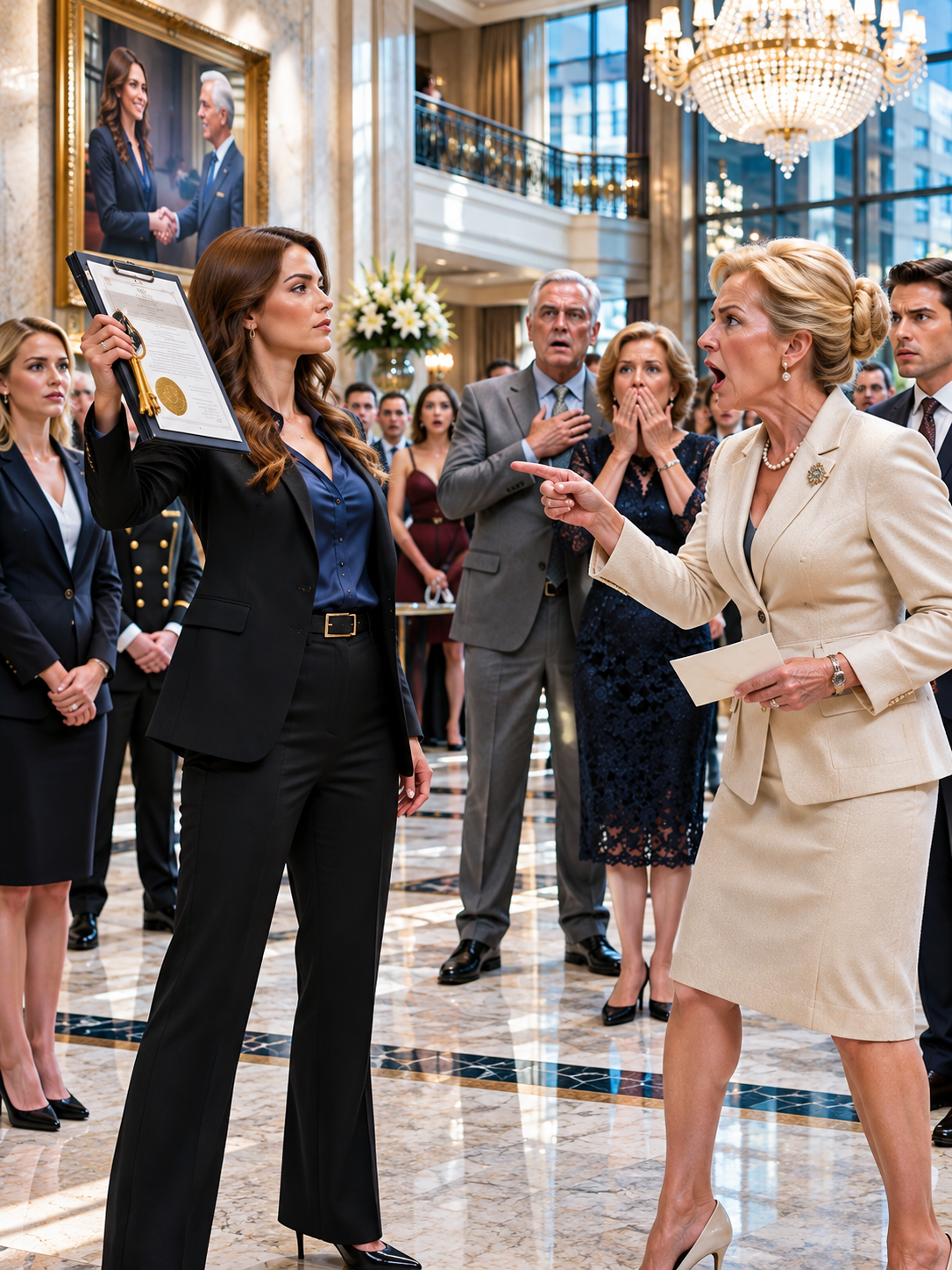
Amber opened the front door wearing a silk robe and stopped when she saw the trucks. “What is this supposed to be?” she demanded, her eyes sweeping across the veterans standing on the lawn. Mrs. Akoy stepped forward with her folder, accompanied by a calm sheriff’s deputy who had agreed to attend to keep the peace. When Amber insisted it was her home and ordered everyone away, the attorney presented the ownership documents and explained that Grandpa had invited these men onto his property.
“You’ve received formal notice concerning your occupancy,” Mrs. Akoy told her. “Mr. Weller remains the lawful owner, and he has every right to return to his bedroom.” Amber’s mouth opened, but no argument followed. Luke appeared behind her, looking at the men who had known our family since before he was born. He did not challenge a single word.
Nobody shouted or threatened anyone. With Grandpa’s permission, the men began restoring his room, carefully relocating Amber’s belongings into the hallway and carrying his original bed from the shed. They brought fresh bedding, opened the curtains, and checked that he could move comfortably around the furniture. Then Walt led them into the garage.
One by one, those fourteen men carried Grandpa’s forty clocks back into the house. Some were enormous wooden mantel clocks, others delicate brass carriage clocks, and several had belonged to families Grandpa had helped decades earlier. They returned each one to its familiar place, using the faint marks still visible beneath the gray paint. Even the youngest helper carried a little clock as carefully as though he were holding something alive.
Finally, Walt returned to the driveway and offered Grandpa his arm. The other men formed two quiet lines along the front walk, removing their caps as we passed between them. Grandpa stopped beside the stump where Grandma Helen’s lilac had once bloomed, and I felt his grip tighten around my hand. He didn’t speak until we reached the living room.
There, hanging above the mantel, was the wedding clock he’d given Grandma more than sixty years earlier. Grandpa reached into his coat pocket and pulled out a tiny brass key that he’d kept with him throughout those freezing months in the garage. His hands trembled as he fitted it into the winding mechanism, but Walt stood close enough to steady him without taking over. Grandpa turned the key, touched the pendulum, and the first tick echoed through the silent room.
Then another clock began ticking, followed by another, until the house filled with the sound I’d known since childhood. Behind me, someone made a broken, choking noise, and I turned to find Luke standing in the hallway with tears running down his face. “I used to fall asleep listening to them,” he whispered. Grandpa looked at him without anger, but the disappointment in his eyes was almost unbearable.
For a moment, I thought Luke might finally explain why he’d allowed it all to happen. Instead, he lowered his head while fourteen men continued winding the clocks his wife had banished. Grandpa sat down in his favorite chair, rested his hands on the wooden arms, and closed his eyes. The house was his again, and no one needed to say another word.
## Part 4: Justice Reclaimed Our Home, While Forgiveness Tested the Family’s Future
Luke and Amber moved out nineteen days later, leaving behind scuffed floors, damaged shelves, and a stack of unopened bills. The county’s investigation confirmed financial exploitation, and the account records showed how Grandpa’s income and my monthly payments had been misused. Under a court-supervised settlement, Amber agreed to repay the money, and Grandpa regained control of his pension and Social Security. Mrs. Akoy helped establish safeguards so nobody could redirect his income again without his knowledge.
Amber never apologized to Grandpa. She left Luke the following spring, taking the leased SUV until missed payments led the bank to repossess it. My brother found work on a road crew, but for eight months he stayed away from Birch Lane, apparently unable to face the man who had once taught him to ride a bicycle. Grandpa never asked me to invite him back, yet every Sunday I caught him looking toward the driveway when a vehicle slowed outside.
One afternoon, I found Grandpa at the kitchen table holding an old photograph of himself, Luke, and me beneath the lilac bush. “I made mistakes raising you two,” he said, studying the picture. I sat beside him and reminded him that he’d given us a home when his own heart was breaking. He touched Luke’s smiling face in the photograph and answered, “I just wish he’d remembered what a home is supposed to mean.”
Eight months after moving out, Luke finally returned. He stood on the doorstep in muddy work boots, holding a young lilac bush in a plastic nursery pot, with his eyes fixed on the place where Amber had cut down Grandma’s flowers. “Grandpa, I don’t know how to say I’m sorry,” he began, his voice unsteady. Grandpa watched him for several long seconds before replying, “You were always a terrible liar, son. Come inside and get a shovel. The hole’s still there.”
I watched from the porch as they worked together in the cold earth. Luke dug carefully around the old roots while Grandpa directed him from a garden chair, occasionally correcting the angle of the shovel. When they finished, Luke knelt beside him and admitted that he’d known about the garage, had avoided looking too closely at the accounts, and had convinced himself things would somehow improve. Grandpa listened without interrupting, then told him forgiveness did not erase responsibility, and trust would have to be rebuilt one honest act at a time.
Luke began visiting every Sunday, helping with repairs and learning to clean the delicate movements inside Grandpa’s clocks. He was clumsy with the tiny screws, and Grandpa frequently took the tools away before he damaged something expensive. Yet neither man complained about the slow progress. “He’s not very good,” Grandpa told me once, smiling as Luke struggled with a stubborn spring, “but we’ve got time.”
I transferred to a hospital flight program forty minutes from Birch Lane and moved back into my childhood bedroom. Every Tuesday, I drove Grandpa to the VFW hall, where Walt kept his favorite stool empty until we arrived. The fourteen veterans who had filled our street with pickup trucks gradually became part of our weekly lives, stopping by to drink coffee, exchange stories, and occasionally bring broken clocks that Grandpa insisted on repairing for free. The house no longer felt like a place we’d nearly lost, but like a home we’d learned to protect.
Last month, Grandpa turned eighty-six. All fourteen men came to his birthday party, filling the kitchen with laughter while I carried in a homemade lemon cake decorated with eighty-six tiny candles we decided not to light all at once. Walt presented him with a photograph of the pickup trucks parked along Birch Lane, framed beneath a small engraved plate that read, Some friendships stand the test of time. Grandpa held that picture against his chest for so long that nobody dared tease him.
Later that evening, when the dishes were washed and our guests had gone, I walked upstairs in spirit, though our little ranch had never had stairs, following the same hallway I’d walked as a child. Grandpa sat on the edge of his own bed, beneath the window overlooking Grandma’s newly planted lilac. He held out his hand, and I placed my old bedside clock in his palm, its gray casing scratched from years of travel. He wound it slowly, listening until its familiar rhythm settled into the room.
“As long as this clock is ticking,” he whispered, “somebody’s looking out for you.”
I sat beside him and rested my head against his shoulder. “I know, Grandpa,” I answered, closing my fingers around his hand. “It’s my turn now.”
For the first time, I understood that the fourteen trucks had not arrived to punish anyone. They had come because a man who spent his life repairing broken things had surrounded himself with people who refused to let him be discarded when he needed fixing himself. And as forty clocks filled the little gray house with their steady music, I realized Grandpa had never been alone because he lacked love; he’d been alone because someone had kept that love outside the door.
Now the door was open, the lilac was growing, and every Sunday my brother came home to do the work of becoming a better man. Grandpa rested his head against mine, and together we listened to the ticking clock that had carried us through childhood, grief, betrayal, and finally, home.
THE END.
All characters and events in this story are fictional, created for storytelling and entertainment purposes. Thank you sincerely for reading. Your feedback and support are invaluable and motivate me to continue sharing more stories with you.