
### Part 2: A Damaged Bullet Uncovers Years of Dangerous Hidden Lies
A young sheriff’s deputy arrived first, carrying a notebook and asking questions that made my stomach twist. Had Jared ever threatened me? Had we been fighting? Was he home when I was injured? I answered no to everything, but each question made my husband’s insistence that I didn’t need medical attention feel more disturbing.
Detective McLean arrived an hour later. He had sixteen years with the Yellowstone County Sheriff’s Office and a voice so calm it made his questions harder to escape. When I mentioned the shooting range beyond our property, he leaned forward. “A mile and a quarter away, over a ridge?” he repeated.
“Yes,” I whispered. “And they were holding a long-distance competition that evening.”
That night, a surgeon removed the fragment through a small incision behind my ear. I heard it strike the bottom of a specimen cup with a tiny click. When the nurse held it up, I saw something smaller than my fingernail, copper-colored on one side and flattened on the other. Detective McLean sealed it into an evidence bag.
Jared arrived at the hospital around ten, his face drained of color. He wrapped his shaking hands around mine and kept repeating that he was sorry I had been frightened. Lorene stood behind him, clutching her purse, and asked why I had wasted money on a taxi. Neither of them asked how a bullet had ended up in my head.
When the detective questioned Jared in the hallway, I heard my husband insist that forty witnesses could confirm he’d been working. Then he blurted, “Nobody could hit our house from that range. You’d have to shoot over the ridge!” The detective hadn’t suggested that anyone had deliberately aimed at our home.
After I returned home, Jared became painfully attentive. He brought tea, repaired a broken porch step, and watched the girls so I could rest. But one evening, he sat beside me and casually asked whether the police knew what kind of bullet had struck me. When I said it had been sent to the crime laboratory, his face tightened.
On Wednesday, Detective McLean called. The recovered fragment was from a 6.5-millimeter rifle bullet, the kind commonly used in long-distance competitions. More importantly, microscopic marks suggested it had struck a hard steel surface before reaching me.
He had already visited Big Sky Precision Range. Its fifty-eight-year-old owner, Jared Witt, was Lorene’s cousin and had employed my husband for four years. Witt insisted his facility had an excellent safety record and suggested a careless hunter might have fired the round.
“But hunters don’t usually shoot steel targets,” the detective told me. “And somebody has complained about that range before.”
The next afternoon, I put a baseball cap over my bandage and walked to my neighbors’ homes. An elderly rancher showed me a jagged bullet hole near the roof of his horse trailer. A young couple brought out a flattened projectile that had punched through their garden shed and struck a wheelbarrow.
Both families had reported their incidents. Neither had received a satisfactory explanation.
The young husband showed me an email from the county saying his complaint had been forwarded to the appropriate agency. He gave a bitter laugh. “They sent me back to the same people who told me nothing was wrong.”
I photographed everything and contacted the county commission. Its office explained that the range had operated under a permit since 2009, with an expansion approved in 2024. Safety complaints, the woman said, belonged with law enforcement.
I hung up trembling with anger. My neighbors had been complaining for months, and somehow every warning had disappeared into paperwork.
That evening, I spread their photographs across our kitchen table. Lorene walked in, studied them, and quietly closed the door.
“Cheyenne,” she said, “you need to stop before you destroy this family.”
I looked up at her. “Somebody almost killed me.”
She pulled out a chair and sat down, perfectly composed. “Nobody meant to hurt you. Sometimes accidents happen.”
Then she said something that made my blood run cold.
“Jared Witt paid eleven thousand dollars for my rehabilitation after my hip surgery. He gave your husband a good job when nobody else would. We owe that man.”
I stared at her across the table. For seven days, she had watched me suffer while protecting the man who owned the range.
And standing silently in the hallway behind her was my husband.
### Part 3: A Missing Notebook Page Reveals the Price of Silence
Jared didn’t defend his mother or contradict her. He simply lowered his eyes and walked back toward our daughters’ bedroom. I sat alone at the kitchen table, staring at the photographs until the overhead light began to hurt my head. I finally understood that the people I loved were less afraid of my injury than of what investigating it might cost them.
At two the next morning, I slipped outside in my socks and opened Jared’s truck. He kept a small spiral notebook in the driver’s door, recording every shooting relay he supervised. Under the dome light, I found September 12 and followed his careful handwriting down the page.
Relay six had begun at 6:22 p.m. Relay seven began at 7:02. Then the records stopped.
The next page had been ripped away, leaving little white teeth in the spiral binding. The following entry began September 13, with notes about cleaning the range. I photographed the missing page and returned the notebook exactly where I’d found it.
When I showed Detective McLean the picture, he studied it without speaking. “Suspicious,” he finally admitted. “But a missing page isn’t proof of what happened.”
He told me the laboratory evidence and previous complaints were enough to request a permit review. The problem was that a public hearing could take months. When I asked what else I could do, he suggested hiring an attorney.
A personal injury lawyer in Billings agreed to represent me on contingency. She listened while I described the headache, the hospital, and my husband’s strange behavior. Then she slid the photographs of my neighbors’ damaged property across her desk and said, “We need an independent range-safety expert.”
She hired a retired Army range control officer from Bozeman. He inspected our property, measured the ridge, and entered the shooting facility with a sheriff’s deputy after Witt refused him independent access. Ten days later, he produced a report and a detailed map.
I spread that map across my lawyer’s conference table. A red fan-shaped area extended from the distant steel targets, crossed the ridge, and swallowed our backyard. It included our clothesline, our porch, and the properties where my neighbors had discovered bullet damage.
The expert explained that steel targets seven through ten had been positioned at dangerous angles. A round striking their edges could ricochet upward and clear the earthen barrier. The berm was four feet too short for that course, and standard overhead baffles could have prevented the danger.
My lawyer tapped the red area with one finger. “Your family wasn’t outside the danger zone, Cheyenne. Your family was living inside it.”
The county received the report and moved the hearing to October 1.
The night before the hearing, Jared Witt arrived at our front door carrying a white envelope. Lorene greeted him warmly, but my husband stood rigid beside the couch. Witt sat in my usual kitchen chair and slid the envelope toward me.
Inside was a check for five thousand dollars.
“Medical bills,” he said, offering a reassuring smile. “I feel terrible about what happened. This should help you move forward.”
Beneath the check lay two typed pages. I read them slowly, my stomach sinking. In exchange for the money, I would release Big Sky Precision Range and its owner from every claim connected to the September 12 incident.
“This isn’t help,” I said. “You want me to surrender my legal rights.”
Witt’s smile barely changed. “We’re neighbors, Cheyenne. Families should be reasonable.”
I pushed the papers back. “I’m not signing.”
He turned toward my husband. “Jared works for me. I hope everybody remembers that.”
Lorene immediately intervened. “Cheyenne, think about the girls. Five thousand dollars could pay for the car.”
I looked at Jared, waiting for him to say that my health mattered more than his paycheck. He stared at the floor, his fists clenched, and gave me nothing.
Witt left the envelope behind. For the next hour, I sat alone with it while Jared paced our bedroom and Lorene whispered into her telephone.
Five thousand dollars could have repaired our Tahoe and covered weeks of groceries. Refusing it could cost Jared his job and end the marriage we’d spent thirteen years building.
But every time I closed my eyes, I saw that red danger zone swallowing our backyard. I saw my daughters running through the grass beneath the very sky that had nearly killed me.
Finally, I folded the check and placed it in my purse.
I knew exactly what I would do with it.
### Part 4: My Husband’s Public Confession Finally Exposes the Devastating Truth
The county commission meeting room was packed when I arrived the following afternoon. Neighbors filled the wooden benches, and fifteen men from the shooting range sat together in matching shirts. Lorene had taken a seat behind them. Jared entered alone, avoiding my eyes as he settled into the last row near the door.
Witt’s attorney spoke first. He described seventeen years of safe operation, local employment, and Montana’s proud shooting traditions. He called my injury an unfortunate incident of unknown origin and insisted nobody had conclusively established that the recovered fragment came from his client’s range.
My attorney stood and handed the commissioners the expert’s report, photographs of the damaged trailer and shed, the recovered projectile from the wheelbarrow, and the unanswered complaints. She spread the danger-zone map across their desk.
Then the commission chair called my name.
I walked to the podium with a manila folder pressed against my chest. My knees trembled, but I could see the elderly rancher sitting beside the young couple whose shed had been damaged. They hadn’t come because they hated shooting ranges. They’d come because nobody had listened when they warned that something was wrong.
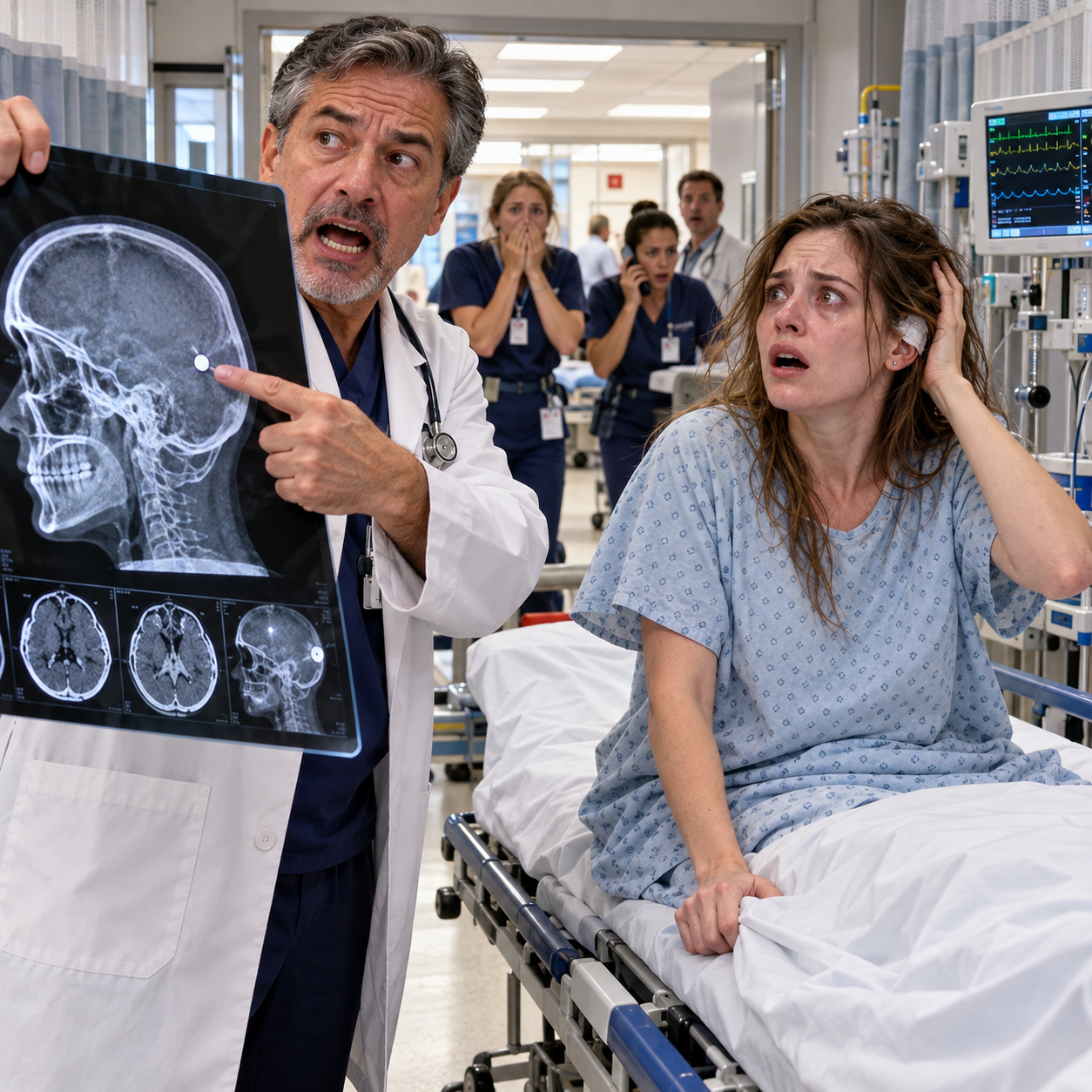
I removed the hospital scan from my folder and held it toward the commissioners.
“This is my skull,” I said. “That bright white object is a bullet fragment. It was removed on September nineteenth after spending seven days beneath my scalp.”
The room fell silent. I steadied the photograph against the podium and continued.
“I was taking sheets off my clothesline when it struck me. I was told it was a wasp. I drove fifty-two schoolchildren around this county while it was still in my head, because the people I trusted convinced me I didn’t need a doctor.”
A woman commissioner lifted her reading glasses, her expression stricken.
“I don’t know who pulled the trigger,” I said. “But I know our homes were exposed to a danger that had been reported before. I’m asking you to make sure nobody else gets hurt.”
Then I unfolded Witt’s check and placed it beside my scan.
“Last night, the owner offered me five thousand dollars to release him from liability. I could use that money. But I won’t sign away my right to speak, and I won’t pretend this didn’t happen.”
A ripple moved through the audience.
The commission chair studied the check before turning toward the back of the room. “Mr. Potter, we understand you were supervising the competition on September twelfth. Would you please come forward?”
Jared rose slowly. Lorene reached for his sleeve as he passed, but he gently removed her hand. He walked to the microphone and stood beside me, looking older than he had that morning.
The chairman asked a simple question.
“To your knowledge, did any round leave the range during that competition?”
Jared closed his eyes. For several seconds, nobody moved.
“Yes, sir,” he finally answered.
My heart seemed to stop.
“At approximately seven fifteen, a shooter on lane four struck the edge of steel plate nine. I heard the impact. It sounded wrong, and then I heard the round whistle over the berm toward the ridge.”
The chairman leaned forward. “What did you do?”
“I wrote it in my log.”
Jared swallowed, then looked directly at me.
“When I got home and saw Cheyenne’s injury, I understood what had probably happened. I knew that sound. I knew what time she’d been outside.”
His voice broke, but he continued.
“I tore the page out of my notebook. I told my mother that night and Mr. Witt the following morning. We convinced ourselves Cheyenne would recover without a hospital visit.”
Behind us, Lorene covered her mouth.
“We were afraid the sheriff would close the long-distance course. I was afraid I’d lose my job. So I kept telling her it was nothing.”
I gripped the podium, struggling to remain standing.
Seven days of agony. My daughters watching me lie in a darkened bedroom. Fifty-two children sitting behind me when the pain became too severe to drive.
And all that time, my husband had suspected the truth.
Jared turned toward me with tears in his eyes. “I thought you’d be okay, Cheyenne.”
I stared at the man I’d trusted for thirteen years.
“You didn’t know I’d be okay,” I whispered. “You just decided your job was worth the risk.”
He lowered his head.
The commission unanimously suspended the permit for the long-distance course that afternoon. It would not reopen without professionally approved safety improvements, including engineered overhead baffles and redesigned target stands. The rest of the facility was permitted to continue operating.
No one went to prison. Detective McLean later explained that proving a criminal offense from an unintended ricochet could be difficult, even with the evidence we’d collected. My attorney pursued the matter through a civil claim instead.
Before Christmas, the range’s insurance company agreed to a settlement. It covered my medical expenses, transportation costs, and vehicle repair, with additional compensation far exceeding Witt’s original offer. My neighbors also received payment for their damaged property.
Witt fired Jared the morning after the hearing. Jared told me he would have resigned anyway, although by then I no longer knew which of his words to believe. He found work driving a gravel truck in Laurel.
A week after the hearing, I packed clothes, schoolbooks, and my daughters’ favorite stuffed animals into cardboard boxes. We moved into my sister’s house in Billings. Jared stood beside the Tahoe as I loaded the last suitcase, his hands tucked into his pockets.
“Are you leaving me?” he asked.
I looked toward the house where we’d raised our daughters, where I’d planted flowers beneath the porch and hung sheets on the line, believing I was safe.
“I don’t know,” I answered. “But I can’t stay somewhere I’m afraid to believe my own pain.”
He nodded, tears filling his eyes, and helped me close the trunk.
Lorene moved back into her own house that October. She paid to install a stair lift, something she had insisted she couldn’t afford before. She sends birthday cards to the girls but hasn’t spoken to me since the hearing.
Jared visits our daughters and comes to Sunday dinner sometimes. He says he will spend the rest of his life regretting what he did, and I believe he feels genuine remorse. But I have learned that forgiveness and trust are two entirely different things.
I’m back driving Route 11 now. Fifty-two children, winding gravel roads, cattle guards, and the same noisy morning conversations I’ve always loved. The first day I returned, the little boy who’d asked whether I was okay climbed aboard and stopped beside my seat.
“Your head doesn’t hurt anymore, does it, Miss Cheyenne?”
I smiled at him. “No, sweetheart. Not like it did.”
He grinned and hurried to his friends. I checked my mirrors, closed the doors, and pulled carefully onto the road.
Every morning before work, I drink coffee in my sister’s kitchen. My hospital scan is attached to her refrigerator with a cow-shaped magnet, right beside my laminated school bus route map. Sometimes I stand there looking at the two pieces of paper and remembering how close I came to losing everything.
The scan reminds me what happens when I let other people decide whether my pain matters. The route map reminds me that I still have somewhere to go.
I don’t know whether Jared and I will ever find our way back to each other. I don’t know whether Lorene will ever admit that protecting her cousin was more important to her than protecting me. Those answers are no longer mine to force.
But I know what I will tell my daughters when they’re old enough to understand.
Love should never require you to ignore your own suffering. Marriage should never make silence more valuable than someone’s safety. And when your body tells you something is terribly wrong, you have every right to demand that someone listen.
For seven days, I believed two people who kept telling me, “It’s nothing.”
It took one doctor, one scan, and a tiny piece of metal to expose what their silence had hidden.
And it took walking away from the life I knew to understand something even more important.
My pain had never been nothing.
Neither had I.
THE END.
All characters and events in this story are fictional, created for storytelling and entertainment purposes. Thank you sincerely for reading. Your feedback and support are invaluable and motivate me to continue sharing more stories with you.


