
## Part 2: The Relatives They Overlooked Helped Me Build Another Thanksgiving
Aunt Miriam waited while I explained about the estate. She asked me to repeat the price, then told me I must have misplaced a decimal point. When I assured her I hadn’t, she lowered her voice. “Elise, does your mother know?” I told her nobody in the family knew, and she spent several seconds considering that before asking whether the house had enough bedrooms.
“More than enough,” I said.
“Then you’d better call Joel before he volunteers to make dinner for twelve.”
Joel answered while unloading groceries with his wife. He already knew about the exclusions and had been debating whether to take his three children out for Thanksgiving dinner. When I invited them to Cannon Beach, he asked for the address, then went quiet as he apparently looked it up. “Elise,” he finally said, “is this a rental or did you win the lottery?”
“Neither. I bought it.”
He whistled softly. “Remember that science fair when your parents didn’t show? I kept thinking you were going to do something big someday.” I smiled at the kitchen window, remembering the photograph he’d taken. “I’m bringing the kids,” he added. “And we’re bringing pie, unless you’ve hired somebody to make that too.”
My next call was to Nana Prue. At eighty-one, she still lived independently in Eugene and maintained a Thanksgiving calendar filled with fifty-three years of family celebrations. When I asked about Thursday, she admitted Dad had called to explain that Brooke needed a more intimate gathering this year. She tried to make it sound reasonable, but her voice softened when she said she’d already purchased ingredients for her cranberry sauce.
“Nana, I’d like you to spend Thanksgiving with us.”
“Where, sweetheart?”
“Cannon Beach. I bought a house there.”
There was a pause, followed by the faint scrape of a chair. “How large a house?”
“Large enough that nobody has to be left out.”
“Well,” she said, “then I suppose I should bring that cranberry sauce.”
After the calls, I contacted Teresa, who owned a catering company in Seaside. She could accommodate twelve adults and five children with a traditional dinner, provided I confirmed the final count by Wednesday. I booked a florist, arranged for my property manager to prepare the guest cottage, and asked him to check the fireplaces before everyone arrived.
By lunchtime, I’d spent more time organizing one meal than my mother had spent informing us we weren’t welcome. I wasn’t entirely sure whether I was responding sensibly or simply doing the largest impulsive thing of my life. Then Lily climbed beside me on the couch, holding a paper turkey with my name written across its tail.
“Did Grandma say what time we’re coming Thursday?”
I put my arm around her. “Actually, honey, there’s been a change. We’re going to have Thanksgiving at our beach house.”
She lifted her head. “The one with the ocean?”
I’d shown her photographs after closing, but we hadn’t stayed overnight yet. “That’s the one.”
“Can Nana Prue come?”
“She’s coming. Aunt Miriam, Uncle Joel, and the cousins too.”
Lily examined the turkey for a moment. “Is Grandma Vera coming?”
“Not this time, sweetheart. She’s having dinner with Aunt Brooke.”
“Did we do something?”
I turned toward her. “No. Absolutely not. Sometimes grown-ups make plans that aren’t very thoughtful. That doesn’t mean you’ve done anything wrong.”
She accepted that answer for the moment, although I knew there would be others to give as she grew older.
On Wednesday afternoon, we reached the estate beneath a sky the color of brushed silver. Lily raced through the foyer in her sneakers, then stopped before the enormous windows overlooking the ocean. The house was filled with the quiet sounds of the heating system and waves breaking beyond the bluff. I set our overnight bags beside the staircase and stood watching her discover the place I’d bought partly so she’d never have to feel uncertain about having somewhere to belong.
Joel’s minivan appeared around four. His wife stepped out first, followed by three children who immediately began arguing about who would sleep nearest the ocean. Joel stood on the gravel driveway, studying the house and the eleven acres stretching toward the trees. When I came down the porch steps, he hugged me tightly and whispered, “You actually did it.”
Aunt Miriam arrived an hour later carrying her homemade pecan pie and two bottles of Oregon Pinot Noir. She walked through the living room, touched the carved wooden mantel, and examined the sweeping staircase. “Your mother’s going to have quite a reaction when she hears about this,” she said.
“That’s not why I invited you.”
“I know.” She set her pie on the counter. “That’s why I came.”
Thursday morning brought Nana Prue through the coastal fog, bundled into her purple cardigan beneath a wool coat. She climbed carefully from her car and looked across the lawn toward the ocean. When I reached her, she took both my hands and studied my face as though I were still the college student she’d watched cross a graduation stage.
“I’m proud of you, Elise,” she said. “Not because of this beautiful house. Because you’ve made a good life for that little girl.”
I bent to collect her overnight bag, pretending its weight required both hands.
Inside, Lily came running down the hallway and embraced her great-grandmother. Nana Prue knelt carefully to kiss her cheek, then produced a small envelope of old family recipes. Tucked among them was my mother’s mashed-potato recipe, written in faded blue ink. Lily carried it into the kitchen like a treasure, and I watched Teresa’s assistant read it with a smile.
For the first time in years, preparing for Thanksgiving didn’t feel like preparing to be disappointed.
## Part 3: Thanksgiving Filled the House With People Who Had Been Excluded
By noon, the kitchen smelled of roasted turkey, sage, butter, and fresh bread. Teresa directed her assistants with practiced efficiency while Aunt Miriam arranged flowers in low glass vases. My Portland neighbors, Deb and Franklin, arrived carrying homemade rolls and a small bonsai tree for the windowsill. Deb had brought me meals when Lily was a newborn, and Franklin was the patient neighbor Lily affectionately called the Tree Man.
I’d found the dining table in an antique barn outside Astoria. It was long, sturdy, and marked with scratches from years of other people’s meals. I covered it with white plates, linen napkins, and candles, leaving the beautiful imperfections visible. There was no special chair at either end, no seating arrangement based on which family member deserved the most attention.
Lily insisted that Nana Prue sit beside her. Joel’s children competed for places near Franklin, who promised to show them how to care for the little tree after dinner. Aunt Miriam raised her glass before anyone began eating and said, “Here’s to having enough potatoes for everybody.” Nana laughed so hard she needed a moment before taking her first bite.
As the dishes passed around the table, I found myself studying the people who’d come. Joel was cutting turkey for his youngest, Deb was asking Nana about her childhood, and Miriam had already started an argument with Franklin about whether his bonsai was older than his marriage. Nobody was performing for anyone else’s approval. Everyone simply had somewhere to sit.
Lily tried the mashed potatoes and announced they were even better than Grandma Vera’s. I glanced at Nana, who responded with an exaggerated look of astonishment and asked whether we should keep that information secret. The children giggled, and Teresa appeared from the kitchen carrying another bowl.
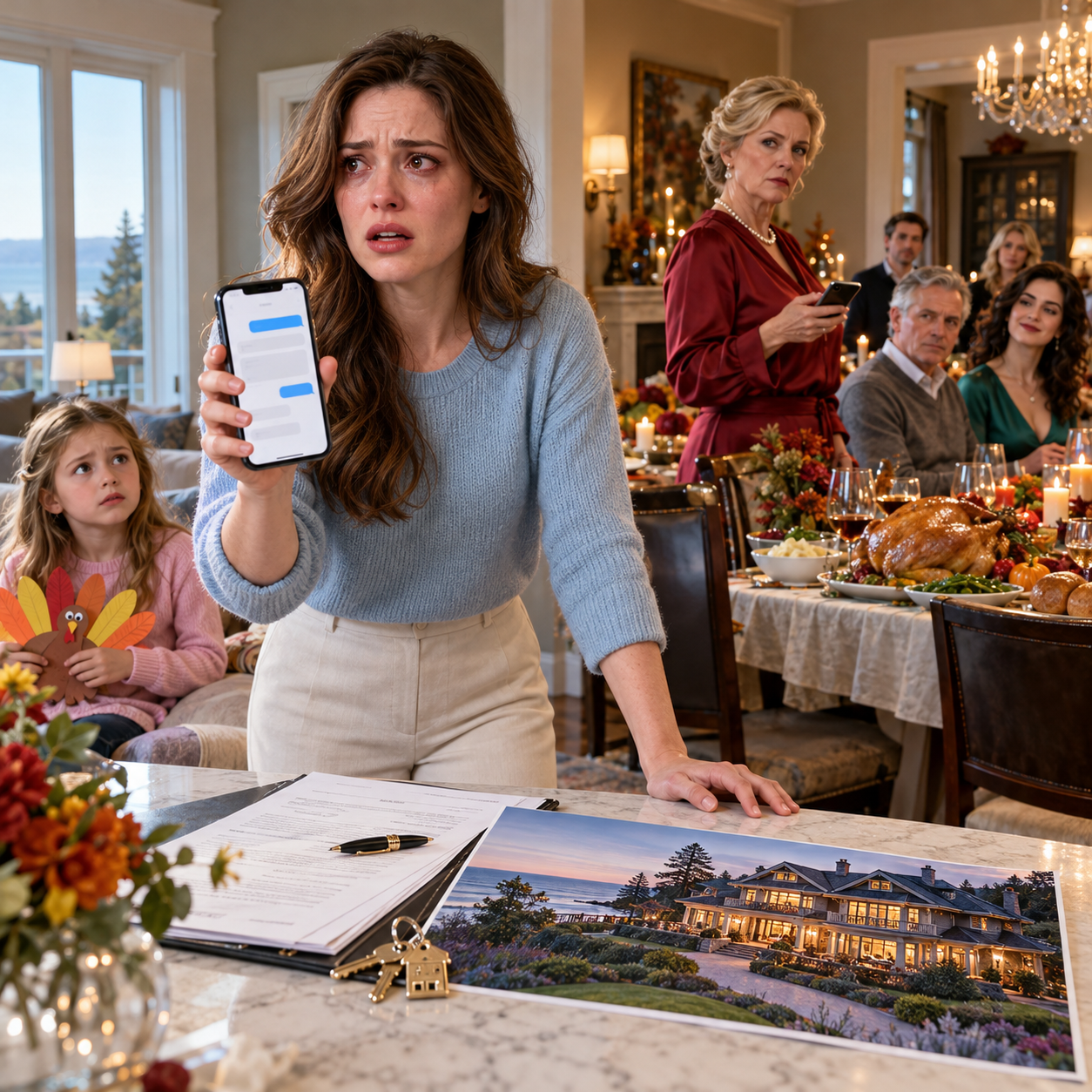
Around three o’clock, my phone began vibrating beside my plate.
Dad called first. Then Brooke. Then my mother, followed by two more calls from Dad. I turned the screen facedown, but Joel noticed and gave me a questioning look.
“Everything okay?”
“I think someone found out where we are.”
He studied me for a moment. “Do you want me to come with you?”
I shook my head, lifted my coffee cup, and stepped onto the deck.
The Pacific stretched below the property, gray beneath the afternoon clouds. Through the glass doors, I could see my daughter leaning against Nana’s shoulder while Aunt Miriam distributed second helpings of dessert. I listened to Dad’s voicemail.
“Elise, your mother is very upset. We understand you’ve invited people over, but keeping something like this from us is embarrassing. Call me before this gets any further out of hand.”
I replayed the message once. There was no mention of Lily, no question about whether Nana had arrived safely, and nothing about the invitation we’d never received.
I called him back.
## Part 4: My Father’s Call Finally Revealed What Our Family Had Chosen
Dad answered immediately. “Elise, why didn’t you tell us you were hosting Thanksgiving?”
“Because you told me not to come to yours.”
“That’s not the same thing.”
I rested my coffee against the railing. “Which part isn’t the same?”
He sighed. “Your mother saw pictures Joel posted. She didn’t even know you’d bought a house, much less something like that. Now relatives are asking why we weren’t invited.”
“Dad, you told Aunt Miriam, Joel, and Nana that there wasn’t room for them at Thanksgiving.”
“We were trying to make things easier for Brooke. She’s been under a lot of pressure lately.”
I watched a wave collapse against the rocks below. “Nana has spent fifty-three Thanksgivings with this family. You were going to let her sit alone in Eugene because Brooke needed an easier day?”
He didn’t answer immediately. Finally, he said, “We assumed she’d understand.”
“And Lily? Did you assume a seven-year-old would understand why her grandmother didn’t want her there?”
“Nobody said we didn’t want Lily.”
I took the phone away from my ear for a moment, looking through the windows at the little girl in question. “That’s exactly what Mom’s message told us.”
Dad cleared his throat. “Your mother probably could have handled it differently.”
“She could have. And you could have said something.”
“We didn’t intend for anyone to get hurt.”
“I believe you,” I said. “I also believe you didn’t spend much time thinking about who might.”
He asked whether we could discuss everything after the holidays. I agreed, but told him I wasn’t asking anyone to apologize for owning a house or inviting relatives to dinner. Before hanging up, I added, “I hope you and Mom have a good Thanksgiving. We are.”
My phone buzzed again a few minutes later. Brooke had sent a message: “I only asked Mom for a quieter holiday. I never told her to make everybody feel unwelcome.” I typed a response, deleted it, and finally wrote, “Then maybe you should tell her that.”
When I returned inside, Franklin was playing a small acoustic guitar beside the fireplace. The children sat on the rug listening, and Nana Prue had closed her eyes in the armchair. Joel joined me by the windows, holding two cups of coffee.
“Your dad?” he asked.
I nodded.
“Did he say anything useful?”
“He said they didn’t mean to hurt anybody.”
Joel looked toward Lily. “Intentions are convenient things. Nobody ever has to see what they leave behind.”
We stood together until the last daylight faded over the ocean. Then he reached into his jacket and showed me an old photograph on his phone. It was the picture from my seventh-grade science fair, scanned from a print he’d discovered years earlier. Twelve-year-old me was holding a blue ribbon beside a homemade filtration system, smiling at the camera.
“I thought you might want this,” he said.
I stared at the girl’s face for several seconds. “I kept that ribbon in my sock drawer for years.”
“Why?”
“Because I needed proof it happened.”
Joel glanced around the living room, at the family gathered beneath the warm lights. “You won’t need proof of this one.”
Later that evening, Lily fell asleep in the guest room with one of her paper turkeys resting on the nightstand. The family group chat filled with photographs of dinner, children laughing, Nana smiling beside the fireplace, and Franklin showing off his little tree. Joel renamed the conversation Cannon Beach Crew.
Before I went to bed, Nana sent me a private message.
“I waited thirty years to see you at a table where nobody made you feel less important. I’m glad I lived long enough to sit at it.”
I read her words sitting on the edge of Lily’s bed. From the hallway came the soft sounds of people talking downstairs, and beyond the windows, the steady rhythm of the ocean.
The next morning, Lily joined me on the deck wrapped in a blanket. Fog drifted between the trees, leaving the coastline almost invisible.
“Nana says this is a healing house,” she announced.
“Does she?”
Lily nodded. “She says you built it.”
“I bought it, sweetheart.”
She considered the distinction. “But you worked for it. And you invited everybody. And you made sure there were enough chairs.”
I put an arm around her shoulders. “I suppose I did.”
“Then you built the important part.”
I kissed the top of her head, and we watched the fog move across the water.
My parents hadn’t apologized, and I couldn’t say whether they ever would. The old disappointments hadn’t disappeared simply because I could afford a beautiful house. But Lily had spent Thanksgiving surrounded by people who loved her, Nana had celebrated another holiday with family, and I had stopped waiting for permission to create something good.
For thirty-three years, I’d measured my place in the family by whether somebody remembered to invite me.
That Thanksgiving, I finally understood something my daughter had figured out before I did.
The important part of a home wasn’t its price, its size, or even its beautiful view.
It was knowing that when someone you loved came to the door, you would make room.
The End .
All characters and events in this story are fictional, created for storytelling and entertainment purposes. Thank you sincerely for reading. Your feedback and support are invaluable and motivate me to continue sharing more stories with you.


