
## Part 2: A Secret Phone Call Revealed What Sabrina Was Planning
That evening, I made meatloaf and roasted potatoes, one of Brandon’s favorite meals since childhood. Sabrina barely touched hers, claiming the baby was pressing against her stomach, while Brandon talked about a difficult customer at his new job. I watched him reach for his wife’s hand and noticed how quickly she picked up her water glass. There was enough ordinary conversation at that table to make Frances’s story seem impossible.
Around eleven, I went downstairs for a glass of water. Sabrina stood in the hallway near the laundry room, speaking into her phone with her back toward the stairs. I would have continued into the kitchen if she hadn’t said, “The timing isn’t ideal, but it’s manageable. Once I have my own place, everything gets easier.”
She listened for several seconds, then rubbed her forehead. “No, he doesn’t know yet. There’s no reason to tell him before I have to.” Her voice had none of the gentle uncertainty she’d used with me in the garden. I backed upstairs, leaving my water glass on the dresser untouched.
The next morning, I called Eleanor Walsh, the attorney who had handled Daniel’s estate. We arranged to meet that afternoon, and I brought the deed, my notebook, and the brochures Sabrina had given me. Eleanor read quietly while I described the changed furniture, the missing photograph, and my son’s reluctance to intervene. She stopped taking notes when I explained that Sabrina expected to remain in the house after I left.
“Roberta, your name is the only name on this deed,” she said, turning the document toward me. “You own the property outright, and you haven’t transferred any ownership to Brandon or Sabrina. They live there with your permission, but that doesn’t make it their house.” She explained that, under the rules applicable to our arrangement, I could require them to leave through a properly delivered thirty-day notice, followed by the legal process if necessary.
I asked her to explain every step twice. I didn’t want to frighten my pregnant daughter-in-law with paperwork or create a legal fight with my son, and Eleanor understood that. Before I left, she placed the deed into a fresh folder and told me not to sign anything Sabrina might present without letting her examine it first. I carried that folder home beneath my arm, feeling less confused than I had in weeks.
For the next two weeks, I said very little. Sabrina replaced my dining-room curtains with pale linen panels and removed the watercolor of the rocky coastline where Daniel and I had spent our honeymoon. In its place, she hung a large round mirror, which she admired whenever she passed the room. When I asked Brandon about the painting, he sighed and said, “Mom, she’s nesting. That’s what pregnant women do.”
“Nesting is preparing a room for your baby,” I answered. “It shouldn’t require erasing your father’s things.” He rubbed the back of his neck and promised to talk with her when she was feeling better. I watched him walk upstairs, knowing how thoroughly he’d learned to avoid conversations that might upset somebody. Daniel had sometimes done the same thing, though he usually came back afterward and made things right.
On Saturday, I returned from the grocery store and discovered an unfamiliar silver sedan parked in my driveway. Two modern upholstered chairs had appeared in the living room, and the furniture Daniel and I had chosen was pushed against the wall. A tall man in a dark jacket stood near the fireplace holding paint samples, while Sabrina pointed toward the ceiling. They were discussing which shade of beige would make the room feel more spacious.
Sabrina noticed me first. “Roberta! You’re home early,” she said, lowering her hand from the wall. The man turned, and something in his expression reminded me of Frances’s description of the stranger at Mercer’s. He was attractive in a polished, rather expensive way, with a silver watch and carefully styled hair.
“This is Adrian,” Sabrina continued. “He’s helping me with some decorating ideas. I thought the living room could use a little update before the baby comes.” Adrian extended his hand and introduced himself as an interior design consultant. I shook it briefly, then asked Sabrina whether she had intended to discuss the changes with me before hiring someone.
“It’s not really a hiring situation,” she said. “Adrian’s a friend, and he’s doing me a favor.”
I looked around at the unfamiliar chairs and the empty space where Daniel’s reading table had stood. “You can put those samples away,” I told Adrian. “Nothing is being painted, and the furniture isn’t being replaced.” He glanced at Sabrina, then gathered his materials while apologizing for the misunderstanding.
After he left, Sabrina followed me into the kitchen. “You embarrassed me in front of someone who was trying to help,” she said, keeping her voice low. I set my groceries on the counter and asked where she’d put Daniel’s reading table. “In the garage,” she answered, then added, “You can’t keep every old thing forever, Roberta. We’re trying to build a life here, too.”
“You already have a life here,” I said. “I invited you into it.”
She stood beside the refrigerator, her hand moving over her belly. “Brandon and I are going to have a child. We can’t spend the next eighteen years asking permission every time we want to move a chair.” I waited for her to acknowledge that it was my house, but she only looked past me toward the window.
That evening, I called Eleanor again. I asked her to prepare the notice, including a dated record of the belongings Sabrina had moved or removed without permission. When Eleanor asked whether I was certain I wanted both of them named, I looked at the family photograph I’d finally placed on my bedroom dresser. “Yes,” I said. “They both need to understand what this means.”
## Part 3: Thirty Days to Leave Forced My Son to Choose
Two days later, I waited until Brandon came home from work. He was sitting beside Sabrina on the living-room couch, still wearing his company polo shirt, when I walked in carrying two envelopes. I handed one to each of them and took my place in Daniel’s old armchair. Brandon opened his first and read the heading aloud.
“Notice to Vacate?” He looked up, bewildered. “Mom, what is this?”
“It’s thirty days to make other living arrangements,” I said. “Eleanor prepared everything, and I’ve made sure it was delivered properly.” Sabrina unfolded her copy, scanning the first paragraph before looking directly at me. “You can’t seriously expect me to move while I’m pregnant.”
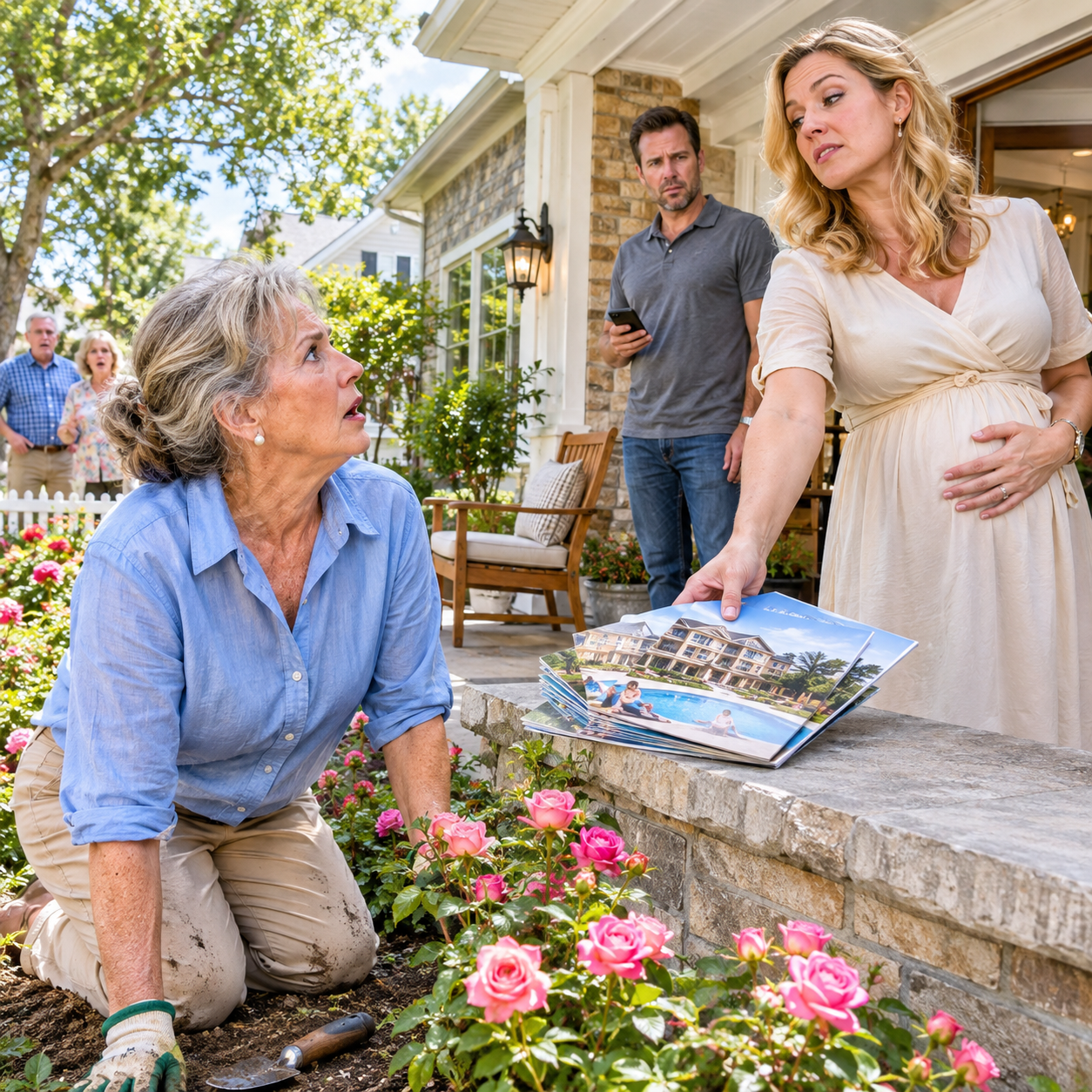
“I expect you and Brandon to find somewhere to live,” I answered. “I will respect whatever medical needs your pregnancy creates, but you cannot decide that I should move out instead.” I pointed to the brochures stacked beneath the notice on the coffee table. “You had already selected a senior community for me before you even asked whether I wanted to leave.”
Brandon turned toward his wife. “You actually gave her brochures?”
Sabrina pressed her lips together. “I was trying to think practically. We need the nursery, and your mother doesn’t need all this space.” Brandon looked around the room, at the chairs neither of us recognized and the empty wall above the fireplace. “You told me we should eventually look for our own place,” he said. “You never told me you were planning for Mom to leave.”
“I said we needed more room,” Sabrina replied. “You said she’d understand.”
He shook his head and returned to the paperwork. Attached to the notice was the list I’d compiled, including the blue lamp, the photograph, the curtains, the painting, and the household items removed without permission. Brandon studied the dates, occasionally raising his eyes toward the objects that had replaced his father’s belongings. He stopped at the entry describing the anniversary photograph.
“Why did you keep putting Dad’s picture away?” he asked.
Sabrina looked down at her hands. “I didn’t think that particular photograph belonged in the main room anymore. It made everything feel like we were living in somebody else’s past.” Brandon reached for the coffee table to steady the papers he’d been holding. “We are living in Mom’s house,” he said. “Of course it has her past in it.”
She turned away, her face tightening. “You always do this. Whenever your mother says something, suddenly I’m the unreasonable one.” Brandon started to answer, then stopped. He took several seconds before saying, “I’ve barely said anything for months, Sabrina. That’s part of why we’re sitting here.”
She went upstairs, leaving the notice on the couch. I could hear her pulling open drawers in their bedroom while Brandon remained seated, staring at the papers. After a while, he asked why I hadn’t told him how serious things had become. I reminded him of our conversations about the photograph, the curtains, and the painting.
He lowered his head. “I thought if I stayed out of it, things would settle down.”
“That’s what I hoped, too,” I said. “But somebody needed to say no.”
A little later, he mentioned Adrian. Sabrina had introduced him as a friend who knew about decorating, and Brandon had assumed they were discussing nursery furniture. I told him what Frances had seen at Mercer’s and repeated the telephone conversation I’d overheard in the hallway. I was careful to distinguish what I knew from what I suspected.
Brandon listened without interrupting. When I finished, he asked for a few minutes alone and went upstairs to speak with his wife. I stayed in the living room, where Daniel’s old clock ticked steadily above the bookcase. Their conversation lasted nearly two hours, sometimes quiet enough that I couldn’t hear anything, sometimes interrupted by raised voices and long pauses.
Over the following weeks, their marriage began to come apart. Brandon told me Adrian wasn’t merely a decorator Sabrina had recently met; she’d known him for two years, including a period before Brandon lost his job. There had been private messages, lunches Brandon hadn’t known about, and conversations about Sabrina eventually finding somewhere of her own. Brandon didn’t show me the messages, and I never asked him to.
One night, he sat across from me at the kitchen table while the coffee he’d poured grew cold. “She says Adrian made her feel like somebody was actually listening,” he told me. “She says I was always worried about money, and you were always here, and she didn’t feel like we had a marriage that belonged just to us.” He turned the mug slowly between his hands.
I wanted to remind him who had kept groceries in the refrigerator when he was unemployed, but he already knew. Instead, I asked whether he understood why Sabrina had wanted me gone. He nodded, looking exhausted. “She figured if you moved out, we’d finally have the house to ourselves. She’d have the nursery the way she wanted, and she wouldn’t have to explain everything she was doing.”
There were other reasons, too, Brandon admitted. Sabrina was frightened of having a baby before they were financially stable, embarrassed about living with his mother, and resentful of how little control she had over their circumstances. None of those fears made her relationship with Adrian or her treatment of my belongings acceptable. Still, I could recognize the frightened young woman beneath the decisions she’d made.
Sabrina moved out before the thirty days expired. She went to stay with her sister in Portland, and Brandon helped carry her suitcases to the car while I remained inside. I saw her pause beside the front steps and look toward the garden where she’d handed me the brochures. She didn’t apologize, but she said, “I never meant for it to get this ugly.”
I answered from the doorway, “Neither did I.”
She drove away with one hand resting on her stomach. Brandon stood beside the empty driveway until her taillights disappeared, then came inside and asked whether he could stay temporarily while he worked out his next steps. I agreed, with one condition: we would discuss decisions openly from then on, even when the conversation was uncomfortable. He nodded and asked whether I needed help bringing Dad’s table back from the garage.
## Part 4: My Granddaughter Arrived After Our Family Finally Faced the Truth
The house didn’t return to normal immediately. Sabrina’s floral candles had left a lingering scent upstairs, and three boxes of her belongings remained stacked neatly near the garage door. I washed the curtains she’d removed, unpacked my mixing bowls, and placed the blue lamp back on its hallway table. Brandon helped me rehang the coastal watercolor, holding the frame while I stepped backward to judge whether it was straight.
For several weeks, he was quieter than usual. He attended counseling, worked, and met Sabrina to discuss the baby and how they would manage parenting separately. They decided not to resume living together, although they agreed that their daughter deserved two parents who could cooperate. I didn’t interfere, except when Brandon asked whether I’d be willing to help with childcare.
“Of course,” I told him. “But you need to be her father, not just somebody who drops her off with Grandma.” He smiled faintly and said he knew, then asked whether the old rocking chair from his nursery was still in the attic. I told him it was probably covered in dust, but the wooden runners had always been good. We carried it downstairs together the following Sunday.
Sabrina and I had little contact before the birth. She occasionally sent Brandon messages about appointments and baby supplies, and I stayed out of their disagreements. Brandon eventually told me that he and Sabrina had arranged to confirm paternity after the baby arrived, a decision both of them considered necessary after everything that had happened. I told him I hoped he would find peace with the answer, whatever it turned out to be.
On a humid morning in August, Sabrina went into labor. Brandon called me from St. Mary’s Medical Center shortly after six, his voice strained but controlled. “Mom, we’re at the hospital,” he said. “She’s doing okay, but she asked me not to have too many people around.” I told him I would respect that and asked him to let me know when there was news.
By afternoon, I was in the waiting room at his invitation, holding a paper cup of coffee I hadn’t touched. Brandon appeared near the nurses’ station wearing the tired, astonished expression I’d seen on Daniel’s face after our son was born. “She’s here,” he told me, and his voice broke on the second word. “Seven pounds, four ounces. They’re both doing fine.”
I hugged him without asking about anything else. When he finally stepped back, he smiled and said the baby had a full head of dark hair and the same stubborn chin he’d inherited from his father. “Sabrina agreed to name her Annelise,” he added. “After Grandma.” My mother’s name sounded different coming from his mouth that day, as though some small, precious part of our family had found its way forward.
When I was allowed to meet her, I washed my hands twice and approached the hospital bassinet. Annelise was bundled in a white blanket, one tiny fist resting beside her cheek, her dark eyelashes barely visible against her skin. Brandon lifted her carefully and placed her in my arms, supporting her head the way the nurse had shown him. She made a small searching movement with her lips, then settled against me.
“Hello, Annie,” I whispered. “I’m your grandmother.”
Across the room, Sabrina rested against her pillows. She looked pale and exhausted, and for the first time in months she seemed uninterested in arranging anything around her. Our eyes met briefly. “She likes being held that way,” she said, and I nodded, adjusting the blanket beneath Annie’s chin.
Several weeks later, the paternity results confirmed Brandon was Annie’s father. He brought the report to the kitchen table, read the conclusion once more, and folded it neatly into the envelope. I didn’t need to see it; his expression told me enough. He spent that evening assembling a crib and sorting baby clothes into little piles on the rug.
By October, Annie had her own small bedroom in my house. I painted the walls a soft gray-blue, the color of the sky before an autumn rain, and placed Brandon’s old rocking chair beside the window. Sabrina had moved into a nearby apartment, and after several discussions about childcare, she and Brandon agreed on a schedule that let him care for Annie on Wednesdays, Thursdays, and alternating weekends, with my help when needed. We kept the crib ready, along with diapers, blankets, bottles, and a photograph of Daniel holding Brandon as a baby.
Brandon was learning to be a father while finding his footing again as a single man. Some evenings, he arrived home from work looking tired, only to brighten when Annie recognized his voice and began waving her small fists. He could change a diaper, warm a bottle, and distinguish her hungry cry from the indignant noise she made when she wanted someone to pick her up. Watching him learn these things helped me see the adult he was becoming, not merely the frightened boy who had once avoided every difficult conversation.
One Wednesday evening, Annie fell asleep against his shoulder after her feeding. He stood beside the window, gently rocking her while the last sunlight caught the blue glass lamp in the hallway. “I owe you an apology, Mom,” he said without looking away from his daughter. “I knew things weren’t right here, and I kept hoping somebody else would fix them.”
I sat in Daniel’s chair and watched Annie’s fingers curl around the collar of Brandon’s shirt. “I appreciate you saying that,” I answered. “But you don’t have to spend the rest of your life apologizing. Just remember what happens when you stay quiet about something that matters.” He nodded, and we let the subject rest.
Sabrina and I never became close again. We exchanged polite greetings during pickups, discussed Annie’s needs when necessary, and avoided reopening arguments that belonged to the past. Once, when she arrived early, she noticed the watercolor back on the dining-room wall. Her gaze lingered on it for a moment before she turned toward her daughter’s diaper bag.
“That’s a pretty painting,” she said.
“Daniel and I bought it on our honeymoon,” I answered.
She glanced at me, apparently searching for something else to say. “I didn’t know that.”
For a moment, I thought about telling her how long I’d owned it, how many dinners it had watched over, and how much it had meant to Daniel. Instead, I handed her Annie’s blanket and told her the baby had eaten an hour earlier. Sabrina thanked me, adjusted the car seat, and left with her daughter.
Later that evening, I returned to the living room and straightened Daniel’s photograph on the mantel. The oak outside had begun turning gold, and the roses needed trimming before the first frost. Upstairs, Annie’s little room waited for her next visit, the rocking chair standing beside the window where the afternoon light would reach it.
I knew the house would never be exactly as it had been before. Families change, children grow, marriages end, and the people we love sometimes disappoint us. But the house was still mine, and I no longer confused generosity with surrendering the right to decide what happened inside my own walls.
The senior living brochures had remained in my kitchen drawer for months. That night, I took them out, placed them in the recycling bin, and carried it to the curb beneath the oak Daniel and I had planted. Tomorrow, Brandon would bring Annie home for another visit, and I had a small quilt to finish before she arrived.
I went inside, turned on the blue lamp, and closed my front door.
The End .
All characters and events in this story are fictional, created for storytelling and entertainment purposes. Thank you sincerely for reading. Your feedback and support are invaluable and motivate me to continue sharing more stories with you.


