
Part 2: I Canceled Christmas And Followed Every Dollar Back Home
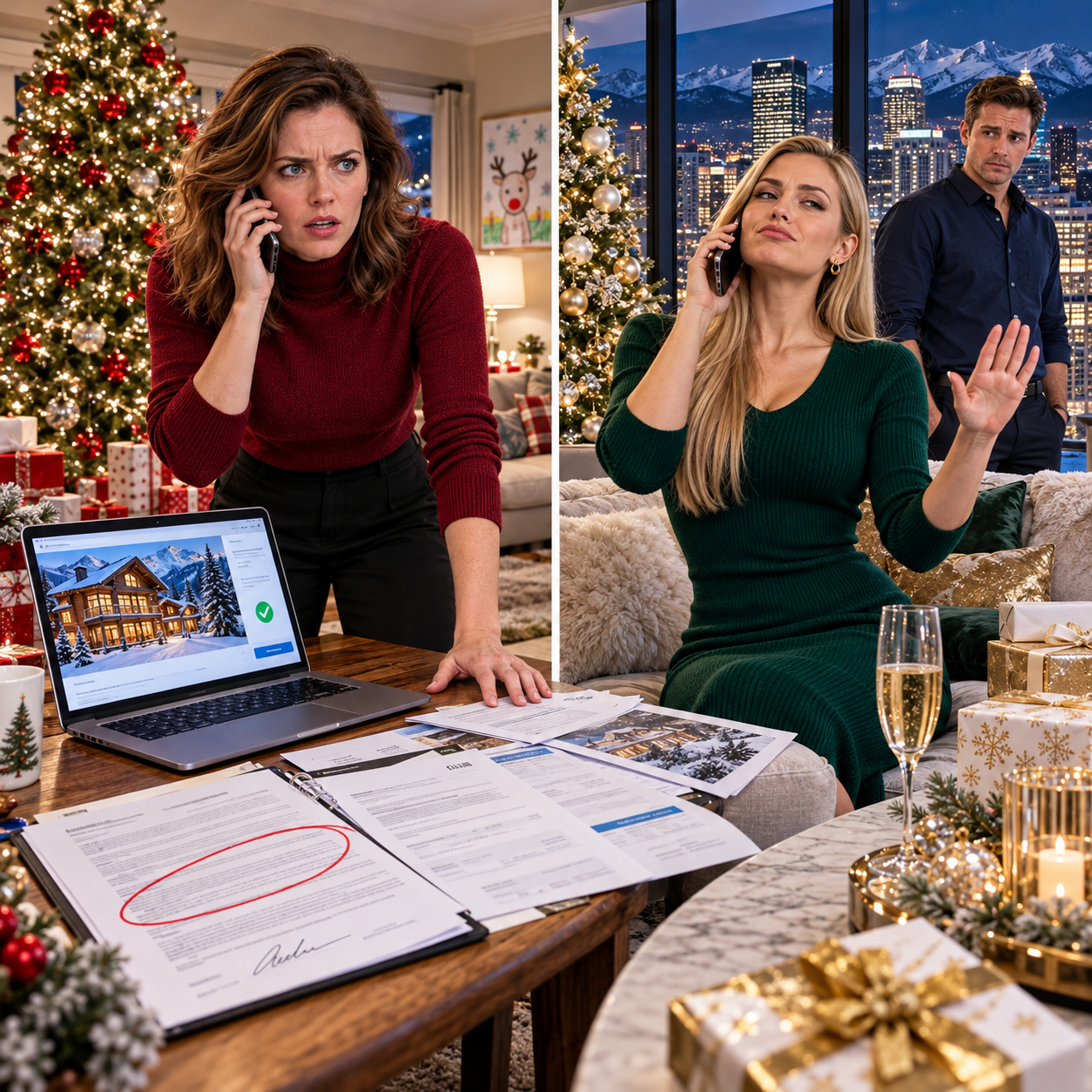
The following morning, I sat at my kitchen table with a notebook, a cup of coffee, and my laptop while the children were at school. Celeste had sent another message overnight: “Please don’t take this personally. We all want the kids to have a beautiful Christmas.” Beneath it was a photograph of the lodge’s enormous stone fireplace decorated with stockings. I saved the message beside the reservation confirmation and called the rental company before I could talk myself into another compromise.
A woman named Marlene answered and verified my identity using the confirmation number and the last four digits of my credit card. When I asked to cancel the entire reservation, she reminded me that the property was scheduled for a holiday arrival and wanted to make sure I understood the consequences. “The cancellation applies to all guests,” she explained. “Once it’s processed, nobody in the original party will have access to the property.” I said I understood and requested written confirmation that the $4,200 paid toward the rental would be refunded.
The email arrived while we were still on the telephone. I thanked Marlene, wrote down her name and the transaction reference, and called the catering company, where the conversation proved considerably more difficult. Their contract allowed them to retain half the deposit when cancellation occurred within two weeks of the event. I explained that the family gathering had fallen apart, that I was the person who had paid, and that I understood if they couldn’t make an exception. After consulting her manager, the coordinator returned to offer a full refund of the $1,800 as a one-time courtesy, provided I confirmed the cancellation immediately.
I accepted, then sat staring at the two emails showing that all $6,000 would be returned. For years, I had paid other people’s bills while worrying that refusing would make me selfish. Yet those two ordinary phone calls had accomplished something no family argument ever had: they had ended an obligation I no longer wanted to carry. My next decision involved a debt that had nothing to do with Christmas, but everything to do with how Celeste had come to depend on me.
Three months earlier, my sister had called close to midnight after damaging her SUV in a parking garage. She had scraped the entire passenger side against a concrete pillar and was terrified Reggie would discover another costly accident. Their insurance payments had already increased, and he had warned her that they couldn’t continue treating every financial emergency as something someone else would fix. She persuaded me to accompany her to a repair shop, where the estimate came to $3,400, and begged me to handle the payments discreetly.
I had contributed $1,000 immediately and helped arrange installments for the remaining $2,400, with Celeste signing the repair agreement and my credit card listed for automatic payments. She reimbursed me $200 once, then started ignoring my reminders. On the morning I canceled Christmas, the outstanding balance was still $2,200. I telephoned the shop, verified that Celeste was the actual customer responsible under the agreement, and asked them to remove my card as the payment method; the representative confirmed that future invoices would go directly to her.
I didn’t dispute the authorized charges or try to take back money already spent. I simply stopped volunteering to pay a debt that had never been mine, something I should have done months earlier. The billing representative sent confirmation that afternoon, and I added it to the folder containing Celeste’s messages, the lodge agreement, the catering refund, and the other receipts I had kept over the years. As someone who investigated financial records professionally, I knew that the hardest part of reconstructing a story was rarely finding the numbers; it was getting people to acknowledge what those numbers meant.
By evening, I had created a clear timeline showing the Christmas payments and cancellations, alongside a record of Celeste’s earlier unpaid requests. I drafted an email to our parents, aunts, uncles, and adult cousins explaining that the Breckenridge gathering would not take place because the reservations belonged to me and had been canceled. I included the financial documentation and explained, without insults, that I had been asked not to attend an event I had funded. Before sending it, I reread every sentence, removed two angry paragraphs, and attached only records that supported what I was saying.
Within minutes, my phone started lighting up. My cousin Delia wrote, “Vivian, did Celeste actually tell you that you couldn’t come?” An aunt asked whether there had been some misunderstanding, while my father called twice without leaving a message. Celeste sent a furious text demanding to know why I had involved the entire family. I answered with one sentence: “Everyone invited to a canceled gathering deserves to know that it has been canceled.”
That evening, Jonah found me removing the printed photographs of the lodge from our refrigerator. He stood beside me in his dinosaur pajamas, studying the empty spaces where the pictures had been, then asked whether our Christmas trip was gone. I crouched next to him and said that the adults had made plans that weren’t fair, so we would be celebrating at home instead. “Did we do something wrong?” he asked, glancing toward the hallway where Petra was brushing her teeth. I pulled him into my arms and told him that neither child had done anything wrong, and that Christmas didn’t depend on where we slept.
He considered that before asking whether we could still make cinnamon rolls. I promised we could, and he went to bed satisfied enough to remind his sister that she could help with the icing. Afterward, I stood alone in the kitchen looking at the bare refrigerator door, aware that I had disappointed my children while protecting them from something worse. I could recover the money and cancel the reservations, but I couldn’t give them back the uncomplicated excitement they’d felt when they first imagined Christmas in the mountains.
Part 3: Christmas Morning Revealed The Lies Behind My Sister’s Perfect Life
Christmas morning began at 6:47 when Jonah jumped onto my bed, shouting that Santa had found our house after all. Petra followed carrying her stuffed rabbit, demanding that we open presents before breakfast because waiting seemed like a terrible Christmas tradition. We spent the morning sitting on the living room rug, surrounded by wrapping paper, while cinnamon rolls baked a little too long in the oven. Jonah loved his new telescope, Petra insisted on wearing her princess costume over her pajamas, and neither child mentioned Breckenridge once.
Around ten, my phone began vibrating across the kitchen counter. Celeste called three times, followed by my father and an unfamiliar number I eventually learned belonged to Reggie’s mother. When I answered, the older woman introduced herself sharply and accused me of humiliating everyone with a family dispute that should have remained private. I asked whether she knew who had paid for the canceled gathering. She paused, then said, “Reginald and Celeste arranged that vacation,” with a certainty that told me exactly what my sister had allowed everyone to believe.
“I paid every vendor directly,” I explained, offering to forward the receipts. She asked me to send them and ended the conversation without another accusation. An hour later, she called again, sounding considerably different, and admitted she had never been told that I financed the trip. When I asked whether she had demanded that I stay home because of my divorce, she answered, “I have my opinions about marriage, Vivian, but I never asked anyone to exclude you.” She wouldn’t discuss Celeste’s explanation, except to say that she intended to speak with her son.
Over the next several days, my cousin Delia helped me understand the conversations unfolding behind the scenes. Reggie’s mother had confronted him after discovering that Celeste had presented the celebration as something the couple could comfortably afford. Reggie, already worried about their finances, began reviewing their household accounts and asking why so many purchases had been described as gifts, temporary arrangements, or expenses someone else had agreed to cover. The receipts in my email made it harder for Celeste to dismiss his concerns as another misunderstanding.
On December 27, the repair shop contacted Celeste about the outstanding $2,200 on her SUV, explaining that my card was no longer available for automatic payments. She called our mother crying, apparently expecting another rescue, but Mom told her that the debt belonged to her and that she needed to discuss it with Reggie. Delia said Celeste accused me of deliberately destroying her marriage, although Reggie had apparently asked why she concealed the accident and the financial arrangements in the first place. I didn’t celebrate hearing that her marriage was under strain; I simply refused to intervene in a problem I had spent years helping her hide.
Delia called me on December 28 while I was folding the children’s laundry. “Most of us knew she leaned on you for money,” she admitted, “but I didn’t realize how much, and I should have asked.” I told her that I hadn’t realized how much either, not until I placed everything together and saw years of promises turned into a pattern. She apologized for watching our family treat my independence as permission to demand more from me. After the call, I put away Jonah’s pajamas and Petra’s tiny socks, thinking about how often I’d confused keeping the peace with making myself useful.
Part 4: My Father’s Apology Could Not Restore Our Old Family
On New Year’s Eve, my father called while snow drifted across the backyard. I nearly ignored him, remembering how he had remained silent when Mom defended Celeste, but I answered because I wanted to know whether he had anything to say for himself. He asked how the children were doing, listened while I described their Christmas presents, then admitted he’d read every document I sent. “I should have called you before all this happened,” he said. “Your mother and I made it easier to believe Celeste because you never seemed to need anything.”
I told him that being capable wasn’t the same as being untouched by what other people did. He stayed quiet for several seconds before admitting that he had spent years expecting me to be understanding while allowing Celeste to remain irresponsible. “Your marriage ending was never something you should have been ashamed of,” he said. “And we had no right to make you feel that you were worth less because of it.” I watched snow collect on the railing outside and thanked him for saying what I had needed to hear long before Christmas.
He asked whether we could start over, but I explained that an apology couldn’t erase what happened. I wasn’t willing to rebuild relationships around the same expectations, and I wouldn’t continue financing Celeste’s decisions or allowing anyone to treat my children as separate from me. Dad said he understood, although I suspected understanding those boundaries would be easier than living with them. We agreed that he could visit the children after the holidays, provided the visit didn’t become another conversation about forgiving Celeste.
My mother sent a short message several days later saying she regretted how Christmas had unfolded. She didn’t mention her comments about my divorce or explain why protecting Celeste’s marriage had required humiliating me. I replied that I was willing to talk when she was ready to discuss what she’d actually said, rather than how uncomfortable the consequences had become. She didn’t answer, and I let the conversation remain unfinished.
Celeste and I haven’t spoken since the canceled trip. Delia mentioned that Reggie and Celeste were reviewing their debts together and making changes to their spending, but I asked her not to bring me further updates. Whatever happens between them belongs to their marriage, just as my decisions belong to my own household. I no longer believe loving someone requires rescuing them from every consequence.
One Saturday near the end of January, Jonah asked if we could make the same cinnamon rolls we’d eaten on Christmas morning. Petra insisted on helping, and soon our kitchen smelled of warm sugar while the children argued about whether the icing should go on before or after the rolls cooled. Jonah ate four standing at the counter, and Petra proudly handed me the one she’d decorated with far too much frosting. I looked around at the ordinary little house I paid for, at the children who filled it with noise and drawings and mismatched socks, and realized that our Christmas hadn’t needed a mountain lodge to become a treasured memory.
I still keep the receipts in a folder, although I rarely open it now. Those records remind me of the money I once gave away hoping to earn a place in my own family, but they also remind me of the day I stopped accepting that arrangement. My children didn’t need a mother who could purchase the perfect Christmas; they needed one who could show them that love should never require humiliation. That winter, I finally understood the difference, and our home became the one place where none of us had to apologize for belonging.
The End .
All characters and events in this story are fictional, created for storytelling and entertainment purposes. Thank you sincerely for reading. Your feedback and support are invaluable and motivate me to continue sharing more stories with you.


