
## Part 2: Hidden travel plans expose a betrayal far beyond abandoned children
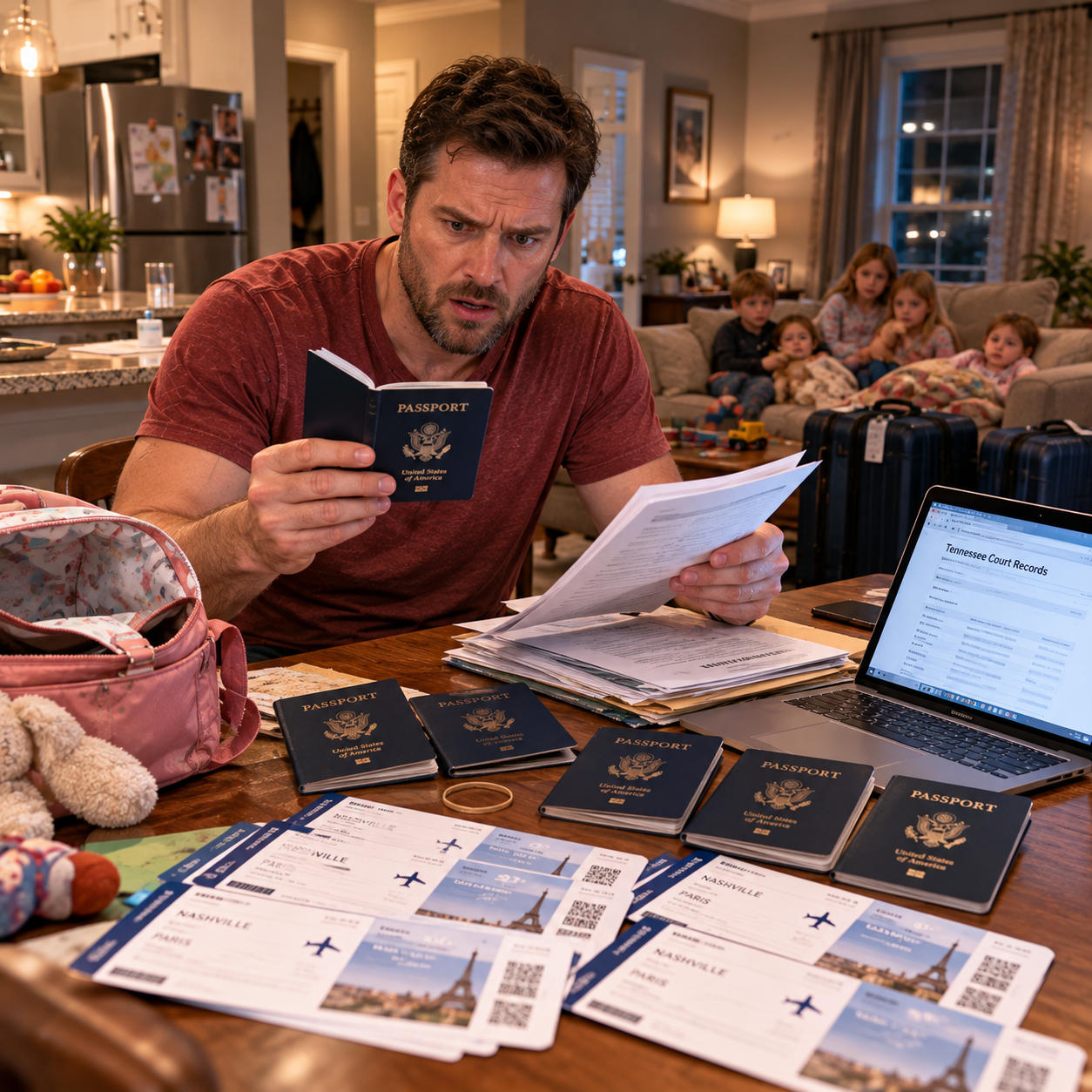
I called Dad at nine that evening and asked why his name appeared on airline tickets for the children. He didn’t answer immediately, and I heard his television playing in the background before he finally muted it. “Brooke wants a fresh start,” he said. “There’s a man over there who treats her well. I’m taking the kids once she gets settled.”
“Does Nathan know?”
“Brooke says he signed everything.”
I explained what I’d found in the court records, including the dismissed protective order and the repeated custody filings. Dad accused me of digging through my sister’s private affairs and suggested that court paperwork couldn’t tell the whole story. When I asked whether he had personally spoken to Nathan, he changed the subject to Brooke’s exhaustion. Finally, he said, “Don’t ruin her chance to be happy because you can’t stand seeing somebody else have a family.”
I had Nathan’s old number saved in my phone, though I hadn’t used it since the separation. When he answered, I introduced myself and asked whether he could speak privately. His first question was whether the children were safe, followed by a hurried request to speak with Owen. I explained that they were asleep at my house and asked whether he’d signed paperwork for their passports.
“No,” he said, followed by several seconds of uneven breathing. “Grant, I haven’t signed a single document Brooke sent me in two years. I’ve been trying to find them since the summer she left.” He told me their divorce decree provided for shared custody and required notice before either parent relocated the children. Within minutes, he’d emailed me copies of the parenting plan, his attorney’s filings, and photographs of birthday gifts he’d never managed to deliver.
I sat at my kitchen table reading until the clock approached midnight. The documents supported what Nathan had said, although I knew they couldn’t settle every allegation Brooke had made about their marriage. Nathan connected me with his attorney the following morning, and I explained the passports, the abandonment, and the proposed international trip. After reviewing the custody order, she advised Nathan to seek emergency court protection immediately and discussed how the children could safely return to his care.
When I told Owen we were visiting his father, he stared at me for so long that I wondered whether he’d heard me. “Is he going to make us leave again?” he asked. I explained that Nathan had been trying to see them, and that we would take things slowly, without expecting anybody to feel a particular way. Lucy began crying when Owen told her where we were going, while Mason asked whether his father still owned the old basketball hoop.
We left for Nashville after lunch, with the children’s belongings secured in Brooke’s minivan. I brought every medication, favorite blanket, and stuffed animal I could identify, along with enough snacks for a much longer drive. Sophie fell asleep near the state line, and Theo sang pieces of the same nursery rhyme until Mason begged him to stop. Owen sat in the back watching the road, occasionally asking whether Nathan still lived in their old house.
He did.
Nathan had repainted the front porch and planted a small maple tree beside the driveway, but the crooked basketball hoop remained above the garage. He was waiting outside when we arrived, his hands tucked into the pockets of his jeans. Owen stepped out first, walked across the driveway, and stopped a few feet away. Nathan crouched slightly and said, “Hey, buddy,” and Owen crossed the remaining distance so quickly that his father barely had time to open his arms.
Lucy followed, crying against Nathan’s shoulder while Mason talked nervously about school and basketball. Sophie stayed near me until Nathan showed her a framed photograph from her third birthday, still standing on a bookshelf inside. Theo had been an infant when they separated and refused to leave my arms. Nathan accepted that without complaint, pulled a chair closer, and let his youngest son study him from a comfortable distance.
He had prepared the children’s old bedrooms with fresh sheets, borrowed toddler supplies from a neighbor, and stocked the refrigerator with their favorite foods. When Owen discovered a box containing his old drawings, he sat on the floor turning through them without speaking. Nathan looked at me over his son’s head and quietly thanked me. I told him the children deserved more than either of us could give them in one afternoon.
Brooke’s plane had landed in Paris by the time I drove to a nearby motel. My phone displayed dozens of missed calls from her and Dad, along with messages demanding the children’s whereabouts. I sent one response explaining that they were safely with their father, who had an existing custody order, and that the matter was being handled through attorneys. Brooke immediately called and accused me of handing her children to a dangerous man, but when I mentioned the passports and Nathan’s disputed signatures, she ended the call.
The next morning, two police officers came to my house after Dad reported that I’d taken the children without permission. I showed them the available court documents, explained the circumstances, and provided Nathan’s attorney’s contact information. They recorded my account and made clear that custody disagreements required proper legal review. By lunchtime, Nathan’s attorney had begun preparing an emergency petition in Tennessee.
I returned to Brooke’s rental house that afternoon to retrieve Mason’s asthma inhaler, using the key she’d left with the minivan and permission she’d previously given me to collect supplies. The place looked unusually bare, with taped cardboard boxes stacked beneath the living room windows. Several were marked for international shipping, and the children’s school photographs had disappeared from the hallway. I photographed what I saw and retrieved the medication from its usual drawer.
On the kitchen counter, beneath a stack of envelopes, lay a notebook open to a page covered with Nathan’s name. The signatures began awkwardly near the top and became increasingly smooth farther down. Next to the notebook sat a photocopy of his old driver’s license and an empty folder labeled for passport applications. I photographed the papers without disturbing them and called Nathan’s attorney from my car.
She instructed me to preserve the photographs and describe exactly how I’d encountered the materials, without collecting anything further. The apparent signature practice was troubling, she said, but authentication and any criminal investigation belonged to the proper authorities. I spent the evening preparing a detailed statement about Brooke’s arrival, the documents in the diaper bag, my conversations with Dad, and the children’s transportation to Nashville. I also arranged to provide the original passports through the legal process.
Nathan called after the children were asleep. He’d found a plastic storage box in his closet containing letters he’d written for every birthday and Christmas since the separation, most of them returned unopened. Owen had read several and asked whether his father had really tried to contact them. Nathan said he’d answered carefully, because the children were already struggling with more changes than any of them deserved.
The following afternoon, his attorney received another piece of evidence from the children’s former school district. Brooke had submitted withdrawal paperwork before leaving for Europe, listing an upcoming international relocation as the reason for their departure. The documents included a forwarding address in France and a requested final attendance date.
It was the Friday before my sister had appeared on my doorstep.
Her three-week vacation had never been the whole plan.
## Part 3: A father’s confession and a courtroom decision redefine our family
The emergency custody hearing took place several days later in Nashville. Nathan sat beside his attorney with a folder of documents arranged in careful chronological order, while I waited behind them wearing the only jacket I owned. Brooke appeared by video from France with an attorney of her own. She insisted that the children were supposed to join her for an extended holiday and that she intended to arrange their return once she knew her schedule.
Nathan’s attorney asked about the one-way tickets, the school withdrawal, and the consent forms bearing his signature. Brooke claimed he had agreed to the passports during a telephone conversation, but she couldn’t identify when it occurred or produce any supporting messages. Her attorney disputed the implications of the documents and emphasized that the abuse allegations still required examination. The judge listened, reviewed the existing custody order, and declined to resolve every contested fact at an emergency hearing.
What the judge could address immediately was the risk of an unauthorized international relocation. Nathan received temporary primary residential custody, pending further proceedings, and the children’s passports were ordered surrendered. The judge also arranged for Brooke to have appropriate contact with the children while the court evaluated their circumstances. I delivered the passports through the designated process and kept the receipt in my glove compartment.
I had expected relief to feel uncomplicated. Instead, I spent the drive home thinking about Sophie asking when she could call her mother, and about Theo reaching for a woman who wasn’t there. Brooke had made decisions that harmed them, but the children still loved her. Whatever consequences followed, I didn’t want them to mistake their mother’s failures for something they had caused.
The disputed passport applications were referred to federal investigators. An investigator contacted me about the documents I’d discovered, the apparent signature practice, and my father’s involvement in the proposed travel arrangements. He asked for dates, original messages, and a factual statement, rather than my opinion of Brooke’s character. I gave him what I knew and admitted what I didn’t.
Dad came to see me the following Saturday. He stood beside my truck holding a grocery bag filled with things Brooke had left at his house, including children’s socks and a broken electronic tablet. “You’ve destroyed your sister’s life,” he told me, though his voice lacked the certainty I’d heard earlier. I showed him the school withdrawal paperwork and asked why he’d agreed to escort five children overseas without speaking to their father.
Dad sat on the edge of my porch and rubbed his hands together. “She said Nathan signed everything because he wanted them gone,” he murmured. I asked whether he’d known Nathan was still trying to contact the children, and he looked away toward the street. After a long pause, he admitted Nathan had called several times and mailed letters to Dad’s house, which Dad had refused to accept at Brooke’s request.
“You knew he wanted to see them,” I said.
“I thought I was protecting her,” Dad answered. “She was scared, and I kept telling myself there must be things she wasn’t saying.” He stared at his shoes before adding, “After a while, I’d helped her so much that admitting I might be wrong meant admitting what I’d already done.” It was the first time he’d acknowledged that his loyalty had become something more damaging than kindness.
I asked why he hadn’t considered the children’s wishes, especially Owen’s. Dad couldn’t answer, and I didn’t supply one for him. Before leaving, he asked whether I’d arrange a visit with the grandchildren, but I told him Nathan and the court would decide what contact was appropriate. Dad accepted that without arguing, which was unusual enough to make me look twice as he walked to his truck.
Meanwhile, the children were adjusting to Nashville one uneven day at a time. Nathan arranged counseling, contacted their schools, and reduced his work schedule until he had dependable childcare. Lucy slept with her bedroom light on, Mason worried about being forced to move again, and Owen sometimes became angry with both parents before withdrawing into his room. Nathan didn’t pretend that bringing them home had repaired two years of separation.
One Sunday, Owen showed me a packet of returned letters Nathan had saved. Among them was a birthday card addressed to him at Dad’s house, bearing a red postal marking and Dad’s handwriting directing that it be returned. Owen traced the handwriting with his finger and asked, “Grandpa knew Dad wanted us?” I told him his grandfather had made choices he needed to answer for himself, and that Owen didn’t have to decide how he felt about those choices that day.
Brooke returned to the United States earlier than planned after receiving notice of the legal proceedings. She contacted me from the airport demanding transportation and insisting I bring the children to her immediately. I told her I wouldn’t interfere with the custody order or arrange an unauthorized meeting. Federal investigators subsequently questioned her about the passport applications, and she was later charged with making false statements in connection with the documents.
Her attorney contested aspects of the allegations, and the criminal proceedings remained separate from the family court case. I didn’t celebrate the charges or discuss them with the children. Whatever penalties she eventually faced would come from the evidence and the legal process, not from anything I wanted to happen to my sister.
At a later custody hearing, the court considered the relocation, Nathan’s earlier attempts to maintain contact, Brooke’s conduct, and the children’s need for stability. Nathan retained primary custody, while Brooke received supervised parenting time with a path toward review if she complied with the court’s requirements. She moved back to Tennessee and began attending the scheduled visits. I heard that she sometimes cried afterward, but I couldn’t undo her choices simply because their consequences had become painful.
Dad eventually apologized directly to Nathan. He acknowledged refusing the letters and helping Brooke conceal the children’s location, without asking Nathan to overlook it. Their relationship remained strained, and any contact Dad had with the children took place on terms Nathan established. Dad called me less often than before, though when he did, he finally asked about my life rather than beginning with something Brooke needed.
I returned to my regular work schedule, but my savings were smaller after the groceries, emergency leave, and trips to Nashville. For years, I had confused being easygoing with being generous, allowing Brooke and Dad to make decisions because challenging them seemed exhausting. Now I understood that avoiding an argument could carry a cost for people who didn’t get a choice.
Several months later, I spent a Sunday morning at Nathan’s house while he made waffles using an old star-shaped iron the children remembered from when they were little. Mason sprinkled cinnamon over his, Lucy complained that Theo had stolen her strawberries, and Sophie sat beside Nathan explaining a picture she’d drawn at school. Owen was helping his father set the table, occasionally correcting him about where everyone liked to sit.
When Nathan reached across the counter to brush flour from Owen’s sleeve, his son stayed close instead of pulling away. Theo, who had once refused to leave my arms, climbed onto his father’s lap carrying half a waffle and offered him a bite. I watched Nathan accept it with an exaggerated expression of appreciation, making the little boy laugh.
My phone buzzed with a message from Dad asking whether I could visit the following weekend. I answered that I’d check my schedule, put the phone away, and returned to breakfast. For once, being part of a family didn’t mean surrendering my own life to keep somebody else comfortable.
It meant showing up where I was needed, telling the truth when it was difficult, and remembering that love never gave any of us permission to decide another person’s future without them.
The End .
All characters and events in this story are fictional, created for storytelling and entertainment purposes. Thank you sincerely for reading. Your feedback and support are invaluable and motivate me to continue sharing more stories with you.


