
Part 2: One canceled payment exposed the family bargain underneath
The next morning I called Debra Kent, the wedding planner. Debra was not a friend, but after eighteen months of invoices and scheduling, we knew each other’s voices well. “I need you to suspend every unpaid charge attached to my authorization,” I told her. She paused, then asked if I wanted the vendors notified. “Yes,” I said. “I’m withdrawing from the financial arrangement.” She did not ask what happened until the end, and even then only said, “Audrey, are you sure?” I looked at Tamara’s email printed beside me. “I’m sure I’m not paying for a celebration I’ve been formally excluded from.”
Debra explained that some deposits were gone, but several major contracts still had cancellation windows. I asked her to follow every contract exactly—no threats, no special messages, no attempt to punish anyone. I simply stopped paying money I was no longer willing to give.
Nolan called at six. “Mom, did you cancel the florist?” he asked, skipping hello. I said I had suspended unpaid commitments in my name. “Couldn’t you have talked to me first?” he asked. I looked out at a neighbor dragging recycling bins up the driveway. “I was waiting for you to talk to me first. Your fiancée removed your mother from your wedding yesterday.”
He was quiet, then began speaking too quickly. Tamara was overwhelmed. Sylvette had been fragile. There were family dynamics I did not understand. “Did you know she was removing me?” I asked. “Not exactly.” I let those two words settle. “Did you know she was considering it?” Another pause. “There had been conversations.” I sat down because standing suddenly felt foolish. “And you never thought to tell me?”
Nolan said he had hoped it would blow over. That was his pattern since childhood: when two people were angry, he waited for the weather to change. Gerald called it diplomacy; I had begun to see it as avoidance. “Pretending not to see a decision does not make you separate from it,” I told him.
Two days later, he offered what he called a solution. Tamara would restore me to the list, but I would sit at a rear table with several of Nolan’s coworkers because the head table was now reserved for “the bride’s immediate family structure.” I nearly laughed, but there was nothing funny in his voice. “Nolan, this is not about proximity to the dance floor.” He said, “Then what do you want?” I answered, “For you to understand why asking me to resume paying after I was told I was outside the family is not a compromise.”
The following morning, Sylvette arrived at my house in a camel coat and pearl earrings, carrying no handbag, as though she intended to keep both hands free for the argument. I opened the door but left the storm door latched. She looked past me into the hallway. “May I come in?” she asked. “I don’t think that would help.” Her mouth tightened. “You are using money to control my daughter.” I held my reading glasses in one hand and thought of all the times I had driven Tamara across town, fetched flowers, picked up altered dresses, delivered small conveniences because I wanted to be generous. “No,” I said. “I’m controlling my money.”
Sylvette looked less angry than disbelieving. To her, once money had been offered, it belonged morally to the couple. “Do you understand what this wedding means to Tamara?” she asked. She described it as her daughter’s chance to enter marriage without old humiliations hanging over them. For the first time I heard the fear beneath her pride: she wanted one perfect public day to erase years of feeling judged.
I almost softened, and perhaps that is why she added, “You can either help your son have a future or make everything about your wounded feelings.” I unlatched the inner door only long enough to say, “You should go home, Sylvette.” Her face hardened. “He’ll remember this.” I nodded. “So will I.”
Over the next two weeks, the wedding shrank under its unpaid bills. The barn released the date, the caterer accepted another event, and the florist demanded a new deposit. My niece sent me a screenshot of Tamara writing online about “financial control disguised as generosity.” I asked her not to send me anything else.
Three Saturdays after the email, a car door slammed outside. Through the front window I saw Nolan, Tamara, and Sylvette coming up the walk together. Tamara carried a manila envelope. When I opened the door, she held it up and said, “These are the losses your cancellations caused.” I did not take it. “The cancellations followed the contracts,” I said. “You knew the money was committed,” she replied. “Committed to what?” I asked. “A wedding I was told I had no place in?”
Sylvette stepped forward, but Nolan spoke before she could. “Can we please not do this on the porch?” I looked at him. “Do you believe her email to me was acceptable?” Tamara’s hand closed around his forearm. He glanced at her, then at me, and his face changed in a small, exhausted way. “No,” he said. Tamara turned toward him. “Excuse me?” He removed her hand carefully and said, “I said no. Mom didn’t deserve that email.”
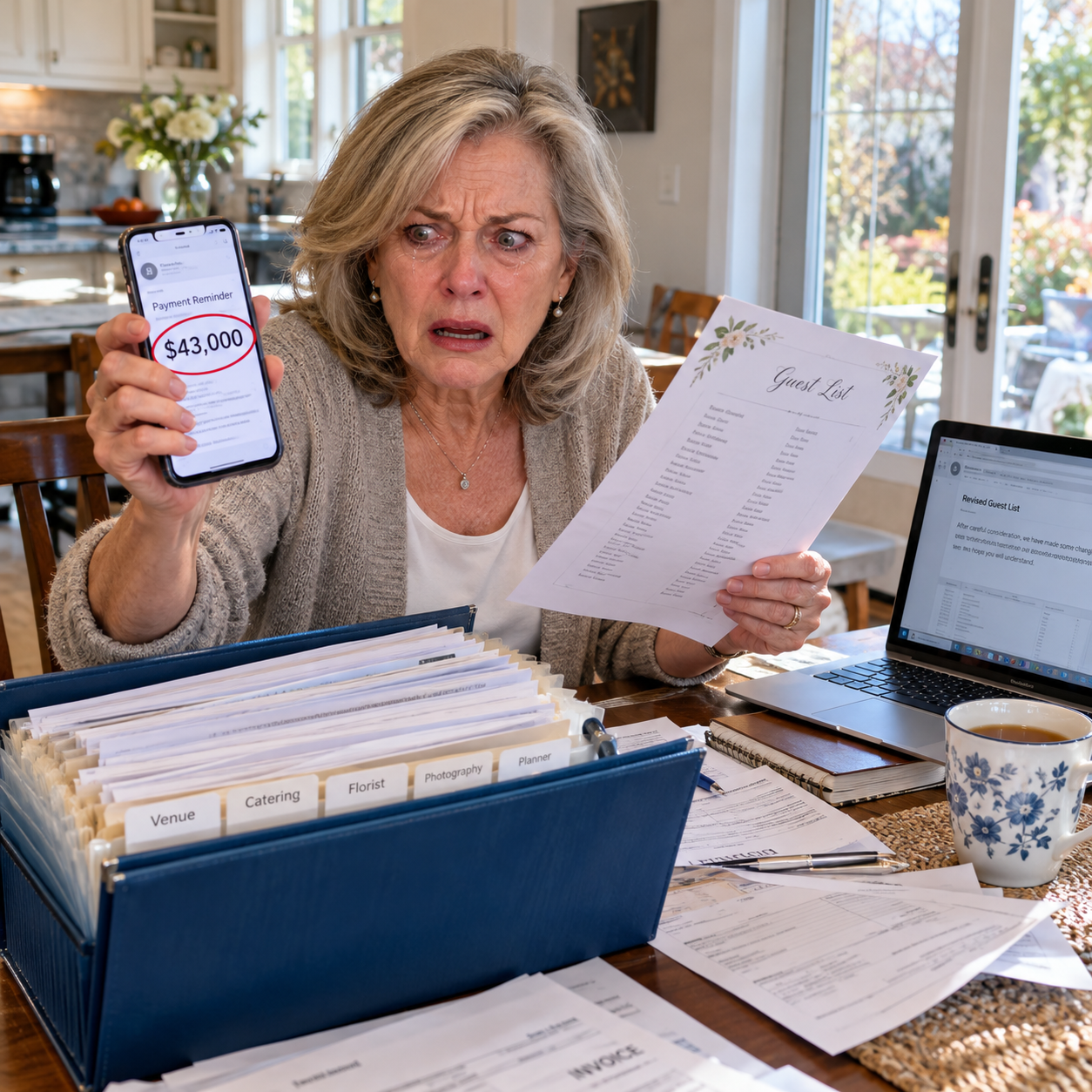
Tamara’s cheeks flushed. “After everything my mother has been through, you’re choosing this moment to humiliate us?” Nolan looked down at the envelope in her hand. “Nobody is humiliating you,” he said. “We’re standing on my mother’s porch asking her for forty-three thousand dollars after telling her she isn’t family enough to attend.” Sylvette said his name sharply, but he kept looking at Tamara. “I should have said that weeks ago.”
Tamara walked to the car without another word. Sylvette followed after telling Nolan they would discuss his “disloyalty” later. He stayed on the porch, shoulders rounded, hands hanging uselessly at his sides. I opened the door wider. “Come in,” I said. “I have soup.”
Part 3: My son finally chose honesty over keeping everyone comfortable
At the kitchen table, Nolan barely touched the soup. “I didn’t know she was going to send the email that day, but I knew she wanted you moved out of the wedding.” He rubbed his thumb over a scratch Gerald had left in the tabletop years ago. “I told myself she’d calm down. If I pushed back, it would become about her mom and everything they’ve been through.”
“What did you want?” I asked. He looked up as if the question had not occurred to him in months. “I wanted everyone to stop being upset.” I gave him a tired smile. “That is not the same as wanting something.” He nodded. We sat quietly, the refrigerator humming behind us, and then he said, “I think I’ve been planning a wedding I didn’t even like because objecting to anything made me the selfish one.”
I did not tell him to leave Tamara. I did not tell him to stay. Parents can become tyrants with good intentions if we confuse love with authority. I only told him what I knew. “Marriage does not improve the parts of a relationship people are already afraid to discuss.” He stared at his bowl. “Dad would’ve said that.” I shook my head. “Your father would have used six more words and somehow brought baseball into it.”
That made him laugh once, unexpectedly, and then he covered his eyes with one hand. I reached across the table but stopped before touching him. He lowered his hand and placed it over mine instead. “I’m sorry,” he said. Not “I’m sorry this happened.” Not “I’m sorry everyone got upset.” Just those two words. I squeezed his fingers. “I know.”
During the next month, Nolan and Tamara tried counseling. They argued less about the guest list than about what it represented. Tamara believed marriage meant forming a new primary family and protecting her mother from judgment; Nolan finally challenged that when “protection” meant erasing his own relationships. Sylvette’s needs had become so woven into Tamara’s decisions that any boundary felt like betrayal.
One Sunday evening Nolan came by carrying a cardboard box. Inside were wedding samples: linen swatches, menu cards, a mock invitation, and a silver cake server engraved with their initials. He set the box beside the coat rack and said, “We ended it yesterday.” I did not ask who ended it first. His eyes were red, and grief does not become less real because a decision is necessary. I made coffee, and we sat for an hour talking about ordinary things until he was ready to say her name.
“She said she needs someone who understands that her mother will always come first,” he told me. “I said I hope she finds what she needs, but I can’t build a marriage where every disagreement gets decided by who has suffered most.” He picked up his mug, put it down again, and added, “I loved her, Mom.” “I know.” He looked toward the dark window. “That doesn’t seem like enough.” “Sometimes it isn’t.”
The $52,000 I had already paid did not return. I mourned it in practical ways, checking the account balance too often and postponing repairs to the back deck. But I did not mourn the $43,000 I kept. It remained in my account, not as a trophy, but as evidence that one painful boundary had held.
Eight months later, Nolan came for Thanksgiving carrying a crooked apple pie. “I made the crust,” he announced before taking off his coat. “You are legally required to be impressed.” I examined the uneven lattice and told him Gerald would have called it structurally ambitious. We ate roast chicken because neither of us cared much for turkey, and after dinner Nolan washed dishes while I dried, the old rhythm of family returning without ceremony.
He moved into a smaller apartment and called most Sundays, no longer waiting until he needed help. We did not become closer by pretending the wedding never happened. We became closer because neither of us tried to edit it into a simpler story.
In May, I used part of the retained money to take the trip Gerald and I had postponed for years. I went to Prince Edward Island alone, drove red roads between fields, ate lobster rolls on a dock, and stood one evening near the water while the sky turned lavender over the Gulf. I missed my husband so fiercely that I had to sit down on a bench, but grief and happiness have never respected separate schedules.
Nolan called while I was there. “You sound good,” he said. Wind pressed against the phone. “I am good,” I told him, and meant it. Not untouched, not victorious, not vindicated. Just good.
At sixty-three, I finally understood something I had spent a lifetime avoiding: generosity is not measured by how much disrespect you can absorb without changing your behavior. Love can pay for flowers, meals, rent, tuition, weddings, second chances, and plane tickets. It should never require you to finance your own exclusion.
The End .
All characters and events in this story are fictional, created for storytelling and entertainment purposes. Thank you sincerely for reading. Your feedback and support are invaluable and motivate me to continue sharing more stories with you.

