
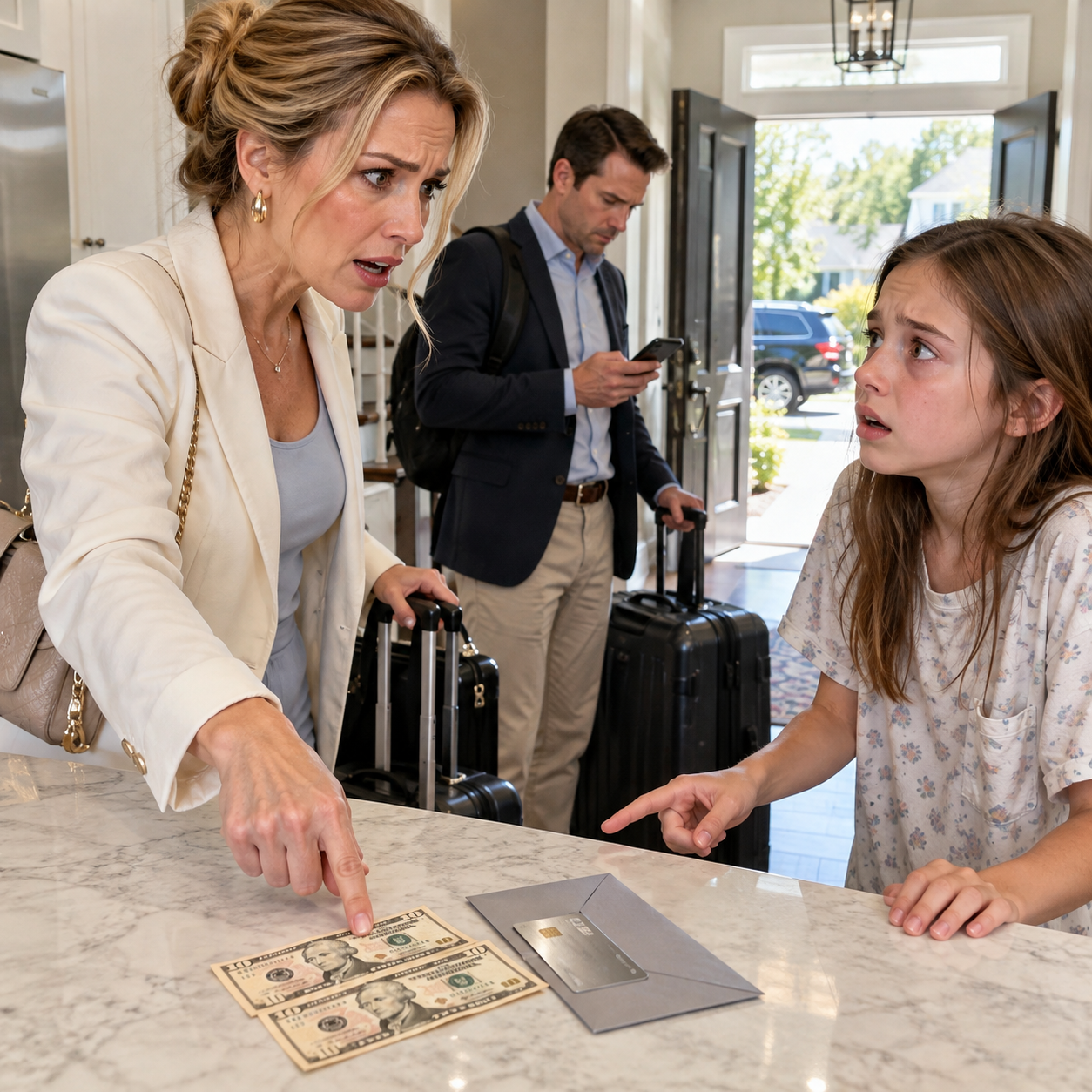
Part 2: A neighbor, a teacher, and the record I kept
Mr. Greene lived next door and had been retired longer than I had been alive. He was seventy-four, walked every evening with a wooden cane, and usually spoke to me only when my basketball rolled into his flower beds. On day eight, he knocked at six-thirty carrying a glass casserole dish covered in foil. “Made too much baked ziti,” he said, although the portion was clearly sized for one hungry child.
I tried to refuse because refusing help had become automatic. He looked over my shoulder into the dark kitchen and said, “Your folks still traveling?” I nodded. “Who’s staying with you?” When I didn’t answer, his face changed—not dramatically, just enough that I understood he had stopped making conversation. He set the dish on the counter. “Claire, where are the adults?”
I told him.
He listened without interrupting, then asked to see the card, the remaining cash, and the messages from my mother. “I could call somebody tonight,” he said. Panic rose so quickly I nearly knocked over the casserole. Mom had spent years teaching me that family problems became real only when outsiders heard them. Mr. Greene must have seen the fear on my face because he softened his voice. “All right. I’m not going to surprise you. But I’m bringing dinner tomorrow, and you’re going to keep records. Dates, calls, receipts. Don’t throw anything away.”
“Why?”
“Because children get called confused. Paper doesn’t.”
After that I documented everything. I filmed the refrigerator shelves every morning, saved grocery receipts, photographed the inactive-card message when I tried it again, and wrote down every call. Mr. Greene left food without making me feel watched: chicken soup, bananas, sandwiches wrapped in wax paper, once a blueberry muffin that was still warm.
My summer enrichment program began the following Monday. Mom had enrolled me because it ran from eight until three-thirty, which made her schedule easier even when she was home. During a math exercise on the third day, the numbers on my worksheet started sliding in and out of focus. I remember putting my pencil down carefully because I didn’t want to make a scene, then hearing my teacher, Ms. Patel, call my name from very far away.
I came around in the nurse’s office with a cold cloth across my forehead. The nurse asked when I had eaten breakfast, and I told her oatmeal. She asked about lunch the day before. I said peanut butter. Ms. Patel stood near the filing cabinet with her arms folded, listening more carefully than adults in my family usually listened to me.
“Where are your parents?” the nurse asked.
“Europe.”
“When are they coming back?”
“In a few weeks.”
Ms. Patel’s eyes met the nurse’s. Neither of them looked surprised enough, which frightened me more than surprise would have. “Who is taking care of you while they’re away?” she asked. I stared at the ceiling tile above the examination table and said, “I am.”
The nurse weighed me. I had lost almost nine pounds.
Mom called that night before I had even changed out of my school clothes. “What did you tell those people?” she asked. Her voice was low and controlled. I could hear waves behind her, or maybe a hotel pool. “Nothing that wasn’t true.” She inhaled slowly. “You have no idea what trouble you can cause by talking carelessly.”
“I got dizzy.”
“You embarrassed us. Do you understand that?”
I rubbed the frayed edge of the couch cushion between my fingers. “They asked where you were.”
“If you keep this up, I will send you somewhere when we get home. Boarding school, residential school, whatever it takes. You will not destroy this family because you want attention.”
Dad’s voice sounded faintly in the background. “Marianne, come on.”
“Stay out of it, Daniel,” she snapped, then returned to me. “Do you understand what I said?”
“Yes.”
When the call ended, I sat with the phone in my lap for perhaps a minute. Then I turned on the tablet and repeated her words as accurately as I could remember them. I included Dad’s voice because he had been there. I had finally begun to understand that silence could belong to the person doing nothing as much as to the person making the threat.
Two days later, a county caseworker named Dana Ruiz came to the house. She wore flat shoes, carried a thick canvas bag, and asked permission before opening cabinets even though she probably did not need mine. She photographed the refrigerator, checked the pantry, looked at the card and my receipts, and asked whether anyone had slept in the house with me since my parents left.
“No.”
“Has either parent arranged for someone to check on you?”
“No.”
She closed her notebook. “Is there anything else you think I should see?”
I brought her the tablet.
There were eighteen recordings by then. She watched several without speaking, her hands folded over one knee. In one video I held up the grocery receipt; in another I showed the refrigerator; in another I described Mom’s threat while trying not to cry because eleven-year-old me still believed crying made evidence less reliable.
Ms. Ruiz stopped the playback. “Claire, why did you make these?”
“Mr. Greene said people believe records.”
“He gave you good advice.”
She looked at me for a long moment, then asked, “Do you feel safe staying here?”
That question reached someplace the others had not. Safe was different from capable. Capable meant I could unlock doors, cook noodles, set alarms, and walk myself to class. Safe meant somebody else had decided my life mattered enough to protect.
“No,” I said.
By sunset, I was sitting in Mr. Greene’s kitchen while Ms. Ruiz made calls from the front porch. My aunt Beth arrived from Indianapolis shortly after midnight wearing jeans, an old university sweatshirt, and one sandal strap held together with silver tape. She crossed the kitchen so quickly she nearly tripped over a chair and wrapped both arms around me.
“I’m sorry,” she whispered into my hair.
I had not told her anything yet.
That was when I learned adults could apologize for what they had failed to know.
The investigation moved faster after that. Records showed my parents had charged nearly forty-four thousand dollars during the trip—hotels, restaurants, private tours, designer shopping, upgraded flights. More important, the bank confirmed the emergency card had never been activated. The account notes showed a request had been started before the trip and then deliberately left incomplete.
My parents had not forgotten to give me access to money.
They had known I didn’t have it.
Part 3: They came home celebrating while the evidence waited
My mother returned expecting thirty-six guests and a catered dinner.
She had arranged the welcome-home party before leaving, which investigators learned from her emails. Aunt Beth and I were not there when the guests arrived; by then I had been temporarily placed with her, and Ms. Ruiz had told us not to go near the house. I know what happened because there were witnesses, photographs, official reports, and later, one short video recorded by a guest who apparently forgot to stop filming.
The living room looked like a magazine spread. White flowers filled tall vases, champagne rested in silver tubs, and a projector displayed photographs from Europe across the wall. Mom stood near the fireplace in a green dress while Dad opened a bottle for one of his coworkers. People were laughing when the doorbell rang.
Mom opened the door smiling.
Ms. Ruiz stood on the porch with two officers.
In the video, my mother’s smile disappears before anyone says a word. One officer explains that they have court-authorized documents and need to speak with both parents. Mom looks over her shoulder at the guests and says, “This is a family misunderstanding. Our daughter is staying with my sister.”
“She was placed with your sister by the county,” Ms. Ruiz replies.
Dad sets down the bottle.
Mom tries to close the door enough to block everyone’s view. “Can we do this outside?” she asks through her teeth. “There are people here.”
One of the guests must have touched the laptop connected to the projector, because the vacation photographs abruptly disappeared. A folder opened on the wall, followed by a video thumbnail. Somebody clicked it.
My eleven-year-old face filled the screen.
“This is day fifteen,” my recorded voice said. “There’s one egg left. Mr. Greene brought me dinner. Mom says I’m embarrassing the family.”
The person filming lowers the phone for a moment. When the image returns, Mom is standing in the middle of the living room, staring at the wall as another clip begins. “Turn that off!” she screams. “Turn it off right now!”
Nobody immediately does.
Dad reaches the laptop first.
Mom begins explaining. I had always been dramatic. I misunderstood instructions. There had been plenty of food. They believed a neighbor was keeping an eye on me. She says each sentence more quickly than the one before it, but Ms. Ruiz opens a folder and answers in the same quiet voice she had used with me.
“No caregiver was designated. No adult entered the residence overnight during your absence. The supplementary card was inactive before departure. Your daughter’s school documented significant weight loss. We also have the communications sent after you were informed she lacked access to food.”
My father finally speaks. “Marianne, stop.”
She turns toward him. “Don’t you dare put this on me.”
“I’m not.”
“You agreed.”
That sentence ended whatever story they might have told separately.
The criminal case took months, not minutes. My parents eventually accepted plea agreements on felony child-endangerment charges. Neither went to prison, which upset some people in the family, but the sentence included probation, hundreds of hours of community service, parenting and counseling requirements, and permanent records that could not be polished away with social-media captions.
Family court was harder.
My father asked to speak with me once through the attorneys. I declined. Mom sent a statement saying she had made a catastrophic error in judgment but loved me deeply, and that losing custody would punish the entire family for one terrible month. Aunt Beth read that part at her kitchen table and slid the pages toward me without comment.
“One month,” I said.
She waited.
“It wasn’t one month.”
“No,” she said. “It wasn’t.”
That was the truth the videos could not fully show. The month alone had been dangerous, but it rested on years of smaller lessons: don’t interrupt, don’t inconvenience, don’t need too much, don’t contradict the version of you your mother prefers. My father had never threatened me or rationed my food. He had simply watched my mother make every important decision and convinced himself that avoiding conflict made him harmless.
Their parental rights were eventually terminated. Aunt Beth became my legal guardian.
Her apartment had two bedrooms, a kitchen drawer that stuck, and a couch covered with a blanket because the upholstery had worn thin. The first week, I woke before six every morning and tried to make breakfast before she got up. On the third morning she shuffled into the kitchen, took the spatula from my hand, and said, “You know you’re allowed to be eleven here, right?”
“I’m making eggs.”
“I see that.”
“I can do it.”
“I know you can.” She nudged me gently toward a chair. “That doesn’t mean you always have to.”
I sat down because I didn’t know what else to do.
She made terrible eggs. They were rubbery and overcooked, and I ate every bite.
I am eighteen now. Aunt Beth still has the same couch, although we finally replaced the broken kitchen drawer. My college acceptance letter is taped to her refrigerator beside a faded photograph from my eighth-grade orchestra concert, and in August I will leave for school on a merit scholarship. I plan to study political science and eventually law, although Aunt Beth says I’m allowed to change my mind at least six times.
Two letters from my mother arrived last month through an attorney.
I waited several days before opening them.
Her handwriting was smaller than I remembered. She wrote that therapy had forced her to examine how much of her life had been organized around appearance—being admired, appearing successful, appearing generous, appearing to have raised an unusually independent daughter. She said she now understood that she had treated my independence as permission to stop parenting me.
My father’s letter was shorter.
He did not blame Mom. That surprised me.
He wrote, I kept telling myself that disagreeing with your mother would make things worse. What I actually meant was that disagreeing with her would make my life harder. I let you pay the price for my comfort.
I read that sentence several times.
Neither letter asked me to forgive them immediately. Maybe their lawyers advised them not to. Maybe they had finally learned that apologies stop being apologies when they contain instructions for the person receiving them.
I put both letters back into their envelopes and stored them in my desk.
Aunt Beth saw me later that evening standing at the stove while pasta water boiled. “You going to answer?” she asked.
“I don’t know.”
She opened the refrigerator and took out the Parmesan. “Then don’t know for a while.”
I smiled. “That’s allowed?”
“Most things are.”
For years, I believed the most important thing I had done that summer was press record on an old tablet. It mattered, but I understand now that the more important moment came later, when Ms. Ruiz asked whether I wanted to be safe and I answered honestly.
At eleven, I thought survival meant proving I could live on twenty dollars without bothering anyone.
At eighteen, I know better.
Survival was telling the truth before someone else could rewrite it.
The End .
All characters and events in this story are fictional, created for storytelling and entertainment purposes. Thank you sincerely for reading. Your feedback and support are invaluable and motivate me to continue sharing more stories with you.

