
### Part 2: A Forgotten Deed Reveals The Secret Behind Brenda’s Power
Deputy Jarvis Boone met me at the Rogers County Sheriff’s Office the following morning. He examined the photographs, the water readings, and the unauthorized pipe connection before looking up. “Mr. Holloway, are you certain you want a formal complaint against the HOA president?” I slid the survey across his desk and said, “Somebody dug up my water line and cut it. Her job title doesn’t change that.”
He filed the report.
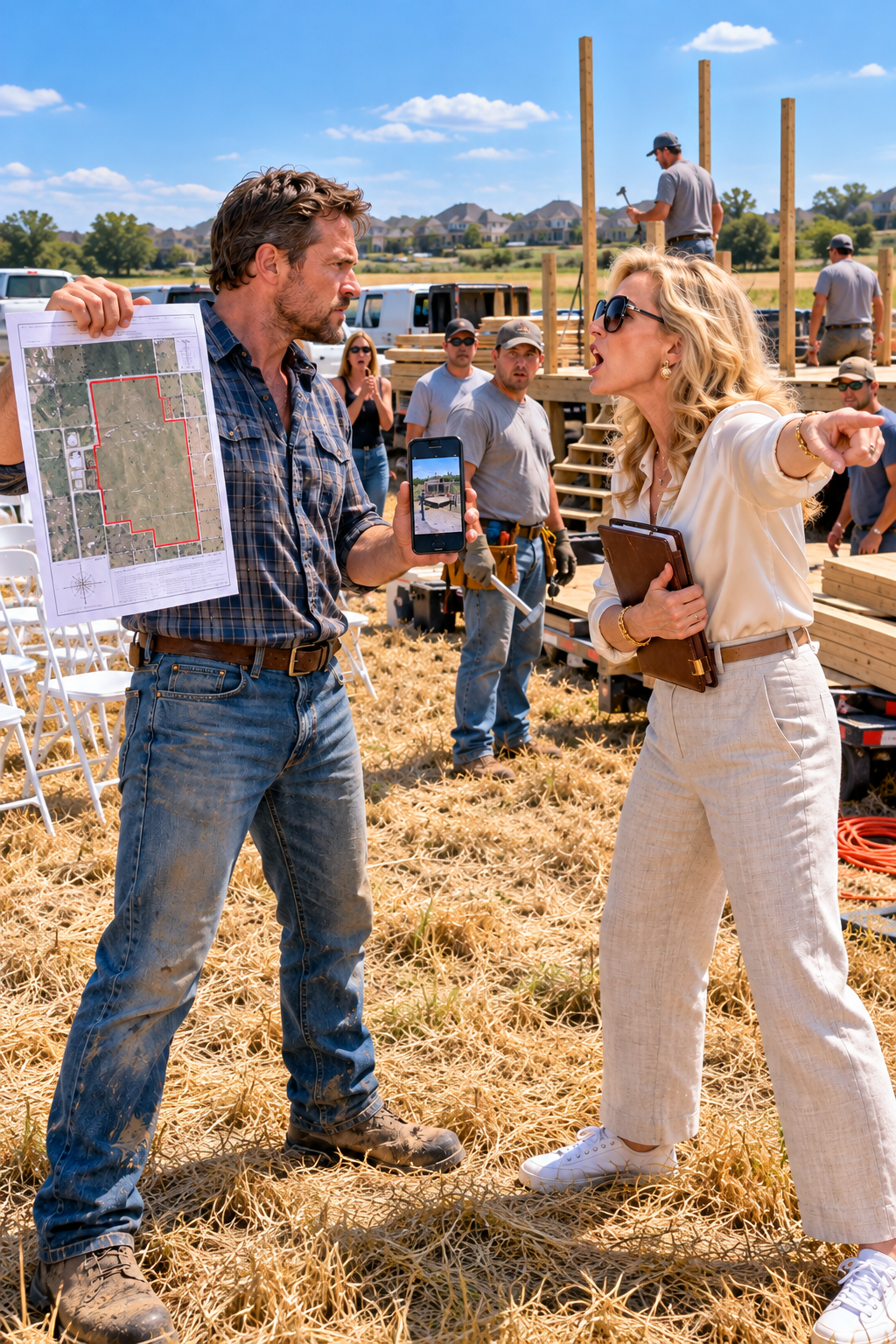
The next afternoon, Brenda appeared on my porch wearing a cream blazer, gold jewelry, and an expression that suggested I had inconvenienced her personally. “Derek, I heard about your little misunderstanding with the sheriff.” She smiled without warmth. “That water connection is temporary. Surely we can act like reasonable adults.”
“You can pay for the water and the repair.”
Her smile disappeared. “Do you have any idea how much work I’ve put into this celebration?”
“I know exactly how much work you’ve put into my property.”
She stepped closer. “You are making yourself very unpopular.”
I held her gaze. “I didn’t buy this land to win a popularity contest.”
She left so abruptly that the screen door rattled behind her. By Wednesday, preparation vehicles had destroyed sections of my gravel road. A catering van blocked my tractor gate for six hours, while SUVs carved deep ruts across the shoulder. I photographed the damage and added it to my growing evidence binder.
That evening, I watched Caleb eat dinner beneath the kitchen light while I considered what my father would have done. Warren Holloway believed in keeping records because memories changed whenever money became involved. After Caleb went to bed, I opened the fireproof cabinet Dad had left behind and searched through the original property documents.
Near the bottom of the third drawer, I found a manila envelope labeled Tully Sale East 40 — 2009. Beneath the title, my father had written four words and underlined them twice: Read every single page.
I spread the papers across the kitchen table. The first recorded covenant established the fifty-foot agricultural buffer. The second protected drainage access between the farmland and the subdivision’s retention ponds. The third made me stop breathing for a moment.
Any organized gathering exceeding fifty persons on or adjacent to the Holloway parcel required prior written consent from the owner of the agricultural property.
I read it again, slowly.
The covenant had been recorded with the original subdivision documents and incorporated into every lot’s deed. Jim Tully had signed it seventeen years earlier. My father had anticipated that a growing neighborhood might someday forget where its rights ended.
In the margin, he had left another handwritten sentence: A neighbor who respects the boundary will never need this protection.
I pressed my thumb against his handwriting.
Then I called Gil Patterson, my father’s oldest friend and a Tulsa real estate attorney who had helped prepare the original agreement.
Gil arrived the next morning in a silver pickup. He was sixty-five, with wire-rimmed glasses and the patience of a man who enjoyed reading fine print. We covered the kitchen table with surveys, photographs, the sheriff’s report, Brenda’s fabricated ordinance, and the recorded covenants.
He spent nearly two hours examining everything.
Finally, he removed his glasses. “Derek, your father protected this farm from exactly this kind of situation.” He tapped the third covenant. “This potentially gives you substantial leverage over large organized events throughout Ridgeview, subject to how a court interprets and enforces it.”
“And the stage?”
“That’s a separate problem. Trespass, unauthorized construction, damage to your access road, and interference with your water system.”
I leaned back. “She has sold two hundred tickets for fifteen dollars each.”
Gil nodded. “Then she has collected money for an event she had no authority to organize on your land.”
We planned formal complaints with county code enforcement and the fire marshal. Gil also prepared a demand for removal, reimbursement, and restoration. He warned me not to confront the workers or interfere with dangerous electrical equipment.
Before leaving, he stopped at the porch and looked toward the stage. “Your father built one impressive irrigation system out there.”
“Four-hundred-foot well. Underground lines. Twenty-two acres of coverage.”
“Still operational?”
“Every sprinkler head.”
Gil nodded thoughtfully. “Then keep your equipment maintained. But don’t create a hazard. We handle the electricity and the crowd safely, and we let the officials do their jobs.”
After his truck disappeared, I walked to the pump house. The gauges held steady, the remote controller responded, and the nearest sprinklers still covered forty-two feet in every direction.
I shut the system down after testing it.
Across the field, Brenda’s workers were hanging a banner that called my property Ridgeview Community Green.
The name my father had written on the original deed was Holloway.
And that name wasn’t going anywhere.
### Part 3: Two Hundred Guests Witness Brenda’s Grand Celebration Fall Apart
The final week before Brenda’s celebration felt like watching someone decorate a house that was already on fire. A glossy invitation appeared in my mailbox, announcing the first annual Ridgeview Estates Summer Celebration. Beneath the pictures of food trucks and smiling families were the words Proudly hosted on the Ridgeview Community Green.
She had taken my field, renamed it, and printed the lie.
On Tuesday, a letter arrived from Travis Hargrove, Brenda’s cousin and an attorney in Owasso. He demanded permanent recreational access to the property and threatened legal action if I interfered with the event. Gil read the letter over the phone, paused, and said, “Keep the original. This may be the most expensive favor Travis has ever done for a relative.”
Wednesday brought enormous speakers and bass that made my kitchen windows tremble. My cattle crowded against the far fence, nervous and refusing to approach their watering trough. Thursday brought two food trucks, a diesel generator, three hundred folding chairs, four portable toilets, and an inflatable castle. Workers drove twenty-two steel poles into the ground, dangerously close to my buried irrigation lines.
I documented every delivery. Two stakes appeared within three feet of a visible PVC junction cap. I photographed those too.
Friday morning, I submitted the evidence to county code enforcement and the fire marshal. The stage had no approved inspection, its electrical installation was dangerously improvised, and the event had no adequate emergency access plan. Both offices arranged to inspect the property Saturday.
At dawn, I fed the cattle and checked the well house. Caleb was staying with his mother that weekend, safely away from the crowd. By nine o’clock, cars were filling the road; by eleven, more than two hundred people had gathered among the food stalls and chairs. Families laughed, children carried balloons, and volunteers wore matching shirts printed with Ridgeview Cares.
Most of them had no idea they were trespassing.
From my truck on the northern rise, I watched Brenda climb onto the stage at 11:30. She wore a white linen dress, gold sandals, and a necklace that sparkled beneath the hard Oklahoma sun. Her blonde hair fell in carefully arranged waves, and a wireless microphone rested in her manicured hand.
“Good morning, Ridgeview!” she called.
The crowd applauded.
“Today proves what happens when people come together for something bigger than themselves.” She pointed toward the field. “When I first imagined transforming this neglected space, I knew we could make it beautiful.”
I started recording.
She smiled at the audience and lifted her chin. “This land represents our future. A permanent gathering place for everyone.”
A white county vehicle turned onto the access road. The fire marshal’s truck followed behind it.
The inspection team moved quickly. Captain Tanya Reeves recognized the exposed wiring and ordered the electrical feed disconnected before anyone approached the stage equipment. Volunteers began directing families away from the platform while the officials halted further use of the temporary electrical installation.
I watched the power disconnect, confirmed the area around the equipment was clear, and checked my irrigation controls. The spray zone now held a deserted row of chairs, some abandoned decorations, and Brenda, who was still arguing into her powerless microphone.
At 11:47, I activated the watering system.
The pump began its deep mechanical rumble.
Four seconds later, the first sprinkler head rose from the grass. A heavy arc of cold well water swept across the empty chairs and flattened a row of paper decorations. Another nozzle burst through the stubble, drenching the side of the stage as the crowd gasped and retreated farther up the access road.
Then the central sprinkler completed its rotation.
A thick stream of water struck Brenda across the shoulders.
She staggered backward, grabbing the railing with one hand. Her white linen dress darkened instantly, her carefully arranged hair collapsed, and black mascara streaked across both cheeks. The leather planner she had carried for years slipped from beneath her arm and landed in a widening puddle.
“TURN THAT THING OFF!” she shrieked.
I let the irrigation complete its brief cycle, then shut it down.
Water dripped from the platform. The glittering community-green banner hung crooked and soaked. The crowd was silent now, and every camera seemed to be pointing toward Brenda.
Captain Reeves approached the stage with code enforcement officer Dale Rigsby. “Ma’am,” Rigsby said, holding out his identification, “we need to see the permits for this structure.”
“It’s a neighborhood celebration,” Brenda snapped, water running from her hair. “You can’t interrupt it!”
Rigsby inspected the platform. “This stage measures two hundred forty square feet. We have no building permit on file, and the electrical installation presents an immediate hazard.”
Captain Reeves opened her inspection folder. “There is no approved event safety plan, no adequate emergency access arrangement, and no proper electrical protection. This gathering cannot continue.”
Brenda stared at them. “This is our community property!”
Rigsby turned a page.
“According to the recorded survey, ma’am, this is privately owned agricultural land belonging to Derek Holloway.”
Her gaze snapped toward my truck.
For the first time since I’d known her, Brenda Hargrove had nothing to say.
### Part 4: My Father’s Forgotten Protection Delivers Justice And Unexpected Peace
Brenda climbed down from the stage with her ruined planner clutched against her chest. The last families were making their way toward the road, and the only sound left was water dripping from the platform. “Derek!” she shouted when she saw me approaching. “You planned this humiliation!”
I stopped several feet away. “I told you nine days ago that this was my property. You laughed.”
“This was supposed to bring people together!”
“Then you should have asked the person who owned the field.”
Deputy Jarvis Boone arrived shortly afterward. He reviewed the existing report, inspected the unauthorized water connection, and took statements concerning the construction and damage. Brenda received formal citations related to trespass and property interference, while the officials documented additional violations for review.
Rigsby issued a stop-work order requiring removal of the unauthorized stage. Captain Reeves completed her safety report, and Gil received copies of everything.
The cleanup took eight days. Workers dismantled the platform, removed the steel poles, cleared the temporary facilities, and hauled away the abandoned materials. Two irrigation couplings were cracked, the water-line repair cost $420, and restoring my gravel road cost another $1,100. Reseeding the damaged portions of the hay field added $1,400.
Gil filed a civil claim for $114,000 against Brenda, the HOA, and Travis Hargrove. The demand addressed the physical damage, unauthorized construction, water interference, covenant violations, and the alleged willful nature of the trespass.
Brenda finally retained an experienced property attorney from Tulsa. He examined my evidence binder, reviewed the subdivision documents, and asked for a private meeting with his clients.
Forty minutes later, Brenda emerged from his office crying.
Her attorney had explained that the registered covenants created a much larger problem than one ruined celebration. My father’s agreement restricted large gatherings connected to the neighboring property, including events Brenda had confidently approved for years. Any attempt to challenge or interpret those restrictions in court would expose the association to considerable expense and uncertainty.
Three weeks later, we reached a settlement for $87,000.
Brenda personally contributed $31,000. The association’s insurer subsequently declined to renew its coverage, citing concerns about the board’s conduct. When the settlement cleared, Brenda resigned as HOA president.
At the next homeowners meeting, ninety-four of Ridgeview’s 120 households attended. All ninety-four supported formally removing her from any remaining leadership role. The vote was unanimous.
I expected to feel triumphant when Gil called with the final paperwork. Instead, I sat at my father’s desk, staring at his old handwriting beneath the lamp. The money would repair the damage, but it could not replace the peace we’d had before strangers began treating our property like an empty space waiting to be claimed.
Then something unexpected happened.
A Ridgeview resident knocked on my door carrying a small envelope. She was an older woman named Margaret whose husband had died the previous spring. Inside was a handwritten note signed by twenty-seven neighbors, apologizing for believing Brenda’s version of events.
“We didn’t know,” Margaret said, twisting the envelope between her fingers. “She told us nobody owned that field anymore.”
I could have reminded her that someone had always owned it. Instead, I looked at her tired face and said, “Next time, ask.”
A few weeks later, the new HOA president, Linda Chan, visited. She was a retired teacher who had read every page of the association’s governing documents before accepting the position. We talked over iced tea on my porch about property rights, responsibility, and how easily a neighborhood could be divided by someone who mistook control for leadership.
That conversation gave me an idea.
Three months after Brenda’s disastrous celebration, I finished building a pavilion near the northern tree line of my property. It had a concrete pad, a steel roof designed for Oklahoma weather, properly inspected electrical service, picnic tables, and a stone fire pit. Every permit was approved, and every wire was installed safely.
Beside the entrance stood a hand-carved wooden sign: Holloway Community Pavilion — Built for Neighbors, by a Neighbor.
I offered Ridgeview residents free use of it through a simple written agreement. The land remained private, but respectful neighbors were welcome.
Our first gathering was a Fourth of July cookout.
Forty-two families attended. I grilled hamburgers while Caleb supervised a cooler full of lemonade and bottled water. Linda brought a homemade sheet cake, and Margaret arrived carrying a bowl of potato salad large enough to feed a football team.
Nobody argued about property lines. Nobody ordered anyone around. People asked before moving tables, cleaned up their own trash, and thanked Caleb when he brought them cold drinks.
Near sunset, Linda approached me beside the pavilion.
“Your father would have liked this,” she said.
I looked across the green hay field where the old stage had stood. The soil was healthy again, the broken irrigation pipes had been replaced, and the grass was almost ready for another cutting.
“He probably would’ve built it sooner,” I answered.
Linda smiled. “Maybe. But I don’t think he could’ve taught the neighborhood this lesson any better.”
Later, Caleb found me standing alone at the fence. He leaned his elbows on the top rail and watched the sun disappear behind the pasture.
“Dad, why did you let those people come back after everything that happened?”
I thought about my grandfather clearing the land, my father digging irrigation trenches, and the envelope that had waited seventeen years for someone to read it.
“Because the land was never the problem, buddy. It was people forgetting how to respect one another.”
Caleb considered that for a moment.
“Grandpa would’ve liked that answer.”
I put my arm around his shoulders. Across the clearing, neighbors were laughing beneath the pavilion roof, and the old field lay quiet in the evening light.
My father had left me more than eighty acres and a powerful irrigation system. He had left me the wisdom to protect what mattered without becoming cruel to the people who had forgotten its value.
Brenda had wanted a stage where everyone would admire her.
I had built a place where everyone belonged, as long as they remembered to ask.
And beneath the grass, my father’s sprinklers rested quietly, ready to water the next crop.
THE END.
All characters and events in this story are fictional, created for storytelling and entertainment purposes. Thank you sincerely for reading. Your feedback and support are invaluable and motivate me to continue sharing more stories with you.


