
Chapter 2
Starting over at 34 was less inspiring than people make it sound.
There was no triumphant music. No line of customers outside my garage. Mostly there were bills, a used van, my dog Boon sleeping under my workbench, and shelves full of fittings I could barely afford.
I made one rule.
I would not call a single Gene’s Plumbing customer.
I would not recruit one employee.
If anybody followed me, it would be because they chose me.
For 11 days, almost nobody did.
Then an elderly man named Mr. Lynwood called because he saw my number painted on my van.
“You got time to clear a bathtub?”
That one call became three.
Three became ten.
Meanwhile, Southpaw started calling.
His real name was Earl Hargus, but nobody had used it since George H.W. Bush was president. He was my father’s oldest employee, a broad-shouldered left-handed plumber who had taught me how to use a level.
Once a week, he parked behind the grocery store and gave me reports from the old company.
Brock introduced commissions.
Plumbers were paid extra for selling replacements.
Suddenly good water heaters became “concerning.” Repairable faucets became “upgrade opportunities.”
Then Brock bought cheap off-brand equipment and charged premium prices.
Dad objected less every month.
Then came the change that hurt most.
Gene’s Plumbing stopped answering emergency calls after 5:00 p.m.
I read the policy Southpaw sent me three times.
The company whose entire identity was We show up no longer showed up.
One January night, at 1:57 a.m., Mrs. Ivy called me.
I had repaired a leak at her house years earlier.
“Honey,” she whispered, “I think my pipes are frozen. I called Gene’s, but the recording said they’re closed.”
It was 11 below zero.
I was dressed before she finished speaking.
Her kitchen line had frozen and begun splitting behind the sink. Another hour and she could have had water everywhere.
I shut off the main, warmed the line inch by inch, repaired the weak section, insulated it, and had her water flowing again before dawn.
When I finished, she peeled an old Gene’s Plumbing magnet off her refrigerator.
The cartoon grin.
The wrench.
We show up.
“Is it still the same company?” she asked me. “Are you still Gene’s?”
I looked at my father’s face on that magnet.
“The part that shows up,” I said quietly, “is me.”
By spring, Southpaw had reached his limit.
An 84-year-old widow named Laura Pickens called Gene’s about a dripping faucet. For 30 years, Dad or Southpaw had repaired small things for her in exchange for terrible coffee.
Brock’s new system charged her $189.
Southpaw drove to her house, reimbursed her from his own wallet, then walked into the office and slapped the receipt on Brock’s desk.
“Thirty-four years,” he said.
Then he quit.
That evening, his rusty Chevy rolled into my driveway.
Southpaw stepped into my garage carrying his toolbox.
“I’m 60 years old,” he said. “I’m not spending what’s left of my working life convincing old ladies they need things they don’t.”
I swallowed.
“I never asked you to leave Dad.”
“I know. That’s why I’m here.”
I bought a second van.
Then Rudy came.
Then Bo.
Then Austin, a 19-year-old apprentice whose mother dropped him off because he didn’t own a reliable car.
I hadn’t called any of them.
Dad told people I had stolen his crew.
That hurt more than losing the company.
But I kept working.
Then one afternoon, my mother called for the first time in nine months.
“Your father’s tired,” she said.
Nothing else.
Two days later, I saw Dad kneeling beside a sewer cleanout on Cedar Lane.
Seventy-four years old.
Bad knees.
Flashlight between his teeth.
He tried to stand and couldn’t.
I slowed my van.
For one second, my hand moved toward the gearshift.
Then I drove past.
I watched him disappear in the rearview mirror, and I hated myself for it.
Two weeks later, an envelope arrived.
Inside was the yellow legal page Mom had written 11 years earlier.
One-half of net profit.
Folded three times.
Still carrying a faint coffee ring.
A note was attached.
Don’t throw this away.
I’m sorry.
I didn’t know how.
I could have hired a lawyer.
I could have demanded money.
I could have dragged Dad into court.
I folded the page, put it in my shirt pocket, and decided I would never use it.
I wanted to build something of my own.
Then Brock appeared in my garage.
White sneakers.
Perfect polo.
Perfect smile.
“Boss man,” he said. “Let’s clear the air.”
He offered me $62,000 to come back as shop foreman.
“Bring the guys too. We’ll forget everything.”
Then his hand settled on my shoulder.
“Don’t worry. You’ll still have a job.”
The same words.
The same smile.
“Thanks,” I said. “I’ll think about it.”
After he left, one question bothered me.
Why was a man who had replaced me begging me to return?
I got my answer at Rigby Motors.
Their new car wash had failed inspection twice because the underground separator was half the required size.
“Who installed this?” I asked.
The manager, Murray Branock, frowned.
“Apex Water Solutions. Used to be Gene’s Plumbing.”
We replaced the system.
After the inspector approved it, Murray asked casually, “Who runs that place now?”
“My brother-in-law. Brock Ellison.”
Murray nearly dropped his cigar.
“Brock?”
“You know him?”
“Son, I fired him.”
I went still.
Murray explained.
Brock had been selling cars when he met Tiffany. He had been good at smiling and poor at telling customers the truth about financing. After several complaints, Murray fired him.
“When?”
“August 22nd last year.”
Three days before Tiffany asked how much money I made.
Three weeks before Brock became president of Gene’s Plumbing.
Suddenly the whole story rearranged itself.
Brock hadn’t left a successful sales career to rescue a family business.
He had been unemployed.
He and Tiffany had just bought an expensive house.
They needed income.
And somehow my father’s company—and my share of it—had become Brock’s emergency parachute.
I told no one.
Not even Southpaw.
I didn’t want gossip.
I wanted the truth to arrive where nobody could look away from it.
That place appeared in August.
At 10:15 one night, my phone rang.
“Sawyer,” Ronnie Gresham said. “We’ve got a situation.”
Chapter 3
Ronnie had four homes stalled at Carver Bend.
Gene’s—or Apex, as Brock now called it—had failed rough-in inspections twice. Vent stacks were wrong. Supply lines were unsupported. One drain was routed into the wrong wall.
A young couple’s closing had been delayed three weeks.
Ronnie had paid for their hotel and their mortgage rate extension himself.
“I called Brock four times,” he said. “Every time he told me he had it handled.”
I apologized.
“Don’t you apologize. I’m calling because I’ve got another development starting this fall. Thirty-four houses.”
I sat upright.
“Tilden Ridge?”
“That’s the one.”
He paused.
“I can’t give it to your father’s outfit.”
I said nothing.
“I should’ve called when you left. Truth is, I was afraid you’d say no.”
“You once told me to call you before I called my mother.”
Ronnie laughed softly.
“You remembered that?”
“I remember everything said to me while I’m covered in mud.”
“Then remember this. I’ve been paying you for 11 years. I just mailed the checks to your father.”
I closed my eyes.
“You want 34 houses?”
“Yes.”
“I can do it.”
I had four vans and seven people.
I signed the biggest contract of my life anyway.
Sawyer Rankin.
Master Plumber.
My own name.
A few weeks later, Ronnie sent Gene’s a certified letter charging $38,000 for corrections, delays, and customer expenses at Carver Bend.
Dad called me the following Monday.
Exactly one year after the Sunday dinner when I left my keys beside the pot roast.
“I got a letter from Ronnie.”
“I heard.”
“He wants thirty-eight thousand dollars.”
Dad sounded older.
“Brock says it’s a misunderstanding.”
“Okay.”
“We need those four houses fixed, Sawyer.”
I waited.
“Your crew knows the work. You could do it quietly. Family price. Put it on a Gene’s invoice, and Ronnie never needs to know.”
There it was.
After a year, my father was not calling to apologize.
He was asking me to rescue the company that replaced me—and hide the rescue.
“Ronnie will know.”
“It’s confidential.”
“No, Dad. He’ll know because Tilden Ridge is mine.”
Silence.
“Thirty-four houses,” I continued. “I signed the contract last month.”
The silence deepened.
Finally Dad said, “I see.”
“Meet me at Ronnie’s job trailer two weeks from Monday. Eight in the morning.”
“Why?”
“Bring Brock.”
“Sawyer—”
“Eight o’clock.”
For once, he did not hang up first.
That morning came cold and gray.
Tilden Ridge stretched across an old wheat field, all mud, framing lumber, and orange construction fencing.
Dad arrived before me.
I watched him stand beside my used van reading the hand-painted letters on the door.
Sawyer’s Plumbing.
He studied them for a long time.
“It’s a good van,” he finally said.
“It’s used.”
“It’s still good.”
At 8:00, Brock’s black Tahoe rolled in.
His white sneakers nearly disappeared into the mud.
Inside Ronnie’s trailer, Dad sat beside Brock. Mom surprised me by sitting silently in the corner.
Ronnie went through everything.
Four failed homes.
Thirty-eight thousand dollars.
Repeated phone calls.
Delayed closing.
Then Dad leaned forward.
“Ron, you’ve dealt with Gene’s Plumbing for 20 years. You know our reputation. We’ll make this right.”
Ronnie unfolded his arms.
“Gene, with respect, I never hired your company.”
Dad frowned.
“I hired your son.”
Brock smiled.
“Ronnie, Sawyer was an employee. A good employee, but still an employee. Gene’s Plumbing has existed since 1988.”
Ronnie looked at him.
“For 11 years, when I had a problem at ten at night, I called one man. He’s sitting across from you.”
Brock shrugged.
“Legally, there wasn’t anything in writing. Pops said it himself. Sawyer had a handshake.”
My fingers touched my shirt pocket.
The yellow page was there.
Mom stopped breathing.
I could have taken it out.
I could have laid it on the table and proven Brock wrong.
Instead, I put my hand flat on the plans.
“You’re right.”
Brock smiled wider.
“A handshake isn’t a contract,” I said. “I’m not here for Dad’s company. I’m not here for the name. I’m here to ask you one question.”
His smile faded slightly.
“Where did you work before you became president?”
“Rigby Motors.”
“Until when?”
He hesitated.
“Until I decided to make a change.”
“August 22nd.”
The trailer became very quiet.
I looked at Dad.
“Three days after Brock was fired, Tiffany asked how much money I made. Three weeks later, you held the dinner.”
Dad turned slowly toward Brock.
“Fired?”
Brock sat straighter.
“It wasn’t like that.”
“Murray Branock confirmed the date.”
“There were disagreements.”
“Did Tiffany know?” Dad asked.
Brock opened his mouth.
Nothing came out.
Dad suddenly looked 74.
Not the man on the vans.
Not the owner.
Just my father.
He closed his eyes.
Then he looked at me.
“What am I supposed to do now?”
For a year, I had imagined that question.
My answer came quietly.
“You built it, Dad.”
He flinched because he knew the phrase.
Every Christmas, raising a glass, he had told everyone, I built this. Sawyer just runs it.
Now the words had weight.
Brock pushed back his chair.
“This whole thing is ridiculous. Boss man, everybody needs to calm down.”
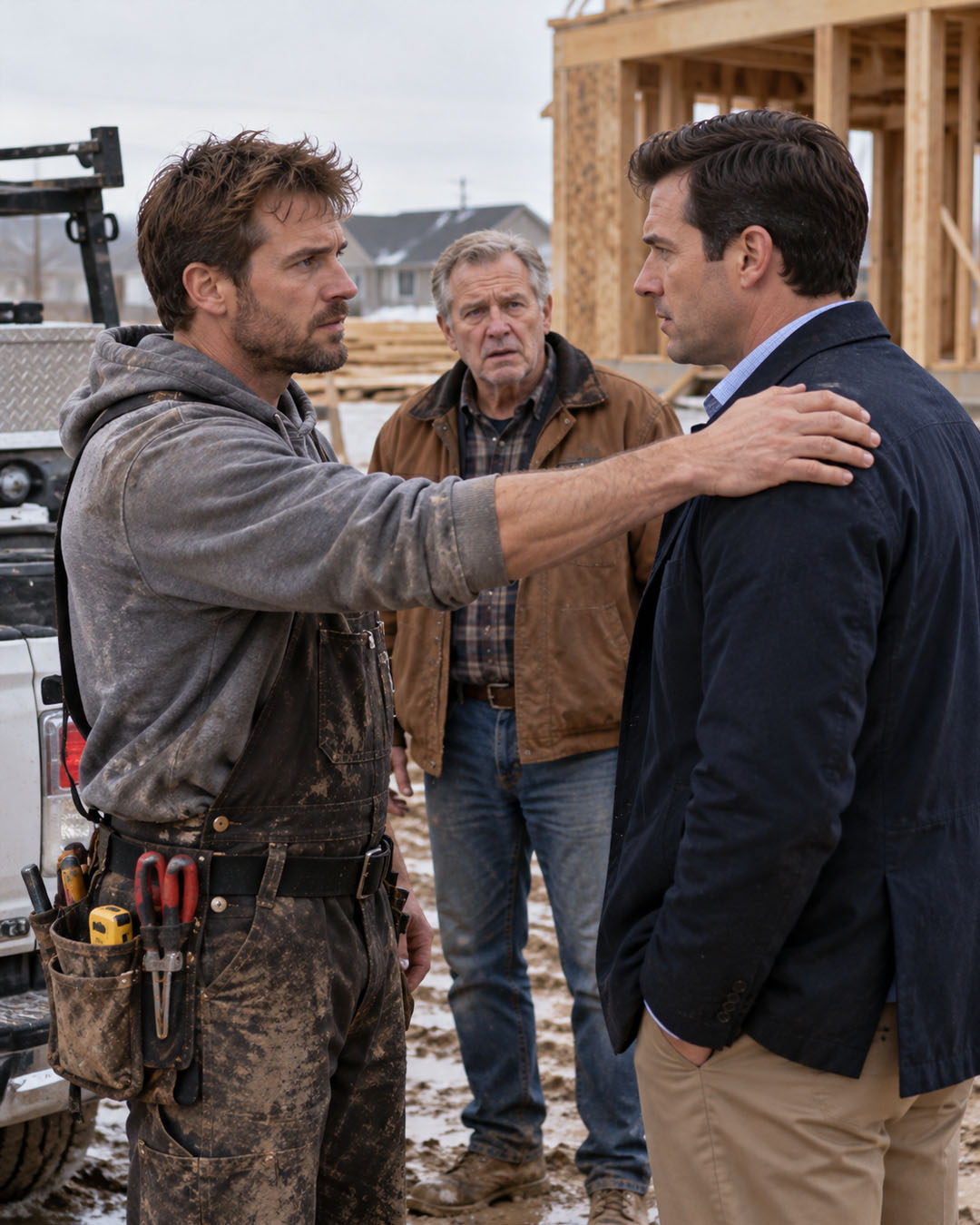
I stood.
I walked behind him.
Then I rested my hand gently on his shoulder.
He froze.
I leaned down slightly.
“Don’t worry,” I said. “You’ll still have a job.”
Dad’s head snapped up.
He remembered.
Brock remembered too.
“Austin’s pulling pipe on Lot 14,” I continued. “Bo could use another set of hands. Seventeen dollars an hour.”
Brock stared at me.
“You’re serious?”
“Absolutely.”
I smiled.
“You’ll be carrying the long skinny metal stuff. Copper. Not the gold kind.”
Ronnie coughed into his hand.
Mom looked down.
Brock’s face reddened.
“My second van is outside,” I said. “Keys are above the visor. If you want honest work, it’s yours.”
I patted his shoulder once.
He left.
His spotless sneakers sank ankle-deep in the mud.
Ronnie turned to Dad.
“Carver Bend and every job after it goes to Sawyer. Starting today. It isn’t personal.”
Dad nodded.
“I understand.”
Mom took his arm.
Together they walked out of the trailer.
I never showed anyone the yellow page in my pocket.
I didn’t need it.
Chapter 4
Gene’s Plumbing shrank quickly after Ronnie left.
By Christmas, Dad had three vans.
By spring, one.
Brock took an hourly position, then eventually left the business entirely. Tiffany learned he had never told her the truth about losing his dealership job.
She came to my house and cried on my porch.
“I thought he left because Dad offered him something better.”
“I know.”
“You believe me?”
“Yes.”
She sold the big house on Aspen Court.
I helped carry boxes.
I did not tell her I forgave everything.
Some things need time before they deserve a name.
That fall, Ronnie and I were standing at Tilden Ridge looking at framed houses when he asked whether I remembered the widow on Maple Street Dad had helped when I was 16.
“Sure.”
“That was my mother.”
I stared at him.
Ronnie smiled.
“Your dad came out on a Sunday. Fixed her water heater. Wouldn’t take a dime. She talked about him for 30 years.”
Then he repeated Dad’s old advice.
“Take care of the widows. Their sons will call you when they build houses.”
My throat tightened.
“That’s why you hired Gene’s?”
“The first time? Yes.”
Ronnie looked toward the houses.
“That old man built something good, Sawyer. He just forgot what part of it mattered.”
Thanksgiving was the first time I returned to my parents’ house.
Mom set an extra chair at the table.
After dinner, Dad asked me to come into the garage.
He reached behind the seat of his old truck and removed a pipe wrench wrapped in a clean rag.
I had seen it since childhood.
“Grandpa gave you that,” I said.
“No.”
Dad turned it over in his hands.
“My father owned a plumbing shop. Rankin and Son.”
I had never heard this story.
“I started there at seventeen. By thirty-six, I was running it.”
He looked at me.
“Same as you.”
The garage seemed to shrink.
“One Tuesday, I walked in and found a stranger sitting at my desk. Dad had sold the company to a Kansas City outfit.”
I said nothing.
“He hadn’t warned me. Hadn’t offered me anything. When I got angry, he put his hand on my shoulder.”
Dad’s voice broke.
“He said, ‘Don’t worry. You’ll still have a job.’”
I stared at him.
Suddenly the sentence had traveled through three generations.
“I walked out. Dad followed me into the parking lot and gave me this wrench. Said, ‘That’s all you’re getting. Be grateful.’”
Dad rubbed his thumb along the worn steel.
“A year later, I started Gene’s with one van. I swore I would never do that to my own son.”
His eyes filled.
“And I did it anyway.”
Neither of us spoke for a while.
Finally I said, “That explains something.”
He nodded.
“It doesn’t make it right.”
“No.”
He looked down.
“No, it doesn’t.”
Then he handed me the wrench.
“I don’t know how to say I’m sorry.”
I took it.
“You just did.”
“No.” He shook his head. “Words are cheap. I taught you that too.”
He looked toward the closed garage door.
“I know how to show up.”
Months passed.
Then one rainy Tuesday in April, my garage door opened.
Dad stood outside holding a grocery sack and wearing old work clothes.
In the bag was a pair of foam knee pads.
He removed his cap.
“I sold the last Gene’s van this morning.”
I waited.
“I don’t suppose you have any use for an old man who can answer phones, pull permits, or maybe kneel down if somebody gives him enough time to get back up?”
I looked at him.
Then I reached into my shirt pocket.
For nearly a year, the yellow page had traveled with me.
I unfolded it and handed it to him.
Dad read Mom’s handwriting slowly.
One-half of net profit.
He reached the date.
Then he laughed.
A tired, wet laugh.
“She always did trust dates.”
“I never used it,” I said.
He looked up.
“I could have.”
“I know.”
“I carried it because I needed to remember I wasn’t crazy. I really had built something with you.”
Dad folded the page carefully.
“You built more than I gave you credit for.”
I put my hand on his shoulder.
For a second, we both knew exactly what was coming.
“Don’t worry, Dad,” I said.
He gave me a wounded little smile.
“You’ll still have a job.”
This time neither of us laughed.
Then I added, “But I own the company.”
He nodded.
“As you should.”
Today, Sawyer’s Plumbing has five vans.
Southpaw is still with me. So are Rudy, Bo, Austin, and Dad, who mostly handles calls because nobody can calm a frightened homeowner like Gene Rankin.
Tilden Ridge is nearly finished.
Thirty-four houses.
I personally checked every major drain.
We still answer at 2:00 in the morning.
We still repair a widow’s dripping faucet for coffee if she’s been around long enough to call us “honey.”
And we do not pay commissions for selling people things they do not need.
One Saturday, I walked outside and found Southpaw lettering the rear door of our fifth van by hand.
Red enamel.
Small brush.
Dad sat nearby in a folding chair drinking coffee.
“What are you two doing?”
“Finishing the van,” Southpaw said.
The name was already there.
Sawyer’s Plumbing.
But down in the bottom corner, no bigger than my thumb, Southpaw had painted a tiny cartoon face.
Big grin.
Ball cap.
Wrench over one shoulder.
Underneath, he had written:
Southpaw — Since 1991.
I stared at it.
“No cartoon,” I reminded him.
Southpaw shrugged.
“Figured we earned a little one.”
I looked at Dad.
He had taken off his cap.
For years, his cartoon face had covered 11 vans, advertising a promise he nearly forgot.
Now that little picture occupied only a few inches.
The rest belonged to something new.
Dad set his coffee on the driveway and cleared his throat.
“You going to make him paint it over?”
I shook my head.
“No.”
Dad smiled.
Not the salesman’s smile.
Not the cartoon grin.
Just my father.
“Good.”
A business name is paint.
A title is ink.
Even ownership can be nothing more than a piece of paper folded inside a drawer.
What lasts is simpler.
Who answers when the phone rings.
Who tells the truth when lying would pay better.
Who stays when staying costs something.
And who shows up.
My father taught me that when I was a boy.
Then he forgot.
Then, eventually, he showed up and learned it again beside me.
Some families pass down houses.
Some pass down money.
Mine passed down an old pipe wrench, a bad sentence, and a mistake repeated from father to son.
I decided the mistake would stop with me.
The wrench hangs above my workbench now.
Not because I want my father’s company.
Not because I defeated Brock.
Not even because I built one of my own.
It hangs there to remind me that a man can inherit somebody else’s wound without realizing it, and if he isn’t careful, he will hand that wound to the next person while calling it tradition.
But he can hand down something better too.
A skill.
A second chance.
A promise.
When the phone rings, we answer.
When somebody needs us, we go.
We show up.
THE END. ⚠️ All characters and events are fictional. Do not imitate or apply them in real life. 😌😌😌


