
## Part 2: Missing Survey Markers Reveal a Much Larger Conspiracy
The next afternoon, I drove to the county records office and requested every document connected to Ridgefield Crossing’s proposed expansion. The clerk pushed a stack of maps across the counter, and I spread them beneath a fluorescent light. There, between a proposed clubhouse and a row of luxury homes, lay my eastern pasture.
A planned access road cut directly through the place where Ann and I had planted two maple trees on our twentieth anniversary.
I stood looking at that drawing longer than I should have.
Someone had treated our life together as empty space waiting for development.
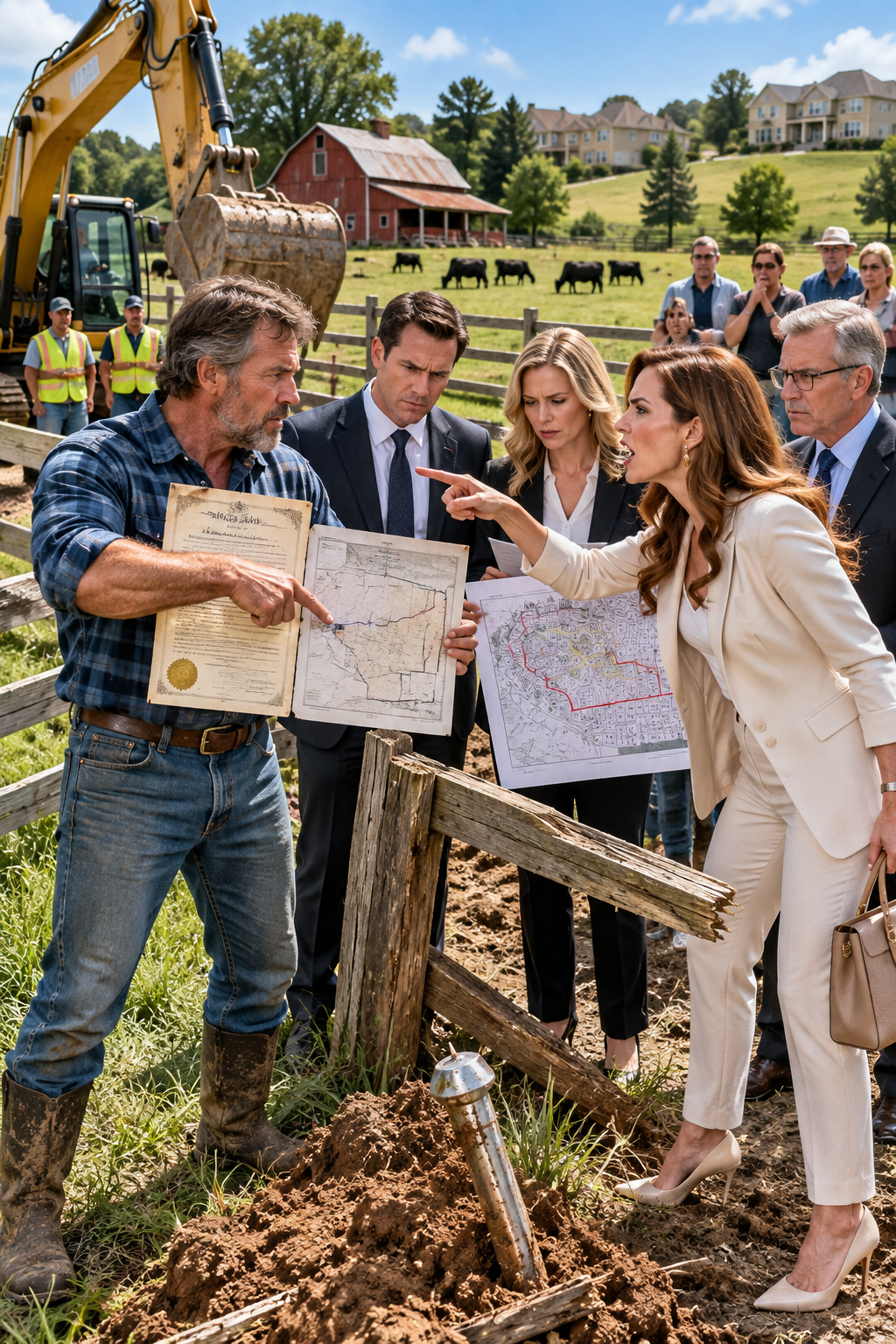
Two weeks later, I spotted Victoria’s Porsche beside a white Mercedes near my eastern fence. Victoria was walking the boundary with Katherine Mercer, a prominent Nashville attorney known for complicated property litigation.
I recognized Mercer immediately, although she didn’t notice me behind the hickory trees.
“The seven-year adverse-possession argument gives us another possible route,” Mercer said, examining a map.
Victoria tapped the paper impatiently. “I don’t care which argument works. I want the fence gone.”
Their problem was obvious. Ridgefield Crossing had existed for less than three years, nowhere near the period they needed for the theory they were discussing.
I walked back to the barn and called Sam Prescott, the surveyor who had measured our land twice before.
“Sam, I need every boundary checked again.”
“Something wrong?”
“Someone’s trying to make forty-seven feet disappear.”
My second call went to Gil Whitaker, a sixty-nine-year-old retired Army Corps of Engineers veteran who farmed the adjoining northern property.
Gil had seen an unfamiliar survey crew crossing his land without permission. He’d photographed their truck and recorded its license plate.
“Victoria came here six months ago,” he added. “Offered four hundred thousand for my place. About half what it’s worth.”
“What happened when you refused?”
“She said she’d find another way.”
That was when the harassment began to look like a coordinated operation.
Sam delivered his certified survey on a Friday afternoon. He laid the drawings across his truck hood while wind whipped at their corners.
“The original measurements match your deed,” he explained. “Three pins were removed. The fourth was relocated. And this Ridgefield survey doesn’t follow any recorded boundary I can find.”
He pointed toward another document.
“It follows Holt’s Phase Two plan almost perfectly.”
I stared at the overlapping lines.
“Someone drew the boundary where the developer wanted it.”
Sam nodded. “That’s exactly what it looks like.”
His investigation also uncovered a troubling connection between Holt Partners Development and a political action committee called Tennessee Growth Alliance.
Two county planning commissioners who supported the Ridgefield project had received a combined $80,000 in campaign contributions from that committee.
Campaign donations alone wouldn’t establish corruption. But the combination of suspicious survey documents, developer financing, and disputed planning approvals demanded a closer examination.
I retained Lydia Shaw, a forensic accountant from Chattanooga.
Within a week, she traced payments from Holt Partners through two shell companies into the political committee.
When she placed the financial chart on my kitchen table, I noticed Ann’s old green-glass lamp illuminating the documents.
“Can you document every transfer?” I asked.
“Every one.”
Meanwhile, Claire began visiting Ridgefield homeowners.
She wasn’t interested in lawsuits or political influence. She wanted to understand why ordinary families were frightened of a woman supposedly elected to represent them.
Tammy Hollis showed her the garden-gnome violation, along with notices about wind chimes, a birdbath, and her grandson’s bicycle.
Other homeowners described threats of escalating fines whenever they challenged Victoria’s decisions.
Within two weeks, Claire had collected eleven signed statements.
“These people bought homes,” she told me one evening, spreading the declarations across our dining table. “Somehow, they’ve ended up afraid to walk outside.”
I looked at her and heard her mother’s voice.
Ann had always believed that when you had the ability to help someone, you also had a responsibility to try.
We organized everything into a four-inch binder: the original deeds, survey reports, photographs, financial records, homeowner statements, zoning complaints, and Gil’s evidence.
Then I contacted Pete Langford, an experienced Tennessee Bureau of Investigation agent I’d known through an earlier public-corruption case.
Pete examined the materials for nearly an hour.
“There’s enough here to justify a serious investigation,” he said.
I also hired independent counsel, Karen Goss of Memphis, to defend the property and seek a temporary restraining order against further interference.
I made one thing absolutely clear: my judicial position would play no part in deciding my personal dispute.
Because the truth Victoria didn’t know was that I had spent twenty-five years on Tennessee’s bench, including eleven as a Court of Appeals judge.
I understood precisely how dangerous it would be to use that authority for private advantage.
We were going to win with evidence, not influence.
But Victoria had one more lawyer to send.
And this time she intended to deliver the ultimatum herself.
## Part 3: Three Powerful Attorneys Discover the Farmer’s Hidden Profession
Victoria arrived at my barn in a white silk blouse and linen trousers, followed by a silver Audi carrying Douglas Ashford, a senior partner at one of Middle Tennessee’s largest law firms.
I was replacing a leaking water-trough gasket when they appeared.
Victoria stepped into the mud, and her expensive red-soled heels sank several inches.
She looked down in disgust.
“This is precisely why your property is unsuitable for the neighborhood.”
“Funny,” I said, setting down my wrench. “The cows have never complained.”
Ashford didn’t smile.
He surveyed the barn, the cattle pens, and the pasture beyond them with the expression of a man estimating demolition costs.
Victoria opened her handbag and produced an envelope.
“Two hundred thousand dollars,” she announced. “For the disputed eastern strip. Take the offer, withdraw your counterclaim, and this unpleasantness ends.”
I didn’t touch the envelope.
“And if I refuse?”
Her expression hardened.
“We continue the lawsuit. We pursue the nuisance complaint. We petition the county to reconsider your agricultural zoning. Eventually, maintaining this farm will become more expensive than selling it.”
Ashford adjusted his cuffs.
“I strongly advise you to appreciate the seriousness of your legal exposure, Mr. Callaway.”
I looked at him carefully.
“Ashford, Klein and Whitmore. Your firm’s handling several appellate cases this term, isn’t it?”
His eyes narrowed.
“Among other matters.”
I named three cases, including the Hendrix estate dispute and a Franklin banking-contract appeal.
For the first time, his polished confidence slipped.
“How do you know those cases?”
“I read court dockets.”
Victoria gave an impatient sigh.
“Douglas, please. We are not here to discuss your other clients.”
“No,” I said. “You’re here to threaten a landowner into selling property you can’t prove belongs to you.”
Her cheeks reddened.
“You have until Friday.”
She turned toward her Porsche. Ashford remained in the barn doorway, studying me as though an overlooked detail had suddenly become important.
Then he followed her.
I picked up my wrench and returned to the leaking trough.
Our hearing was scheduled for June twelfth at the Rutherford County Courthouse. Judge Martha Kingsley would preside over the request to protect my property while the ownership dispute proceeded.
By coincidence, I was also assigned to sit as a visiting judge in another courtroom that week, helping clear an unrelated civil docket.
My own attorneys would represent me. I had no judicial role in the property case, and any professional conflicts involving Victoria’s lawyers would be disclosed and handled through the proper recusal process.
On the morning of June twelfth, I arrived before nine.
The courthouse smelled of polished wood, coffee, and floor cleaner. I completed my last assigned matter in courtroom three, thanked the clerk, and stepped through the side door.
I was still wearing my black judicial robe.
My plan was simple: return to chambers, change into a suit, and attend my property hearing as an ordinary litigant.
Then I turned the corner.
Todd Brennan stood outside courtroom one, holding a thick folder. Katherine Mercer was beside him, examining a legal pad. Douglas Ashford adjusted his glasses while Victoria waited behind them in a charcoal designer dress, clutching an expensive white handbag.
They didn’t notice me at first.
Then Donna, the longtime court clerk, called down the hallway.
“Judge Callaway? Your courtroom is cleared for the morning.”
Four heads turned.
Brennan recognized me first.
His folder bent beneath his tightening fingers, and his mouth opened without producing a word.
I watched him remember my muddy porch, my flannel shirt, and the coffee mug sitting beside the geraniums.
Mercer’s face drained of color.
She knew exactly who I was. Her name had recently appeared among candidates being considered for a federal judgeship, and I had served on an advisory review panel involved in evaluating applicants.
She glanced at the robe, then at Victoria.
Ashford lowered his glasses.
He remembered the three appellate cases I’d mentioned in my barn.
For several seconds, nobody spoke.
Victoria’s voice broke the silence.
“What is everyone staring at?”
Brennan swallowed.
“Mrs. Ashworth, we need to talk privately.”
“About what?”
Mercer whispered, “Mr. Callaway is a judge.”
Victoria stared at me.
“That’s ridiculous.”
“I’m afraid not,” I said.
Her eyes moved from my face to the robe, lingering on the state insignia.
“But you’re a farmer.”
“Yes,” I answered. “I am.”
Ashford finally found his voice.
“Your Honor, we were unaware—”
“Mr. Ashford,” I interrupted quietly, “whatever concerns you have should be handled through the appropriate legal channels. Today’s hearing belongs to Judge Kingsley.”
I turned toward chambers without another word.
Behind me, Victoria began demanding explanations in a voice that echoed down the marble corridor.
Later, Donna told me all three attorneys had stood motionless for several moments after I left.
Their client’s supposedly helpless farmer had become someone they suddenly realized understood every word of their pleadings.
And there was something else they were beginning to understand.
The evidence against Ridgefield Crossing would not disappear simply because they’d discovered my profession.
## Part 4: The Courtroom Exposes the Fraud and Restores Our Family’s Legacy
At ten o’clock, I entered courtroom one wearing a charcoal suit.
No robe. No special seat. No judicial title.
Just Wade Callaway, the farmer whose family had protected the same acreage since 1941.
Claire sat beside me. Across the aisle were Gil Whitaker, Tammy Hollis, and several Ridgefield homeowners who had decided they were finished being intimidated.
Victoria sat at the opposing table between Brennan and Mercer. Ashford occupied a chair farther down, staring at the documents before him.
Karen Goss rose to address Judge Kingsley.
“Your Honor, this case involves more than conflicting surveys. The evidence suggests a deliberate attempt to manufacture a boundary dispute to acquire privately owned agricultural land.”
She projected Sam Prescott’s certified survey onto the courtroom screen.
The original boundaries appeared in blue. The disputed line appeared in red.
Forty-seven feet separated them.
Karen displayed photographs of the missing markers, the freshly disturbed soil, and the relocated fourth pin.
“These measurements correspond to the Callaway deed and historical surveys. The opposing measurements instead correspond to a proposed development plan.”
Judge Kingsley leaned forward.
“Has the plaintiff produced a recorded instrument transferring ownership of this disputed property?”
Brennan studied his notes.
“Not one establishing a direct conveyance, Your Honor.”
“Then I would like to understand the legal basis for claiming it.”
His silence lasted several uncomfortable seconds.
Karen introduced the financial records next.
Lydia Shaw’s report documented $80,000 traveling from Holt-connected companies through intermediaries into a political committee that had supported two planning commissioners.
“The existence of these payments doesn’t, by itself, establish unlawful conduct,” Karen explained. “But their timing and connections warrant further investigation, particularly when considered alongside the disputed land documents.”
Victoria whispered something furious to Brennan.
He shook his head.
Then came the homeowner statements.
Tammy’s garden-gnome fine. The holiday-light penalties. The repeated threats against residents who questioned Victoria’s authority.
Claire squeezed my hand when Tammy’s declaration was read.
Finally, Karen informed the court that Special Agent Pete Langford had opened an investigation into possible fraudulent property filings and related misconduct.
Judge Kingsley looked toward the opposing table.
“Mr. Brennan, does your client wish to respond to the request for temporary relief?”
Brennan rose slowly.
“Your Honor, in light of the materials presented, we will not oppose an order preventing removal of the fence or further entry onto the disputed property. We also intend to seek dismissal of our ownership claim.”
Victoria shot to her feet.
“Absolutely not!”
Her chair scraped across the courtroom.
“Sit down, Mrs. Ashworth,” Judge Kingsley instructed.
“That land is supposed to be part of Phase Two! We have investors. We have contracts!”
Brennan reached toward her sleeve.
“Victoria, please.”
She jerked away.
“Vance promised me that land would be ours before summer!”
Every whisper in the gallery stopped.
Judge Kingsley looked directly at her.
“Mrs. Ashworth, you will sit down immediately.”
But Victoria was no longer looking at the judge.
She was staring at her lawyers, whose expressions had changed from embarrassment to alarm.
“He said the survey had already been taken care of,” she blurted. “He told me the commissioners wouldn’t be a problem!”
Brennan rose again.
“Your Honor, I request a brief recess so I may confer with my client.”
That was the moment the truth began to break through.
Victoria hadn’t simply invented a personal campaign against my farm.
She had been working from Vance Holt’s expansion plans, relying on assurances that the legal and administrative obstacles had already been handled.
Her own anger had exposed the relationship she and the developer had tried to keep hidden.
Judge Kingsley called a recess and directed that Victoria’s statements be preserved in the record.
The court subsequently granted protection against further encroachment while the claims were resolved. My attorneys continued their work, and the investigation moved forward independently.
Outside the courtroom, Claire wrapped both arms around me.
“Mom would have been proud of you.”
I closed my eyes.
For the first time in months, I believed I might finally sleep through the night.
The investigation continued beyond that hearing.
Vance Holt was eventually indicted in connection with fraudulent property documents, attempted theft, and corruption-related allegations. Two county planning commissioners resigned amid scrutiny of the development approvals.
Victoria faced separate proceedings involving her submission of disputed documents and statements to county officials. Her behavior in court brought additional sanctions.
Harrison Ashworth filed for divorce several weeks later.
Brennan withdrew from representing the association. Mercer’s federal judicial candidacy ended, and Ashford’s firm sought to resolve the remaining civil claims.
I disclosed the conflicts created by my personal dispute and stepped aside from judicial matters involving the attorneys where my impartiality could reasonably be questioned.
I wanted no victory that anyone could honestly attribute to my position.
The evidence was enough.
At Ridgefield Crossing, seventy-eight homeowners voted to remove Victoria as HOA president. Only three opposed her removal.
Tammy Hollis joined the new board and helped overturn forty-seven questionable violation notices.
Her garden gnome returned to its rightful place beneath her front window.
Sam Prescott supervised the restoration of the original property markers, placing my eastern boundary exactly where the historical records established it.
On the afternoon the last marker was reset, I walked the fence carrying my grandfather’s deed.
The pasture smelled of cut hay. Cattle moved slowly beneath the ridge. The two maple trees Ann and I had planted stood untouched beside the creek.
I rested my palm on one of their trunks.
“We kept it,” I whispered.
Three months later, Claire arrived at the farmhouse carrying a rolled architectural drawing.
“Before you say no,” she began, “I want you to look at something.”
She spread the drawing across our kitchen table.
It showed a modest rural veterinary clinic with treatment stalls, an examination room, and enough space for trucks and livestock trailers.
I frowned.
“Claire, what is this?”
“The new Ridgefield board wants to help fund emergency veterinary care for local farming families. Tammy proposed using community fundraising, and several residents have volunteered.”
I studied the plans.
The building would stand near our access road, on land we could provide without disturbing the working pastures.
Then Claire turned the final page.
Across the top were the words:
Ann Callaway Rural Veterinary Fund.
My throat tightened.
“Who decided on that name?”
“The homeowners,” she answered softly. “I told them about Mom. About how she used to help neighbors who couldn’t afford to call a veterinarian.”
I sat down.
For years, I’d been afraid that losing Ann meant everything we’d built together would slowly disappear.
But here was proof that kindness could outlive the person who gave it.
Claire pulled out the chair beside me.
“She would have loved this, Dad.”
I touched the drawing with trembling fingers.
“Yes,” I whispered. “She would have.”
The following morning, Gil Whitaker stopped by while I repaired a gate.
He leaned against the fence and grinned.
“Heard Victoria’s selling that white Porsche.”
“Is that so?”
“Apparently she’s having some financial difficulties. Thought you might want to make an offer.”
I looked toward my old pickup, its paint scratched and its dashboard cracked by years of Tennessee summers.
“No thanks. My truck knows the way home.”
Gil laughed so hard he had to remove his cap.
We stood together watching the cattle graze across the valley.
After a while, he asked, “Did you ever think about what would have happened if those lawyers hadn’t recognized you?”
I considered the question.
“Probably the same thing that eventually happened,” I said. “The surveys would still have been false. The records would still have existed. And the people who told the truth would still have deserved to be heard.”
Gil nodded.
“Your grandfather would be proud.”
I watched sunlight cross the barn roof my father had built.
“My grandfather taught me something when I was little,” I said. “He told me never to confuse having authority with having the right to use it.”
Gil rested his elbows on the fence.
“Sounds like he knew what he was talking about.”
I smiled.
The strangest part of the entire ordeal was that Victoria had spent months trying to make me feel small because I worked with my hands.
She saw the dirt on my boots and assumed I was powerless. When she finally saw my robe, she assumed my power was what would defeat her.
She misunderstood both things.
The robe had never made the land mine, and it hadn’t made her claims false.
The truth had been there all along, buried in county records, preserved in old surveys, and remembered by people who refused to be frightened into silence.
That evening, I carried two cups of coffee onto the porch out of habit.
I stopped when I realized what I’d done.
For a moment, I stood there holding them, looking at Ann’s empty chair.
Then Claire came outside, took the second cup, and sat beside me.
Neither of us said anything.
The cattle settled beneath the fading sky, the barn cat curled against the steps, and a breeze carried the scent of freshly cut grass through the yard.
For the first time since Ann died, the quiet didn’t feel quite so empty.
We had protected the farm.
And now, through the clinic bearing her name, the land would help protect other families too.
I took a sip of coffee and watched the last sunlight touch the fence.
Eighty-five years after my grandfather bought that first acre, our family still belonged here.
And no amount of money could purchase what that meant.
THE END.
All characters and events in this story are fictional, created for storytelling and entertainment purposes. Thank you sincerely for reading. Your feedback and support are invaluable and motivate me to continue sharing more stories with you.


