Part 2: The Emergency Nurse Who Refused to Accept His Explanation
During the ambulance ride, I kept asking whether my daughter was alive. One paramedic monitored my vital signs while the other checked the baby’s heartbeat with a portable device. When I heard the rapid, steady rhythm, I wanted to believe everything would be fine. But I had worked in maternal health long enough to know that a heartbeat alone could not answer every frightening question.
At the emergency department, nurses transferred me onto a bed and attached monitors to my abdomen. Daniel appeared shortly afterward, carrying my purse and a folder of medical records, looking exactly like the attentive husband I had once trusted. He told the admitting nurse I’d been unusually tired lately and had probably fainted. I watched him offer these explanations while I tried not to move my aching shoulder.
Then a nurse named Judith Reynolds entered the room. She was probably in her late fifties, with short gray hair and reading glasses attached to a cord around her neck. She introduced herself, checked the baby’s monitoring equipment, and asked whether I had experienced any bleeding earlier in my pregnancy. Her questions were ordinary, but she paid particular attention to the way Daniel answered before I could speak.
When she asked how I’d been injured, I repeated that I’d fallen. Judith looked down at the bruising along my forearm and asked whether I could show her the other areas that hurt. I lifted the hospital gown enough for her to examine my side and upper back. She studied the marks carefully, then placed the blanket over me again.
“Mr. Morgan,” she said, turning toward Daniel, “I need to explain how we’re documenting this examination.”
He straightened his jacket and nodded, apparently relieved to have a practical matter to discuss. Judith explained that the ambulance record included the original emergency call and that she was recording the locations and patterns of my injuries in my medical chart. She said photographs could be taken with my permission, preserved in the hospital’s secure system, and made available to investigators through the proper legal process. Then she added, in the same measured voice, “Our hospital works with law enforcement when there’s evidence of an assault, and the information already collected cannot simply be changed because someone prefers a different explanation.”
Daniel’s fingers tightened around the strap of my purse. “I’m not sure I understand,” he said, although his face suggested that he understood perfectly. Judith explained that medical records carried timestamps and that staff documented both a patient’s account and any conflicting information. He asked whether she was accusing him of something, and she answered, “I’m explaining what happens when a patient arrives with traumatic injuries.”
His gaze moved from Judith to the computer, then toward the door. I recognized the expression from occasions when a contractor had challenged him about a construction estimate: he was searching for the point where he could regain control of the conversation. But Judith offered him no argument to win. She simply continued writing, as though the subject had been settled.
After another minute, she asked him to wait outside while the obstetric team completed a private assessment. Daniel hesitated and reminded her that he was my husband. “I understand,” Judith replied, “but Rebecca needs to answer some medical questions alone.” He placed my purse on the chair, told me he’d be nearby, and walked out without meeting my eyes.
Judith waited until the door closed before sitting beside my bed. “You don’t have to explain anything before you’re ready,” she said, pulling a stool closer. “But I want to ask you directly whether you feel safe going home with him.” I looked at the pale blue blanket covering my belly and tried to imagine returning to that house, where Patricia would still be waiting.
“No,” I finally answered.
Judith let me have a moment before asking whether Daniel had caused the injuries. I nodded, then started talking about the nursery, the argument, and the way his hands had changed from holding mine to hurting me. Once I began, the details came out in uneven pieces, including things I hadn’t intended to mention. I told her about the isolation, the arguments over ordinary decisions, and how I’d started checking his mood before speaking.
When I finished, Judith asked permission to document the injuries more thoroughly and contact the hospital social worker. I agreed to both, and she carefully photographed the marks while explaining each step before touching me. She also reassured me that telling the truth did not mean losing control over every decision that followed. For the first time in years, someone was asking what I wanted instead of deciding it for me.
I eventually asked how she’d known Daniel wasn’t telling the truth. Judith glanced toward the closed door and said, “I didn’t know the whole story, Rebecca, but the injuries and the account weren’t matching.” She admitted that she’d spoken as if every part of the documentation process were already complete, even though the photographs and some notifications were still being arranged. Her purpose had been to make clear that he couldn’t control the medical record, while giving me a private opportunity to speak.
The obstetrician arrived soon afterward, and my attention returned completely to my daughter. I was having contractions, and there were concerns about complications from the trauma, so the doctors arranged continuous monitoring and additional imaging. They warned me that the next twenty-four hours would be important. I listened to each explanation while holding Judith’s hand whenever the discomfort intensified.
That evening, two police officers came to speak with me. They had already interviewed Helen Donnelly, who had heard my pleas through the open window and described the argument immediately before the ambulance arrived. Her call had been recorded, and the paramedics had documented the account they received at the house. I repeated what I’d told Judith, aware that Daniel’s version of events was now being compared against evidence he hadn’t expected anyone to collect.
One officer asked whether Patricia had witnessed the assault. I said she had, although I doubted she would tell them the truth. The officer wrote down her name and asked several questions about where she’d been standing. Later, I learned that Patricia had given an indignant statement describing how disrespectfully I’d spoken to her and how Daniel had intervened to defend his mother.
She apparently believed this explanation would excuse his behavior. Instead, she confirmed that Daniel had confronted me, grabbed me, and continued the assault after I had fallen. She insisted that she’d tried to calm everyone down, although she could not explain why she hadn’t called for medical help. Her account supplied independent confirmation of details that Daniel had denied.
Police arrested him at the hospital. A social worker named Nicole came afterward with information about victim services, emergency housing, legal assistance, and safety planning. She didn’t pressure me to decide immediately whether to divorce him, which was a relief because I could barely think beyond the monitors attached to my belly. Instead, she asked whether there was someone I trusted who could stay with me.
I called Laura, who lived about an hour away. She arrived shortly before midnight wearing jeans, an old college sweatshirt, and the frightened expression of someone who had driven too fast. When she saw the bruises, she covered her mouth for a moment before sitting beside me. “You and this baby are coming home with me,” she said, and I was too exhausted to argue.
By morning, the contractions had eased, and the doctors told me the baby’s heartbeat remained reassuring. They couldn’t promise that every risk had passed, but the examinations had shown no immediate reason for an emergency delivery. I needed continued observation and careful follow-up after discharge. Laura listened to every instruction, writing things down because she knew I was struggling to concentrate.
I spent four days in the hospital. During that time, Daniel was charged, and the court imposed restrictions preventing him from contacting or approaching me while the criminal case proceeded. His mother tried to reach me through a relative, claiming we should settle matters privately before our family was permanently damaged. Laura read the message, looked at me, and asked whether I wanted it saved for my attorney.
“Yes,” I told her. “Save everything.”
Part 3: The Evidence Held Together As I Rebuilt Our Lives
I moved into Laura’s guest bedroom with two bags of clothing, my medical paperwork, and a small box containing the baby’s first yellow cardigan. Everything else remained at the house Daniel and I had shared. Laura cleared a dresser, found extra pillows, and placed a lamp beside the bed so I wouldn’t have to cross the dark room at night. She never told me how I ought to feel about my marriage, and that kindness gave me room to understand what had happened.
The first few weeks were harder than I expected. I kept checking my phone, partly afraid Daniel would contact me and partly disturbed by how accustomed I’d become to hearing from him. When a car slowed outside Laura’s house, I instinctively moved away from the window. My counselor helped me recognize these responses without treating them as proof that I was incapable of managing my own life.
One afternoon, Helen called after obtaining my number through Laura. She apologized for not checking on me earlier, explaining that she’d suspected tension between Daniel and me but hadn’t known how serious things were. I told her that calling 911 had probably saved my daughter’s life. Helen took several seconds before answering, then said she was simply grateful she’d left her window open while watering the plants.
Two weeks after my discharge, Laura accompanied me to collect belongings from the house through a safely arranged visit. A police officer remained nearby while I packed documents, family photographs, maternity clothes, and the few pieces of jewelry my father had given me. The nursery looked almost exactly as I’d left it, except that Patricia’s antique changing table had been pushed against the opposite wall. I found my father’s framed photograph wrapped in an old towel at the back of the linen closet.
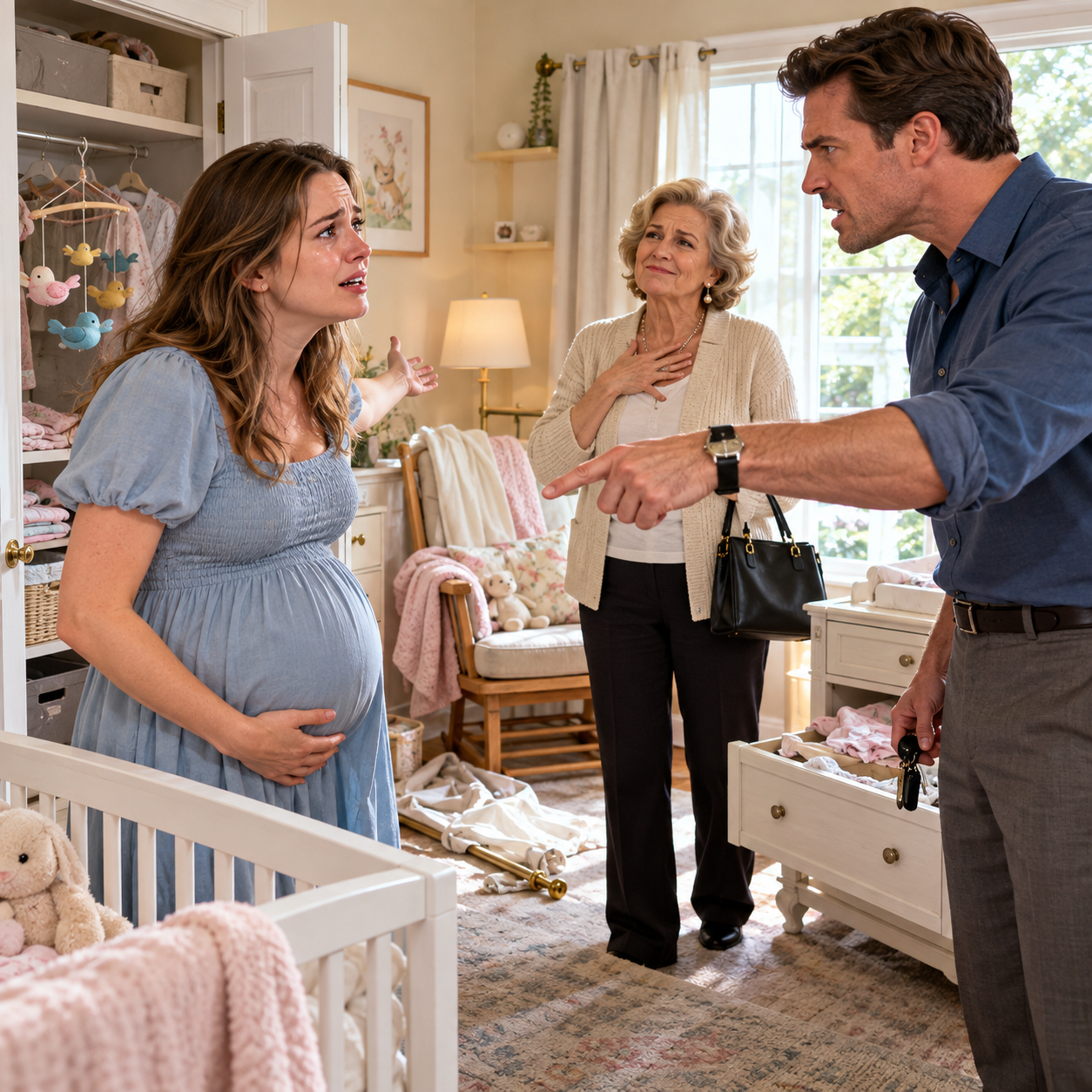
Underneath it was the little felt-bird mobile. I sat on the nursery floor for a few minutes, holding it across my knees while Laura folded baby clothes into a suitcase. Daniel and I had once stood in that room laughing over how difficult the crib was to assemble. Remembering that afternoon hurt almost as much as remembering the assault because it meant accepting that some of our happiness had been genuine, even if the marriage had become unsafe.
My daughter was born nine weeks after the attack, a little earlier than expected, following complications that required a cesarean delivery. Laura stayed with me through the preparation, making jokes about the hospital’s dreadful coffee because she knew I needed something familiar. When the doctor finally lifted my daughter into view, I saw a wrinkled little face, a determined chin, and one tiny hand reaching toward the lights. Her name was Eleanor Grace, and I whispered it to her before anyone else spoke.
Motherhood was beautiful, exhausting, and occasionally frightening. I worried whenever Eleanor slept longer than usual, and sometimes I cried during ordinary feedings without understanding exactly why. Laura helped with night bottles of expressed milk, and my mother traveled from northern Michigan to stay for several weeks. Slowly, our days developed a rhythm built around meals, laundry, pediatric appointments, and Eleanor’s extraordinary talent for losing one sock.
Daniel’s criminal case moved much more slowly. His attorney initially suggested that the incident had been a mutual argument followed by an accidental fall. But the medical photographs, the emergency call, and Patricia’s own statement made that version difficult to maintain. After months of negotiations, Daniel pleaded guilty to a felony assault charge and received a custodial sentence followed by supervision, along with restrictions on contacting me.
The sentence didn’t erase what had happened, and I learned that criminal court was only part of the process. Divorce proceedings required decisions about the house, finances, and Eleanor’s future. Through my attorney, I requested sole custody and safeguards against contact that could expose us to further harm. The family court reviewed the documented violence and issued orders designed to protect Eleanor while addressing Daniel’s legal rights under the circumstances.
Patricia attempted to obtain visitation rights separately. Her attorney portrayed her as a devoted grandmother who had been unfairly excluded from a child’s life over one family disagreement. But her earlier statement was introduced, and the court considered her conduct during the assault, including her failure to protect or seek help for me. Her request was denied, and afterward she sent no more messages through relatives.
The divorce settlement required selling our house. I cried when I signed the final paperwork, not because I wanted Daniel back, but because selling it felt like disposing of the future I’d once worked so hard to build. Every room had held a plan, from the kitchen where we’d discussed baby names to the nursery I’d prepared with such care. The proceeds eventually helped me rent a comfortable townhouse near Laura, with enough savings to begin again.
When Eleanor was fourteen months old, I returned to public health nursing. My first assignment involved visiting a new mother who seemed unusually nervous whenever her partner entered the room. He answered several questions for her, and she repeatedly glanced at him before speaking. I recognized something familiar in that careful exchange, so I quietly arranged an opportunity to speak with her alone without making assumptions about what was happening.
Driving home afterward, I pulled into a grocery store parking lot and cried for several minutes. I had spent years believing that professional knowledge should have protected me from abuse. Now I understood that expertise didn’t make a person immune to fear, attachment, confusion, or the hope that someone they loved would change. It did, however, give me a way to become more thoughtful about how I helped other women.
Nearly two years after the assault, I contacted Judith Reynolds. I wrote a short letter explaining that Eleanor was healthy, that we were living safely, and that I wanted to thank her for the way she’d handled my examination. She invited me for coffee at a small restaurant near the hospital. I brought Eleanor, who spent most of the visit trying to feed crackers to a stuffed rabbit.
Judith remembered Daniel’s questions almost word for word. She said she’d seen how carefully I watched him before answering and had worried that I wouldn’t feel free to talk while he remained in the room. When I mentioned her explanation about medical records and police access, she gave a small, rueful smile. “I made the process sound farther along than it was,” she admitted, “but I needed him to understand that your medical record belonged to you, not to him.”
I asked whether she ever feared she’d misread situations like mine. Judith stirred her coffee, considering the question before answering. “Of course,” she said. “That’s why we ask privately, document what we observe, and give people choices instead of demanding confessions.” She added that what mattered most that evening wasn’t the look on Daniel’s face, but the moment I felt safe enough to tell her what had happened.
I carried that conversation into my own work. Over the following years, I participated in training sessions about recognizing controlling behavior and responding to patients who might be frightened to disclose abuse. I always emphasized that an injured person’s first explanation might not be the complete story, especially when someone else was standing nearby. I also reminded colleagues that listening without judgment could matter just as much as asking the right questions.
Eleanor is eight now. She loves swimming, hates mushrooms, and has recently decided that she wants to become an astronaut who studies animals on other planets. Our townhouse has a narrow backyard where she grows strawberries in mismatched pots, and her bedroom contains more stuffed animals than I ever imagined one child could own. Above her desk hangs the photograph of my father that Patricia once removed from the nursery.
Eleanor knows that her father hurt me before she was born and that the courts made decisions to keep us safe. I answer her questions honestly, using words she can understand, and I never ask her to carry my anger. When she’s older, there will be more to explain about our family and the years before she arrived. For now, she knows that she is loved and that grown-ups are responsible for keeping children safe.
Last spring, we visited Laura for Sunday dinner. After eating, Eleanor went outside to collect dandelions while Laura and I cleared the kitchen. My sister watched through the window as Eleanor arranged the yellow flowers in a crooked row along the patio. “Remember when you thought you couldn’t raise her without him?” Laura asked, passing me a damp dish towel.
I nodded, remembering how impossible the future had looked from that hospital bed. Laura dried her hands and went outside to help Eleanor gather the flowers before the rain arrived. I remained at the window for a moment, watching them laugh as the wind scattered the dandelions across the grass. The ordinary happiness of that afternoon was something I once believed I might never have again.
That evening, Eleanor asked whether we could put the old felt-bird mobile in her bedroom, even though she was much too old for a crib. I climbed into the attic, found the carefully wrapped birds, and hung them near her window where the evening breeze could move them. She lay on her bed watching them turn, then held out her hand until I sat beside her.
“Mom,” she asked, “were you scared when I was a baby?”
“Sometimes,” I said, brushing her hair away from her forehead. “But there were people who helped us, and we learned how to be safe.”
She considered that answer, then reached for my hand and held it between both of hers. Outside, the neighborhood settled into the quiet sounds of sprinklers and children being called home for dinner, while the little birds moved gently above us. I stayed until Eleanor fell asleep, grateful that the room she called home belonged to a life neither of us had to fear.
The End .
All characters and events in this story are fictional, created for storytelling and entertainment purposes. Thank you sincerely for reading. Your feedback and support are invaluable and motivate me to continue sharing more stories with you.