
Part 2: A House Key Forced Me To Reconsider Six Years Of Help
After our guests left, Emma and I took the Mazda for a short drive. She named it Zippy, tested the radio, and carefully parked in the garage before calling her best friend. I watched her go upstairs, then entered the kitchen, where Daniel’s handmade wooden key rack hung beside the pantry.
Sandra’s house key was still on my ring.
I took it off and placed it on the counter. Then I opened my laptop and reviewed six years of rental records, repair invoices, insurance payments, and correspondence with my accountant. Over the previous twelve months, Sandra had paid $5,400 in rent, while the property’s mortgage payments, taxes, insurance, and maintenance had totaled just over $17,000.
Some of that money built equity in a property I owned. Still, the monthly cash shortfall was substantial, especially when combined with the personal expenses I’d quietly covered for Sandra. I discovered I was even paying $89 monthly for a storage unit containing her unused furniture and holiday decorations.
For years, I’d called it helping my sister get established.
Now I wondered what being established was supposed to look like.
I photographed the key and sent Sandra a message.
“Remember how Britney said ‘mine now’ about Emma’s car? I’ve been thinking about ownership. That house is mine now.”
My phone rang almost immediately.
“Melanie, what is that supposed to mean?”
“Apparently, claiming something that belongs to somebody else is funny.”
“This is my home!”
“Yes, Sandra. It’s your home, and it’s my property.”
She accused me of threatening to throw her onto the street. I told her clearly that she had a legal tenancy, that I wasn’t changing the locks, and that no one was being removed without proper procedures.
“But the financial arrangement is changing,” I said. “I’ve been subsidizing your living expenses for six years.”
“You’re punishing me over a joke.”
“No. That joke finally made me recognize something I’ve refused to face.”
Mom called before I could put down my phone. She said Sandra was crying and reminded me that family should never fight over material things.
“Then why did you laugh when Britney wouldn’t return Emma’s car keys?”
“Because nobody thought she was serious.”
“Emma asked for them back three times.”
Mom dismissed Emma as overly sensitive. I ended the conversation before I said something I couldn’t take back.
The following morning, I explained everything to Emma. She was relieved when I assured her that Sandra wouldn’t be illegally evicted. Then she showed me a message from Grandma asking her to persuade me to forgive Sandra.
Emma had answered, “Family shouldn’t fight over possessions. That’s why Britney should leave mine alone.”
I smiled at my daughter’s words. She was beginning to understand that kindness didn’t require surrender.
On Monday, I consulted a landlord-tenant attorney. We reviewed the written month-to-month lease and Kentucky’s applicable notice requirements. After obtaining a market assessment of approximately $1,650 monthly, I arranged formal written notice proposing a new rent of $1,300 after the required period, with an opportunity for Sandra to find another home if necessary.
It was still below market. But it required Sandra to participate in the cost of her own household.
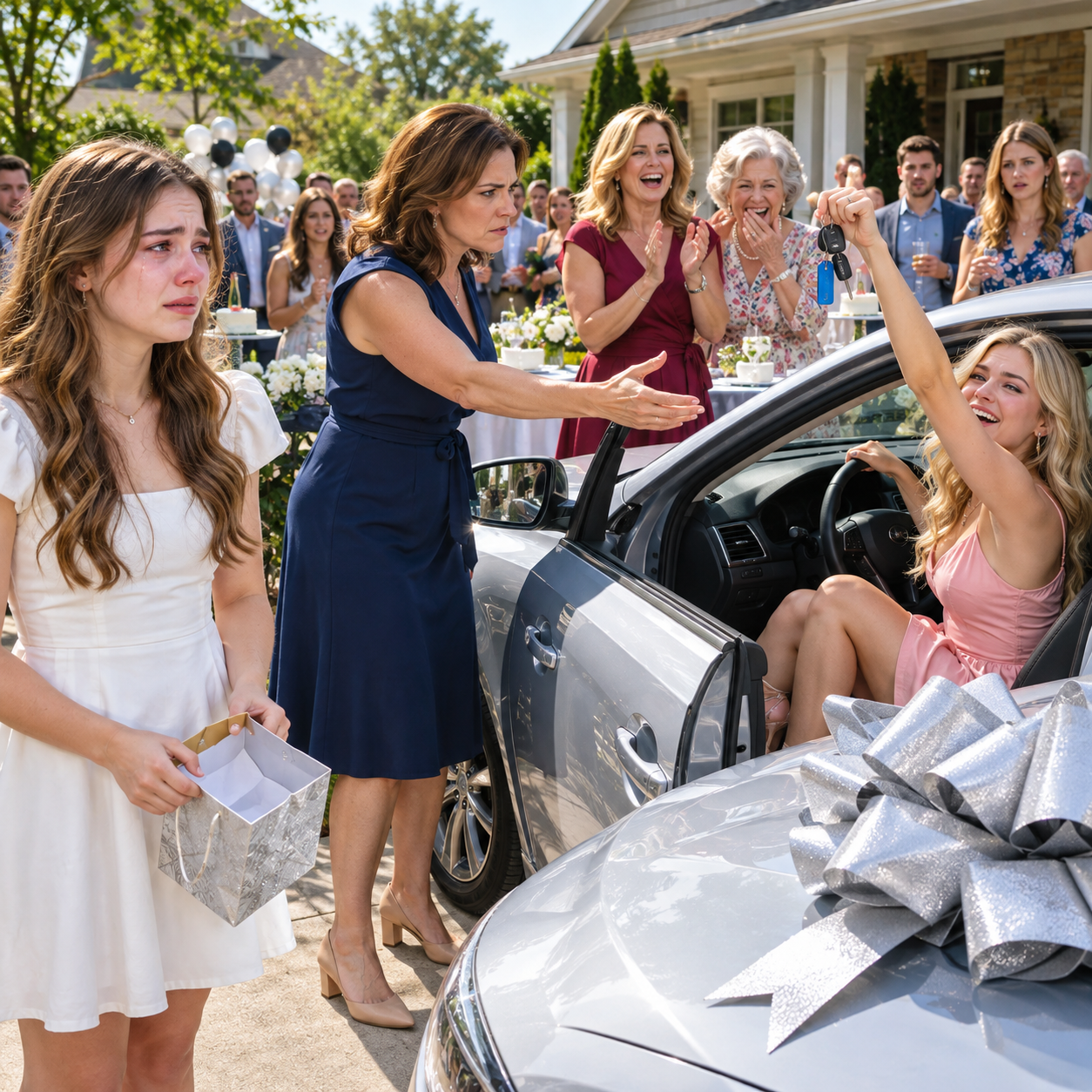
Britney responded by posting online about a toxic aunt who had humiliated her and threatened her mother’s security over a harmless joke. Rosa had photographed her sitting in Emma’s Mazda, holding the stolen keys above her head while Sandra applauded. I saved the photograph and refused to argue publicly.
Then my cousin Patrick called.
“Melanie, I thought Linda bought Sandra that house.”
I sat upright. “Who told you that?”
“Sandra. She’s been saying for years that your mother helped her become a homeowner.”
Before I could answer, he mentioned an online fundraiser Sandra had organized the previous year for urgent home repairs. He sent me the link.
The page had raised $2,180. It described serious plumbing problems and the financial burden of keeping a roof over Britney’s head.
I knew exactly which plumbing problem Sandra meant.
A pipe beneath her kitchen sink had burst. I’d hired the plumber, received the $860 invoice, and paid it myself.
I printed the fundraising page, retrieved the paid invoice, and laid them beside the photograph from graduation.
Until then, I’d believed Sandra was merely careless with my generosity. These documents suggested she’d also been claiming credit for sacrifices she hadn’t made.
Part 3: The Records At Dinner Exposed The Cost Of Our Silence
The following Saturday, Mom invited everyone to dinner to settle our differences. Emma asked to come, and I agreed after making clear she owed nobody an apology. When we arrived, Sandra and Britney were already seated in the living room. Patrick had been invited as a supposedly neutral relative and looked considerably more interested in the pot roast.
Mom began the conversation by asking me to acknowledge how frightened Sandra had been.
“I shouldn’t have sent that message about the house,” I said. “It was deliberately upsetting. I should have told Sandra directly that I needed to reconsider the rental arrangement.”
Sandra relaxed slightly.
“But the decision itself stands. The formal notice has been prepared.”
I explained the new rent and the available options. Sandra stared at me, then looked toward Mom, who suddenly became fascinated by her dinner plate.
“How do you expect me to afford thirteen hundred dollars?” Sandra demanded.
“By reviewing your budget, increasing your income, or choosing somewhere less expensive.”
Patrick asked what she’d been paying until now. When Sandra reluctantly answered “$450,” he set down his fork.
“For three bedrooms?”
Sandra glared at him. “That’s between Melanie and me.”
“Fair enough,” Patrick replied. “I just hadn’t realized how much she was helping.”
Sandra’s face reddened. “Mom helped us get that house.”
I opened my folder.
“Here is the closing statement. Here are my mortgage records. Mom didn’t contribute to the purchase.”
Sandra reached for her water glass. Mom looked away.
I placed the plumber’s invoice on the table beside the printed fundraiser.
“And here is the repair you collected donations for.”
Britney leaned forward to read the page. Patrick quietly confirmed he’d donated fifty dollars because he thought Sandra was facing an unaffordable repair.
Sandra examined the invoice without touching it.
“I had other expenses,” she finally said.
“Then why did the fundraiser tell people you needed money for repairs?”
“Because people don’t donate for electric bills.”
Even Britney looked at her mother.
Sandra rubbed her forehead and began speaking more softly. She’d fallen behind on utilities, insurance, and personal expenses. She’d been ashamed to admit that despite having a job and a house, she couldn’t manage her finances.
“I didn’t want everybody thinking I was a failure,” she said.
I understood the humiliation behind her decision. But I’d paid the very bill she’d used to justify the fundraiser, and the people who donated deserved an honest account of where their money had gone.
“You let everyone believe Mom bought your house,” I said. “You let them believe you were paying for repairs. Why couldn’t you tell them I was helping?”
Sandra’s eyes filled.
“Because I’m always the unsuccessful sister, Melanie. You’ve got the career. Emma’s got her scholarship. Everybody knows you can manage anything.”
I looked at her for a long moment.
“Daniel died when Emma was eleven. You know what those years were like. Nothing about getting through them was easy.”
“I know,” she whispered.
“Then stop treating what I’ve built as something I owe you for having built it.”
Britney muttered that everyone was making too much of everything. Emma turned toward her before I could respond.
“When you took my keys, I asked you to give them back.”
“It was a joke.”
“I know you thought it was funny. But you kept doing it after you saw I wasn’t laughing.”
Britney shifted in her chair.
Emma continued, “Everyone was looking at you while I stood there wondering why my own graduation present had become something I had to beg for.”
For once, Britney had no clever answer.
Two days later, Sandra called to ask whether we could review her finances together. We met at a coffee shop, where she arrived carrying bank statements instead of complaints.
She spent $240 monthly on salon services, $180 on takeout, $79 on subscriptions, and $46 on a gym membership she rarely used. Her credit card carried expensive debt, and Britney contributed almost nothing despite working approximately twenty-five hours weekly.
Sandra studied the numbers with growing embarrassment.
“I could probably manage a thousand dollars,” she said.
“Then we need to see whether thirteen hundred is realistic or whether moving would be better.”
We spent two hours discussing cuts, additional work, an emergency fund, and a reasonable contribution from Britney. I offered to help organize her budget, not pay the difference.
Sandra initially resented the distinction. Gradually, she began making changes.
She canceled the storage unit, donating most of its contents, including an extraordinary collection of thirty-seven decorative pumpkins. She stopped unused subscriptions, accepted Saturday shifts at another dental office, and asked Britney to contribute $250 monthly.
After reviewing her revised income and expenses, she decided she could remain in the house under the new rental terms.
One evening, Sandra called to tell me she’d begun saving for emergencies.
Then her voice changed.
“I think I spent so much time making my life look successful that I forgot to make it work.”
I sat at the kitchen table, looking at Daniel’s crooked wooden key rack.
For the first time in years, my sister wasn’t asking me to rescue her.
She was telling me what she intended to do herself.
Part 4: An Unexpected Lesson Gave Both Our Daughters Room To Grow
In August, we gathered at a small Italian restaurant for Mom’s sixty-ninth birthday. Sandra paid for the appetizers, Emma brought a framed photograph, and Patrick appointed himself guardian of the breadbasket. Britney arrived late carrying an expensive boutique bag and presented Grandma with a gold bracelet.
Mom admired it, slipping it onto her wrist before passing it to Sandra for a closer look.
Sandra examined the clasp, then casually put the bracelet on her own wrist.
“Mine now.”
Britney laughed once, uncertainly.
“Mom, give it back.”
Sandra leaned away. “Why? It looks better on me.”
“Seriously. That’s Grandma’s present.”
“Oh, relax. It’s just a bracelet.”
Britney reached across the table. Sandra withdrew her arm and gave her daughter the same playful smile Britney had worn beside Emma’s car.
“You’re being awfully sensitive.”
Britney stopped reaching.
Sandra removed the bracelet and returned it to Mom’s box. Then she looked directly at her daughter.
“That’s what you did to Emma.”
Britney stared down at the tablecloth. She glanced toward Emma, who was sitting beside me with her hands folded around her water glass.
“I thought everybody was having fun,” Britney said.
“Everybody wasn’t,” Emma replied.
Britney swallowed. “I’m sorry.”
“Thank you.”
Mom studied the bracelet, then quietly admitted that perhaps everyone had been too eager to laugh at graduation. It wasn’t a dramatic reconciliation, but I saw Britney look toward Emma more than once before dinner ended.
Over the following months, Sandra began paying her rent on time. She built a $600 emergency fund, stopped asking me to solve every inconvenience, and even sent me a photograph of her organized kitchen. On the refrigerator, a handwritten reminder read, “No more decorative pumpkins.”
Mom needed longer to reconsider her own behavior.
One afternoon, she called while Emma was outside washing Zippy.
“I didn’t mean to make her feel bad at graduation,” Mom said.
“You told her she was sensitive when she was hurt.”
Mom paused.
“I suppose I was trying to keep everyone from fighting.”
“You’ve done that since Sandra and I were children. You always asked the person who’d been hurt to make things easier.”
After a long silence, Mom spoke again.
“I thought I was teaching you to be generous.”
“I know.”
“I didn’t realize I was teaching your sister that she could always take.”
I watched Emma rinsing soap from the windshield.
“We can still teach them something different.”
By October, Emma was busy with nursing classes, carefully maintaining her car and learning to manage her college expenses. Britney had also begun saving for a replacement vehicle. She picked up additional shifts and surprised Patrick by asking him to inspect a used Toyota Corolla, including its maintenance records.
Thanksgiving was the first holiday I hosted because I genuinely wanted everyone together.
Sandra brought green beans she’d purchased herself. Britney arrived on time with homemade cranberry sauce, and Patrick announced that his dinner rolls had passed a rigorous inspection. Mom complained about the temperature, Rosa brought too much pie, and Emma laughed at an unfortunate incident involving burnt vegetables.
While I put away leftovers, I heard Britney speaking softly to Emma near the sink.
“I wanted to apologize again. About graduation.”
Emma turned toward her.
Britney looked down at the dish towel in her hands.
“I was jealous. My car was falling apart, and everybody was celebrating you. I wanted some of that attention.”
Emma listened without interrupting.
“You deserved your car,” Britney continued. “I shouldn’t have made you feel bad about getting it.”
“Thank you,” Emma said.
Britney gave a hesitant smile. “Maybe sometime you can show me all the features?”
“Sure,” Emma answered. “From the passenger seat.”
They both laughed.
I carried the leftovers into the refrigerator, smiling at the familiar sound of their voices. Emma hadn’t surrendered her boundary to preserve the relationship. Britney had accepted it, and they were finding their way toward each other.
Later that evening, Sandra texted to thank me for dinner. She mentioned that she’d washed her serving dish and reminded me that she was perfectly capable of operating her own dishwasher.
I glanced toward Daniel’s key rack. Sandra’s house key was no longer attached to mine; we’d arranged appropriate access for maintenance and emergencies. The property was still mine, Sandra still lived there, and we were slowly becoming sisters again rather than someone who paid and someone who expected payment.
Emma came downstairs wearing pajamas and carrying the little blue key tag.
“Mom, can we go for a drive?”
“It’s nearly ten.”
“Just around the neighborhood?”
I almost suggested tomorrow. Then I remembered how many ordinary evenings Daniel and I had postponed because we assumed there would always be another.
I took my coat from the hook.
“All right. But you’re buying the coffee.”
Emma laughed. “With what money?”
“Your money, sweetheart. That’s generally how coffee shops operate.”
Inside the garage, the silver Mazda stood beneath the overhead light. Emma opened the driver’s door, then turned toward me with the keys dangling from one finger.
“Mine now!”
This time, nobody reached to take them away.
I laughed, and so did she. We climbed into the car, and Emma started the engine.
As we drove down our quiet street, I thought about that graduation afternoon and the frightening possibility that standing up for my daughter might cost me my family. Some relationships had become uncomfortable, and not everybody had forgiven me. But Sandra was building her own stability, Mom was reconsidering old habits, and Britney was learning that another person’s happiness wasn’t an invitation to compete.
Most importantly, Emma no longer apologized for having something wonderful.
She slowed at an intersection and looked over at me.
“Mom?”
“Yes?”
“Do you think Dad would’ve liked Zippy?”
I pictured Daniel in the passenger seat, asking too many questions about the dashboard and pretending not to worry while his daughter drove.
“He would have loved it,” I said. “But he’d have been even prouder of the person driving.”
Emma smiled and turned onto the road ahead.
For twenty years, I’d believed keeping my family together meant giving everyone whatever they needed from me. Now I understood that love could survive a refusal, generosity could have limits, and a daughter could learn to stand up for herself without learning to be cruel.
When we returned home, Emma parked neatly in the garage and placed the blue key tag in my hand for a moment.
“Thanks for everything, Mom.”
I turned it over, reading the inscription I’d chosen months earlier.
“For every road ahead.”
I handed the keys back to their rightful owner.
“You’re welcome, sweetheart.”
And this time, nobody questioned whose they were.
The End .
All characters and events in this story are fictional, created for storytelling and entertainment purposes. Thank you sincerely for reading. Your feedback and support are invaluable and motivate me to continue sharing more stories with you.


