### Part 2: Seven Hospital Nights Ended With An Empty Children’s Bedroom
On Sunday, Julia sent a message asking when I expected to leave the hospital. She added that I shouldn’t worry about anything at home, followed by a pink heart. Later, Naomi mentioned that my mother had discouraged her from stopping by the apartment to collect the children’s clothes, claiming she was having the place cleaned. I texted Mom, asking her not to rearrange anything. Her answer was a thumbs-up.
Tuesday morning, the doctors finally discharged me with medication, follow-up appointments, and instructions to avoid strenuous activity. Clare drove me home while Naomi agreed to keep the children one more night. As we approached my building, I noticed Mom’s car in the parking lot. For one foolish moment, I imagined she’d prepared a meal or come to welcome me home.
Instead, I opened the door to a nearly empty living room.
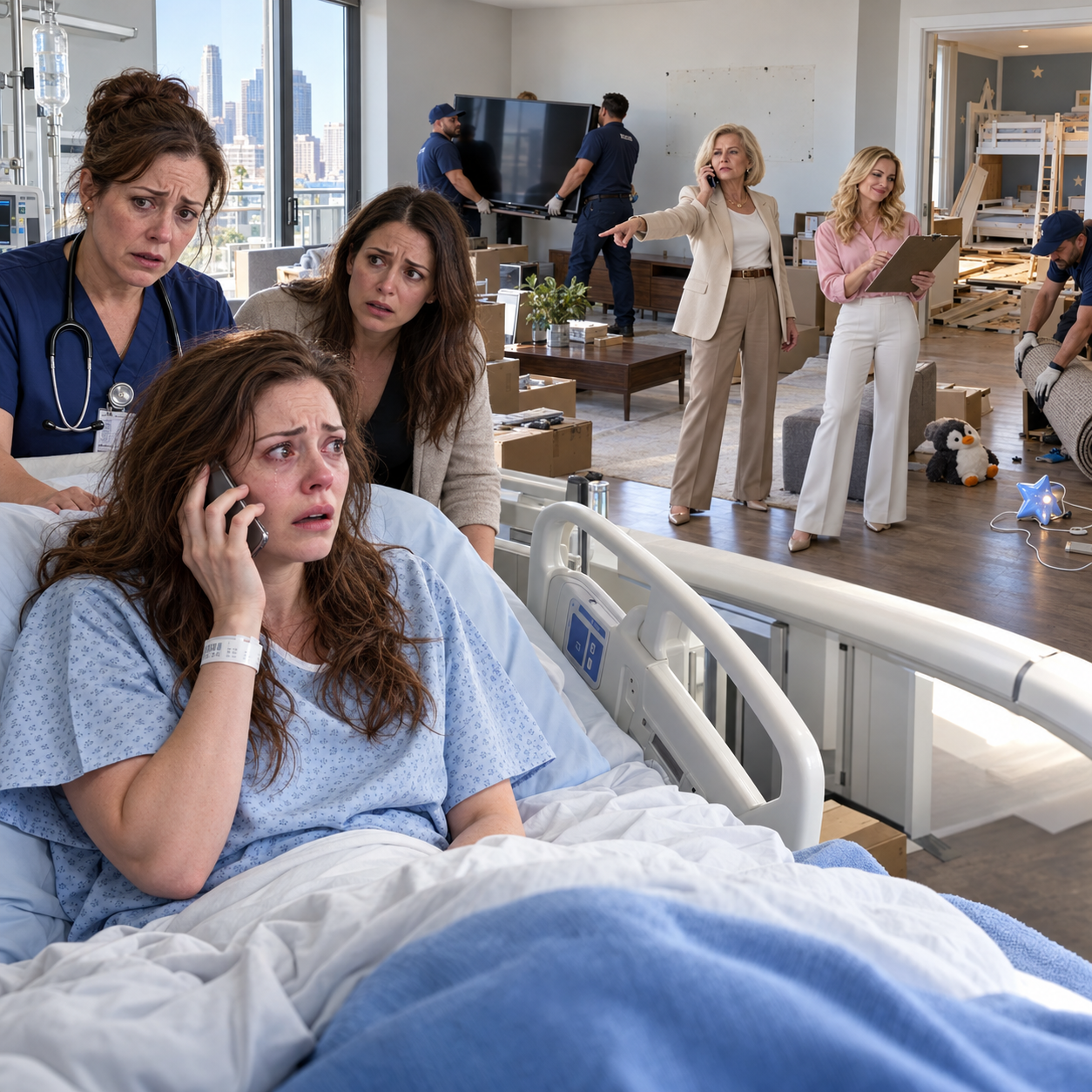
The television, couch, rug, floor lamp, and walnut coffee table were gone. A pale rectangle marked the wall where the television had hung. The dresser had disappeared from my bedroom, but the worst discovery waited down the hallway. Both children’s bunk beds were missing, leaving only Mary’s star-shaped reading light and Captain Malcolm sitting on the bare carpet.
I picked up the little penguin and turned toward the doorway. Ray had modified those beds himself, adding shelves, stronger rails, and reading lights so Mary could stay up with her astronomy books. He had spent three weekends sanding the wood while our children supervised with snacks. Now his work had vanished from their room.
“Your sister needed furniture,” Mom said behind me.
She was standing in the kitchen holding a mug Ray had given me years earlier. Clare remained near the front door, staring at the empty space. I asked why Julia needed my children’s beds, and Mom explained that her new apartment had a guest bedroom. When I reminded her that Mary and Sam would need somewhere to sleep, she shrugged.
“They weren’t using them while you were away.”
“Because I was in the hospital.”
“Exactly. There was no reason for everything to sit here unused.”
I looked at my hospital bracelet, still wrapped around my wrist. Mom began explaining that Julia had endured a difficult separation, that I was financially comfortable, and that I could replace anything I missed. She even mentioned Ray’s life insurance, most of which I’d used years earlier to secure our home and establish savings for our children.
“That money came from losing my husband,” I told her. “It wasn’t a gift fund for Julia.”
Mom looked toward the hallway. “Don’t make this about Ray.”
“Then why did you take something he made?”
For once, she had no immediate answer. I asked whether she’d requested permission, and she admitted she’d assumed I would refuse. Clare stepped closer, but I raised one hand to reassure her. I wanted facts now, not another argument that would end with my mother insisting I’d misunderstood her intentions.
Ray had installed our first indoor security camera, and I’d added two more after several package thefts in the building. I opened the recording app and selected Saturday’s footage. Mom entered using her emergency key, followed by Julia and three movers. My sister carried a clipboard and pointed toward the couch, television, rug, and coffee table while a mover consulted an inventory sheet.
“Your sister gave permission?” one man asked.
Mom nodded on the recording. “Yes, Hazel knows all about it.”
I played that section again. Mom shifted her weight beside me but said nothing. The next clip showed Julia standing inside the children’s bedroom, directing the movers toward the bunk beds.
“Take those, too,” she said. “Hazel can buy replacements. She makes plenty teaching women to be aggressive.”
Mom answered from the hallway, “Besides, the kids aren’t here.”
I watched the clip twice. Somewhere inside that sentence was everything I had spent years refusing to acknowledge about my family. My children hadn’t merely been overlooked; their absence had been used as justification.
I saved copies of the footage, photographed the empty rooms, and began listing the missing property. Mom demanded to know whether I intended to make a scene over ordinary household things. I asked when Julia planned to return them, and she said that would depend on how quickly my sister got settled.
“That’s not an arrangement,” I said, slipping the phone into my bag. “That’s permission you never had.”
Clare picked up my discharge folder. Mom watched us move toward the door and asked where we were going. I told her I intended to file a police report.
“You wouldn’t do that to your own sister.”
I looked back at the empty bedroom. “You both had seven days to remember she was my sister.”
Then Clare helped me downstairs.
### Part 3: A Moving Inventory Revealed Who Had Authorized The Theft
Officer Elena Brooks listened without interrupting while I explained what had happened. She reviewed the recordings, asked whether I’d authorized anyone to remove the furniture, and examined the purchase records I could retrieve from my phone. I showed her photographs of Ray working on the bunk beds and a digital receipt for our television. She carefully documented everything without promising arrests or pretending the legal questions would be simple.
When she asked whether I knew which moving company had been hired, I showed her the truck visible through our front window. Clare sat beside me while Officer Brooks noted the company name. Before leaving, I asked for the report information, and she handed it over. Ray had always told me that when people disagreed about what happened, good records were worth more than loud arguments.
Back home, Naomi found me sitting at our mismatched dining table, one of the few pieces Julia apparently hadn’t wanted. She arranged temporary mattresses in case the children’s beds weren’t returned promptly and insisted on handling anything heavy. I was still weak enough that walking between rooms required a rest. When I apologized for imposing, Naomi reminded me how often I’d collected her daughter from school or helped when she was sick.
That evening, my phone filled with calls. Mom wanted to know whether I’d really involved the police. Julia accused me of destroying her fresh start, then insisted that Mom had assured her everything was permitted. I replied that I wanted every item returned in its original condition and asked that all further arrangements be made in writing.
Julia’s response arrived minutes later.
“I spoke to a lawyer. Family property is complicated.”
“You signed a lease,” I wrote. “You didn’t acquire my living room.”
The following morning, she offered to return the bunk beds but wanted to keep the other furniture because she’d already arranged her apartment around it. I declined. She complained about moving expenses and suggested I should show more compassion for someone rebuilding her life.
My father called that night. He admitted knowing Julia needed furniture but insisted he’d believed she was buying it. When I told him the beds were gone, he stopped speaking for several seconds. Then he said, “I should have asked what your mother was doing.” I told him I needed him to stop calling it a misunderstanding, and after a long pause, he agreed.
Two days later, Officer Brooks contacted the moving company as part of the investigation. Its signed work order listed Julia’s apartment as the destination and itemized the couch, television, rug, lamp, dresser, coffee table, and both beds. Julia had signed the inventory herself. The paperwork also showed the movers had been told that I had authorized the removal.
When those records were compared with my messages from the hospital and the security footage, my mother’s explanation became difficult to sustain. She had told strangers that I agreed, while I had explicitly asked her not to rearrange my home. The movers hadn’t invented a story; they’d followed instructions from two women who had no authority to give them.
Mom finally texted, “We need to fix this.”
“Return everything,” I replied.
The deliveries began three days later. The children’s beds came first, followed by the couch, television, coffee table, rug, and lamp. The dresser took longer because Julia had filled it with her clothes and claimed she needed time to find storage. When it finally arrived, an orange scarf remained inside. I photographed it and told her she could collect it through Mom.
With advice from a local attorney, I documented the expenses for moving, assembly, repairs, and changing the locks. Julia eventually agreed in writing to reimburse those costs. The police report remained part of the official process, and I cooperated with the follow-up inquiries. There was no dramatic courtroom victory, only returned property, a written agreement, and consequences my family couldn’t simply talk away.
I gave Naomi the new emergency key, updated the security account, and informed my mother that she could no longer enter without an invitation.
She responded that I’d destroyed her trust.
I looked at the freshly assembled bunk beds and put my phone down.
### Part 4: Returning The Furniture Was Easier Than Rebuilding Our Trust
When Mary and Sam came home, their beds were exactly where they belonged. Mary noticed a fresh scratch near the couch and asked whether someone had moved it. I sat with them at the kitchen table and explained that Grandma and Aunt Julia had taken things without asking while I was sick. I told them the furniture was back and that I’d made arrangements to keep our home secure.
“Even our beds?” Mary asked.
I nodded. She looked toward the hallway, then asked whether Grandma knew Dad had worked on them. When I said yes, she pressed her lips together and studied her hands. Sam held Captain Malcolm against his chest and wanted to know whether anybody had tried to take him.
“No, sweetheart. He’s safe.”
“Good,” Sam said. “He’s in charge of security.”
Mary almost smiled. Then she leaned against me, and I held her until she was ready to get up.
My father visited six weeks later. He called before coming and brought pastries from our neighborhood bakery. We sat at the old dining table while he admitted he should have visited me in the hospital. When he said he’d assumed Mom was taking care of everything, I didn’t rush to excuse him.
“You should have checked yourself, Dad.”
He nodded. “I know.”
We talked about Ray afterward, including his terrible attempts at woodworking and his refusal to throw away a crooked shelf. Dad smiled when I reminded him how much Ray loved those beds. Before leaving, he asked permission to take the children for ice cream the following weekend. I appreciated that small change more than he probably realized.
Julia remained distant. Three months passed before she finally sent a message acknowledging that taking the children’s beds had been wrong. I replied that taking anything without permission had been wrong. After several minutes, she answered, “I know.” It wasn’t the apology I’d once hoped for, but it was the first acknowledgment that didn’t come attached to an excuse.
My recovery continued, and eventually the doctors cleared me to resume teaching. On my first morning back, Clare handed me a mug that read, “I Teach Boundaries.” Ruth, my oldest student, studied it and asked whether I offered private lessons for difficult relatives. I told her I’d retired from that particular specialty, and she smiled as though I’d finally passed an examination she’d been giving me for years.
At home, Sam created an inventory in green marker. Captain Malcolm appeared first, followed by me, cheese, Mary’s telescope, and the couch. Beneath the list, he wrote, “Do not borrow without asking, even if you are Grandma.” Mary insisted on laminating it. Naomi brought over one of her label makers, and the notice took its place beside our grocery list.
Four months after the hospital stay, I took the children to a lakeside cabin for a quiet weekend. One evening, Mary sat beside me on the porch while Sam attempted to explain space travel to Captain Malcolm. The sun had disappeared behind the trees, leaving the lake silver beneath the first stars. Mary rested her head against my shoulder.
“Mom, are we going to be okay?”
I thought about the hospital, our empty apartment, and all the people who had appeared when I needed help. “Yes, sweetheart.”
“How do you know?”
“Because we know how to take care of one another. And when we need help, we know who we can ask.”
“Like Naomi and Clare?”
“Exactly.”
She considered that, then asked whether Grandpa counted. I smiled. “Grandpa’s learning.”
A few weeks later, Mom asked whether she could visit on Sunday. She didn’t mention Julia or ask for anything. I told her three o’clock would work and requested that she call before coming upstairs. She agreed without an argument.
At three, the doorbell rang. Mom stood outside holding a small bakery box, looking unusually uncertain. I invited her in, and she glanced around the restored living room before sitting carefully on the couch. Sam appeared with Captain Malcolm tucked beneath one arm.
“Grandma, are you taking anything home?”
Mom blinked. Mary looked embarrassed, but I didn’t interrupt. After a moment, my mother gave a small, awkward laugh.
“No, Sam. I’m just visiting.”
“Okay,” he said. “We have rules now.”
He pointed toward the laminated notice on our refrigerator. Mom walked over and read it, lingering on the sentence about Grandma. She turned toward me as though expecting an explanation, but I simply poured the coffee and asked whether she wanted cream.
Dad arrived a little later, having arranged to stop by separately. While we ate cookies, Mom mentioned that Julia had finally purchased a beige couch and complained about how expensive furniture had become. She sounded sympathetic, as though Julia had survived an extraordinary hardship.
“Well,” I said, “I’m glad she found one she likes.”
“She had to make sacrifices,” Mom replied.
Dad looked toward my returned coffee table. “That’s usually what happens when you buy things with your own money.”
Mom gave him a look, but he continued eating his cookie. Mary smiled into her glass of milk, and Sam announced that Captain Malcolm approved of the new security arrangements.
I looked around the living room. Ray’s coffee table still had the uneven patch he’d never managed to sand smooth. The children were laughing, my father was reaching for another cookie, and my mother was sitting in a home she finally understood she had to be invited into.
I couldn’t know whether our family would ever become what I’d once wanted it to be. But I no longer needed to pretend that everything was fine to keep everyone comfortable. My children had their home, I had my health to protect, and the people who truly cared about us had shown themselves when it mattered.
For seven days, I’d waited for my family to come through a hospital door.
Now, sitting in my own living room, I finally understood that love wasn’t measured by who possessed a key or shared my last name. It was measured by who respected the people living on the other side of that door.
And for the first time in years, I knew I could love my family without handing them the keys to my life.
The End .
All characters and events in this story are fictional, created for storytelling and entertainment purposes. Thank you sincerely for reading. Your feedback and support are invaluable and motivate me to continue sharing more stories with you.