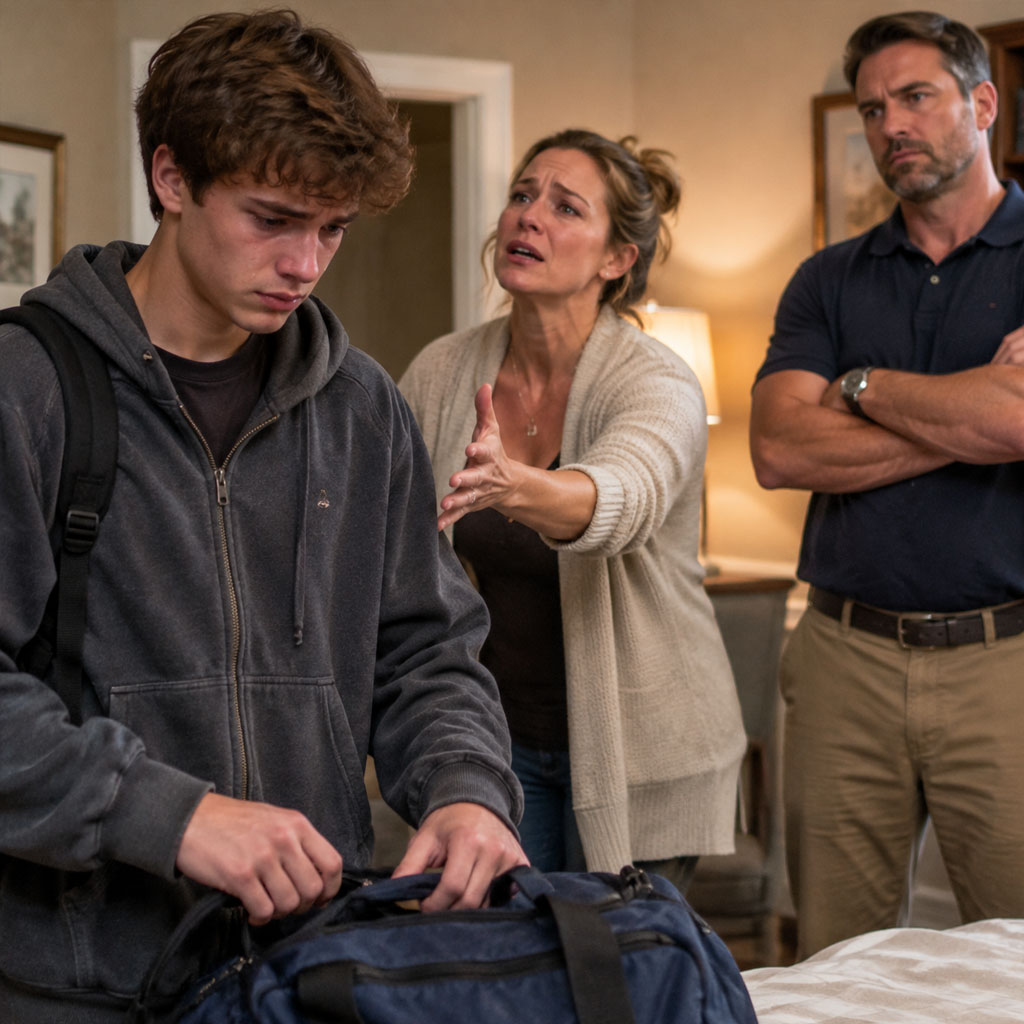
At 9:52 on a Tuesday night, my son sent a message telling me I was no longer welcome in his family’s life. I stood in my kitchen, staring at those words while my tea went cold. Then I opened my banking app and made one decision that would eventually cost him his house.
## Part 1: My Son’s Cruel Message Exposed Four Years of Financial Betrayal
The message arrived while I was pouring boiling water over a red rose tea bag, hoping the warmth might ease the arthritis in my knuckles. My phone vibrated against the kitchen counter, and I smiled, expecting another photograph of my seven-year-old grandson, Leo, showing off his latest missing tooth. Instead, I found a paragraph from my thirty-eight-year-old son, Evan, that made my fingers go numb.
“Mom, Britney and I have talked it over, and we need to step away from you. Your energy is too heavy for our family. You’re suffocating and negative. Please don’t try to find us. We are finished with this relationship.”
I read it twice, watching the tea bag slip beneath the surface of my mug. The words sounded nothing like Evan, who had never discussed anyone’s energy unless he meant the Hamilton Bulldogs. That was Britney’s language, polished and distant, like something printed inside an expensive wellness brochure. But whether she wrote it or not, my son had allowed those words to reach me.
My name is Joyce Hart. I was sixty-eight, widowed, and living alone in the same brick bungalow in Hamilton, Ontario, where my husband, Wayne, and I had spent most of our marriage. I had worked thirty-one years in a school board office, saving carefully, paying every bill, and believing that family helped family. For four years, I had carried my son’s household on a retirement income that barely supported my own.
I looked toward the photograph of Wayne on the refrigerator. He had been gone five years, but I could almost hear his voice telling me that being a mother did not mean surrendering every boundary. I dried my hands, picked up my phone, and opened the banking app.
Two recurring payments appeared on the screen. One was $1,350 toward Evan and Britney’s mortgage. The other was $610 toward the truck Evan insisted his renovation business couldn’t survive without.
I canceled both.
Then I typed my response.
“No problem. I’ll be canceling the monthly payments toward your mortgage and your truck effective immediately.”
I pressed send, rinsed my untouched tea down the sink, and went to bed. For the first time in months, I slept without dreaming about bills.
At six the next morning, sunlight striped the dining room table as I opened my laptop and examined four years of bank statements. Every month, $1,960 had disappeared into Evan’s life. Nearly all my Canada Pension Plan and Old Age Security income had gone toward their expenses, leaving me dependent on a small pension from Wayne’s former employer.
I remembered comparing grocery flyers at No Frills, stretching a bag of potatoes across three dinners, and taping the cracked guest-room window because replacing it seemed selfish. My winter coat had frayed cuffs, and I had been putting off buying another for six years. Meanwhile, Evan had abandoned his steady distribution-center job to start a renovation business, while Britney reduced her hours at the dental office to spend more time with Leo.
Everything was supposed to be temporary.
At 8:10, Evan called. I watched his name flash across the screen until it disappeared. Seconds later, Britney sent a message.
“Joyce, what do you mean you’re canceling? The mortgage comes out Friday. Evan is under enough stress already. Stop overreacting.”
Overreacting. That was their favorite word whenever I questioned something. Asking to see Leo was demanding, declining an expensive birthday gift was dramatic, and apparently refusing to finance people who had disowned me was unreasonable.
I blocked both numbers.
At 9:30, my doorbell rang.
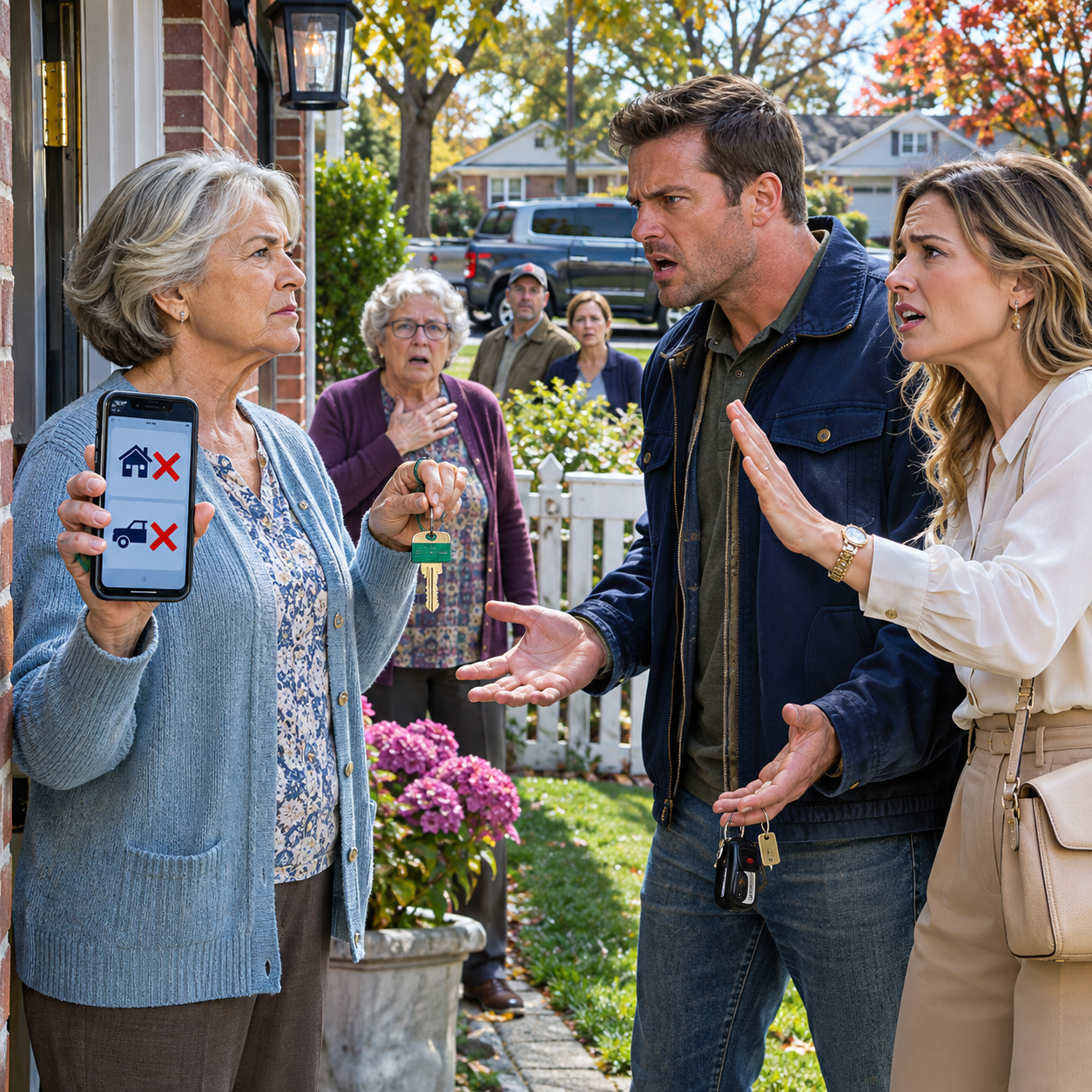
Through the peephole, I saw Evan standing on the porch with his arms folded. Britney hovered behind him, clutching a designer purse that probably cost more than my washing machine. I opened the door but remained firmly in the doorway.
“Mom, why aren’t you answering your phone?”
“You told me not to contact you. I’m respecting your wishes.”
Britney stepped closer. “Joyce, this is ridiculous. You can’t suddenly stop helping us.”
“You said you were finished with me.”
“We needed space,” she snapped. “That doesn’t mean you get to punish us.”
“I’m not punishing you. I’m simply removing the part of me you no longer want.”
Evan’s face reddened. “We don’t have fourteen hundred dollars for Friday!”
“Thirteen hundred and fifty,” I corrected. “And you’ve had four years to figure out how to pay your own mortgage.”
Britney reached toward my hand. I saw panic in her eyes, but not one trace of regret over the message.
Then I noticed Evan’s key ring. A brass key marked with green tape hung beside his truck keys.
“I’ll take my back-door key, please.”
He stared at me, then silently removed it. I closed my fingers around the cool metal and shut the door.
That afternoon, while I was pulling dead tomato vines from the garden, my neighbor Martha leaned over the fence. At seventy-three, she missed very little, especially when shouting carried across our adjoining driveways.
“I saw your Evan at Costco last weekend,” she said. “Buying an enormous television. He was telling the fellow helping him about the home theater they’re putting in their basement.”
My hands stopped moving.
“And Britney’s Niagara wine weekends,” Martha continued carefully. “Funny how they have money for all that when you’re still wearing that old coat.”
I stared down at the dried vines tangled around my fingers.
They weren’t struggling because they had nothing.
They were spending their own money on luxuries because they knew I would pay for everything else.
And suddenly, the cruelest part of my son’s message wasn’t that he wanted me gone.
It was that he expected my money to stay.
## Part 2: I Cut Their Financial Lifelines and Uncovered Another Forgotten Debt
“Come over for tea,” Martha said, studying my face. “I’ve made lemon loaf, and you look like you’ve been carrying something heavier than gardening tools.”
In her kitchen, I finally admitted how much money I had been sending Evan. She listened without interrupting, then lifted her teacup. “Joyce, those two have been treating you like a bank machine with a pulse. I’m glad you’ve finally unplugged it.”
That evening, I opened a notebook and wrote down every bill connected to my son’s household. The list stretched farther than I expected.
On Thursday morning, I drove to the Rogers store on Upper James Street. Three years earlier, Evan had persuaded me to put the entire family on one mobile-phone plan because it supposedly saved everyone money. In reality, I paid almost $200 each month while Evan and Britney upgraded their phones whenever they pleased.
A young employee named Tyler studied my account.
“Mrs. Hart, they can assume responsibility for their devices, but someone still owes the remaining balances.”
“Then the balances belong to the people using the phones,” I replied. “I want those lines removed.”
Forty-five minutes and a cancellation penalty later, I walked outside with a single phone and a monthly bill of $44. Standing beside my car, I changed the passwords to Netflix and Disney Plus, signed out every device, and tucked my phone into my purse.
By the time I arrived home, my landline was ringing.
Evan’s voice burst from the answering machine. “Mom, our phones stopped working! I was talking to a customer about a quote. And Netflix is gone. What are you doing?”
I listened until the recording ended, then made myself a sandwich.
He had asked for distance. I was simply making sure the distance included his expenses.
The next discovery waited inside my rented storage unit on Barton Street. I had originally taken it to preserve Wayne’s tools and several boxes of winter clothes. Two years earlier, Evan and Britney asked whether they could temporarily store a few belongings while renovating their garage.
When I rolled up the metal door, I could barely see my own possessions.
Two kayaks leaned against stacks of expensive baby furniture Leo had outgrown. A hockey net blocked the walkway, holiday decorations filled plastic tubs, and cartons from one of Evan’s failed business ideas covered Wayne’s red tool chest. Several imported patio heaters sat unopened beneath a layer of dust.
I had been paying $140 a month to store their clutter.
At the office, I gave thirty days’ notice. Two workers helped me retrieve my belongings for fifty dollars, and I left everything else untouched.
Back home, I wiped the dust from Wayne’s tool chest and placed it beside his old workbench. For a moment, I rested my hand on its scratched red lid, remembering him repairing Leo’s wooden rocking horse years earlier.
Then I briefly unblocked Britney’s number.
“The storage unit is paid through September 30. After that, you’ll need to arrange your own agreement or remove your belongings.”
I sent the message and blocked her again.
But there was another financial connection I hadn’t yet touched, one that went back to the years before Wayne died.
Five years earlier, Evan and Britney had found their dream house but lacked the down payment. Wayne and I had accumulated savings through decades of ordinary work, and Evan begged us for help. He promised that once his career improved, he would repay everything.
Wayne agreed to lend them $40,000 on one condition.
“Family or not, Joyce, we put it in writing.”
His friend Larry Franklin, a real-estate lawyer, prepared a loan agreement. Evan signed it at Larry’s office, smiling as though the paperwork were an unnecessary formality. The agreement allowed us to demand repayment with sixty days’ written notice.
I had kept it in a filing cabinet for five years.
The following Monday, I put on my good navy blazer and carried that folder into Larry’s office. He read the agreement, removed his glasses, and looked at me across the desk.
“Are you certain you want to enforce this, Joyce?”
I placed my son’s message beside the contract.
“He’s made his decision about our relationship,” I said. “I need to make mine about my finances.”
Larry studied the message, then nodded.
The registered demand letter went out the next morning. The deadline was November 12, and the amount owed was forty thousand dollars.
When the postal confirmation arrived showing Evan had signed for it, I placed the receipt beside Wayne’s photograph.
For years, I had protected my son from the consequences of his choices.
Now the consequences had a date.
## Part 3: Thanksgiving Exposed the Lies My Son and Daughter-in-Law Had Told
October arrived with sharp winds, yellow leaves, and Canadian Thanksgiving approaching. For five consecutive years, I had hosted the family dinner, spending three days preparing the free-range turkey Britney preferred and every side dish she demanded. Evan watched football while I cooked, and Britney photographed the finished table as though she had prepared it herself.
Ten days before the holiday, an email appeared from Britney.
“Joyce, my mother and her husband are coming for Thanksgiving. We’re hosting at our house, but we’re keeping the table small. Since you know how to make the turkey and sides, we’d appreciate you preparing everything and dropping it at the side door by noon Monday. We’ll reimburse the groceries.”
I read the email three times.
They didn’t want me sitting at their table.
They wanted me working in their kitchen.
I could picture Britney greeting her mother, Brenda, beside a perfectly roasted turkey, accepting compliments for a meal she hadn’t lifted a finger to prepare. In previous years, I would have swallowed the insult because I was terrified of losing access to Leo.
This time, I typed two words.
“No, thank you.”
Then I walked next door and invited Martha to share Thanksgiving with me.
On Monday afternoon, her little dining table held roasted chicken, potatoes, and two glasses of chilled white wine. I brought a butter tart pie, and we ate beside the window while autumn sunlight warmed the floorboards.
At 2:15, my phone rang. Evan’s name flashed on the screen. Ten minutes later, an unfamiliar number called.
Martha raised an eyebrow. “Trouble?”
“Someone forgot to hire a caterer.”
We finished our pie before I listened to the voicemail.
“Joyce, this is Brenda,” a bewildered woman said. “I’m standing in Britney’s kitchen. There isn’t any turkey, and she keeps saying you were supposed to bring dinner. Something is terribly wrong. Could you call me?”
I called her from Martha’s porch.
“I’m sorry your Thanksgiving was ruined, Brenda.”
“Don’t apologize,” she answered immediately. “My daughter just admitted you’ve been supporting them for four years. I had no idea. Britney told me Evan’s business was thriving and they had a bank loan.”
“They did borrow money,” I said. “Forty thousand dollars. From me.”
The silence lasted several seconds.
Then Brenda whispered, “I’d like to visit you, Joyce. Not on their behalf. On mine.”
She arrived Wednesday carrying a box of shortbread. A retired nurse of seventy, Brenda had always seemed kind at birthday parties, although Britney rarely allowed us to speak alone. Now she sat at my dining room table, turning the pages of my bank statements with trembling fingers.
When she reached the loan agreement, tears slid silently down her cheeks.
“Britney asked me for money twice last year,” she admitted. “I gave her two thousand dollars in the spring. She said they were having a temporary cash-flow problem.”
I poured fresh tea as she carefully folded the document.
“I won’t give them another dollar to support this nonsense,” Brenda said. “And Joyce, that message they sent you? I know my daughter’s phrases. She wrote it. I’m ashamed I raised someone capable of treating you this way.”
I looked at her hands wrapped around the cup.
“Evan sent it,” I said quietly. “That’s the part I can’t forget.”
Two mornings later, his truck screeched into my driveway while I was sweeping the porch.
Evan slammed the driver’s door and marched toward me, his work jacket hanging open in the cold.
“You humiliated us!” he shouted. “Brenda walked out of Thanksgiving. We ate frozen pizza! Britney’s furious, and now everybody knows our business.”
I continued sweeping the steps.
“Good morning, Evan.”
“Stop acting so calm! Our mortgage payment bounced. Do you understand what that’s going to do to our credit?”
I rested both hands on the broom.
“I warned you five weeks ago that the payments were ending. You chose not to prepare.”
“We’re family! You’re supposed to help!”
I looked directly into his eyes.
“And what exactly am I supposed to call the message telling me never to contact you again?”
His expression flickered.
“Britney was stressed. She wrote half of that thing.”
“Then who agreed with the other half?”
He stared at the porch boards.
“You sent it from your phone, Evan. You had every opportunity to stop it.”
For the first time, he had nothing to say.
Then I mentioned the registered letter.
“The forty thousand dollars comes due November twelfth.”
He looked up sharply. “Mom, we can’t pay that!”
“You signed an agreement.”
“You’re seriously going to take our house?”
“No,” I said. “I’m asking you to return money I lent you. What you do with the house is your decision.”
He stepped backward, shaking his head.
For a moment, I saw the little boy who used to run to me when he was frightened. Every instinct in my body urged me to embrace him and promise everything would be all right.
Instead, I opened my front door.
“You should speak to a realtor, Evan.”
I went inside and fastened the chain.
Behind me, the house remained quiet. I stood with one hand against the door, fighting the urge to call him back.
But there would be no rescue this time.
## Part 4: Losing Everything Finally Taught My Son the Meaning of Family
November 12 arrived beneath a cold, gray sky. I sat at my dining table waiting for a call from Larry, knowing Evan and Britney had received every opportunity to arrange repayment. Shortly after lunch, Larry confirmed what I had expected.
“They haven’t paid, Joyce. I’ll send the next formal notice.”
I looked at Wayne’s photograph.
“Do what the agreement requires.”
January brought a real-estate sign to Evan’s front lawn. Brenda told me they had finally listed the house, although Britney insisted the decision was temporary. By February, the truck payments had fallen so far behind that a tow truck arrived one freezing morning and hauled the vehicle away.
Britney stood in the driveway in her slippers, screaming that I had destroyed their lives.
Brenda told me what happened next.
Evan watched the truck disappear around the corner, then turned to his wife.
“No,” he said quietly. “We did this.”
His renovation business folded in March. Without the truck, reliable financing, or enough customers, the company he’d spent years describing as his future simply stopped functioning. He took an evening position in the flooring department at Canadian Tire, and Britney began searching for additional hours at the dental office.
Brenda refused to offer them her basement.
“They have a child to raise,” she told me over the phone. “It’s time they learn how to stand on their own feet.”
Meanwhile, small changes began appearing inside my own home.
A contractor replaced the cracked guest-room window. I bought a deep-green wool coat on clearance, the first new winter coat I had owned in six years. I even booked a fall bus tour through the Canadian Maritimes, something Wayne and I had once planned but never managed to take.
At a medical appointment, my doctor studied my blood pressure readings and smiled.
“Whatever you’ve changed, Mrs. Hart, keep doing it.”
But there was one ache no medicine could touch.
Leo.
I missed his crooked drawings, his endless questions, and the way he used to curl beside me on the sofa while I read him stories. Every month, I mailed him a postcard, writing ordinary things about my garden, the weather, or the birds at my feeder.
I never knew whether he received them.
In April, Evan and Britney’s house finally sold. The proceeds cleared their mortgage and left enough to repay my loan, with Larry’s fees covered from the interest. They rented a modest two-bedroom apartment above a dry cleaner in Stoney Creek.
On a bright Tuesday morning, Larry called and asked me to come collect my check.
When I entered his office, I stopped in the doorway.
Evan and Britney were sitting in the waiting room.
Britney wore a thin coat, her hair pulled back with an ordinary elastic. Evan had exchanged his renovation-company jacket for one bearing the name of the hardware store where he now worked.
They both stood.
For several seconds, nobody moved.
Then Britney stepped forward, her eyes filling.
“Joyce, I’m sorry,” she whispered. “For the message. For the money. For treating you the way I did.”
She swallowed hard.
“I thought you’d always be there, no matter how we treated you.”
I felt the familiar impulse to make things easier for everyone. But before I could speak, Evan moved toward me.
“Mom, I was a coward.”
His voice cracked.
“I let Britney write that message because I didn’t want to argue with her. But I agreed with enough of it to send it. I let you pay our bills while I bought things we didn’t need. When you asked to see Leo, I acted like spending time with your own grandson was some kind of privilege you had to earn.”
He wiped his eyes.
“I kept telling myself the business would take off and I’d pay you back. But I never made a real plan. I just assumed you’d keep sacrificing.”
Britney lowered her head.
“I don’t want anything from you,” Evan continued. “Not another loan. Not another favor. I just want you to know that I finally understand what I did.”
I looked at my son, remembering the frightened little boy beneath the grown man’s face.
I still loved him.
That was what made everything so difficult.
“I believe you’re sorry,” I said. “But I don’t know whether you’d be standing here apologizing if your mortgage had never bounced. That’s something you’ll have to answer for yourself.”
He nodded, tears slipping down his cheeks.
I glanced at Britney, then back at Evan.
“Here’s what happens next. I’m never financing your lifestyle again. Not the mortgage, not the truck, not the phones. If I return to your family, I return as your mother and Leo’s grandmother. Not as your emergency savings account.”
“That’s fair,” Evan whispered.
“And respect isn’t something you switch on when you need help. You’re going to have to earn my trust again, one visit at a time.”
Britney nodded without meeting my eyes.
Then I said the words I had been carrying for seven months.
“I’d like to see Leo.”
Evan covered his mouth with one hand.
“Saturday mornings,” I continued. “Two hours to begin with. You can bring him, Evan. Britney can drive, but I’m not ready to welcome her into my home yet.”
Britney wiped her cheeks.
“I understand, Joyce.”
It was the first time she had said my name as though it belonged to a person rather than an obligation.
Larry’s secretary called me to the counter and placed the repayment check in front of me. I signed the receipt and slipped the check into my purse beside a postcard I had bought for Leo, showing a loon swimming across a northern lake.
Outside, April sunlight washed across the parking lot. I walked toward my little car, feeling neither victorious nor defeated.
I had my savings back.
My son had finally accepted responsibility.
But the one thing I wanted most was still waiting behind Saturday morning.
At exactly ten o’clock, a knock sounded at my front door.
I hurried down the hall, smoothed my blouse, and opened it.
Leo stood on the porch holding a folded piece of paper. He had grown taller, and there was a new gap between his front teeth. Evan stood several steps behind him, his hands buried in his jacket pockets.
“Grandma!” Leo cried.
Then he unfolded the paper.
It was a drawing of my little brick bungalow, with tomato plants in the garden and two figures standing beside the front door. One was a small boy. The other was an older woman carrying an enormous handbag.
Across the top, in crooked blue letters, he had written, “GRANDMA AND ME.”
I pressed my fingers to my lips.
“Did you draw that for me, sweetheart?”
He nodded enthusiastically.
“And Grandma? I got your postcards.”
I blinked back tears.
“All of them?”
“Every single one. Dad kept them in a box for me. I read them whenever I missed you.”
Behind him, Evan lowered his head.
I knelt carefully and opened my arms. Leo rushed into them, wrapping himself around my neck with the fierce certainty only a child can have.
I held him until he loosened his grip.
Then I looked over his shoulder at my son.
Evan didn’t ask whether he could come inside. He simply waited, giving me the choice he had denied me for so long.
“Two hours,” I reminded him gently.
He nodded.
“Thank you, Mom.”
I took Leo’s hand and led him toward the kitchen, where a plate of homemade cookies waited beside two glasses of milk.
As I closed the door, I glanced once at the green wool coat hanging on its hook and the sunlight spilling through my new window.
For years, I had believed that loving my son meant keeping him comfortable, even when it left me with almost nothing.
But love wasn’t supposed to make one person disappear so another could live without consequences.
I had not destroyed my son’s family by finally saying no.
I had given him the chance to become the man I had always hoped he would be.
And when Leo climbed onto his favorite kitchen chair and asked whether we could plant tomatoes together again, I smiled through my tears.
“Of course, sweetheart,” I said, reaching for the seed packets. “There’s plenty of room in the garden.”
THE END.
All characters and events in this story are fictional, created for storytelling and entertainment purposes. Thank you sincerely for reading. Your feedback and support are invaluable and motivate me to continue sharing more stories with you.