
The Two Words My Father Fought to Say at My Wedding—After My Stepmother Erased His Promise
I paid for my wedding after my stepmother insisted Dad had forgotten the $5,000 he promised before his stroke. Losing the money hurt, but losing his place beside me at the altar felt unbearable. She called him too weak and confused to face 150 guests. I pushed his wheelchair down the aisle anyway. When the minister asked the traditional question, Dad opened his mouth and struggled for words—and my stepmother looked suddenly terrified of what he might say.
Part 1
The first thing Denise did was slide the unpaid bills between us. Then she told me Dad didn’t remember promising five thousand dollars for my wedding. Her kitchen smelled of burnt toast. In the next room, Dad watched baseball from his wheelchair.
“Ray doesn’t remember saying any such thing, Maren,” she said, pressing her fingers against the paper stack. “And I have power of attorney now. His care comes first.” His care came first. But a stroke hadn’t erased forty years of fatherhood.
In December, a month before the stroke, Dad had caught me and Eli beneath the porch light after Eli proposed. He’d hugged us both, laughing into Eli’s wool coat, and said, “I’ve put five grand aside for your wedding, kiddo; your mom would’ve wanted me to help.” Mom died when I was nine, and Dad had always handled the things she would have wanted to do, from sewing loose buttons onto my winter coat to driving five hours for a school awards ceremony. I hadn’t asked for money, and wouldn’t beg now.
“I remember exactly what he said,” I told Denise. She flipped a utility bill face down and replied, “Well, he doesn’t, and I’m not discussing it further.” Two taps sounded from Dad’s chair, which Denise ignored.
I went to him before leaving. The January stroke had weakened his right side and tangled speech that once came as easily as breathing. He still followed conversations and complained about lukewarm coffee with one look. When I kissed his forehead, he squeezed my hand with his left and watched me a little too closely.
“It’s okay, Dad,” I whispered, although I wasn’t sure whether I meant the money, the wedding, or what had happened to him. His lips moved around a sound he couldn’t catch, and frustration tightened his jaw. Denise appeared with his afternoon schedule, so I said goodbye before he exhausted himself trying. I cried beside a grain field until I could see the road.
Eli was at our kitchen table when I arrived, still wearing his grain-elevator work boots. I told him everything. He pulled a yellow pad from the drawer and wrote “WEDDING.” “We can pay for a day,” he said. “We can’t buy back a memory of him being there, so let’s protect the part that matters.”
We crossed off the ballroom, photo booth, and elaborate flowers. We kept the little white church, a potluck-style supper in its fellowship hall, and enough room for the 150 people who’d already received invitations. I cleaned kennels after clinic hours while Eli worked weekend grain shifts. By June, our savings account looked less hopeless, although our hands were always tired. Our revised budget came to almost nine thousand dollars, with enough for a modest meal and a photographer. I kept the figures folded in my purse, afraid Denise might somehow make me feel ashamed of even that.
I found my dress on a clearance rack for $280 and stitched a loose pearl back onto the neckline myself. Eli’s aunts volunteered to bake dessert bars, and his uncle offered to repair the church’s temperamental sound system. Their generosity warmed me, even as Dad’s unfulfilled promise still stung.
In early July, I returned to Denise’s house to make one request. “I want to push Dad down the aisle and hold his hand,” I said. Denise answered, “He tires opening mail. Don’t make him perform.”
Dad was listening, his left hand resting on the kitchen table. When I asked him directly, “Do you want to come down the aisle with me?” he struck the wood twice, hard enough to rattle Denise’s spoon. Two taps meant yes. Denise called it a reflex; Dad met my eyes and repeated it.
I left with his answer and a new worry: if Denise could dismiss his yes while he was sitting right there, what would she do on the day he needed her help getting to the church?
Part 2
Every Tuesday, Denise drove Dad sixty miles to a speech clinic in Fargo. I appreciated that she made the drive. But when I asked how therapy was going, her answers sounded rehearsed. “Same as always. Don’t expect miracles,” she’d say, before changing the subject to the price of gasoline.
Dad and I developed our own little language. A raised eyebrow meant I was talking too much; two taps meant yes; one meant no. He chose tablecloths and approved Eli’s navy tie through photographs. Once, when I offered him two cake flavors, he tapped no for both, then pointed stubbornly at the chocolate one I had accidentally left off the list. Denise would stand nearby and say, “He’ll agree to anything if you give him enough choices,” even when he had clearly made up his mind.
One Saturday in August, I arrived with samples of the wedding music. Dad sat outside under the old cottonwood tree, where cicadas rattled in the branches and the garden hose dripped against the concrete. I played the instrumental tune he’d hummed while fixing my bicycle as a child. His eyes filled, and he touched his chest, then reached for my wrist.
“You remember it?” I asked. He tapped twice and made a rough sound that could have been the beginning of my name. I wanted to push him to say more, but the therapist had advised patience, and Dad hated an audience when words wouldn’t come. So I sat beside him until the song ended and let the quiet be enough.
The next week, Denise called to say he was too tired for our planned dress fitting. I’d arranged for the seamstress to check the height of his wheelchair armrest, so the tulle wouldn’t catch on its wheel. Denise said that sounded unnecessary and added that her brother could escort me if Dad couldn’t manage. “People will understand,” she told me, with the particular certainty of someone who hadn’t asked the person involved.
I drove over anyway, carrying a bag of peach muffins from the bakery Dad loved. His chair was empty when I looked through the living room window, and I panicked until Denise opened the door. He was in the back room practicing transfers with a visiting physical therapist, working harder than I’d seen him work all summer. When he noticed me, he straightened his shoulders and gave the therapist a stubborn little wave to continue.
That afternoon I learned something Denise hadn’t mentioned. The therapist said Dad was practicing sitting upright for the length of the ceremony. He’d shown her our church invitation. I went home relieved, then unsettled: why had Denise talked about replacing him when he was working so hard to be there?
Eli found me at midnight surrounded by seating charts and receipt envelopes. “Are you worried about the wedding or your dad?” he asked, kneeling beside my chair. I admitted I was afraid I’d spend the whole ceremony watching Denise, waiting for her to decide he was too much trouble. Eli took my pen and wrote one line across the schedule: “Ray and Maren: aisle together, no substitutes.”
I called the church coordinator and arranged a clear path between the pews, a front-row space for Dad’s chair, and a quiet room if he needed to rest. Our minister, Reverend Porter, agreed to pause whenever Dad needed time. I didn’t ask him to say anything at the altar. Just getting there together seemed like more than enough.
Three days before the wedding, Denise brought back my written schedule with a change in blue ink. She had crossed out “Ray and Maren” and written “Maren escorted by Uncle Peter.” Underneath, she’d added, “Don’t put Ray through unnecessary embarrassment.” I stared at her neat letters while Dad watched us from across the table, his left fist curled tight against the wood.
For the first time, I wondered whether Denise was protecting him from the ceremony—or protecting herself from hearing him make a choice she couldn’t control.
Part 3
“Uncle Peter isn’t walking me anywhere,” I told Denise, keeping my voice low. Denise folded her arms and said I was being selfish, that nobody wanted to watch a sick man struggle in front of a church full of relatives. Dad hit the table twice, and the sharp knocking cut through her sentence.
I moved beside Dad. “One tap for no, two for yes. Do you still want us to go together?” He looked at the schedule in my hand, then at Denise, and knocked twice with deliberate spaces between the taps. She turned toward the sink, muttering that I would be sorry if he became upset.
With Dad’s permission, I called his therapist about his energy limits. She couldn’t promise what he would manage on Saturday, but she said something that made my throat tighten: “Your father has been very clear about what matters to him.” When I thanked her, she paused, as if deciding how much to say. “He has a particular goal,” she added. “I think he’d rather surprise you.”
I assumed he wanted to stand. For a moment I imagined him beside the pew, before guilt replaced hope. The next morning I told him, “You don’t have to prove anything to anybody,” and he gave me his familiar exasperated look. I remembered him standing for hours beside my childhood horse at a county fair, just so I wouldn’t have to wait for the judges alone. Showing up had always been his language.
On Thursday, I visited with his shoes freshly polished. Dad pointed to a framed photograph of my mother in her church dress, then to the dark suit waiting on his closet door. He couldn’t explain the connection, but I knew the wedding belonged to both of them in his heart.
On Friday, I arrived at the church to arrange wildflowers in jelly jars. Denise was there first, speaking quietly to Reverend Porter beneath the stained-glass window. “Please don’t ask him to speak,” she said. The minister promised no one would pressure him.
Denise noticed me and pressed her lips together. “I’m trying to spare him,” she said, brushing lint from her sleeve. I thought about the twice-tapped answers she’d dismissed for months. “Then listen when he tells you what he wants,” I replied, and turned back to the jars before my voice could shake.
That evening, Dad called from Denise’s phone. I could hear the television and the faint squeak of his wheelchair, but he didn’t manage a recognizable word. I stayed on the line and told him the flowers were ready, the weather forecast was clear, and Eli had finally learned how to tie his own bow tie. He answered with his old breathy chuckle.
Saturday morning came with a pale blue sky and the smell of cut grass around the country church. I stood in the dressing room while Eli’s aunt fastened the last pearl on my gown. I dropped an earring, and she found it. “Your father is here,” she said when she returned, smiling. “He insisted on wearing his good suit.”
He waited by the doors, his boutonniere crooked. Denise wore sage green and held a folded program as if it were a legal document. “Remember, we can still change this,” she whispered, but Dad reached for my hand before I could answer. His palm was warm; his grip was weak and unmistakably his.
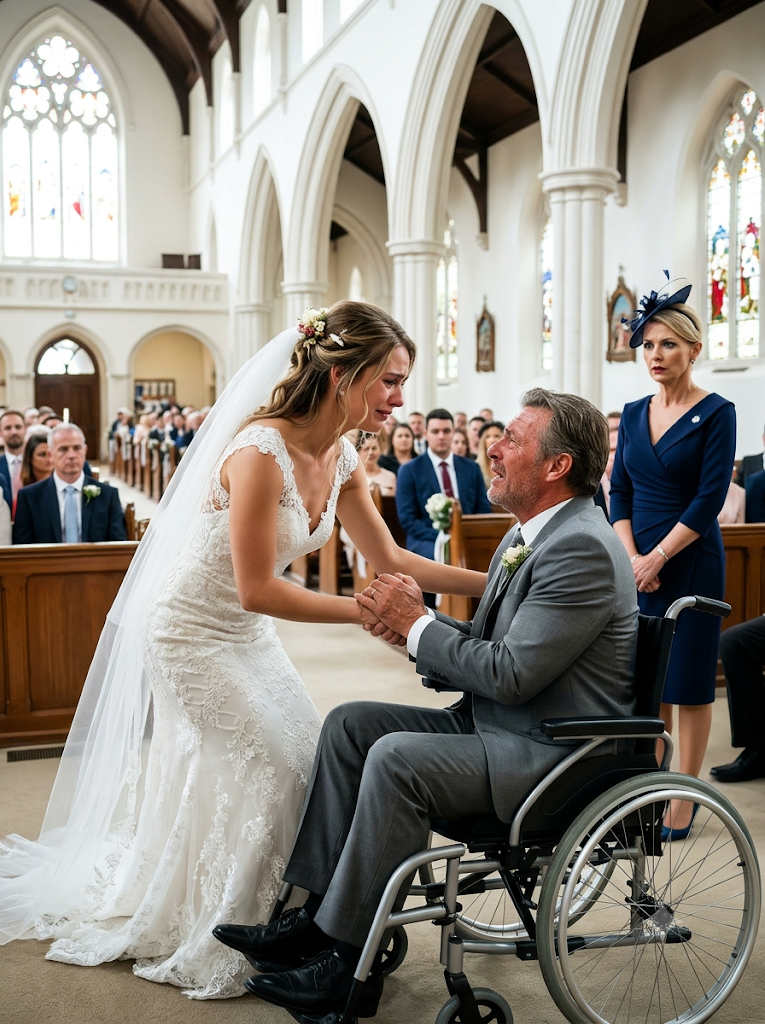
As the organ began, I pushed his wheelchair toward the aisle, checking the wheel locks one last time before releasing them. All 150 guests stood, programs rustling. Dad kept my fingers wrapped in his left hand while I steered with my right, and when someone murmured, “Look at Ray,” I saw him lift his chin.
At the front, I stopped the chair and locked its wheels. Reverend Porter smiled, then asked, “Who gives this woman to be married?” Dad tightened his grip and opened his mouth. Across the first pew, Denise leaned forward, and I heard the sharp little breath she took as my father tried to speak.
Part 4
At first, no sound came. Dad’s lips moved with fierce concentration. I wanted to rescue him from the silence. But Dad squeezed my fingers once, asking me to wait.
A loose windowpane ticked in the breeze. Dad drew a careful breath and worked his mouth around the first sound. Then, with a trembling voice that carried farther than any of us expected, he said, “I do.” Those two words carried the man I knew before January.
Someone gasped. Eli’s eyes shone; Denise covered her mouth. Reverend Porter waited while I bent to kiss Dad’s cheek. In the front pew, two elderly neighbors held hands and smiled at him, the way people smile when someone finishes a hard race. He smelled of aftershave and peppermint. He squeezed my hand before letting go.
The ceremony passed in fragments: sunlight on Eli’s collar, my cool wedding ring, my shaky vows. At the reception, people thanked Dad, who blushed as though he’d delivered a speech.
His speech therapist, invited as a friend, stood by the lemonade table. “He practiced that?” I asked. She asked Dad’s permission; he tapped twice.
“For weeks,” she said. “We worked on different things, but those were his words. Sometimes he’d manage the first one and lose the second. He’d rest, then ask to try again.” He hadn’t wanted an audience; he’d wanted to give me one clear answer.
Denise approached while I was still wiping my eyes. “I truly didn’t think he could do it,” she said, staring at the floor. I asked why she’d crossed him off the program when he’d repeatedly said yes. She answered, “I was afraid people would pity him,” then added, after a pause, “And I didn’t want him upset with me about the money.”
Denise admitted Dad had told her about the money before his stroke, but she had held it for medical expenses. “I thought if you knew he remembered, you would ask him to overrule me,” she said. Keeping money for his care was understandable; pretending he had forgotten was not. “You could have told me the truth instead of making me doubt whether Dad still knew me,” I replied.
She apologized; I did not forgive her. She had made him seem confused to conceal her decision. That hurt more than the money. I told her she would no longer speak for Dad when he was capable of expressing his wishes, and that future visits and decisions would respect his voice and his legal rights. She nodded, and I returned to the reception.
Later, Dad caught my sleeve as Eli and I prepared to leave. He handed me a small card with a shaky line of writing on it, made slowly with his left hand: “Proud of you.” Beneath it was the horse he used to draw on my lunch notes. I folded it carefully into my bouquet ribbon and hugged him for as long as he wanted.
I never asked about the money again. Eli and I paid the last bill ourselves, then framed a photograph of Dad and me halfway down the aisle, both looking ahead. I kept a respectful distance from Denise; I saw Dad when he wanted to see me and made sure he could answer for himself. He continued therapy, one stubborn syllable at a time. There was no sudden miracle recovery, only practice, frustration, small victories, and the familiar look he gave me whenever I tried to help too soon.
Years later, when our daughter asked why Grandpa Ray was holding my hand in that picture, I told her he had worked all summer to say something important. “Was it a long speech?” she asked, tracing the frame with one finger. I smiled at the photograph of his crooked boutonniere and proud, lifted chin. “No, honey,” I said. “It was two words, and he meant every one of them.”
Legal Notice: This story is a work of fiction. Names, characters, businesses, events, and incidents are the product of the author’s imagination or are used fictitiously. Any resemblance to actual persons—living or dead—or to actual events is purely coincidental. Thank you! 💓


