
The Two-Dollar Birthday Gift That Cost My Son His Home
I turned seventy-three with a homemade cake, a two-dollar lottery ticket, and a daughter-in-law who thought my future was a joke. I smiled when she laughed, even after I discovered something on that ticket that could have changed everything. For ten months, I kept cooking their dinners and listening to them plan where to put me when I became inconvenient. Then my son handed me a retirement-home brochure, and I made one quiet decision. By morning, he would understand who had really been holding the keys.
Part 1
The only present at my seventy-third birthday dinner was a scratch-off ticket with a price sticker still attached. My daughter-in-law, Brooke, slid it across the kitchen island as if she were leaving a tip for slow service. “Maybe you’ll win bus fare, Evelyn,” she said, laughing. My son, Daniel, smiled into his glass, and I concentrated on cutting the cake I had baked myself.
It was February, and rain rattled the windows of their house outside Raleigh. I had prepared meatloaf, mashed potatoes, and the lemon frosting Brooke liked before she decided it was too tart. My grandson, Noah, asked whether I had made a wish. I said I had, although I couldn’t have told him what I wanted without embarrassing everyone at the table.
I had lived under that roof for almost four years, ever since my husband, Owen, died of a sudden heart attack. Daniel had insisted I leave our old place because the stairs were steep and he worried about me alone. At first, having family nearby softened the silence Owen left behind. Then my place at the dinner table slowly became a position on the household staff.
I made breakfast before Brooke’s early meetings, collected Noah and his younger sister, Sadie, from school, and washed sheets that weren’t mine. When I asked to visit my sister in Charleston for a long weekend, Brooke frowned at her calendar. “But who will take Sadie to gymnastics?” she asked. I stayed, convincing myself that being needed was another form of being loved.
The children were not unkind, although they copied what their parents said without understanding it. Sadie sometimes tucked drawings beneath my pillow, and Noah still asked me to tell stories about his grandfather’s tackle shop. Yet even they had learned to call my downstairs bedroom “Grandma’s room for now.” The words bothered me more each time I heard them.
At the birthday table, Brooke handed me a quarter because I couldn’t find one in my purse. I scraped the gray coating off the ticket while Daniel checked a message on his phone. A cluster of matching symbols appeared beneath the dust, alongside a printed instruction I read three times. My hand trembled so badly that I put the quarter down before anyone could notice.
“Anything?” Daniel asked, already reaching for another slice of cake. “Not even bus fare,” I answered, folding the ticket into the pocket of my cardigan. Brooke gave a delighted snort and asked if I could rinse the plates before the icing hardened. I carried the dishes to the sink, where cold water ran over my fingers without my feeling it.
That night, I laid the ticket on my bedspread beneath a reading lamp and examined every symbol again. Owen had always handled big financial decisions, while I managed the ordinary details that kept our lives running. I wanted his calm voice beside me, telling me whether to laugh or be afraid. Instead, I found the claim instructions and carefully hid the ticket inside my sewing box.
Three days later, I passed the kitchen doorway with a basket of clean towels and heard Brooke say, “Your mother has become a burden.” Daniel replied, “I know, but what am I supposed to do?” He didn’t defend me, didn’t mention the meals or school pickups, didn’t even lower his voice. I stood there until the towels grew heavy in my arms.
The following morning, I told them I had a dental appointment and took a cab downtown. In my purse were the ticket, my driver’s license, and a small photograph of Owen standing outside our shop. I had arranged to meet an attorney named Adrian Bell, whose office smelled of coffee and polished wood. He looked at the ticket, then looked at me with an expression that made my throat tighten.
“Mrs. Mercer,” he said, closing the office door, “before we discuss what this is worth, does anyone in your family know?” I pictured Brooke’s laugh, Daniel’s shrug, and Sadie’s drawings under my pillow. “Nobody,” I said. Adrian placed the ticket gently inside a protective sleeve and told me there was a very good reason to keep it that way.
Part 2
Adrian did not congratulate me until he had verified the ticket through the proper lottery process. The top prize was advertised at eight million dollars, an amount so absurd I could barely pronounce it. The cash option and taxes would reduce that figure considerably, but what remained could still change several lives. I sat in his office gripping Owen’s photograph and wondering why joy felt so much like danger.
“Sudden money doesn’t fix people’s intentions,” Adrian told me. We worked with a financial adviser, reviewed the claim rules, and protected my privacy as far as the law allowed. I updated my will and arranged separate education trusts for Noah and Sadie, with an independent trustee controlling distributions. Their parents would never be able to use that money to pay their own bills.
I almost told Daniel on the night everything was finalized. He came home exhausted, dropped his briefcase on the counter, and said the rent had increased again. I opened my mouth, imagining how relieved he might be if I offered to help. Then Brooke called from upstairs, “Evelyn, did you remember to wash my work blouse?” and my son called back, “She’s doing it now.”
I hadn’t touched the blouse. I was repairing the dishwasher instead. Something in me shifted as quietly as a lock turning. I finished the repair, went to my room, and wrote a sentence in my notebook: “No more decisions made out of guilt.” It was the first promise I had made to myself in years.
For the next several months, my days looked almost exactly the same. I packed lunch boxes, listened to Brooke complain about office politics, and watched Noah practice basketball in the driveway. But I also started meeting Adrian once a week and learning how to read investment statements. At seventy-three, I discovered that understanding my own finances felt better than being praised for folding towels.
One afternoon in March, Adrian mentioned that the owner of Daniel’s rental house wanted to sell. The landlord lived several states away and had grown tired of repairs and paperwork. Daniel had wanted to buy the house for years. I asked Adrian to investigate the asking price, the lease, and the condition of the property.
I paid for an inspection and spent an hour studying photographs of rooms I cleaned every day. I found it strange to see the chipped kitchen baseboard listed as a defect worth negotiating over. Owen used to say you couldn’t know the value of a thing until you stopped taking it for granted.
In April, Daniel announced at dinner that the landlord had sold to a company called O&E Home Holdings. “Probably some investment outfit,” he said, scrolling through an online payment portal. I poured lemonade for Sadie while the familiar initials sat unnoticed between us. They had once appeared on every cardboard box at Owen and Evelyn’s Outdoor Supply.
I wasn’t ready to leave immediately, even though I now had the means. Leaving the children would hurt. Instead, I visited my sister, Ruth, who lived near Charleston, and let her drive me past quiet streets lined with live oaks. She had spent years inviting me to make a life that did not require asking permission.
We stopped at a small cream-colored cottage with green shutters and an overgrown rose garden. Sunlight spilled across the kitchen floor, and I could hear wind brushing the porch screens. “You look like yourself again,” she said, and I surprised us both by crying.
By June, the cottage was mine. I chose a blue sofa, an oak table, and a reading chair. I kept the keys in the same sewing box that had held the ticket. Nobody in Raleigh knew I had another front door.
Then one evening, I found a real estate folder beneath Brooke’s laptop, with my name written across a yellow sticky note. I assumed it was another scheme to make me sign something about the house. When I lifted the cover, however, the smiling silver-haired strangers in the photograph told me it was something else entirely.
Part 3
I put the folder back exactly where I’d found it, but I couldn’t forget the smiling couple on the cover. They were playing pickleball beneath a headline promising freedom and companionship. At breakfast, Brooke watched me over her coffee as though I might ask the wrong question.
For two weeks I watched them hold private conversations that stopped when I entered the room. Daniel took calls on the deck; Brooke measured my bedroom. When I asked what she was measuring, she said Noah needed to know whether his desk would fit downstairs. “For a school project,” she added, too quickly.
The explanation didn’t make sense, but it told me something important: they had already pictured my room without me. I called Adrian and asked him to review the lease on the rental house. He explained the month-to-month lease’s notice requirements. I asked him to prepare options but not send anything yet.
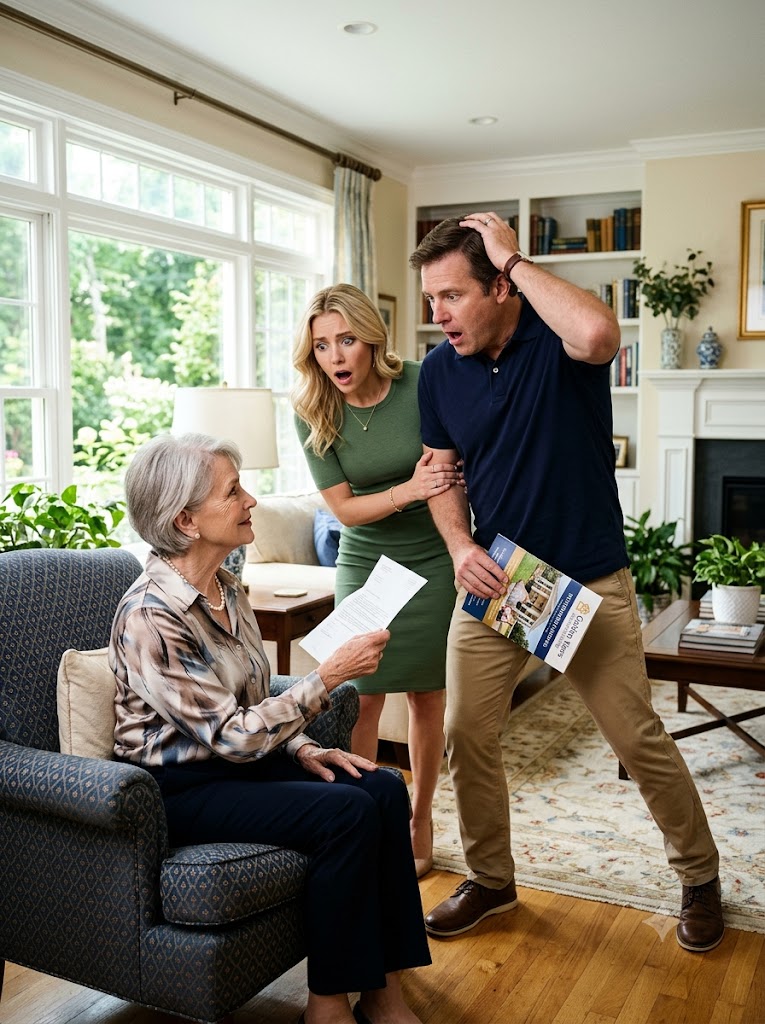
On a chilly Thursday in mid-November, Daniel put down his fork before dessert. “Mom, Brooke and I found a place we think you’ll love,” he said. Brooke slid over the same brochure. Willowbrook Gardens promised meals, shuttles, and companionship.
“Have you visited it?” I asked. “Twice,” Brooke replied, tapping a polished fingernail against a studio floor plan. “There’s a room that could be available in January, and we paid a refundable deposit to hold it.” I looked at Daniel, waiting for him to say it was only an idea. He avoided my eyes and reached for his water glass.
“You made an appointment for my future without inviting me,” I said. Daniel rubbed the bridge of his nose and explained that I would have meals, activities, and people my own age. Brooke added that living here was becoming inconvenient for everyone. She used the word “everyone” while Sadie sat beside me, silently pushing peas around her plate.
“When did you decide I had to go?” I asked. Daniel finally admitted Noah wanted the downstairs bedroom before the new school term. It had a separate bathroom and enough space for a gaming desk. I glanced at my grandson, whose ears had turned red. “I didn’t ask them to send you away, Grandma,” he whispered, and my anger found its proper direction.
Brooke reached over and patted my hand. “We were trying to spare you the stress of sorting out the logistics,” she said. There it was again, that word they used whenever they wanted to make decisions without me. I remembered how Owen and I had once taught Daniel to knock before entering anyone’s room. Somehow, my son had forgotten that respect applied to his mother.
They had circled the smallest studio in blue ink. “Is this legally arranged already?” I asked. “Of course not,” Daniel said quickly, clearly relieved by the practical question. “You would have to agree to the assessment, sign the papers, everything.” I closed the folder and slid it back across the table.
“Then I agree that it’s time I lived somewhere else,” I said. Brooke blinked, then smiled so fast it hurt to watch. Daniel let out the long breath of a man who believed an unpleasant chore had finished itself. Neither asked where I wanted to go, or whether I needed help finding a place. Their relief was more revealing than anything they had said.
That night, after the dishes were washed, I called Adrian from my room. I told him to proceed with the lawful notice required under the lease and to arrange an orderly sale once the tenancy ended. I also asked him to include a personal note explaining why I would no longer be living there. He warned me that Daniel might be angry; I told him that was Daniel’s problem.
On November thirtieth, I packed a suitcase, tucked Owen’s photograph into the outside pocket, and left two handwritten notes for the children. My ride was booked; Ruth knew my plans. Before bed, Daniel knocked and thanked me for being “reasonable” about Willowbrook. I wished him goodnight without telling him who would be arriving at the front door ahead of my ride.
Part 4
The courier rang the bell at eight twenty-seven on December first, three minutes earlier than Adrian had predicted. I was sitting at the kitchen table with black coffee, watching pale sunlight stretch over the tiles. Daniel answered in a bathrobe, signed for the envelope, and read the return address aloud. “O&E Home Holdings,” he muttered, frowning as he walked back into the kitchen.
I kept both hands around my mug. Daniel opened the envelope and unfolded several pages, then read them again as though a second look might change their meaning. “They’re ending our lease,” he said, his voice thinning. “They’ve given us the notice our contract requires, and the property is going on the market after we move.”
Brooke came downstairs with one earring in her hand. She snatched the paperwork from Daniel and scanned the dates, already arguing about moving expenses and school schedules. “Who does this right before Christmas?” she demanded. She had planned my holiday move without a second thought.
Adrian had checked the notice and everyone’s obligations. The letter did not change the rules simply because I owned the property. They could ask the property manager about their options. What they no longer had was the assumption that my life would always bend around theirs.
Daniel pulled a second sheet from the envelope, pale cream paper covered in my familiar handwriting. I had drafted it carefully, avoiding unnecessary cruelty. He read in silence while Brooke demanded to know what it said. When he reached the last lines, he gripped the counter as though the floor had shifted beneath him.
“Dear Daniel and Brooke,” I had written, “Owen and I believed a home should make people feel welcome, not useful only until they become inconvenient. You offered me a retirement home without asking what I wanted; I have chosen a home for myself instead. The property will be sold after your tenancy ends, and arrangements for the children’s future education are secure. Please direct questions about the lease to the manager, not to me.”
Daniel turned the note over and stared at the initials printed at the top of the legal documents. “O and E,” he whispered. “Owen and Evelyn.” I watched him search my face, remembering perhaps the shop sign his father had painted by hand. “Mom, are you telling me that you bought this house?” he asked. His voice held more disbelief than anger.
“Yes,” I said. The word was quiet enough that Brooke stepped closer to hear it. “How?” she demanded. “You don’t have that kind of money.” I remembered their laughter over that ticket, but my finances were private.
“I was fortunate, and I made careful decisions,” I answered. Brooke’s expression changed so quickly it was almost frightening: outrage, calculation, then a smile she seemed to have pulled from a drawer. “Evelyn, we’ve had misunderstandings, but we’re family,” she said. “You know we never wanted you to feel unwanted.” Behind her, the brochure still lay on the kitchen counter beneath a grocery coupon.
Daniel asked whether I could simply let them stay and forget the notice. He promised to help more, to listen, even to put my name on the vacation plans. A week earlier, those promises might have made me hesitate. Now they sounded like offers made only after discovering what I possessed.
A car horn sounded softly outside. I stood, collected the suitcase beside the doorway, and put on my coat while Daniel hurried around the table. He reached for the handle, and I moved it gently out of his way. “You don’t have to leave,” he said, suddenly sounding like the boy who used to beg me to stay until he fell asleep.
“I know,” I said, meeting his eyes. “That’s the difference.” I stepped into the cold morning and walked toward the waiting car, hearing Brooke call that the retirement brochure had only been a suggestion. As the driver loaded my suitcase, Daniel came onto the porch holding the letter against his chest. He had one more question, and I knew it before he asked.
Part 5
“Did you ever intend to tell me?” Daniel called from the porch. For a moment he looked like the boy I’d raised. I wanted to tell him about the ticket, the months of secrecy, the home I had purchased near Ruth. But the only answer that mattered was, “I would have told you if I had felt safe doing it.”
He opened his mouth, then shut it. Brooke stood behind him, already asking whether the children’s college funds were really secure. “They are,” I told her, “but you will not administer them.” I closed the car door before the sentence could become another argument.
The ride to the airport passed through neighborhoods bright with holiday decorations. I grieved the evenings Daniel and I might have spent simply talking. Money had not created the distance between us. It had only given me enough room to see it clearly.
Ruth met me in Charleston with tea and gardening gloves. “Welcome home,” she said, and I laughed until my eyes filled. At the cottage, I opened the windows and let the ocean air move through the rooms. We ate soup and sandwiches on the good dishes, just because.
The next week, Daniel called eleven times. In one voicemail, he blamed work pressure for his neglect. In another, he asked to stay in the house. When he finally said “I’m sorry,” I believed him but no longer trusted him.
I wrote him a letter rather than returning the calls. The sale would proceed lawfully through the manager, without further financial help from me. I loved him, but I would no longer build my life around his convenience. I signed it “Mom” and did not add an invitation to visit.
There were practical complications, of course. Daniel and Brooke found a smaller rental across town, and they complained about the expense before their old tenancy ended. I signed the sale papers from my cottage. I refused to negotiate directly with Daniel, even when he sent photographs of moving boxes as though they were evidence of my cruelty.
I kept a different promise to Noah and Sadie. On their birthdays, I sent cards with notes about the things that mattered to them, not checks meant to impress their parents. The children’s education trusts remained safe, beyond their parents’ reach. I hoped they would one day understand that loving them did not mean surrendering my judgment to the adults around them.
Spring arrived with thick green leaves and rosebuds opening along my porch. I joined a book club at the library and volunteered twice a week at a community garden, where nobody expected me to cook dinner afterward. Ruth and I took slow walks beneath the live oaks and argued cheerfully about which tomatoes to plant. For the first time since Owen’s death, I was building a routine around curiosity rather than obligation.
One Saturday, nearly a year after my birthday, Daniel sent a handwritten card. He admitted he had taken me for granted and asked if we could start over. I held the card beside the kitchen window and remembered him at eight years old, proudly carrying the O&E shop sign after Owen painted it. Then I remembered him at forty-five, discussing where to send me while I sat at the same dinner table.
I did not write back. Forgiveness, if it ever came, would be something I worked out privately, not a key that let him into my home again. I placed his card in a drawer with the old family photographs and walked outside to trim the roses. A breeze moved through the porch screens, carrying the smell of salt and fresh-cut grass.
Sometimes I still think about that two-dollar ticket, not because it made me wealthy but because it showed me how much of my life I had been giving away for free. My son had offered to find me a place where I would be out of his way. In the end, I found a place where I could finally be myself. And when I turned the key in my own front door, there was no one inside waiting to tell me what to do next.
Legal Notice: This story is a work of fiction. Names, characters, businesses, events, and incidents are the product of the author’s imagination or are used fictitiously. Any resemblance to actual persons—living or dead—or to actual events is purely coincidental. Thank you! 💓


