
My Parents Invited 20 Guests to My Lake House. I Changed One Thing Before They Arrived.
My mother ordered me to stock my lake house for twenty guests, then laughed when I refused. By Friday, my father was pounding on the door, demanding to know what I’d done to the locks. He thought humiliating me in front of his friends would force me to surrender. But some of those guests weren’t vacationers at all. Before the weekend ended, I’d uncover the deal my father had hidden from me—and the terrible reason he needed my house.
Part 1
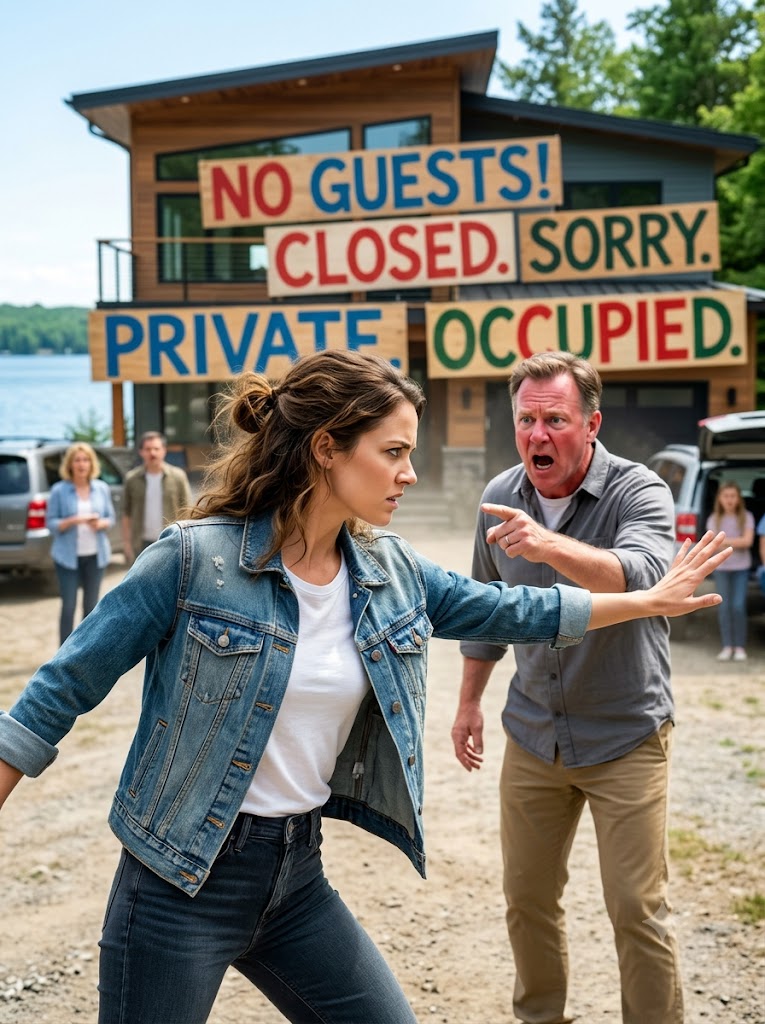
At 8:07 Friday morning, my phone lit up with seventeen missed calls and a live image of my father punching the doorbell at my lake house. Rain silvered his expensive vest, and his mouth made furious shapes through the camera’s wide-angle lens. Behind him stood my mother, two coolers, several SUVs, and enough luggage for a wedding. I counted twenty people before I heard him shout, “Mara, what did you do to the house?”
I was eighty miles away in my Portland apartment, sitting cross-legged on the bed with a cold cup of coffee. I’d come home from a twelve-hour ICU shift smelling of disinfectant, barely awake. My father, Russell Bennett, called again, and I answered because I wanted the next words recorded. “I changed the locks,” I said, “after I told you nobody had permission to stay there.”
“You can’t lock us out of family property,” he snapped, his voice competing with the crunch of shoes on gravel. “The Ashfords drove from Bend, and your mother bought groceries for three days.” He paused, clearly waiting for my familiar apology. Instead, I said, “It’s my property, Dad, and you were never invited.”
On Tuesday, Mom announced in a group text that she and Russell were “hosting” a gathering at my Devils Lake house. There was no question mark, only a grocery list and instructions to wash every guest towel. When I replied that I was working and the house wasn’t available, she sent a laughing emoji. “Do you actually think you can stop us?” she’d written.
The house had been a leaking, neglected cedar cabin when I bought it five years earlier. I spent weekends replacing flooring, hauling ruined drywall, and repairing deck boards between hospital shifts. Russell visited once, looked at my bruised hands, and told relatives he’d helped me make a smart investment. He never paid a dollar toward the mortgage.
My brother, Nolan, had used the place for a party last summer without asking, leaving a cracked dining chair and sticky drink rings on the walnut table my grandfather had made. Mom called me “dramatic” for billing him, then used my spare key again at Thanksgiving. I replaced the locks on Thursday, reset the keypad, and asked my neighbor to watch the driveway. Before bed, I sent one last message: “Do not come. The house is closed to guests.”
Now Nolan was leaning against his pickup, filming our parents as if he’d bought tickets to the show. Mom took his phone and stared into the camera as if addressing an incompetent waiter. “Unlock it, Mara,” she said. “Important people are standing in the rain, and you’re making us look ridiculous.”
I noticed a man in a navy coat near the back of the group, holding a leather portfolio rather than an overnight bag. He was pointing toward my dock, where wind lifted ripples from the dark water. It seemed odd for a weekend barbecue, but my mother’s voice cut into my thoughts. “You can apologize in person after we get inside.”
A white sheriff’s SUV turned onto the gravel drive, its tires hissing through a puddle. Russell visibly relaxed, smoothing his vest and marching toward the vehicle with his hand extended. “Finally,” he told me, “someone reasonable.” I watched Deputy Colin Beck step out, consult a paper in his hand, and ask Russell a question that made his smile disappear.
“Are you the owner listed on this deed?” the deputy asked. Russell tried explaining how our family “shared everything,” while Mom complained that police shouldn’t interfere in private matters. Then the deputy placed a call to verify my instructions, and I answered on the first ring. “Nobody here has my permission to enter,” I told him, surprised by the steadiness of my voice.
Russell glared into the camera as the deputy told the group to leave and warned them against returning without authorization. His friends began loading their bags in uncomfortable silence, and Nolan stopped filming. I thought that would be the end of the worst morning of my life. Then my banking app chimed with a withdrawal request from the inheritance account my father had promised never to touch.
Part 2
The amount on my screen was $14,200, almost every dollar my grandfather had left for my education. The pending wire was headed to Bennett Commercial Holdings, my father’s real estate company. A memo beside it read, “Emergency family reimbursement.” I stared at those three words until the coffee beside me went cold.
My grandfather Walter Finch had set up the account before he died, naming me as beneficiary and Russell as temporary custodian. At twenty-five, Dad persuaded me to keep it open, claiming the interest rate was unusually good. I was thirty-six and had never questioned him. At the bank’s fraud number, a woman named Elena told me the wire could be challenged while the receiving bank reviewed it.
I called my friend Tessa Moreno, an attorney who had once shared a cramped college apartment with me. She listened, then asked for written proof I’d refused entry. I forwarded the group texts, the camera clips, and the account documents I’d saved in a file marked “Grandpa Walter.” “Don’t contact your father again for now,” she said. “I need to find out whether he’s using more than your money.”
Her question made me remember the man with the leather portfolio and the way he had studied my dock. The week before, Russell had asked for the lake house’s square footage and whether the septic system could support “higher occupancy.” I’d assumed he wanted to brag about the place to his country club friends. Tessa searched public planning records while I opened every old email from him, looking for anything I’d dismissed.
One email called the property a “family hospitality asset”; another requested a photograph of the sunset. I’d sent the photograph, proud that my dad finally seemed interested in something I’d built. Then I found a message I’d never answered: “We may need a few signatures later. It’s routine.” My stomach tightened as I read it for the second time.
At lunchtime, Tessa called back with news that made the wire seem like a small problem. Three weeks earlier, an application had been filed to expand commercial guest use at my address, naming Russell’s newly formed company as manager. Attached was a document authorizing him to negotiate leases and receive payments on my behalf. Across the bottom lay an imitation of my signature, close enough to fool someone who didn’t know me.
I did know it, though, because Russell had taught me cursive at the kitchen table when I was eight. The capital M bent just like the M on his old birthday cards. A notary stamp belonged to Lorraine Pike, his longtime office administrator, who’d brought cookies to my graduation party. The document claimed I’d appeared before her on a Tuesday afternoon when I had actually been working in the hospital.
“Does that mean he sold my house?” I asked, suddenly unable to feel my fingertips. “No,” Tessa said. “The deed is still yours, but he may have been trying to give someone contractual rights over the property using your name.” She explained that an operator could pay a substantial advance to manage vacation rentals, and any resulting dispute might become expensive. “We need the full agreement before anyone relies on that fake authorization.”
I looked again at the porch recording, this time pausing on the man with the portfolio. Tessa recognized the logo embossed on it from a company brochure: Cascadia Stay Partners, a regional vacation-rental operator. The guests weren’t there only for a vacation. Russell had planned to show them a furnished waterfront property that wasn’t his.
Before I could absorb it, the bank called and confirmed that the receiving account had attempted to route the money onward to a real estate escrow service. Tessa asked for the escrow name and went quiet when I repeated it. “Mara,” she said carefully, “is Nolan buying a house in Happy Valley?” My brother had spent the past month posting pictures of a five-bedroom home he couldn’t possibly afford.
Part 3
I remembered Nolan’s latest photo: his enormous pickup parked in front of a house with black-framed windows and a double garage. Under it he’d written, “Hard work finally pays off,” followed by a row of house emojis. I had congratulated him, assuming he’d gotten a raise or found a generous lender. Now I was looking at a transfer designed to cover part of his purchase, and I could almost hear him laughing in my driveway.
Tessa requested a formal bank investigation and sent preservation notices to Russell’s company and the notary. She arranged for a document examiner to review the signature. By midafternoon, we knew the application was pending and a draft contract promised a $150,000 advance. I wanted to confront everyone, but Tessa urged me to let the records speak.
Lorraine called me at 2:40, her voice thin and trembling over the sound of office printers. “Mara, your attorney says I need to preserve the original paperwork,” she began. “Your dad told me you’d approved it over the phone, and there was a deadline. I stamped it because he said the family would lose the deal otherwise.” She paused, then added, “I know I should have insisted you appear in person.”
I sat at my kitchen table, tracing a water stain left by an old houseplant. Lorraine had watched me grow up, had asked after my nursing exams, and had smiled every Christmas while Russell described my career as “a nice stable job.” Now she was admitting she’d helped make my home available to strangers without even calling me. “Give Tessa every original and every email,” I said. “Tell the truth to whoever investigates. I can’t promise what happens after that.”
“There are files Russell wanted destroyed,” she whispered. “He called from the road after the sheriff sent them away and told me to clear his desk.” I heard a drawer open. “I haven’t touched the shredder. I’ll give your lawyer the complete folder.” When the call ended, the shaking in my hands wasn’t fear anymore; it was fury at how many people had mistaken my silence for agreement.
An hour later, Tessa had the scanned drafts. Russell had described the lake house as “family-controlled inventory,” offered the operator access dates, and listed me as a consenting owner. There was also an email from my mother saying, “Once everyone sees the place, Mara will come around; she always does.” The sentence hurt worse than the forged signature, because it proved Mom hadn’t been a confused passenger in Dad’s plan.
The proposed advance explained the twenty guests and the carefully staged weekend. Several were prospective investors, and others were people Russell hoped would vouch for the project; dinner and overnight stays were part of his pitch. His brokerage had lost two large commissions and was behind on payments to creditors, according to the records Tessa found. The house I’d restored with night-shift wages was supposed to rescue his reputation and his balance sheet.
The escrow instructions revealed a second motive. Russell had promised Nolan money toward a home purchase, and part of the trust withdrawal was being positioned as the shortfall on a deposit. My brother wasn’t merely enjoying free lodging; he expected to profit from my inheritance while calling it family generosity. I thought of all the holidays I’d worked to pay off student loans while Nolan unwrapped gifts that cost more than my monthly rent.
Then my apartment intercom buzzed, long and impatient. On the black-and-white entry monitor, Russell stood on the sidewalk with rain running down his cheeks, Mom beside him gripping a shopping bag like a shield. Nolan hovered at the curb, checking his phone with frantic movements. Dad pressed the button again and barked, “Open up. We need to fix what you’ve done.”
I kept my hand away from the entry release. They had followed me from one locked door to another, and this time I knew what they were really afraid of. Behind me, my phone vibrated with a text from Tessa: “Do not let them in. There’s something else in Lorraine’s folder you need to see.”
Part 4
Russell’s finger stayed on the buzzer until I pressed the intercom microphone. “Move away from the door,” I said, watching the rain splash against the awning over his head. “We have to talk,” he insisted. Mom leaned into the camera and demanded, “Are you really sending lawyers after people who helped raise you?”
I wanted to ask why raising a child had become a lifetime invoice, but Nolan stepped forward first. “My deposit is due Monday,” he said. “Dad said the money was just a loan, and now escrow is asking questions. Do you have any idea what happens if I lose that house?” His anger was familiar, but the fear underneath it was new.
“Yes,” I said. “You don’t buy a house you can’t afford.” Nolan jerked back as though I’d slapped him, and Mom immediately began telling me he had worked hard for this opportunity. I thought of the years I’d spent sleeping in my car between clinical rotations because driving home would have taken too long. Nobody had called my exhaustion an opportunity worth protecting.
Russell moved closer to the grille and lowered his voice. “I can withdraw the permit application, Mara. We don’t need the rental company, and I’ll pay back the trust once another property closes.” His gaze darted toward the street as he continued, “But your lawyer has to stop calling Lorraine. She doesn’t understand what she’s doing.”
Tessa’s message was still open on my phone. An attachment showed a draft financing letter in which Russell had described the proposed rental advance as already secured, though the application and authorization were disputed. He’d circulated it to creditors while trying to negotiate more time on his overdue payments. My house hadn’t just been a possible payday; it had already been presented as the answer to debts he couldn’t cover.
“You’re using my name to reassure people you owe money,” I told him. “And you’re asking me to pretend you didn’t.” Mom opened her mouth, then closed it when Russell didn’t deny the accusation. That silence told me more than the shouting had.
A delivery truck growled past the apartment building, briefly drowning out the conversation. When the noise faded, Russell said, almost gently, “You don’t want your father ruined over paperwork.” I recognized the tone; he’d used it whenever I pushed back against giving Nolan money or surrendering a holiday. It was the voice that made compliance sound compassionate and self-respect sound cruel.
“No,” I answered. “I wanted you to respect my no before any of this happened.” Nolan shook his head, muttering that I was choosing a lake house over my own family. I watched a passing woman pull her umbrella closer and hurry around them, then realized I felt embarrassed for their behavior, not mine. That was new too.
A black sedan stopped at the curb, and Tessa climbed out carrying a slim document case. With her was a process server who had been trying to reach Russell at his office; Tessa had called ahead when I reported the family at my building. She didn’t announce an arrest or make promises about prison. She simply handed Russell notice of the civil action, a demand to preserve records, and notice that we were seeking emergency protection against further use of my signature.
Russell read the first page, and his shoulders seemed to fold inward. Mom asked him what it meant, but he didn’t answer; Nolan backed toward his pickup as if distance might undo the deposit problem. Tessa looked straight into the camera and gave me a small nod. “You don’t have to come down, Mara,” she said.
I ended the intercom call and went to the kitchen, where the dishwasher hummed beneath the counter. My phone showed another message from Tessa, this one attaching an email Russell had sent to the rental operator two weeks earlier. It contained one sentence that made my throat tighten: “After this closes, Mara won’t have a practical way to object.” For the first time, I understood that my father hadn’t merely gambled I’d give in; he’d planned to leave me no comfortable choice.
Part 5
The next month was not the satisfying montage people imagine when someone finally stands up to a controlling family. I worked my shifts, answered questions from investigators, and spent lunch breaks gathering mortgage statements and hospital attendance records. The lake house sat empty behind its new locks while storms blew fallen branches across the yard. Every time an unfamiliar number appeared on my screen, my stomach tightened before I remembered I didn’t have to answer.
Tessa secured written confirmation from the rental operator that it would not enter the property or act on Russell’s disputed authorization. The county withdrew the application after we submitted proof of ownership and a formal objection. A judge later issued temporary restrictions barring Russell and his companies from representing that they could act for me while the civil case proceeded. None of it happened overnight, but each letter made the lake house feel a little more like mine.
The bank’s investigation ended with the $14,200 returned, although recovering it required more forms and patience than I’d expected. Lorraine cooperated, surrendered the original documents, and faced a separate review of her notarial conduct. Russell’s business accounts drew regulatory scrutiny, and several creditors demanded explanations about the financing letter. I didn’t need to predict the criminal outcome to understand that his shortcuts finally had consequences he couldn’t transfer to me.
Nolan’s house purchase fell through after the disputed funds were removed from the transaction. He sent me a message saying I’d destroyed his future, followed an hour later by a photograph of the empty living room he’d planned to furnish. I wrote back once: “My savings were never your down payment.” Then I blocked him, because there was nothing left to negotiate.
Mom tried a different approach. A handwritten card arrived at my apartment, smelling faintly of the rose perfume she’d worn my whole childhood. She wrote about holidays, family traditions, and how hard it had been to see Russell so distressed. Not once did she acknowledge the false signature, the attempted lease, or the money taken for Nolan.
I placed the card beside the old photograph of my grandfather standing in front of his workshop, sawdust clinging to his sweater. He had been the first person to tell me that building something carefully was a form of respect. I thought about the table Nolan had damaged and how I’d spent an entire Sunday sanding it smooth. I could repair wood, but I couldn’t make other people value what I loved.
One afternoon in December, Mom called from an unfamiliar number, and against my better judgment I picked up. “Your father is willing to put this behind us,” she said, as if forgiveness were another favor he had decided to grant. “We could all start fresh at Christmas.” Outside my hospital break-room window, a bus sighed at the curb while somebody warmed soup in the microwave.
“Putting it behind us would mean telling the truth,” I said. “And even if you did, I wouldn’t give you access to my life again.” She called me unforgiving, then accused me of enjoying the family’s humiliation. I told her I wished none of it had happened, but wishing didn’t change what they had chosen. I ended the call before she could ask for another sacrifice.
On Christmas morning, I drove west with Tessa in the passenger seat and a box of cinnamon rolls warming between us. The clouds opened just above the coast, throwing a pale stripe of sunlight across Devils Lake. At the cabin, I unlocked the door with a key nobody else carried and breathed in cedar, clean linen, and the sharp scent of pine from the small tree I’d set by the window. Tessa looked toward the dock and asked, “Does it finally feel peaceful?”
I watched the water wrinkle around the pilings and thought about all the times I’d mistaken being useful for being loved. My family’s apologies had arrived only after their access disappeared; I had no intention of buying them back with another chance. “Not completely,” I said, carrying the cinnamon rolls inside. “But for the first time, this peace belongs to me.”
Legal Notice: This story is a work of fiction. Names, characters, businesses, events, and incidents are the product of the author’s imagination or are used fictitiously. Any resemblance to actual persons—living or dead—or to actual events is purely coincidental. Thank you! 💓


