
The Captain Threatened to Throw Me Off His Plane—But He Had No Idea I Owned the Entire Airline
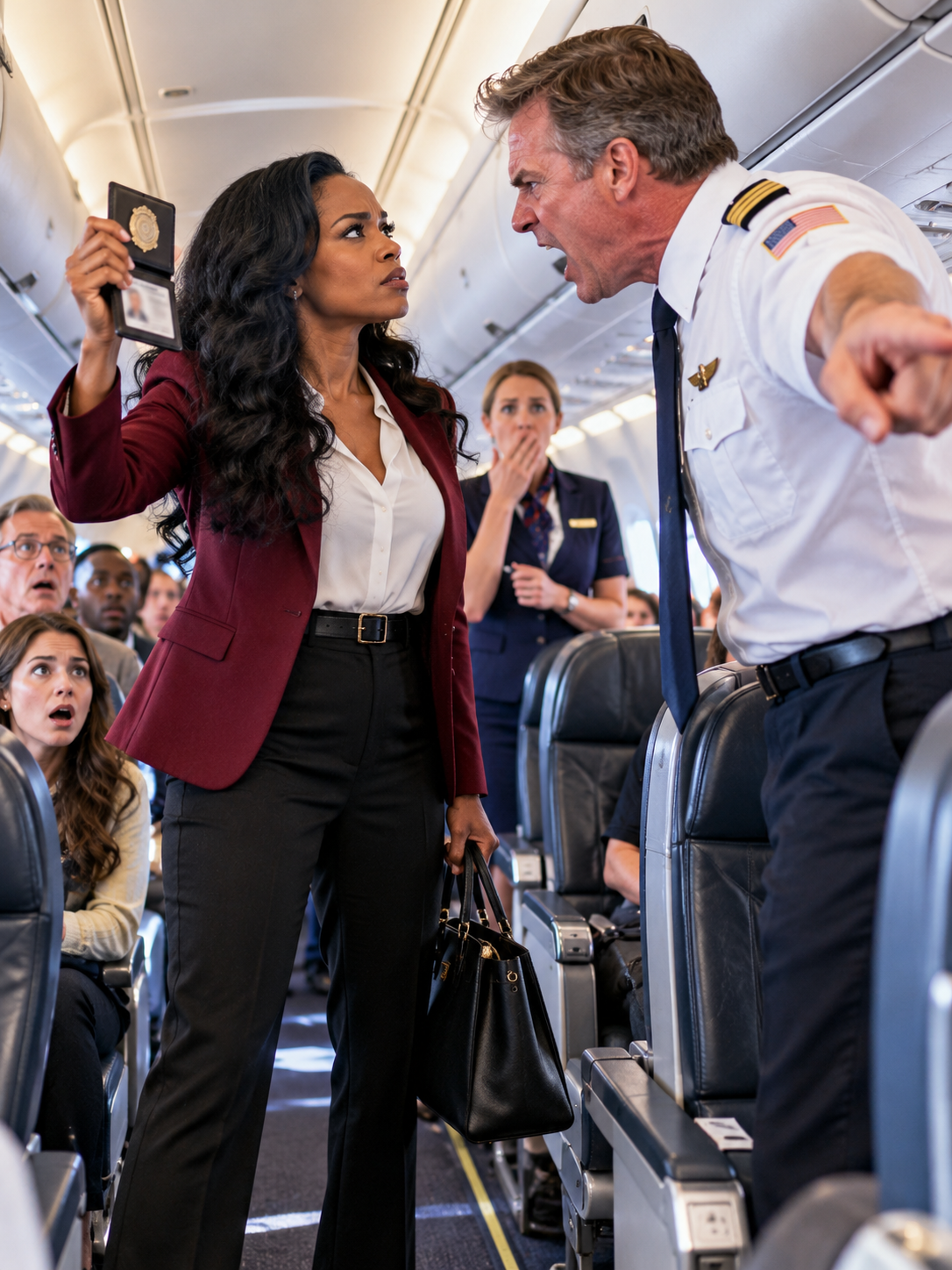
“Get out of that seat right now, or I’ll have security drag you off my aircraft!” The captain’s voice thundered through first class as twenty passengers watched him humiliate me. My boarding pass clearly showed seat 1A, but he refused to look at it. The wealthy white woman demanding my seat smiled like she’d already won. I was a Black woman traveling alone, dressed simply, with an old backpack at my feet. What none of them knew was that I’d purchased their entire airline fourteen days earlier.
Part 1
The trouble started at 8:17 on a bright Thursday morning, when a woman wearing enough diamonds to buy a small house decided I didn’t belong in first class. I was sitting in the private departure lounge at Teterboro Airport, reading a paperback with a cracked spine, when she began arguing with the receptionist about her seating assignment. Her voice carried across the marble floor, sharp enough to interrupt the quiet conversations around her.
“My husband and I have been members for eleven years,” she announced, striking the counter with her manicured fingernails. “I specifically requested seat 1A, and I expect to receive what I paid for.” The receptionist apologized and explained that the seating assignments had been finalized, but the woman wasn’t interested in explanations. When she noticed me watching, her gaze traveled from my plain teal blouse to the worn leather backpack beside my chair.
My name is Vanessa Sterling, and at forty-eight, I’d learned to recognize that particular expression without needing anyone to explain it. I’d seen it in boardrooms, luxury hotels, and investment meetings where people mistook my appearance for evidence that I didn’t belong. What they rarely discovered until much later was that I controlled Sterling Meridian Holdings, a private investment company with interests in transportation, logistics, and commercial real estate.
Fourteen days earlier, Sterling Meridian had completed the acquisition of Meridian Executive Air, a struggling luxury aviation company headquartered in New Jersey. The transaction remained confidential while regulatory filings and corporate communications were being finalized, and only a small circle of senior executives knew who controlled the new ownership structure. I had insisted on that temporary discretion because I wanted to understand the company before its employees learned to recognize my face.
Our preliminary investigation had uncovered disturbing complaints about Meridian’s executive shuttle service. Passengers described arbitrary seating changes, preferential treatment for influential clients, and crew members who treated certain travelers as unwelcome intruders. More troubling were reports that complaints disappeared after being forwarded to senior management, sometimes without even receiving a response.
I had already spent three days reviewing flight records and speaking privately with former employees when I decided to experience the service myself. My reservation was made through an ordinary customer account, and my identity wasn’t connected to any corporate executive profile. I paid for seat 1A on Meridian Flight Seven, a scheduled executive shuttle to Palm Beach, because I wanted to see how the company treated someone who appeared to possess no influence.
At 8:45, boarding began, and I followed the other passengers across the sunlit ramp toward a sleek white aircraft with polished silver lettering near its entrance. Inside, cream leather seats faced walnut-paneled tables, and the cabin smelled faintly of fresh coffee and expensive upholstery cleaner. A young flight attendant named Tessa Morgan checked my boarding pass, smiled warmly, and directed me toward the first row.
I placed my backpack beneath the seat, fastened my belt, and reopened my book. Two minutes later, the diamond-covered woman from the terminal appeared beside me, accompanied by a flight attendant who looked visibly uncomfortable. “Excuse me,” the woman said, staring down at me. “You’re sitting in my seat, and I’m going to need you to move.”
I showed her my boarding pass, which clearly displayed 1A. She barely glanced at it before announcing that there must have been some mistake, because she and her husband had always received priority seating. When I explained that I had a confirmed reservation, she crossed her arms and said, “People who travel at this level expect certain standards, and frankly, this arrangement is unacceptable.”
“Which standards are you referring to?” I asked, keeping my voice even. Her cheeks tightened, and she turned toward Tessa as though I’d spoken out of turn. Before the young attendant could answer, a tall man in a crisp pilot’s uniform emerged from the cockpit, his expression already irritated.
Captain Conrad Mercer introduced himself with the confidence of someone accustomed to having the last word. The woman immediately pointed at me and announced that I’d refused to surrender a seat that belonged to her. Mercer glanced at my clothing, then at my backpack, and told me I would need to relocate without ever examining my boarding pass.
I offered him the ticket again, but he waved it away and accused me of delaying departure. When I asked him to explain the airline’s seating policy, his face darkened, and several passengers raised their phones. Then he stepped into the aisle, squared his shoulders, and shouted, “I’m the captain, and I’m ordering you out of that seat. Leave immediately, or I’ll have you removed from this aircraft!”
I closed my paperback and slipped its frayed bookmark between the pages. As the cabin fell silent, I noticed something peculiar on the flight attendant’s handheld device: a red notification marked “Executive Seating Exception.” I’d seen that phrase before, buried inside the complaints my investigators had collected.
For the first time that morning, I understood that the captain’s behavior might be connected to something much larger than one spoiled passenger.
Part 2
Captain Mercer apparently expected me to become frightened, apologize, and gather my belongings. Instead, I remained seated and asked him to show me which airline rule authorized removing a paying passenger because somebody else preferred her seat. My calmness seemed to infuriate him more than open resistance would have, and I watched his jaw tighten beneath the fluorescent cabin lights.
“You’re not entitled to debate operational decisions with the captain,” he replied, pointing toward the aisle. “We can accommodate you farther back, or you can leave the aircraft altogether.” The woman standing behind him smiled and adjusted her pearl necklace, apparently satisfied that the problem had been solved.
I asked Tessa whether another passenger had been assigned seat 1A, and she glanced nervously at her handheld device. For several seconds, she hesitated, looking between the captain and the screen, before quietly confirming that my reservation was valid. Mercer interrupted immediately, telling her to stop discussing internal procedures with passengers.
“Captain, her boarding pass does say 1A,” Tessa repeated, her voice barely rising above the hum of the ventilation system. Mercer’s expression turned dangerous, and he reminded her that probationary employees were expected to follow instructions. I saw her fingers tighten around the device, and for a moment, I wondered how many times she’d been forced to choose between protecting a passenger and protecting her paycheck.
The woman demanding my seat introduced herself as Evelyn Pritchard and announced that her family had spent hundreds of thousands of dollars with Meridian Executive Air. She explained that her husband belonged to several influential business organizations and that the airline’s management knew their expectations. “I shouldn’t have to explain why premium clients deserve premium treatment,” she said, looking directly at me.
An older gentleman across the aisle lowered his newspaper and asked why a confirmed passenger should lose her seat. Mercer told him to mind his own business, then instructed Tessa to contact ground operations for assistance. The man’s wife quietly began recording, while a young father seated behind me pulled his daughter closer and whispered something that made her stare at the captain.
I had encountered prejudice throughout my career, but this confrontation was especially revealing because nobody involved had bothered to invent a believable excuse. Evelyn wanted something that belonged to me, and Mercer believed her financial importance outweighed my reservation. The flight attendant knew the assignment was correct, yet the captain appeared more concerned with obedience than fairness.
I took my phone from my backpack and opened the Meridian customer portal. My digital boarding pass still showed seat 1A, confirmed at 7:06 that morning, with no cancellation or reassignment notice. Beside the booking information was a small service reference that matched the red notification I’d spotted on Tessa’s device.
“Would you please explain the Executive Seating Exception?” I asked the captain, holding up my screen. He went still for half a second before demanding to know where I’d seen that phrase. Evelyn stopped smiling, and Tessa immediately lowered her eyes toward the cabin floor.
Mercer recovered quickly and announced that internal classifications were confidential. He suggested that I’d accessed information improperly, although the reference was plainly visible within my own reservation record. When I asked whether the exception had been created before or after I boarded, he warned that my continued questioning could be treated as disruptive behavior.
I recognized the tactic immediately. If he could transform a legitimate complaint into a passenger conduct problem, he could justify removing me without explaining the seating discrepancy. I placed my phone on the armrest, started an audio recording where permitted, and told him I would comply with lawful safety instructions but would not voluntarily surrender a confirmed seat to satisfy another passenger’s preference.
A ground supervisor named Olivia Price entered the aircraft several minutes later. She looked at my ticket, examined the cabin manifest, and frowned when Mercer explained that I was refusing a necessary seating adjustment. “Captain, the original assignment is correct,” she said carefully. “I don’t see a documented operational reason to move this passenger.”
Mercer pulled Olivia toward the galley and spoke to her in a low voice. I couldn’t hear every word, but I caught the phrases “executive authorization” and “corporate headquarters.” When Olivia returned, she seemed more troubled than before and asked me whether I would consider taking another seat voluntarily to avoid further delays.
I told her I wanted the name of whoever had authorized the exception. She hesitated, then quietly said the request had come through the office of Adrian Knox, Meridian’s chief operating officer. My stomach tightened because Adrian was one of the few executives who knew about the acquisition, and he had personally assured me that operational decisions were being reviewed for fairness.
Then my phone vibrated with a message from Adrian himself. “Vanessa, I just learned there’s a situation on Flight Seven. Please don’t reveal who you are until I’ve had a chance to explain.”
For the first time, I wondered whether the captain was the problem I’d come to investigate—or simply the most visible part of it.
Part 3
I read Adrian’s message twice while Mercer continued arguing with Olivia near the galley. The aircraft’s ventilation system hummed overhead, and the smell of freshly brewed coffee suddenly made me feel nauseated. I’d trusted Adrian to oversee the transition after the acquisition, and his first response to a passenger being threatened wasn’t to investigate what happened but to ask me to remain anonymous.
I typed back, “Explain in writing why a valid reservation was overridden and why your office authorized it.” Three dots appeared on my screen, disappeared, and returned before his reply arrived. “It’s complicated. There are longstanding arrangements with certain members, and Richard knows how those arrangements work.”
The message explained more than Adrian probably intended. I had suspected individual employees were abusing their authority, but his words suggested an established system of preferential treatment. Worse, he seemed to believe that because the arrangement had existed for years, it deserved some kind of protection.
Mercer returned with Olivia and announced that security personnel were waiting in the terminal. He offered me one final opportunity to leave voluntarily, adding that the captain had ultimate responsibility for safety aboard the aircraft. I agreed that flight safety was essential, then asked what specific safety concern justified removing me from a seat assigned to me.
He couldn’t provide an answer beyond insisting that I was challenging his authority. Olivia stood beside him with a troubled expression, while Tessa remained near the galley holding a tray she’d forgotten to put away. The passengers had become almost completely silent, and I could hear the faint electronic chirping of a cockpit instrument through the open door.
“Captain Mercer,” I said, “you’ve had several opportunities to correct this situation, and every time, you’ve chosen intimidation instead. Before we proceed, I’d like you to understand something about the company whose uniform you’re wearing.” He laughed sharply and told me that wealthy passengers weren’t impressed by people pretending to have important connections.
I reached into my backpack and removed a gray tablet that contained my company’s secure executive communication software. After unlocking it, I opened the completed acquisition summary, which identified Sterling Meridian Holdings as the owner of Meridian Executive Air. Then I placed a video call to Adrian Knox and turned the screen toward the captain.
Adrian answered from his office, wearing a charcoal suit and an expression that changed dramatically when he recognized the cabin behind me. “Vanessa, please tell me you’re alright,” he said. I asked him to identify me for the captain and explain my relationship to Meridian Executive Air, making certain everyone nearby could hear.
Adrian swallowed visibly before answering. “Captain Mercer, you’re speaking with Vanessa Sterling, chairwoman and principal owner of Sterling Meridian Holdings. Her company acquired one hundred percent of Meridian Executive Air fourteen days ago, and she now controls its ownership.” The silence that followed was so complete that I heard someone drop a metal pen several rows behind me.
Mercer’s expression went from irritation to confusion and finally to naked fear. He glanced at the tablet, looked at Olivia, and then stared at me as though my appearance had changed. “Ms. Sterling,” he whispered, “I had absolutely no idea who you were. If someone had told me, I never would have handled this situation that way.”
“That’s exactly why we’re having this conversation,” I replied, looking directly at him. “You shouldn’t need to know a passenger owns your company before deciding to treat her with basic dignity.” My voice remained steady, but I felt anger rising beneath it because I knew how differently this morning might have ended for someone without my resources.
Evelyn backed away from my seat, her expensive handbag clutched against her stomach. She began explaining that she’d simply misunderstood the reservation and had never intended to cause trouble, although several passengers had recorded her earlier comments. I told her the misunderstanding could have been resolved the moment she saw my boarding pass, and that her confirmed seat remained available if she wanted to travel.
Adrian suggested that everyone calm down so the flight could depart, but I refused to let punctuality become another excuse for ignoring misconduct. I asked Olivia to contact the duty flight operations director, preserve the relevant records, and arrange for Mercer to be replaced before departure pending a formal review. When the director confirmed the crew change, Mercer slowly removed his identification lanyard and walked toward the terminal without looking at anyone.
I expected that moment to bring relief, but Adrian’s earlier message kept troubling me. After Mercer left, Olivia showed me an internal record linking the seating exception to the office of the chief operating officer. Beneath the authorization was another entry I hadn’t expected: my original customer complaint, submitted as part of a routine test booking inquiry, had already been marked “Resolved—No Further Action.”
I stared at the timestamp, which showed the complaint had been closed before I’d even boarded the aircraft.
Someone at headquarters hadn’t merely protected the captain. They’d built a system designed to make complaints disappear before anyone could investigate them.
Part 4
Flight Seven was delayed while operations arranged a qualified replacement captain and completed the necessary crew checks. Olivia offered to move me into a private waiting room, but I asked to remain nearby until the original passenger records had been secured. I had no intention of turning an aviation safety process into a public spectacle, yet I also wasn’t going to let the evidence disappear while everyone congratulated themselves for identifying the owner.
Tessa approached me after the passengers returned to the lounge. Her eyes were swollen, and she kept twisting the narrow silver bracelet around her wrist as she asked whether she was going to lose her job. I told her that confirming a passenger’s legitimate reservation wasn’t misconduct and that my legal team would make certain she could report what happened without retaliation.
She looked toward the corridor before speaking again. “This isn’t the first time Captain Mercer has done something like this,” she whispered. “Last November, a woman was removed after refusing to give up her seat for a corporate member. I reported it, but they told me the passenger had been disruptive, and my supervisor warned me not to question the captain again.”
I asked whether she still had a copy of her report. Tessa nodded and explained that she’d saved the original submission confirmation because the final incident summary didn’t match what she’d witnessed. Her hands trembled as she showed me the document, and I felt a cold heaviness settle in my stomach.
The report described a passenger who had purchased a confirmed premium seat while traveling to her mother’s funeral. Captain Mercer had ordered her to move for a preferred customer, then characterized her objections as aggressive behavior when she requested an explanation. Tessa’s original statement contradicted his account, but her concerns had been removed from the final customer-service summary.
I contacted our outside legal counsel and instructed them to preserve the reservation records, communications, witness statements, and relevant camera footage through the proper company procedures. I also requested an independent review of the Executive Seating Exception system. By late afternoon, the first audit findings suggested that the mechanism had been used repeatedly to override confirmed reservations for influential members.
Adrian called me six times before I finally answered. He insisted that the airline depended on wealthy clients and that accommodating those clients had always been part of its business model. When I asked whether he’d approved removing paying passengers who objected, he said that some customers misunderstood the special arrangements.
“Did the woman traveling to her mother’s funeral misunderstand when your company called her disruptive?” I asked. Adrian went quiet, and I could hear someone speaking urgently in the background of his office. After several seconds, he admitted that he hadn’t personally reviewed every complaint, which was an astonishing answer from the executive responsible for overseeing the system.
The independent investigators uncovered more troubling details over the following week. Certain complaints were automatically diverted from normal review whenever an executive exception appeared in the reservation record. Some were categorized as resolved despite lacking any evidence of investigation, while others contained descriptions of passenger behavior that conflicted with witness accounts.
I learned that Black passengers had appeared repeatedly among those reporting unfair treatment, although the available records required careful review before anyone could determine the full extent of discriminatory practices. The pattern was serious enough that I authorized external specialists to examine the company’s customer treatment, employment practices, and compliance procedures. I wanted findings that could withstand scrutiny, not conclusions produced merely to satisfy my anger.
Meanwhile, a passenger’s recording from Flight Seven began circulating online. The footage showed Mercer shouting at me, Tessa attempting to confirm my reservation, and Evelyn standing behind him with a triumphant smile. Thousands of strangers commented on the incident, but I refused interview requests because the investigation mattered more to me than public applause.
Then our legal counsel forwarded a document that changed the direction of the inquiry. It was an internal memorandum from seven months earlier, addressed directly to Adrian, warning that executive seating overrides were creating legal and reputational risks. Beneath the warning, Adrian had written a short instruction ordering the issue handled internally without further escalation.
The memorandum included a reference to the woman who’d been removed while traveling to her mother’s funeral. Her original complaint had specifically mentioned Captain Mercer, but the final response had dismissed her account without interviewing Tessa. Adrian hadn’t been unaware of what was happening; he’d been warned and had chosen to protect the arrangement.
Attached to that memorandum was one last item: a request from the airline’s membership department to preserve a preferred client’s seat at almost any cost. The name at the top of the request was Evelyn Pritchard.
The woman who’d demanded my seat hadn’t stumbled into an unfair system. She’d benefited from it before.
Part 5
The investigation lasted nineteen days, and every morning brought another discovery that made me question how Meridian had operated for so long without meaningful accountability. Evelyn’s membership records revealed eight requests for special seating accommodations, several of which had displaced passengers holding confirmed reservations. In three cases, customer complaints had been closed without proper investigation, and Captain Mercer had personally participated in two of those incidents.
Adrian tried to defend the arrangements as necessary concessions to important clients. He argued that premium aviation depended on relationships and that I couldn’t expect to retain customers if I insisted on treating every reservation identically. I told him loyalty programs could provide legitimate benefits, but they couldn’t become permission to mistreat people or falsify records.
By the end of the investigation, the company’s board had received enough independently verified evidence to remove Adrian from his position. The membership executive responsible for encouraging unauthorized seating changes was also dismissed following a separate disciplinary review. Their departures were announced internally alongside new reporting procedures, and counsel continued reviewing the company’s legal obligations concerning the affected passengers.
Captain Mercer received an opportunity to respond to the allegations against him. His explanation emphasized pressure from management, the influence of wealthy members, and his belief that he was protecting the company’s reputation. But witness recordings, booking records, and his own incident reports demonstrated that he’d repeatedly chosen intimidation over resolving legitimate passenger concerns.
His employment was terminated after the formal review concluded. The company also referred the relevant records to the appropriate aviation compliance personnel for any further action within their authority. I didn’t celebrate his dismissal, because nothing about what he’d done made me happy, but I felt an enormous responsibility to ensure that he couldn’t repeat it under Meridian’s name.
The woman who’d been removed while traveling to her mother’s funeral contacted our legal department after the video of my confrontation became public. Her name was Naomi Foster, and she told investigators she’d stopped flying with Meridian because the experience had left her feeling powerless and humiliated. She’d missed the family gathering before her mother’s funeral, and the airline had initially refused to acknowledge that anything improper had occurred.
I spoke with Naomi privately after she agreed to a conversation. I apologized for the company’s treatment of her and explained what the investigation had uncovered, without asking her to excuse what happened. Meridian subsequently reached an appropriate settlement with her, and she told me that receiving a truthful acknowledgment meant more than another carefully worded customer-service response.
Evelyn sent a lengthy letter claiming she’d misunderstood the situation and deeply regretted any embarrassment she’d caused me. Her membership privileges were discontinued after the company reviewed her repeated misuse of special arrangements, and I declined her request for a personal meeting. I didn’t need another apology that appeared only after someone discovered I possessed the power to impose consequences.
A letter arrived from Mercer two weeks later. He wrote that he wished he’d known who I was, that the incident had destroyed his career, and that he hoped I could eventually forgive his mistake. I read it once, placed it in my desk drawer, and instructed my assistant to acknowledge receipt without arranging further contact.
His words confirmed that he still hadn’t fully understood what mattered. The problem wasn’t that he’d mistreated the owner of his airline; it was that he’d believed mistreating an ordinary passenger was acceptable. I wasn’t interested in repairing his conscience at the expense of my own peace.
Over the following months, Meridian introduced independently monitored complaint reviews, clearer seating protections, and mandatory training on respectful passenger treatment. We established confidential reporting channels for employees and stronger safeguards against retaliation, while our compliance team began examining whether the changes were actually working. I made it clear to senior management that I expected evidence of improvement, not attractive presentations filled with promises.
Tessa remained with Meridian and eventually joined an employee advisory group helping redesign its reporting procedures. She told me she’d almost resigned after Flight Seven because she’d believed speaking up would end her career. Watching her contribute without fear became one of the few genuinely satisfying outcomes of the entire experience.
Three months after that morning at Teterboro, I boarded another Meridian flight to Palm Beach. I wore the same teal blouse and carried the same battered backpack, which had belonged to my mother during the years she worked two jobs to put me through college. My paperback was still tucked inside, its pages slightly more worn than before.
The flight attendant checked my ticket, confirmed seat 1A, and welcomed me aboard without recognizing my face. An older gentleman behind me needed assistance placing his bag in the overhead compartment, and she helped him with the same warmth she’d shown the passengers arriving in expensive suits. Nobody questioned whether his clothes matched the cabin, and nobody made him feel he had to prove he belonged.
I settled into my seat and looked out at the bright morning sky. My mother used to tell me that having money didn’t make someone important, and lacking money didn’t make someone less deserving of respect. I’d spent most of my life trying to honor that lesson, but Flight Seven had taught me that owning a business meant little unless I was prepared to enforce those values when doing so became uncomfortable.
As the aircraft began taxiing, the new captain made a brief announcement welcoming everyone aboard. There were no threats, no displays of superiority, and no suggestion that the aircraft existed to serve one privileged person. He simply thanked the passengers for choosing Meridian and promised to get them safely to their destination.
I smiled, opened my book, and finally began reading the chapter I’d been interrupted in months earlier.
Captain Mercer had once shouted that it was his aircraft and that he could decide who deserved to remain aboard. In the end, his arrogance had cost him his career, exposed a corrupt management system, and forced an entire company to confront practices it had tolerated for years.
I hadn’t needed anyone to know I owned the airline that morning. I’d only wanted the seat I’d paid for and the dignity every passenger deserved.
And that was the lesson I intended Meridian never to forget: respect shouldn’t begin when someone discovers who you are. It should be there long before anyone knows your name.
Legal Notice: This story is a work of fiction. Names, characters, businesses, events, and incidents are the product of the author’s imagination or are used fictitiously. Any resemblance to actual persons—living or dead—or to actual events is purely coincidental. Thank you! 💓

