
The Birthday Roast My Family Tried to Steal—and the Dinner They Never Got
I spent five hours cooking my grandmother’s roast for my mother’s birthday, but Mom ordered me aside so my sister could choose first. When my father called me “an extra in this family,” I carried the entire dinner back to my car and drove away. Twenty-four guests were coming, and Mom called before I reached the next traffic light. I soon discovered she wanted back far more than dinner. That was the night I finally learned why they needed my silence.
Part 1
By four thirty on Saturday afternoon, my apartment smelled like rosemary, browned butter, and the garlic I had crushed with the flat side of a knife. My tiny kitchen was crowded with a roasting pan and covered vegetables. The roast had been in the oven for five hours, from Grandma June’s handwritten recipe. I was twenty-one, working weekends for a catering company and taking classes during the week, and the groceries had cost almost as much as my electric bill.
Three weeks earlier, Mom called. “Leah, I’d love to have your grandmother’s roast for my birthday,” she’d said, in her favor-request voice. “Twenty-four people, nothing fancy. You know how to make it better than anyone.” When I asked whether she wanted to split the grocery bill, she sighed so heavily I could picture her hand against her forehead. “After everything we’ve done for you, I thought you might enjoy giving me one nice present.”
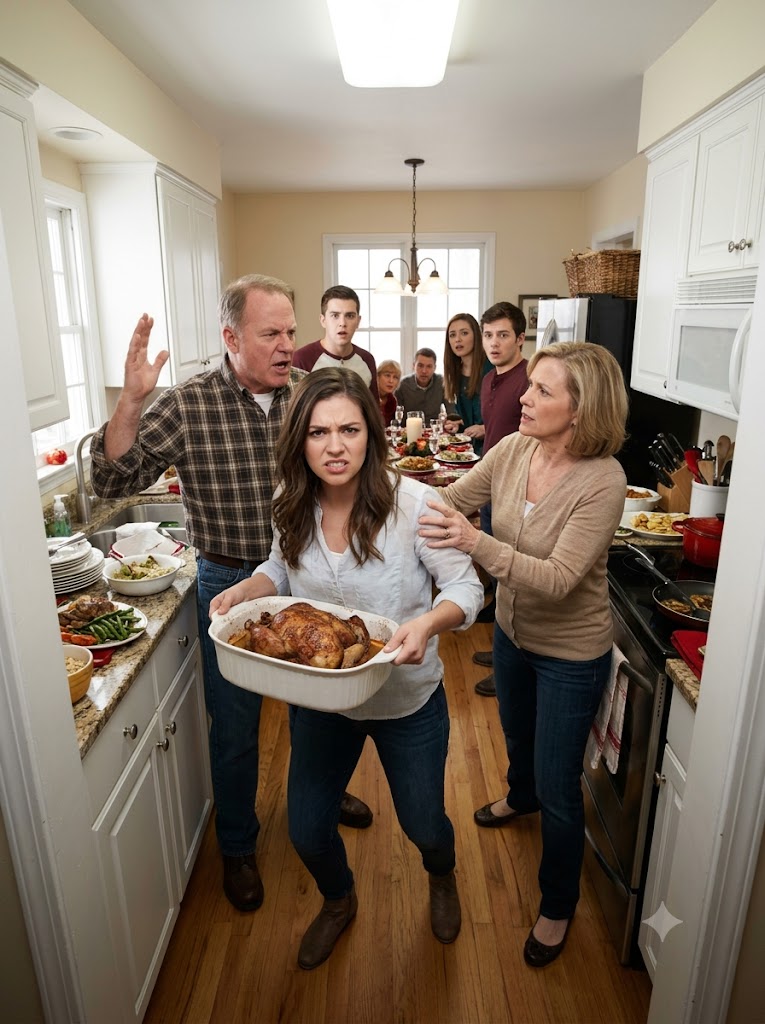
At five fifteen, I drove the insulated roast to my parents’ house. My nineteen-year-old sister was at the kitchen island when I came in, photographing a glass of sparkling cider beside the centerpiece. She tasted the gravy without asking. “It needs more salt,” she announced, then resumed her photographs. I told her it would taste different once it warmed through, but Mom cut across me without looking up from a stack of place cards. “Leah, put that down and get out of the kitchen until Tessa decides what she wants.”
I stared at her. “I’m just setting dinner on the counter,” I said, gripping the handles through my oven mitts. Mom pointed down the hall. “And don’t touch anything until your sister has picked her pieces. She likes the center cuts.” Tessa shrugged, scrolling through her pictures, as if that was normal. Behind me, Aunt Ruth and Uncle Daniel had stopped talking beside the pantry door.
Dad appeared carrying a bag of ice. “Why is everyone standing around?” he asked, and I tried one last time to make my voice sound normal. “I made dinner. I’d like to finish getting it ready before the guests arrive.” He gave a short laugh and looked straight at Ruth. “See? Leah always needs a starring role, when she’s nothing but an extra in this family.” The refrigerator hummed loudly in the silence afterward, and I could hear Tessa’s phone camera click.
I said nothing, carried my pan outside, and breathed in the damp-leaf air. I secured the carrier on the back seat, checking the buckle twice. Tessa came onto the porch and called, “You’re being dramatic!” but didn’t follow. As I started the engine, I noticed a small cream-colored sign through the dining room window, propped next to the empty serving platter. It had Tessa’s photograph on it, and underneath, a line of gold lettering I couldn’t make out.
My phone rang before I reached the corner. “Where are you?” Mom demanded. “In my car.” She spoke over the sound of dishes clattering: “You need to come back immediately. Where’s the roast?” I glanced at the carrier in my rearview mirror. “With me,” I said, and heard her call Dad’s name as if I’d announced a break-in.
“That’s dinner for twenty-four people!” she shouted. “You said I wasn’t allowed to touch it until Tessa chose her pieces,” I reminded her. “Dad said I was an extra, so I figured you could manage without me.” Mom lowered her voice, which somehow made it worse. “Your father didn’t mean it. Come back, and we can discuss your feelings after everyone leaves.”
With my parents, “after” never came. I asked, “Would you want me back if dinner were already on the table?” Dad ordered her to make me return. Then she said, “Whatever you do, don’t tell the guests what happened.” I ended the call, watching two cars turn toward her house, and drove away with the first thing I’d ever refused to give them.
Part 2
At the next stoplight, a message from Tessa illuminated the dashboard. “Seriously? You took all the food because you couldn’t wait ten minutes?” Another followed before the light turned green: “Mom says stop making her birthday about yourself.” I kept both hands on the wheel until I reached the park near my apartment, still remembering how Tessa had taken credit for Grandma’s Christmas cake without correcting Mom’s post. Then I parked beneath a maple tree, where dried leaves scraped against the pavement like crumpled paper.
Dad’s text arrived at six twelve. “Bring the roast back and we’ll forget this happened.” He was offering to forgive me for what he had done. Mom sent a second message, more specific: “Put the pan on the buffet, smile, and behave normally. Do not repeat what your father said.” Neither asked whether I was all right.
I took a picture of the roast buckled into the back seat. Then I photographed the grocery receipt, the recipe card, and the messages, saving everything in one folder. It wasn’t a plan for a social media battle; I’d spent too many years being told I remembered family arguments incorrectly. I needed proof before guilt softened my memory.
I called my best friend, Morgan, who lived two floors below me. She answered over a grocery cart’s rattle. When I explained, she was quiet long enough to make me nervous. Then she said, “Stay at the park. I’ll bring bread, and we’re going to eat that dinner you made.” “There’s plenty,” I said. “Good,” she answered.
At six twenty-three, our family group chat started flashing. My cousin Parker asked why everyone was standing around without dinner, and Tessa replied almost instantly. “Leah threw a childish tantrum and stole Mom’s birthday meal because she wanted attention. Mom is literally crying.” A laughing reaction appeared beneath the message, followed by Uncle Daniel asking whether I couldn’t have waited until later to discuss it. The accusation hit harder than Dad’s insult because it offered everyone a simple story in which I was the villain.
I opened the keyboard, typed “That isn’t what happened,” and erased it. Mom always controlled the family story. Then a private message arrived from Aunt Ruth. “I heard every word your father said. You did nothing wrong. Please don’t come back.”
Before I could answer, Ruth posted in the group. “Tessa, stop lying. I watched Leah carry in the roast she paid for and cooked herself. Your mother ordered her out of the kitchen, and your father called her ‘nothing but an extra in this family.’ Daniel and I are leaving. If dinner is late, ask the people who drove the cook away.” For nearly a minute, the group remained silent, the kind of silence that feels louder than shouting.
Then Parker sent, “Wait. Leah made the entire dinner?” Two cousins began asking why they’d been told Tessa was cooking, and Daniel wrote, “Ruth is right. I heard Grant say it too. I should have spoken up.” I read his apology three times. It mattered that he admitted it publicly, but I couldn’t stop thinking about how he’d been standing within reach of me while Dad spoke and had said nothing.
Another message from Ruth came through. “There’s something else. Your mother asked us to come early for a special announcement about Tessa.” Attached was a blurry photograph taken from the hallway, showing the cream-colored sign I’d noticed through the window. The gold letters were still hard to read, but beneath Tessa’s smiling face I recognized a photograph of Grandma’s Christmas cake, the one I’d baked last year.
I zoomed in until the pixels turned soft and square. Why was my cake on my sister’s birthday-party display, and why had Mom asked Ruth not to mention the announcement to me? The knock against my car window came just as a second photo began downloading, and I nearly dropped the phone.
Part 3
Morgan stood outside my car wearing a green raincoat, with two paper bags of baguettes tucked against her chest. “Are you okay?” she asked as I unlocked the door. I told her I wasn’t sure, then showed her the photograph. She leaned against the passenger window, reading, and let out a low whistle that made my stomach tighten.
The sign read “Tessa’s Table: Family Recipes, Beautifully Made” above six food photographs. I recognized the Christmas cake, Thanksgiving’s glazed carrots, and rosemary rolls I’d made for Dad’s retirement dinner. The blue tablecloth beneath them belonged to Grandma, who had given it to me before she died. In smaller print, the sign announced that Tessa would soon be accepting private-dinner bookings. My mother hadn’t asked me to make her birthday meal as a present; she’d asked me to provide the centerpiece of somebody else’s advertisement.
Morgan passed the phone back. “You took those photos, didn’t you?” I nodded, remembering that Mom had requested them. “Then save these screenshots,” Morgan said. “And come upstairs before that roast gets cold.” She wasn’t smiling now. We carried the heavy pan between us, the foil still warm against my knuckles.
My apartment had one small table and four mismatched chairs, so Morgan knocked on the doors of Nora and Ben, the couple across the hall. They brought a folding table, extra plates, and a jar of pickles from Nora’s grandmother. Morgan called her friend Eli, who brought salad greens. In less than half an hour, the cramped room filled with damp jackets, conversation, and the thick savory smell rising from the uncovered roast.
I lifted my carving knife and found everyone watching me carve. “Would you like the first slice?” I asked Nora, and she laughed. “You cooked for hours. You take it.” The beef was tender enough to pull apart beneath the blade, and the gravy carried the sweetness of slow onions. Forks scraped against plates while butter melted into the warm bread. Nobody inspected the pieces for flaws.
Halfway through dinner, my phone buzzed again. Uncle Daniel had posted in the family chat that Mom had ordered pizza and was telling guests I’d misinterpreted a joke. Aunt Ruth answered, “Calling your daughter an extra isn’t a joke.” Parker added that he’d heard Mom introduce the dinner as Tessa’s special creation before anyone arrived. I put the phone facedown, but Morgan noticed my hands shaking when I reached for the bread.
“Eat first,” she said, sliding a bowl of potatoes toward me. Ben asked what gave the carrots their smoky sweetness, and I explained how Grandma used to sear them in the same pan after the beef came out. It was such a small question, but answering it without interruption felt strange and wonderful. Later, Nora asked if I’d ever considered offering weekend dinners to people in the building. For the first time that evening, my future seemed larger than a family dining room.
At eight, the calls came in clusters. Dad left a voicemail demanding that I deliver whatever leftovers remained. Mom’s message was quieter, almost sweet enough to sound concerned: “Leah, please. People are asking questions about Tessa’s business. Just tell them you misunderstood.” Tessa texted, “You destroyed my launch over one stupid comment.” I looked around the table, and realized the missing roast had exposed something none of them intended to explain.
Ruth sent me another message, this time a picture of the printed program placed at every setting. Under a birthday greeting, it promised a “preview dinner prepared by our talented young chef, Tessa.” My grandmother’s recipe was described as Tessa’s original signature entrée. I read that line aloud. It wasn’t only my work they’d borrowed; they’d tried to rewrite a piece of Grandma’s life, too.
Then Parker forwarded a screenshot of a message Tessa had sent several relatives that morning. “If you like tonight’s food, Mom will have ordering details ready after dessert,” it said. I stared at the words as a harder possibility formed. If this was a business launch, who had already agreed to pay my sister for food she didn’t know how to make?
Part 4
The answer arrived from Ruth before I’d put the plates in the sink. Two guests had shown her their booking confirmations. Four households had already placed deposits for November family dinners, trusting the photographs and samples advertised under Tessa’s name. One order called for Grandma’s roast. I sat on my couch, realizing they’d promised my time without asking.
Mom called again, and this time I answered, my voice steadier than I expected. “Did you know Tessa was taking deposits?” I asked before she could speak. She hesitated, then said, “They’re just expressions of interest. We were going to talk to you.” I gripped the couch seam. “You told people Tessa cooked my food, and you promised them more of it.” Mom’s tone turned sharp. “We were building something for your sister. Why do you insist on making everything a competition?”
“Because you didn’t ask me,” I said. She replied that I was better at cooking, Tessa was better with customers, and a sensible older sister would appreciate a chance to help. I asked why the business wasn’t called ours, or why she’d never mentioned any plan at all. Mom said, “Tessa needs a head start. You already have a job.” Water ran in the kitchen while Mom waited. I watched drops gather on a plate, wishing she could hear how little she valued my consent.
I remembered an August conversation. Mom had asked for digital copies of my favorite food photographs “for a family album,” then wanted the measurements for my holiday recipes. I’d sent only the pictures; Grandma’s notes weren’t meant for strangers. Now I understood Tessa’s sudden interest in photographing every dish I brought home. The clues had looked like ordinary requests.
Morgan helped me open the public page for Tessa’s Table. Its gallery showed my dishes, cropped to hide my hands and chipped blue plates. I recognized a scorch mark on my own baking dish. A caption beneath the Christmas cake called it “Tessa’s treasured family recipe, perfected over years.” Anger gave way to grief. I’d been proud when Mom requested photographs of my cooking, believing she wanted to keep them, not hand them to someone else.
I wrote in the family chat. “I made and paid for tonight’s roast. I did not agree to cook for Tessa’s business, and the food photos on her page show dishes I prepared. Anyone who has paid a deposit should ask Tessa directly who will fulfill the order.” I attached the receipt and Grandma’s card, hiding the recipe. I wanted customers to know what they were buying.
Replies came quickly. Parker thanked me for clarifying, and a cousin asked for her deposit back. She wasn’t taking sides; she wanted to know where her money had gone. Another relative admitted she’d assumed I was Tessa’s paid business partner. Daniel said Dad called it a misunderstanding. “Then he can misunderstand without me,” I said. Daniel didn’t argue.
Tessa called from an unfamiliar number. I nearly hung up, but she blurted, “I thought Mom was going to convince you to do the cooking.” Mom had promised I’d join after orders were confirmed. Tessa said it as if consent was just another obstacle Mom could remove. “You would have said no if we told you,” she added, as though that explained the secrecy. I answered, “Exactly. That’s why you were supposed to ask.”
She went quiet, then accused me of embarrassing her in front of everyone. I told her to refund the deposits, correct the food captions, and stop using my pictures; what she chose after that wasn’t my responsibility. “But I can’t make the roast like you can,” she whispered. Once, I’d have rescued her. Tonight, I said, “Then don’t sell it,” and ended the call without promising to fix anything.
At ten thirty, an envelope appeared beneath my apartment door. Dad had left it without knocking. Inside was a copy of Mom’s invitation, with a handwritten note across the bottom: “You can still make this right if you come home tomorrow.” I turned it over, expecting another demand, and found a sentence that made me sit down: “Grandma would be ashamed of you.”
Part 5
Dad’s note curled beside an empty gravy bowl overnight. By morning, the apartment smelled of coffee and Morgan slept on my couch. Dad’s words about Grandma no longer frightened me. Through the window, a delivery truck inched along the street, and I felt relieved that the world had kept moving. Grandma had been the person who let me make mistakes without turning them into character flaws, and I could hear her telling me to eat breakfast first.
I called Aunt Ruth while the kettle heated. After hearing Dad’s note, she said, “Your grandmother used to tell me that feeding people was an act of love, not a debt they could collect.” She’d confronted my parents after the party. Dad had admitted he wanted Tessa to feel special before her announcement, and Mom complained that I had ruined an opportunity for her youngest child. Neither mentioned my work.
That afternoon, Mom showed up at my building with Tessa. I met them beside the bike rack. Tessa kept twisting a ring around her finger, her white sneakers speckled with dried mud. Still wearing her birthday necklace, Mom asked if I’d deleted my message. “People are canceling,” she said, while Tessa stared at the pavement. I told her cancellation made sense when customers learned the photographs weren’t the cook’s work. Mom frowned.
Dad hadn’t come. Mom said his note came from anger. If he could drive across town with an envelope, I figured he could manage an apology. “He can apologize himself,” I replied. Tessa asked whether I’d teach her the recipe before Thanksgiving. I shook my head. “Not while you’re still pretending you invented it.”
Mom changed tactics. She said Tessa needed encouragement, while I was already capable. “Encouragement doesn’t require lying about me,” I said. “And it doesn’t require Dad humiliating me so she’ll feel important.” Tessa didn’t apologize. She asked if I really wanted one dinner to divide the family, and I answered, “No. I wanted a family that didn’t treat me like hired help they didn’t have to pay.”
I gave them a simple choice: Tessa could remove my photographs, credit Grandma accurately wherever she’d used her recipe, and refund any orders she couldn’t personally fulfill. Mom could stop speaking for me, and Dad could contact me only when he was ready to acknowledge what he’d said without adding excuses. I wasn’t bargaining for another invitation. I was saying what it would take for me to feel safe hearing from them again.
Over the next week, Tessa deleted the disputed photos and posted that her planned holiday bookings were canceled, with refunds offered to everyone who had paid. Ruth confirmed the refunds. Dad left a voicemail saying he’d “used unfortunate words,” then spent the rest of it explaining why I should’ve known he was joking. I saved the message and didn’t answer. Mom sent a picture of an untouched pizza box.
I expected guilt. Instead came homework, quiet Tuesdays, and dinners I chose. I worked extra catering shifts and tested small menus with Morgan. Choosing my schedule gave me room for people who wanted me there. Nora and Ben invited neighbors to a November supper, with everyone contributing to groceries.
In December, I hosted my first paid dinner in the building’s community room. I printed a menu that said “Leah’s Table,” with one line underneath: “Inspired by Grandma June.” Ruth came early and helped arrange the dishes, quietly tucking Grandma’s old serving spoon beside the roast. The room smelled of cloves and bread, and I could almost see Grandma’s hands arranging the serving dishes. I still had exams, but everyone knew who cooked the meal. That honesty felt like celebration.
Tessa sent a final message on Christmas Eve, saying she missed my cooking and hoped we could “forget the whole mess.” I replied that I wished her well, but I wouldn’t pretend nothing had happened. I didn’t invite her over. Then I turned off my phone and carried the roast to a table crowded with people who moved their chairs to make room for me. I took the first slice this time, and nobody asked me to earn it.
Legal Notice: This story is a work of fiction. Names, characters, businesses, events, and incidents are the product of the author’s imagination or are used fictitiously. Any resemblance to actual persons—living or dead—or to actual events is purely coincidental. Thank you! 💓


