
My Parents Said My Welding Career Was Handed to Me—Then I Found the Secret My Father Had Hidden for Seven Years
The morning my mother ordered me to give my sister $35,000, she called my career a lucky break and my house proof I could afford it. I recognized the contractor’s estimate because I had written it. When Dad tried to save money by tearing apart the shop himself, the bill doubled, and my family came after my weekends instead. I thought their greed was the worst of it. Then my boss told me to open a personnel folder from seven years earlier.
Part 1
The number at the bottom of the estimate was $35,000. My mother, Paula Reed, slid the paper across her kitchen table as if she were passing me the check at a diner. Tessa clicked her pen, while Dad poured coffee into a chipped mug. I still wore my work jacket.
“You’ve always had things come so easily, Mason,” Mom said. “Your sister needs this done before the holiday shopping season.” I looked at the address printed beneath the contractor’s logo: 214 Main Street, Joplin, Missouri. Four days earlier, I’d prepared that estimate at Baird Fabrication.
“I’m not paying for her staircase,” I said. Mom blinked, as though the possibility of refusal had never occurred to her. “We’re talking about your sister’s future,” she answered, pushing a plate of cinnamon rolls toward me. “You own a house, Mason, and she’s trying to get started.”
Tessa’s latest venture was a candle boutique called Ember & Pine, with shelves she’d ordered on credit. Before that came a clothing resale shop that lasted thirteen months, and before that, an inflatable-party rental business our parents had financed. Each failure was called brave; every paycheck I earned was called luck. It was a strange family math.
I started helping with the inflatables at sixteen, driving out before sunrise to unload equipment, scrub grass off vinyl, and roll up damp castles that smelled like warm plastic. Tessa called it “helping the family,” which meant there was no wage beyond leftover pizza and the occasional twenty-dollar bill. Once I missed a lake trip to scrub a muddy slide. Mom still liked to mention how selfish I became when I finally stopped showing up.
At nineteen, I earned a welding job after my shop teacher recommended me for a practical test. I worked full shifts, took night classes, and earned certifications. By twenty-three, I was leading a crew; at twenty-five, I put a down payment on a modest brick bungalow with a roof that needed attention. The mortgage statement was on my refrigerator, not a treasure chest in my basement.
Dad finally turned from the counter. “We didn’t raise you to watch your sister struggle,” he said. “I’m not watching her struggle,” I replied. “I’m watching you hand me a bill without asking whether I can pay it.” He put down his mug hard enough to slosh coffee onto the laminate.
Tessa stared at her laptop. “The contractor’s price is ridiculous anyway,” she muttered. “A few steel steps and some railing shouldn’t cost that much.” I could have explained the permits and fabrication, but she’d already discounted my work. Instead, I turned the estimate over and drew a line under one condition: “Price assumes existing loft supports remain intact.”
“What’s that supposed to mean?” Dad asked. “It means nobody should start tearing things out without having the structure checked,” I said. He snorted and asked when I had become too important to give a straight answer. My mother quietly folded the page so the condition disappeared underneath the table.
I finished the coffee, stood, and collected my jacket. Mom told me Tessa had cried over her lease, and Dad said a decent son would find a way. Tessa didn’t look up as I walked out, but I saw the display on her laptop: a checkout page for custom gold-lettered shopping bags. Outside, the cold air smelled like rain on concrete.
I drove to the fabrication shop, where my boss, Calvin Baird, was catching up on paperwork beneath the humming office lights. I told him the customer at 214 Main was my sister and asked him not to reduce the price or lend out company equipment because my parents pressured him. “Our guys have families,” I said. “They don’t owe mine free Saturdays.”
Calvin set down his reading glasses. “Your dad’s involved?” he asked, his voice suddenly careful. When I said yes, he studied a spot on his desk before promising the estimate would stand. As I left, I heard him close a filing-cabinet drawer I hadn’t seen open.
Part 2
Mom’s first text arrived before I reached home: Tessa can’t sleep because of you. The second arrived after dinner: You have equity in your house, don’t you? I turned my phone facedown beside my dripping faucet. Owning a house, apparently, meant every dollar of it belonged to my sister.
On Monday, I checked the drawings for 214 Main again. The building was a former hardware store, all worn brick, tall front windows, and a narrow mezzanine above the back room. Its wooden stairs concealed supports nobody had documented. My estimate explicitly excluded structural repairs because nobody had authorized opening the walls.
Tessa had signed a two-year lease without financing. Dad guaranteed it, which he announced at dinner as proof that he believed in her. Now the rent was running while the shop sat empty, and the landlord, June Whitcomb, wanted approved drawings before construction. Instead of calling June, Dad borrowed tools from a neighbor and announced he’d remove the old stairs himself.
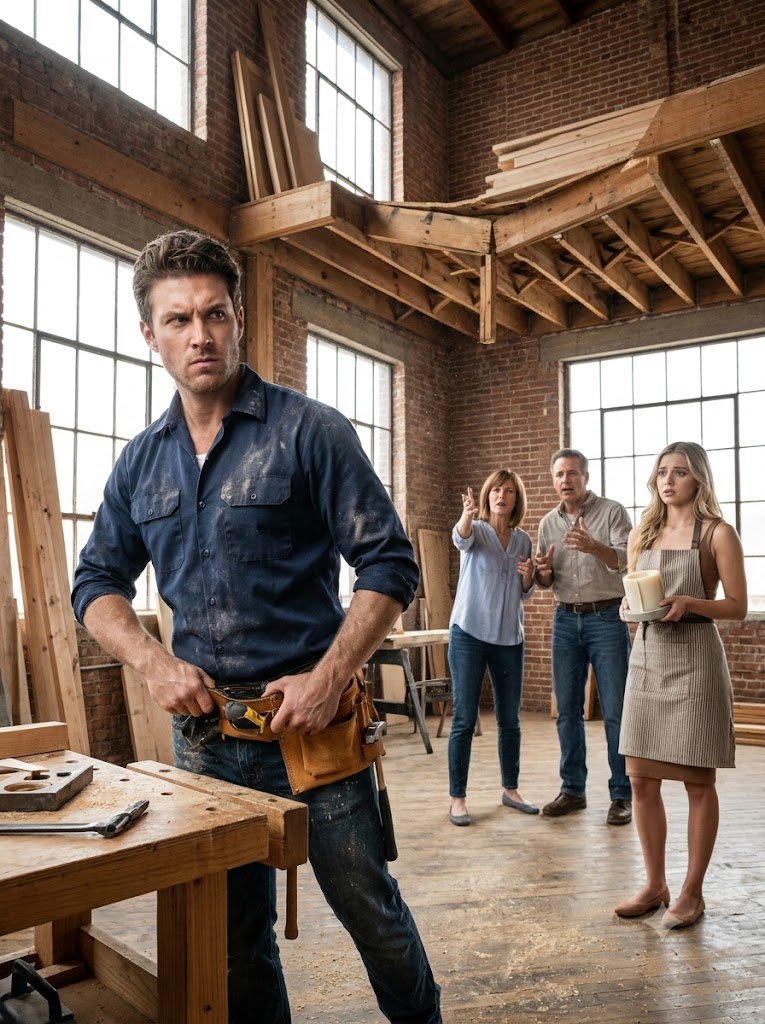
On Saturday afternoon, Mom sent our family group a photograph captioned: Saved four thousand dollars today! Dad grinned inside the gutted shop, holding a pry bar beside a heap of lumber. Behind him, an exposed timber ran beneath the mezzanine, and a dark split stretched from one end toward a metal bracket that no longer appeared attached to the wall. My stomach tightened before I finished enlarging the image.
“Stop working and keep everyone off that loft,” I texted. “There’s visible damage at the support connection. Have a structural engineer inspect it before anyone goes back inside.” Dad replied that he’d built decks longer than I’d been alive; Tessa wrote, “You don’t have to scare us just because we wouldn’t hire your company.” My mother sent a thumbs-down and called me dramatic.
I drove downtown anyway, because being insulted was easier to live with than somebody getting hurt. Behind the locked glass door, unopened candle jars stood in drifting dust. Dad answered my call, told me to mind my own business, and refused to let me inspect the damage. I sent the photo and my concern to June, then drove away feeling sick.
June called Monday. An inspector had closed the space until the framing could be secured. She sounded furious about the unauthorized demolition, but she also thanked me for alerting her. I told her any repairs would need an engineer’s approval and that my shop would only bid through normal channels.
Mom called six times while I was cutting plates for a warehouse railing. When I finally answered during lunch, I could hear the television playing behind her. “Just tell the inspector the downstairs is fine,” she said. “I’m not qualified to clear the building,” I answered. “And neither are you.”
“You’d rather let Tessa lose her dream,” she said. I looked through the shop window at my crew, each man wearing hearing protection and concentrating on a job that could hurt someone if we got careless. “I warned you before Dad touched anything else,” I said. “That wasn’t sabotage. That was the only useful help anyone offered.” She hung up before I finished.
Two nights later, Tessa stood on my porch holding a bakery box. She brought lemon bars, the kind she’d used to bribe me into unloading inflatables when we were kids. She asked why I’d stopped helping her business at nineteen without even saying goodbye. I told her about the mandatory Saturday shifts during my apprenticeship and the Sundays I’d offered instead.
“Dad said you told him you’d never work for me again,” she said. The porch bulb buzzed above us, attracting moths against the screen. “Did you ever ask me yourself?” I replied. Tessa opened the box, closed it again, and admitted she hadn’t.
Her phone rang, showing Dad’s name, and she silenced it without answering. “He says Calvin owes him a favor,” she said slowly. “What favor?” I asked. She shook her head, looking toward the driveway. “I don’t know, Mason, but he says he’s going to collect it.”
Part 3
The engineer arrived at 214 Main on Thursday with a flashlight, a level, and an expression that grew less cheerful every time he looked upward. I came as the estimator for Baird Fabrication, while June stood by the entrance with her arms crossed. The dismantled stairs lay against the wall beneath freshly cracked plaster. Pine shavings smelled faintly of Tessa’s vanilla candles.
After nearly an hour, the engineer showed us the critical connection. Dad had removed a concealed supporting post and cut the framing around it. The mezzanine needed shoring, redesigned supports, and new steel. The problem was no longer a staircase; it was an unsafe loft.
June took photographs for her property records. “Your father told me that post wasn’t doing anything,” she said. I stared at the empty place where it had stood and remembered Dad’s favorite phrase: How hard can it be? Tessa leaned against a shelf. “Please tell me there’s a cheaper way.”
Engineering, repairs, new stairs, inspections, and rushed weekend work brought the estimate to $71,800. Calvin assigned another crew supervisor, Oscar Velez, because he didn’t want my family dispute affecting the job. Tessa read the quote in silence, then folded it so tightly the paper creased across the total. No amount of optimism could make a damaged beam stronger or erase an engineer’s calculations.
That evening, Dad left me a voicemail accusing Calvin of exploiting his daughter. He wanted my crew and shop equipment for a free weekend job. He’d turned the damage he’d caused into my responsibility. Then I saved the message and went back to sanding a cabinet door in my kitchen.
Three weeks after the original breakfast, my parents’ sedan appeared beside my driveway. Dad waited against the hood while Mom stood with her arms folded, and Tessa stayed in the back seat. They hadn’t called; they wanted me cornered. I stepped outside and left the front door closed behind me.
“We’re not asking for your money,” Mom announced. “We’re asking for your labor,” Dad added. He wanted me to bring my team to the building on weekends, borrow the shop’s machines, and somehow persuade Calvin to supply the steel at cost. When I told him none of those things belonged to me, he laughed as if I were pretending not to understand.
“You were handed your career, and you won’t give your sister a weekend,” Mom said. I glanced toward my truck, its dented tailgate still carrying rust-colored dust from last week’s job. “I worked for that career,” I answered, but Dad had already moved closer. “Calvin will listen to me,” he said. “He did once.”
I remembered Tessa’s comment about a favor and asked him what he meant. Dad’s jaw tightened. “Men have conversations you don’t know about,” he said, suddenly studying the street. Mom listed groceries and shoes as if childhood were an unpaid invoice. I told them to leave before either of us said something worse.
The next morning, Calvin asked me into his office. Dad had shown up while I was at a job site, demanded free fabrication, and invoked their old conversation as though it gave him leverage. Calvin refused everything and asked Dad not to return without an appointment. Yet when I pressed him about that conversation, his expression became the same guarded one I’d noticed on Sunday.
“Your father was here when you first applied,” he finally said. I felt the familiar sting of Dad’s old remark after I’d passed my welding test: Didn’t think they’d take you. “To recommend me?” I asked. Calvin didn’t answer immediately, and that silence made my throat feel dry.
He pointed to a gray filing cabinet by the window. “The bottom drawer has employee records going back years. You can read your own file, Mason.” Behind my certificates and tax forms lay my original application, filled out in pencil at nineteen. In the office-use section, beneath a date seven years old, someone had written my father’s name followed by the words: Telephone call, 7:15 a.m.
Part 4
For a few seconds, I could hear nothing except the rattling air conditioner above Calvin’s office door. Below the date, his handwriting read: “Russell Reed requested candidate be failed on welding qualification. Said son was needed for sister’s rental business and should not be encouraged to leave. Candidate passed independently with excellent results; hired on merit.” The page trembled against my fingers.
I read it again, slower this time, searching for a less ugly explanation. Dad had asked whether I’d really passed and warned me not to embarrass myself. I’d always thought he doubted my ability. In fact, he’d tried to keep me from having the opportunity at all.
“Why didn’t you tell me?” I asked Calvin. He rubbed a coffee stain on his cuff. “You were nineteen, and you were proud of that job,” he said. “I wasn’t going to let a call from your father decide how you saw yourself.”
Calvin explained that Dad had phoned before the hiring decision was final, presenting himself as a concerned parent. He called me unreliable and requested a quiet rejection. Calvin had documented the conversation because it attempted to interfere with the hiring process. “You got the position because you earned it,” he said, sliding the folder back toward me.
I photographed the entry with permission and asked Calvin for a copy. He made one, then put the original back where it belonged. I spent the drive home remembering cold mornings hauling inflatables, the smell of wet canvas, and the way Dad congratulated Tessa for bookings I’d helped fulfill. The debts I’d felt guilty about were manufactured.
Two days later, my family arrived carrying the $71,800 estimate. Dad walked into my entryway without waiting for an invitation, red-faced beneath the porch light. “Seventy-one thousand eight hundred? Your boss is stealing from us,” he snapped. “You could cut that figure in half if you stopped acting like a stranger.”
I held my ground beside the coat rack. “The engineer’s design costs money because you removed a structural post,” I said. Mom began crying, but her tears didn’t stop her from accusing me of watching Tessa fail. Tessa asked us to stop shouting.
Dad pointed at the framed photograph of my house on the hallway wall. “You got lucky with that job,” he said. “We carried you until someone handed you a paycheck, and now you act better than the people who raised you.” I took the copied application from a kitchen drawer. “Then tell them what you did the morning after my welding test.”
His expression changed before he touched the paper. He scanned the note, tried to fold it away, and said Calvin had misunderstood him. Tessa reached for the page. “Let me read it,” she said, and for once Dad didn’t have an answer ready.
Tessa read Calvin’s words aloud, stumbling over the phrase “requested candidate be failed.” Mom stared at Dad, waiting for him to deny the sentence. Instead, he said, “We needed Mason at home. Tessa couldn’t run that business by herself.” My sister backed into the wall as though the floor had shifted beneath her.
“I was selling bounce-house rentals, Dad,” she said. “You made me believe he walked away because he didn’t love us.” Dad insisted he had done what was best for the family, but Tessa asked why his idea of family required stealing my choices. My mother whispered that he should have told her, then turned to me and said, “You know he meant well.”
That was the moment I stopped expecting either parent to understand. Even with the evidence in her hands, Mom was already making room for an excuse. “He wanted me dependent and working for free,” I said. “And you’re still asking me to pay for the mess he made.”
I opened the front door. Dad stood motionless, then muttered that someday I’d regret humiliating him. “I didn’t call my boss and ask him to fail you,” I said. “You did that yourself.” Mom followed him into the cold, leaving Tessa inside with the paper pressed to her chest.
Part 5
Tessa stood in my hallway long after their car pulled away. The refrigerator motor clicked on behind us, suddenly louder than either of us wanted to acknowledge. She wore the oversized sweatshirt she saved for bad days. “I honestly didn’t know,” she said, looking at the copied application. “He told me you chose your new boss over me because you thought I was a joke.”
“I never thought your work was a joke,” I said. “I thought three unpaid summers were unfair.” She swallowed and nodded. For once, she didn’t make her hurt my debt.
She’d called June about ending the lease. June was willing to discuss a settlement, though Dad’s guarantee and the damage remained. Tessa would return fixtures and find a cheaper workspace. I wished her luck without offering my garage or my weekends. For years, volunteering my time had been a reflex; now I could feel that reflex passing.
At the door, she asked whether we could start over. I remembered the birthdays she’d missed after our arguments. “Not tonight,” I said. “Maybe we can have a different relationship someday, but I’m not pretending the old one was fine.” She accepted that answer and left without asking me to soften it.
On Monday, June called to confirm she’d received Tessa’s written notice and was negotiating terms with the family and her attorney. The building remained closed pending approved repairs. June was also collecting other bids. Her professionalism felt like a relief.
Dad sent a message accusing me of turning June against him. Mom followed with a photograph of herself beside a stack of Tessa’s unsold candle boxes and the words, This is what you’ve done to us. I saved the messages, then muted both numbers. I didn’t owe a debate to people who kept treating my boundaries as damage they could invoice.
Work returned to its familiar rhythm: measuring, cutting, fitting, checking, and occasionally starting over when something came out a sixteenth of an inch wrong. One Friday, Calvin watched me inspect a weld. “You always double-check,” he said. I thought of the shop loft and told him I’d learned early that assumptions were expensive. He nodded and handed me the next drawing.
Months later, another contractor completed the structural repairs. June and my parents negotiated the damage and lease settlement. I never asked what Dad paid. For once, their financial choices weren’t my emergency.
Tessa started selling candles online in small batches from a legitimate shared maker space. She sent a photograph of her small, paid-for setup. I replied, “Looks practical. Hope it goes well.” That was all, and it was enough for the moment.
Mom tried a different approach at Thanksgiving. Her email said Dad’s call had been a mistake, but families shouldn’t be broken over something that happened seven years ago. She wanted me at dinner so everyone could “put the unpleasantness behind us.” I read it at my kitchen table beneath the repaired faucet.
I wrote back once: “The call happened seven years ago. The demands, insults, and excuses happened this year. I won’t be coming, and I need you to stop contacting me.” I didn’t list old grievances. They already knew the facts and had chosen what to do with them.
That Thanksgiving, I ate smoked turkey with Calvin’s crew and their families in Oscar’s backyard. Kids argued over pie while charcoal smoke drifted across the yard. Nobody asked me for a loan or told me my work had been handed to me. When I went home, the porch light came on over a house whose payment I would make myself.
I still keep the copy of my application in a folder beside my mortgage paperwork. Not because I need proof that Dad betrayed me, but because the note reminds me what his phone call failed to change. I got the job, earned the promotions, and built a life without his permission. I won’t let him charge me for that freedom ever again. I wasn’t keeping a scorecard anymore; I was keeping my own keys.
Legal Notice: This story is a work of fiction. Names, characters, businesses, events, and incidents are the product of the author’s imagination or are used fictitiously. Any resemblance to actual persons—living or dead—or to actual events is purely coincidental. Thank you! 💓


