
My Father Threw Me Out of My Own House While I Was Eight Months Pregnant—Then One Phone Call Exposed His Empire
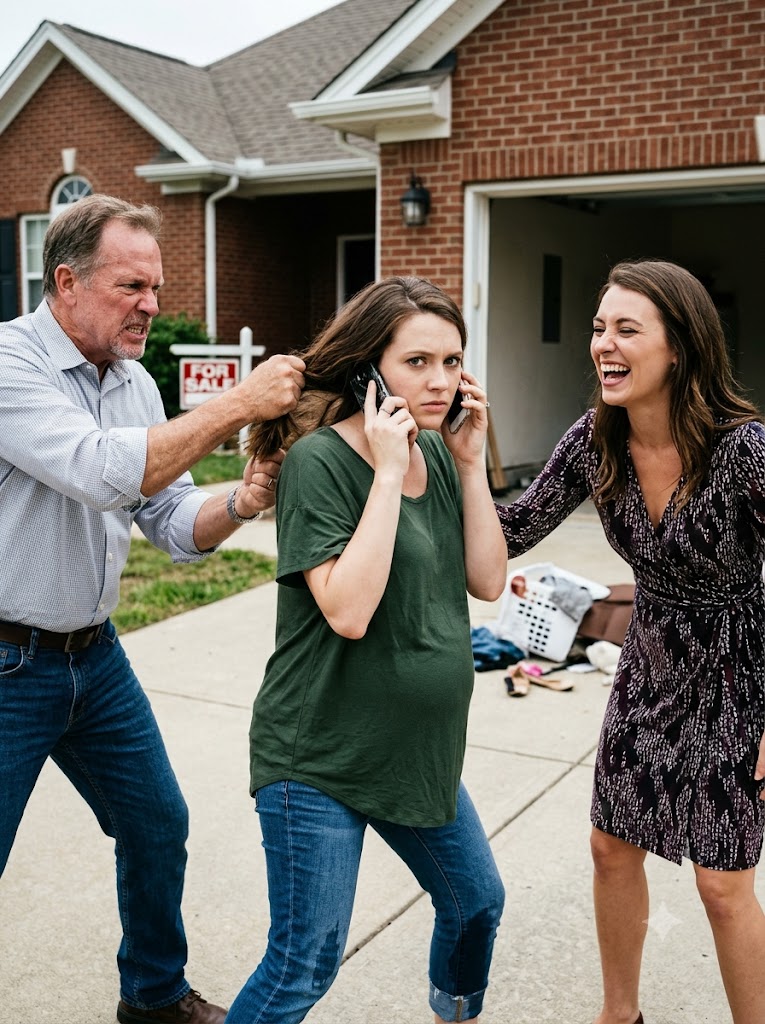
Three weeks after I buried my husband, my father grabbed my hair and dragged me onto the porch of the house my husband and I had bought together. I was eight months pregnant. His young wife laughed when my water broke, then told me the property was theirs now. I called the one person my husband had told me to trust. Within minutes, my father’s phone started ringing—and the secrets behind my husband’s final drive began coming apart.
Part 1
The first thing I noticed was the smell of Ethan’s coffee. Three weeks after his funeral, the dark roast he loved still lingered inside our kitchen cabinets, and I had refused to throw away the last bag. Then my father dropped a stack of papers onto our dining table and said, “Sign these, Nora. I’m done asking nicely.” His wife, Brielle, was standing behind him in one of my bathrobes.
“Why are you wearing that?” I asked. She glanced down at the blue silk sleeves and smiled. “Walter said you’re moving out. I figured you wouldn’t need it.” My father, Walter Mercer, tapped the top page.
The document was titled Temporary Property and Estate Administration Agreement. Beneath it sat an authorization to sell the house, although Ethan and I had never discussed selling anything. “This is my home,” I said, resting one hand on the hard curve of my stomach. “And Ethan’s lawyer hasn’t finished reviewing his estate.”
“Your husband left debts,” Dad said. “Big ones. I’ll deal with the mess if you stop making everything difficult.” He’d been repeating that story since the funeral, each time with fewer details and more certainty. Brielle set her phone against a vase of wilted lilies, its camera facing the table, and said, “Maybe we should record how unreasonable she’s being.”
I had grown up in a house where disagreeing with Walter Mercer meant losing something: a birthday dinner, a college visit, sometimes weeks of conversation. After Mom died, I mistook his rules for grief and his money for love. Ethan had been the first person to ask why I apologized before expressing an opinion. Now he was gone, and Dad sounded relieved to be the loudest voice in the room again.
I slid the documents back. “I’m not signing without Evelyn.” My father’s expression changed at the name of Evelyn Ross, the attorney Ethan had insisted I keep on speed dial. “That woman works for you, not me,” he snapped, and I thought it was a strange objection from a man claiming he was trying to help me.
Brielle picked up the pages. “She’s thirty-two, Walter. You’d think she could make a decision.” She was twenty-five, barely older than the interns at my husband’s freight company, yet she’d been calling herself my stepmother for six months. When I reached for my phone, she moved it across the table and said, “Just sign. Then everyone can calm down.”
I stood, my back aching. Dad stepped between me and the hallway, blocking the stairs that led to the nursery Ethan had painted pale yellow. “I founded Mercer-Hale Logistics,” he said. “That house was paid for with company money. Everything in it belongs to me.” I told him Ethan had paid our mortgage himself, and Walter’s face tightened as if I’d struck him.
He seized my wrist, then caught a handful of hair when I twisted away. I remember the scrape of the front-door latch, the shock of cold porch boards against my knees, and Brielle’s little burst of laughter. “Go call your lawyer,” Dad said, tossing my purse beside the steps. “See who believes you.”
A sudden warmth spread down my legs. For one terrible second I thought I’d wet myself, until a deep cramp forced me to grip the porch railing. “My water broke,” I said, looking toward the doorway, but Brielle only lifted her phone as though she’d been waiting for a better picture.
I pulled my own phone from the purse with shaking fingers and called Evelyn. “Don’t sign anything,” she said before I finished explaining. “Ethan left instructions for exactly this. I’m notifying the trustees, and you need an ambulance now.” I called 911, gave the dispatcher our address outside Buffalo, and tried to breathe through another tightening wave.
Inside, Walter’s phone rang. I heard him say, “What do you mean the transfers are on hold?” The arrogance drained out of his voice, replaced by disbelief as a second call came through. Then he appeared in the doorway, staring down at me, and asked the question I had waited my entire life to hear him ask with fear: “Nora, what did you do?”
Part 2
Two police officers arrived before my father could come down the steps. A paramedic spread a warm blanket over my knees while another checked my pulse and asked how far along I was. “Thirty-four weeks,” I told him, watching Walter argue with an officer beside the mailbox. When the ambulance doors shut, I could still hear Dad insisting that it had been a family misunderstanding.
At the hospital, the room smelled of disinfectant and warmed plastic. A monitor filled the silence with my daughter’s steady heartbeat while the obstetrician explained that my membranes had ruptured early and they were assessing the safest next steps. I nodded as though I understood every word. All I could think was that Ethan should have been standing beside the bed, complaining that the hospital chairs were designed by someone who hated husbands.
Evelyn arrived with damp hair and a leather portfolio, but she left it closed until the doctor finished speaking. “The baby looks stable right now,” I told her. Saying it aloud made me cry, which embarrassed me until she offered a tissue and waited. Then I asked, “What did you mean when you said Ethan left instructions?”
She laid a copy of our recorded deed on my blanket. Ethan and I had owned the house together with rights of survivorship, and after his death, his interest passed to me. Walter’s name appeared nowhere. I traced the address with my finger, overwhelmed by how certain my father had sounded while telling me I was homeless.
“And the company?” I asked. Evelyn explained that Ethan’s holding company controlled fifty-one percent of the voting interest in Mercer-Hale Logistics. Before his death, he’d arranged for that interest to be held in a trust for me and our daughter, with independent trustees empowered to protect the business. Walter was a minority owner and longtime executive, not the person who could unilaterally sell its assets.
“Then why did he always say it was his?” I whispered. Evelyn’s mouth tightened. “He started it. Ethan helped rescue it after the recession, invested heavily, and kept hundreds of employees working. Your father never adjusted to the idea that ownership and authority could change.” That history explained Walter’s pride, but not the frantic calls I’d heard from the porch.
Evelyn showed me a bank notice: suspicious transfer requests had prompted a review, and the trustees had asked the board and banks to restrict unauthorized payments. These protections were already being prepared before my call. She said Ethan had become concerned about unexplained company expenditures several months earlier, but she would not speculate until accountants examined the records.
Then she unfolded three pages recovered from the document packet Walter had left in my kitchen. They authorized him to manage my affairs, sell my house, and draw money from an account Ethan had intended for our child. Every page carried a signature that looked like mine, down to the tiny hook on the last letter. I had signed none of them.
“Brielle asked me to sign for flowers after the funeral,” I said slowly. “The delivery never came. She said the florist had mixed up the order.” Evelyn wrote that down without promising it proved anything. Moments later, a message flashed on my phone from Brielle: “YOU DON’T UNDERSTAND WHAT ETHAN WAS ABOUT TO DO TO US.”
I turned the screen toward Evelyn. “About to do?” She hesitated before showing me a ledger of consulting fees paid to a company called Northline Advisory. The invoices were vague, the amounts enormous, and Brielle Mercer was its registered owner. Almost four million dollars had moved through questionable accounts, although the audit had not yet established how much was improper.
My father had told me Ethan ruined the business. Instead, Ethan had been investigating money moving out of it. Evelyn reached for a sealed envelope with my name written in my husband’s careful handwriting, but before she opened it, she said, “Nora, there’s something about the morning Ethan died that you deserve to know.”
Part 3
Evelyn didn’t open the envelope immediately. A nurse came in, checked my temperature, and turned up the volume of my daughter’s heartbeat so I could hear its quick, stubborn rhythm. When we were alone again, Evelyn explained that Ethan had been driving to Rochester to meet an outside auditor on the morning of the crash. My father knew about that appointment, although he’d told me Ethan was going to meet a potential customer.
“Did Ethan think he was in danger?” I asked. “He thought someone might interfere with the audit,” Evelyn said. She slid the envelope closer, and I recognized the crooked E in my husband’s handwriting. Inside was a flash drive and a note: “If Walter starts pressing you about the house or the company, ask Evelyn to show you what I found.”
Evelyn connected the drive to her laptop. Ethan appeared on the screen in his navy sweatshirt, sitting at the desk he’d built from reclaimed oak. “Hey, Nor,” he said, and hearing his voice nearly folded me in half. “I hoped this would be a conversation we’d have together, but I don’t want you left with somebody else’s version of the truth.”
He described payments he couldn’t reconcile, a disagreement with Walter, and a request to stop digging because the money was supposedly needed to save the company. “I didn’t believe him,” Ethan said. “And I should have told you sooner, instead of pretending I could settle this quietly.” His eyes shifted toward the nursery door. “Whatever happens with the business, don’t give away your choices just to keep your dad calm.”
There was no accusation about the crash, only a final line that stayed with me: “If somebody tells you I was careless with our future, please look at the facts first.” I wanted to ask why he’d kept so much from me, even while I understood he’d been afraid of making me carry another burden during pregnancy. Evelyn shut the laptop when the monitor beside me started chiming. My contractions were getting closer together.
Labor moved faster that evening than anyone had expected. A nurse named Tessa talked me through each contraction while the doctor watched the baby’s heart rate, and I held the edge of the mattress where Ethan’s hand should have been. Shortly after midnight, a small cry cut through the room. My daughter had arrived early, blinking furiously beneath the bright lights.
They took her for neonatal care after letting me touch one tiny hand. She needed breathing assistance and careful monitoring, and I listened to every update as though my life depended on each syllable. I named her Lucy Mae Hale, the name Ethan and I had written on a sticky note above the nursery paint samples. When Tessa brought me a photograph, I stared at her little nose and whispered, “Your dad would be so proud.”
The next day, Evelyn told me police had secured the doorbell footage. It showed Walter dragging me outside, Brielle laughing when I called for help, and the moment I sank onto the porch. Walter had been arrested in connection with the assault, while investigators continued examining the signatures and company records. The camera had settled the question of what happened to me; it couldn’t answer what happened to Ethan.
Three days later, Brielle called from an unfamiliar number. “Walter said everything was legal,” she began, sniffling, but she stopped when I asked why she’d needed my signature on a document I had never seen. I kept the conversation brief and saved her messages. Then she blurted, “We never meant for Ethan to die.”
I went cold. “Who is ‘we’?” I asked, but she said she’d made a mistake and hung up. Evelyn helped me give a detailed account to the detective, careful not to pretend an unrecorded statement proved what she meant. Two days later, he called back with news: a highway maintenance camera had captured another vehicle near Ethan’s car moments before the crash.
Part 4
Detective Owen Price laid a photograph on the hospital’s family-room table. My daughter was still receiving neonatal care, and I’d been looking forward to spending an hour holding her; instead I stared at a black pickup with a silver toolbox behind the cab. “We can’t establish a collision from this picture,” he said. “But the video shows the truck closing in before your husband’s car left the road.”
I recognized the pickup as one of the maintenance vehicles at Mercer-Hale. Its usual driver was Grant Ellis, Dad’s operations manager, who had handed me a tissue at Ethan’s funeral and said he’d lost a good friend. I described the truck, then asked if the detective was sure. “We’re verifying everything independently,” he said, keeping the photograph while I tried to stop shaking.
That week, Lucy’s breathing improved enough for me to hold her against my chest. She smelled like clean cotton, and her fingers opened and closed around the edge of my shirt as if she were testing whether the world could be trusted. I promised her she would never have to earn a safe home. Then Evelyn called: Walter’s attorney had proposed a settlement.
According to the proposal, Dad would abandon any claim to my house if I supported a favorable resolution of the financial dispute. I almost laughed. “He wants credit for not taking something that’s already mine?” Evelyn said she would respond formally, but the choice about accepting the proposal was mine. I looked at Lucy sleeping in her bassinet and said, “No. We follow the evidence.”
The financial investigators found that Northline Advisory had billed the company for consulting work it could not document. A string of payments led to other businesses with overlapping contacts and fabricated invoices. Brielle said she had only followed Walter’s instructions; Walter said his accountants had approved everything. Neither explanation squared with the original records Ethan had preserved.
Then Grant was questioned about his route on the morning Ethan died. At first, he claimed he’d been inspecting a broken-down company truck elsewhere. Electronic toll records, vehicle location data, and maintenance-camera footage put him on the same highway as Ethan instead. When detectives confronted him with those discrepancies, he admitted he’d followed Ethan because Walter wanted him stopped before the Rochester meeting.
I read the summary with both hands wrapped around a mug of tea that had gone cold. Grant claimed he’d only meant to frighten Ethan into turning around, but the footage showed repeated aggressive maneuvers and a dangerous approach near the shoulder. Investigators still needed to establish who authorized what and what conduct caused the fatal crash. For the first time since the funeral, the questions had answers beginning to form rather than guesses filling the silence.
Walter’s messages were even harder to read. One said, “He cannot walk into that meeting with those files.” Another instructed Grant to “make sure he turns around,” and a payment agreement promised Grant a bonus if the appointment was missed. The words didn’t establish that my father had wanted Ethan dead, but they showed he had arranged the confrontation that came before his death.
A letter from Walter arrived the next afternoon. He wrote that he had built the business, that pressure had made him behave badly, and that my late mother would be ashamed of my refusal to help him. He never asked whether Lucy was healthy, and he never mentioned the porch except to call it an argument. I passed the letter to Evelyn and requested that all future contact go through attorneys.
Weeks later, prosecutors brought financial charges against Walter and Brielle, and additional charges connected to the fatal highway encounter against Walter and Grant. Brielle’s involvement in planning that encounter remained unproven. That night, as I rocked Lucy beneath the nursery window, I learned Grant had agreed to testify about the instructions he’d received. He said my father had offered him far more than a bonus to keep Ethan from reaching Rochester.
Part 5
By the time the criminal cases reached trial, Lucy could walk three careful steps between the couch and the coffee table. She liked the sound of wooden spoons on metal pans and slept with one sock tucked inside her fist. I measured the passing months by her first teeth, not court dates, although the legal files kept growing. The house was still ours, and the company was finally operating under a board that answered to its legitimate owners.
At trial, the auditors explained how company funds had been diverted through false invoices. Investigators presented the forged signatures, the trust documents, and the communications arranging Grant’s pursuit of Ethan’s car. Grant testified that Walter had demanded Ethan be prevented from reaching the meeting and had offered money beyond his regular salary. Grant admitted that his own reckless driving had caused the crash, while Walter’s lawyers disputed how much their client understood about the danger.
The defense tried to make Ethan sound like a ruthless businessman who’d threatened the company his father-in-law founded. I listened to strangers debate whether my husband had been too stubborn to walk away from missing money. Then Evelyn reminded me that a court decides responsibility from evidence, not from whose grief sounds most convincing. I held onto that thought when I took the witness stand.
I told the jury about Ethan’s careful habits, the audit he’d been preparing, and the day Walter threw me outside while I was pregnant. I described Brielle’s laughter and the way my father answered his bank calls while I waited for an ambulance. Nobody asked me to exaggerate, and I didn’t. The video from our doorbell spoke clearly enough without help.
Grant was convicted of manslaughter for his role in the crash. Walter was convicted of fraud and conspiracy offenses connected to the scheme to obstruct Ethan’s investigation and the dangerous highway encounter, as well as the offense arising from his assault on me. Brielle was convicted of financial fraud; prosecutors did not establish that she had planned the driving confrontation. The sentences were substantial, and appeals remained possible, but the truth had finally been tested in public rather than whispered in our kitchen.
Afterward, I sold the last of the company interests that I could responsibly sell under the trust’s rules, leaving professionals to manage the business and protect its employees. The house stayed in my name. I returned to my work as a freelance book designer, scheduling projects around Lucy’s naps and discovering that ordinary afternoons could be beautiful again. Some days grief still arrived unexpectedly, usually with a song Ethan used to hum while making pancakes.
On Lucy’s second birthday, we filled the backyard with yellow balloons and let the neighborhood kids scatter frosting across the picnic table. A photograph of Ethan stood beside the cake. Lucy pointed to it and said, “Daddy,” then grinned because she knew the word made me smile and cry at once. I told her he had loved her long before she was born.
That evening Evelyn forwarded a letter from Walter. This time, he admitted he’d seen my fear on the porch and chosen to protect his money anyway. He wrote that he was sorry, that he understood I might never answer, and that he hoped Lucy would grow up without learning to fear her own parent. It was the first honest thing he’d said to me in years, and it changed nothing about the distance I needed.
I placed the letter in a drawer beside the one Ethan had left. I didn’t burn it, and I didn’t write back. When Lucy grew older, I’d tell her the truth in words she could understand, without teaching her that sharing blood requires accepting betrayal. My father could regret what he’d done without earning a place in our lives.
Later, Lucy woke and called for me from the nursery. I climbed the stairs past the yellow walls Ethan had painted, lifted her from the crib, and felt her warm cheek settle against my shoulder. “Home, Mama?” she murmured, still half asleep. “Yes, sweetheart,” I told her, looking around the house my father had tried to take. “We’re home, and nobody gets to throw us away.”
Legal Notice: This story is a work of fiction. Names, characters, businesses, events, and incidents are the product of the author’s imagination or are used fictitiously. Any resemblance to actual persons—living or dead—or to actual events is purely coincidental. Thank you! 💓


